Speed to Lead Response Time: Why It Matters More Than Your Marketing Budget
Speed to lead response time is how fast your business contacts a new lead after they fill out a form, call, text, or submit a chat message. It is one of the most overlooked metrics in local marketing because owners focus on generating leads, not on how quickly someone follows up with them. Research consistently shows that the speed of your first response has more influence on whether a lead converts than almost any other factor — including price or reputation.
If you're spending money on ads, SEO, or a new website, speed to lead is the metric that decides whether that spend turns into revenue or gets wasted.
In this guide you'll find:
- What speed to lead measures and why most owners never track it
- What the research says about the first five minutes
- Response benchmarks for calls, forms, texts and chat
- How automation closes the gap without adding staff
- A self-audit and a quick-win checklist you can use this week
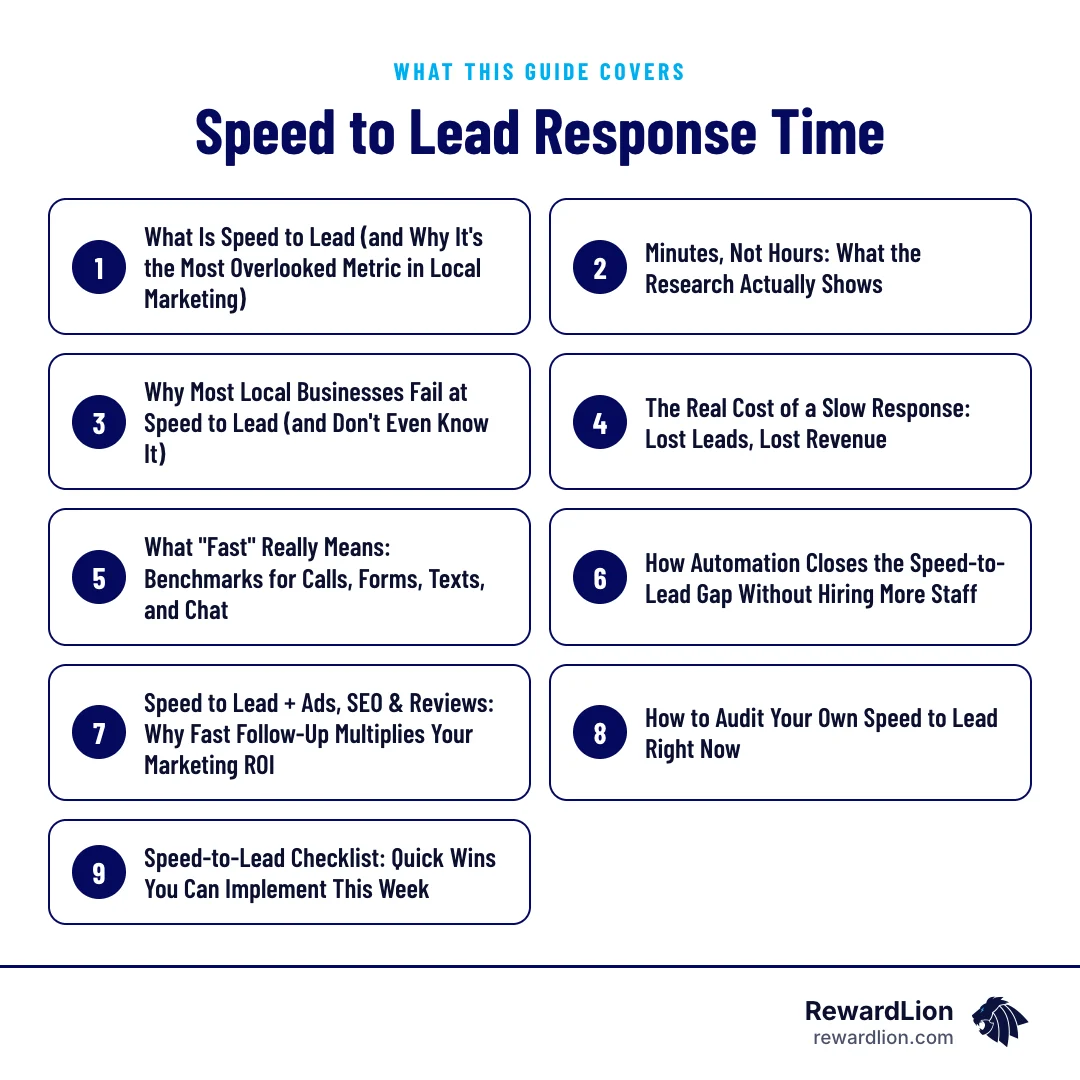
What Is Speed to Lead (and Why It's the Most Overlooked Metric in Local Marketing)
The gap between lead volume and revenue
Most local business owners measure marketing success by traffic, clicks, or lead volume. Those numbers feel good, but they don't tell you what happens after the lead comes in. A lead that sits in an inbox for three hours is functionally no different than a lead that was never generated — the prospect has usually already called a competitor or moved on.
How to measure it
Speed to lead closes that gap. It measures the time between when a prospect raises their hand and when your business actually reaches them. Get this right, and a mediocre ad campaign can outperform a great one with slow follow-up.
To measure it yourself, record two timestamps for every lead: when the inquiry arrived and when a real person or a meaningful automated message first reached the prospect. The difference is your response time. Track the typical value and the slowest cases, since a handful of leads that wait overnight can hide behind a decent-looking average.
Minutes, Not Hours: What the Research Actually Shows
Responding within minutes, not hours, isn't a guess — it's backed by some of the most cited studies in sales and marketing research.
- Responding to a new lead within the first minute, sometimes called the "Platinum Minute," can boost conversions by as much as 391%, according to Velocify research cited by Kixie and LeadAngel.
- Leads contacted within 5 minutes are 21 times more likely to qualify than those contacted after 30 minutes, and businesses are 100 times more likely to even connect with the lead in that window, per Kixie.
- A landmark Harvard Business Review study, which analyzed more than 2,200 U.S. companies, found that businesses contacting leads within an hour are nearly 7 times more likely to qualify them than those who wait even one more hour, as reported by CallPage.
- Leads contacted within 5 minutes convert at 8x the rate of those contacted at 30 minutes, according to an InsideSales study of 55 million sales activities cited by GetNextPhone; EngageBay cites InsideSales.com research tracking 5.7 million inbound leads.
The pattern across every study is the same: the first few minutes matter more than anything else in your sales process.
Why the first minutes matter so much
The reasons are practical. A person who just filled out a form is still at their screen, still thinking about the problem and often still comparing options. A few hours later they're back at work, on another call or already talking to a competitor. Reaching them while the need is top of mind is what the research is measuring.
Why Most Local Businesses Fail at Speed to Lead (and Don't Even Know It)
What the averages show
The average B2B lead response time is roughly 42 hours, and 55% of companies take five or more days to respond to a new inquiry, according to Kixie. For local and service businesses, the numbers are just as troubling: 51% of leads are never contacted at all, and an estimated 71% of internet leads are wasted due to poor follow-up, per Verse.ai.
Where leads actually get stuck
Most owners assume their team is responsive. In reality, leads get buried in a shared inbox, a voicemail box, or a spreadsheet nobody checks until the next morning. By then, the prospect has already called someone else.
The most common hiding places:
- A shared inbox that several people can see but nobody owns
- Voicemail that's only checked at the end of the day
- Website forms that email an address nobody monitors closely
- Social messages and chat that arrive outside office hours
- Spreadsheets that are updated after the fact instead of in real time
The Real Cost of a Slow Response: Lost Leads, Lost Revenue
What a delay costs you
Every hour of delay has a measurable cost. Sales teams are 60 times more likely to qualify a lead when they respond within one hour versus waiting 24 hours, according to Teamgate. Waiting more than five minutes to follow up can reduce the likelihood of qualifying a lead by up to 80%, per Teamgate.
After 24 hours, conversion odds flatten out almost entirely because the lead has cooled off or already chosen a competitor, according to EngageBay. This means the marketing dollars spent to generate that lead were effectively wasted — not because the ad or website failed, but because the follow-up did.
A simple way to see your own cost
Take last month's leads and split them into two groups: those contacted quickly and those contacted late or never. Compare how many in each group became customers. You don't need a precise figure; even a rough comparison usually makes the case for fixing follow-up before buying more traffic.
What "Fast" Really Means: Benchmarks for Calls, Forms, Texts, and Chat
What customers expect
Customer expectations have shifted alongside the research. According to Verse.ai, 88% of customers expect an email reply within one hour, and nearly 66% expect a response within 10 minutes for any sales or marketing inquiry.
First to respond often wins
And speed isn't just about qualifying the lead — it's about winning the business. 78% of customers buy from whichever company responds to them first, not the cheapest or best-reviewed option, according to Teamgate and GetNextPhone. For local businesses, this means the fastest responder often wins the job — regardless of who has the better service or price.
Practical response targets by channel
The research points to minutes, not hours. Here's how that translates into a working standard for each channel:
| Channel | First response | What the first response should do |
|---|---|---|
| Phone call | Answer live where possible; a missed call gets a text back within minutes | Confirm you received the call and offer a time to talk |
| Web form | An instant automatic reply, then a personal call or text within minutes | Acknowledge the request and set expectations for next steps |
| Text message | A reply within minutes during business hours | Answer the question or book the next step |
| Website chat or social message | An instant acknowledgment, then a human reply as soon as possible | Capture contact details so the lead isn't lost if they leave |
How Automation Closes the Speed-to-Lead Gap Without Hiring More Staff
Why manual handling breaks down
Manual lead handling — checking a shared inbox, waiting for a rep to notice a form submission, returning voicemails between appointments — is the primary bottleneck behind slow response times, according to Nextiva. No front desk or office manager can realistically monitor every channel in real time while also running the day-to-day business.
What automation actually does
Automated lead scoring and routing solves this by instantly notifying the right person — or triggering an automatic text or email reply — the moment a lead comes in, per Nextiva. This is the core idea behind RewardLion's lead follow-up automation: every new lead, whether from a form, a call, or a chat, gets an instant acknowledgment and a fast handoff to your team, without requiring someone to be glued to a phone all day.
A typical automated flow looks like this:
- A lead arrives from a form, a call, a text or a chat.
- An instant reply goes out by text or email confirming you received it.
- The right person is notified on their phone with the lead's details.
- The lead is logged in your CRM with its source, so nothing depends on memory.
- Reminders fire if nobody has followed up within the time you set.
Tools such as SMS automation, a properly configured CRM and voice and chat assistants that answer after hours can each cover part of this flow.
Speed to Lead + Ads, SEO & Reviews: Why Fast Follow-Up Multiplies Your Marketing ROI
Follow-up as a multiplier
Ads, SEO, and a strong website are what bring leads in the door. Speed to lead is what determines whether those leads turn into paying customers. A business running great ad campaigns but responding in hours instead of minutes is paying for traffic it's not converting. Conversely, even a modest marketing budget performs better when every lead gets a near-instant response.
This is why lead follow-up automation isn't a separate line item from your marketing — it's the multiplier that makes every other channel worth more. Fast response also compounds with reviews and reputation: prospects comparing several businesses are more likely to choose, and later recommend, whichever one responded first.
Before increasing ad spend, it's worth asking a simple question: are we already contacting every lead we get within minutes? If the answer is no, fixing follow-up is often the cheaper way to get more from the same budget.
Quick answers from this guide
| Question | Short answer |
|---|---|
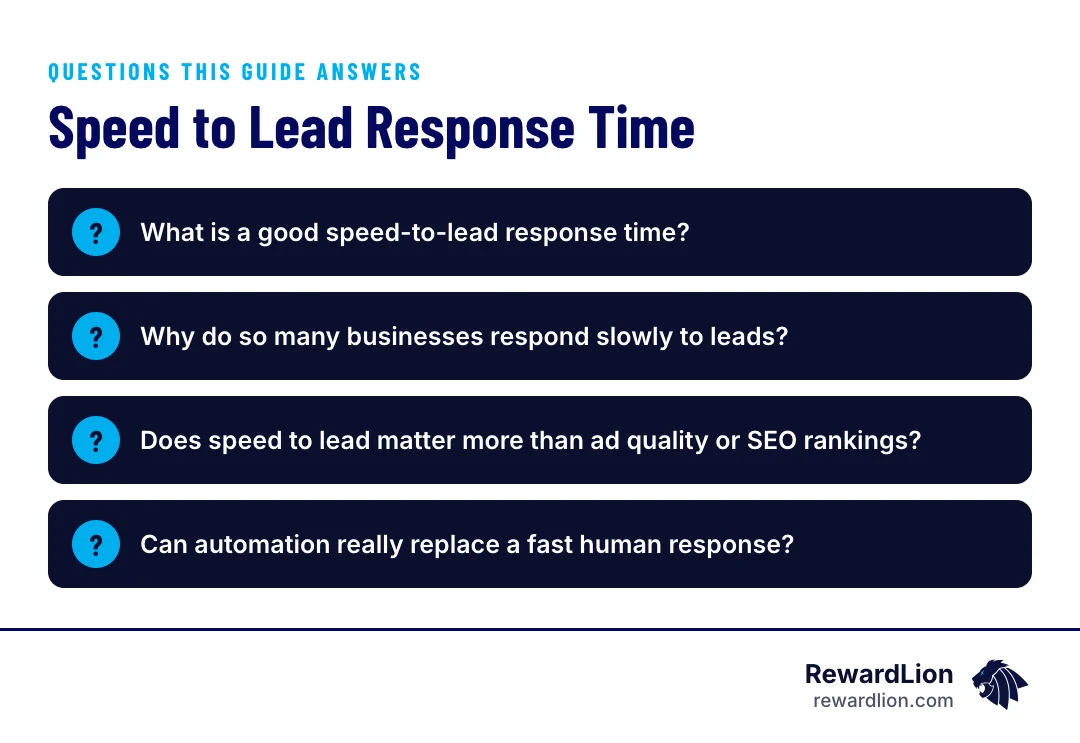
| What is a good speed-to-lead response time? | Research points to minutes, not hours. The strongest conversion lifts appear when leads are contacted within the first five minutes, and conversion rates drop sharply after that window, per Kixie and Teamgate. |
| Why do so many businesses respond slowly to leads? | Most rely on manual processes — shared inboxes, voicemail, or a single staff member checking messages between other tasks. |
| Does speed to lead matter more than ad quality or SEO rankings? | Ads and SEO determine how many leads you generate. Speed to lead determines how many of those leads actually become customers. |
| Can automation really replace a fast human response? | Automation doesn't replace your team — it makes sure no lead waits unnoticed. |
How to Audit Your Own Speed to Lead Right Now
You don't need special software to get a baseline. Try this:
- Submit a form on your own website and time how long it takes to get any response — automated or human.
- Call your main business line after hours and see what happens to that call.
- Check your CRM, inbox, or spreadsheet for the oldest unanswered lead right now.
- Ask your team how leads are currently routed, and who is responsible for responding.
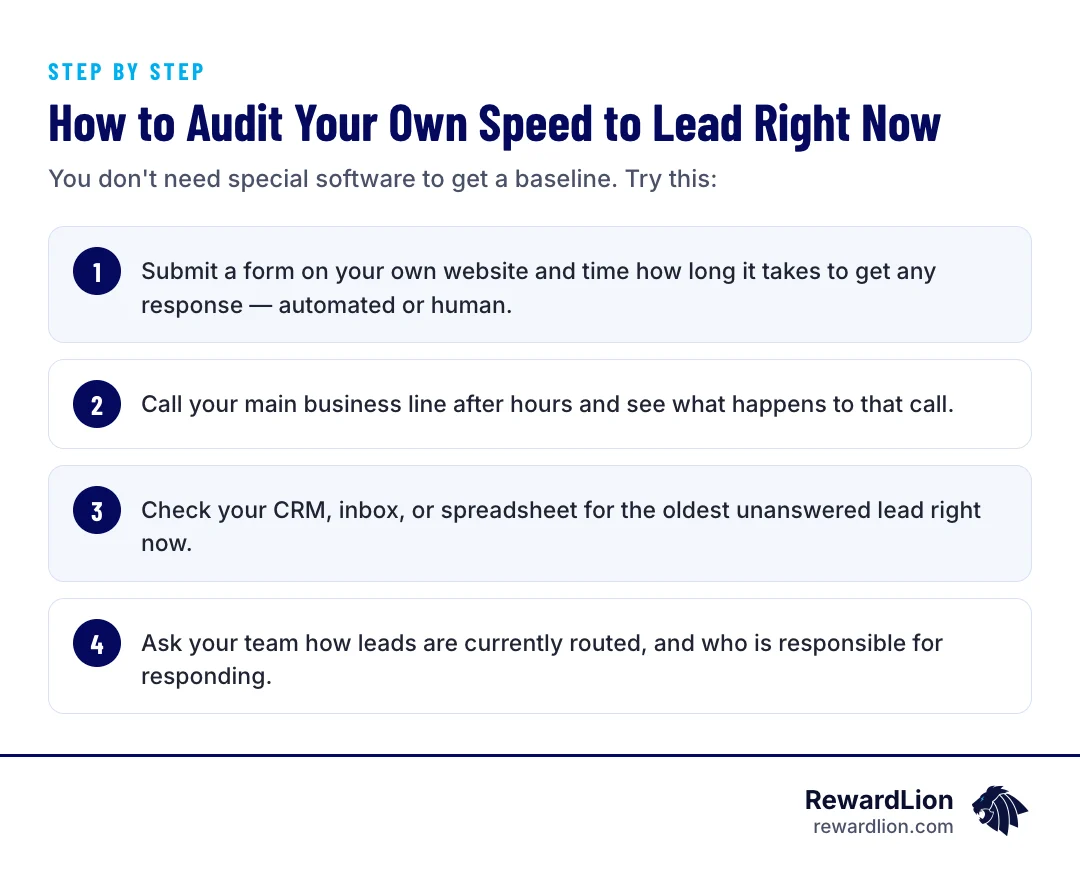
If any of these steps reveal a gap of more than a few minutes, you've found a leak in your marketing funnel.
Turning the audit into a baseline
Write down what you found for each test, then repeat the same four tests a month later. Keeping the tests identical makes it easy to see whether changes to routing, auto-replies or staffing actually improved your response time.
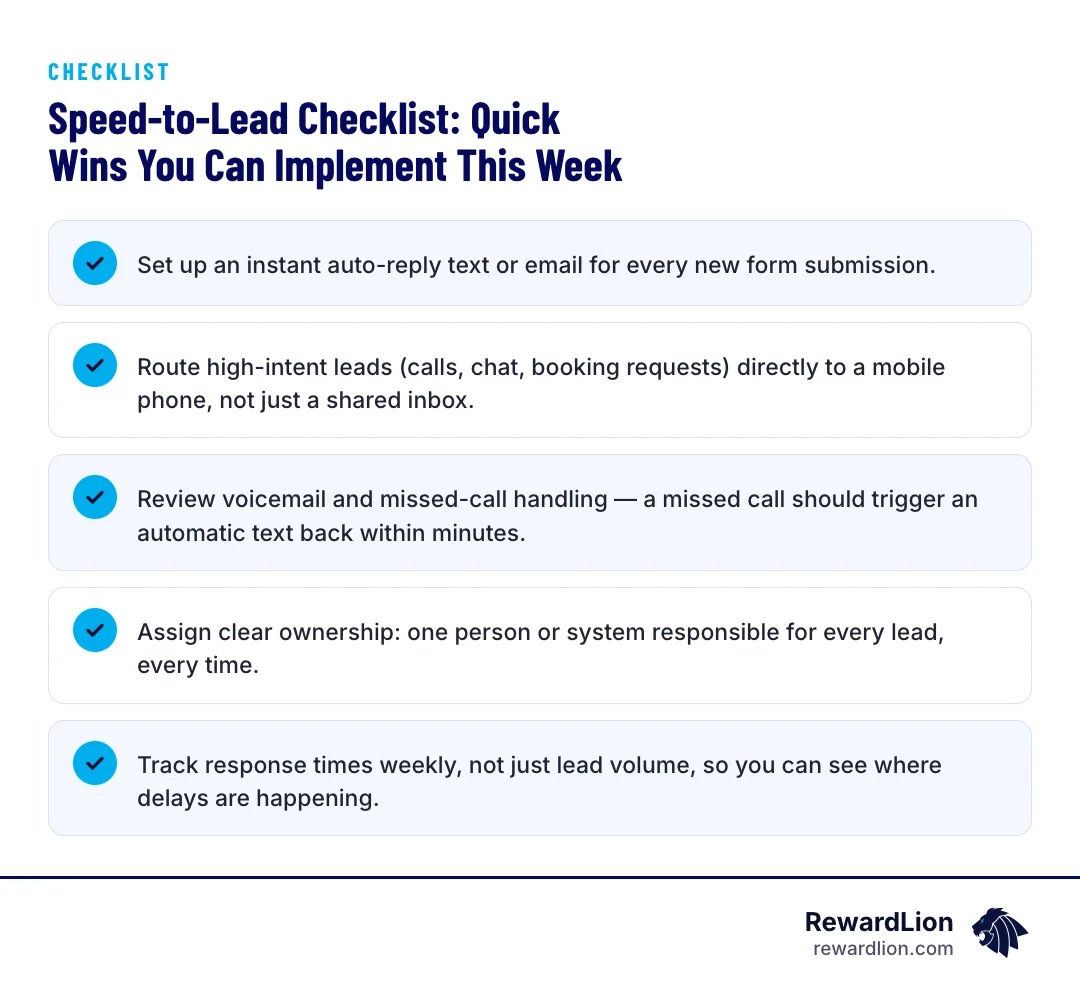
Speed-to-Lead Checklist: Quick Wins You Can Implement This Week
- Set up an instant auto-reply text or email for every new form submission.
- Route high-intent leads (calls, chat, booking requests) directly to a mobile phone, not just a shared inbox.
- Review voicemail and missed-call handling — a missed call should trigger an automatic text back within minutes.
- Assign clear ownership: one person or system responsible for every lead, every time.
- Track response times weekly, not just lead volume, so you can see where delays are happening.
Keeping it working after week one
Quick wins fade if nobody checks them. Put a short weekly review on the calendar: look at the slowest response of the week, find out why it happened and fix that one cause. Over a few months this steady habit removes most of the gaps. If you want the routing and follow-up built and maintained for you, see our marketing automation services and our guide to sales automation services.
Related reading
- How to Optimize Your Lead Generation Process
- Lead Capture Solutions That Integrate With Your CRM
- Robots Do It Better: How to Automate Your Customer Acquisition Process
- RewardLion lead generation solutions
- RewardLion RewardLion CRM
FAQ
What is a good speed-to-lead response time?
Research points to minutes, not hours. The strongest conversion lifts appear when leads are contacted within the first five minutes, and conversion rates drop sharply after that window, per Kixie and Teamgate.
Why do so many businesses respond slowly to leads?
Most rely on manual processes — shared inboxes, voicemail, or a single staff member checking messages between other tasks. Nextiva identifies this manual handling as the primary bottleneck behind slow lead response.
Does speed to lead matter more than ad quality or SEO rankings?
Ads and SEO determine how many leads you generate. Speed to lead determines how many of those leads actually become customers. Without fast follow-up, marketing spend on ads and SEO is less likely to convert into booked appointments.
Can automation really replace a fast human response?
Automation doesn't replace your team — it makes sure no lead waits unnoticed. Automated routing and instant acknowledgment messages ensure every lead gets immediate contact while your team follows up personally as soon as possible, per Nextiva.

Sources
- Speed to Lead Response Time Statistics That Drive Conversions
- 25 Eye-Opening Speed to Lead Statistics: Why Response Time Matters
- Lead Response Time Study: How Speed Impacts Revenue
- What Is Speed to Lead? Statistics, Strategies, and Software to Improve Lead Response Time
- Speed to Lead: The 5-Minute Rule That Wins More Jobs
- How to Improve Speed to Lead and Convert More Customers
- Speed to Lead: Definition, Benchmarks & How to Improve It (2025)
- Why Leads Die in 5 Minutes: The Lead Response Time Study Every SMB Sales Team Needs to Read