Why Businesses Are Racing to Automate the Customer Acquisition Process
If you want to automate your customer acquisition process, here is the short answer:
Define your ideal customer — build a clear profile of who you're targeting
Map your funnel — identify the stages from awareness to purchase
Choose your channels — email, LinkedIn, SEO, paid ads, or social media
Deploy automation tools — AI agents, CRM sequences, and chatbots handle repetitive tasks
Nurture leads automatically — set up email and retargeting sequences that run 24/7
Track key metrics — monitor CAC, CLV, conversion rate, and churn
Optimize continuously — use A/B testing and AI analytics to improve results
Finding new customers is hard. Doing it consistently, at scale, without burning out your team? That is even harder.
Here is the reality most small business owners face: their sales team spends only 33% of their time actually selling. The other two-thirds goes to emails, data entry, and tasks that a system could handle automatically.
At the same time, today's customers expect frictionless experiences. Research shows that 96% of customers who hit friction are unlikely to sign up for a brand's offerings. And with the average buyer needing to encounter your message seven times before making a purchase, manually keeping up with every prospect is simply not realistic.
That is exactly why automating your customer acquisition process is no longer a "nice to have" — it is a competitive necessity.
My name is Mike Ibrahim, founder and CEO of RewardLion and a marketing director with over a decade of experience helping businesses automate their customer acquisition process to drive scalable, repeatable growth. In this guide, I will walk you through exactly how to build a system that works for you around the clock.
What is Customer Acquisition and Why Does It Matter?
At its core, customer acquisition is the systematic process of finding, attracting, and converting prospects into loyal, paying customers. It is the lifeblood of sustainable business growth. Without a predictable methodology for pipeline creation, companies hit a ceiling, relying on inconsistent word-of-mouth or unpredictable market waves.
A strategic approach to acquisition directly builds long-term brand strength, diversifies your customer base, and increases your market share. When done correctly, the acquisition process becomes a continuous loop of learning. Every interaction provides valuable customer insights that help you refine your messaging, product positioning, and overall customer experience.
However, manually running this process in 2026 is a recipe for high operational costs and slow scaling. Implementing automatic lead generation eliminates the friction that causes prospects to drop off. It transforms a reactive, manual hustle into a proactive, predictable engine that captures interest the exact moment it occurs.
Understanding the Customer Acquisition Funnel
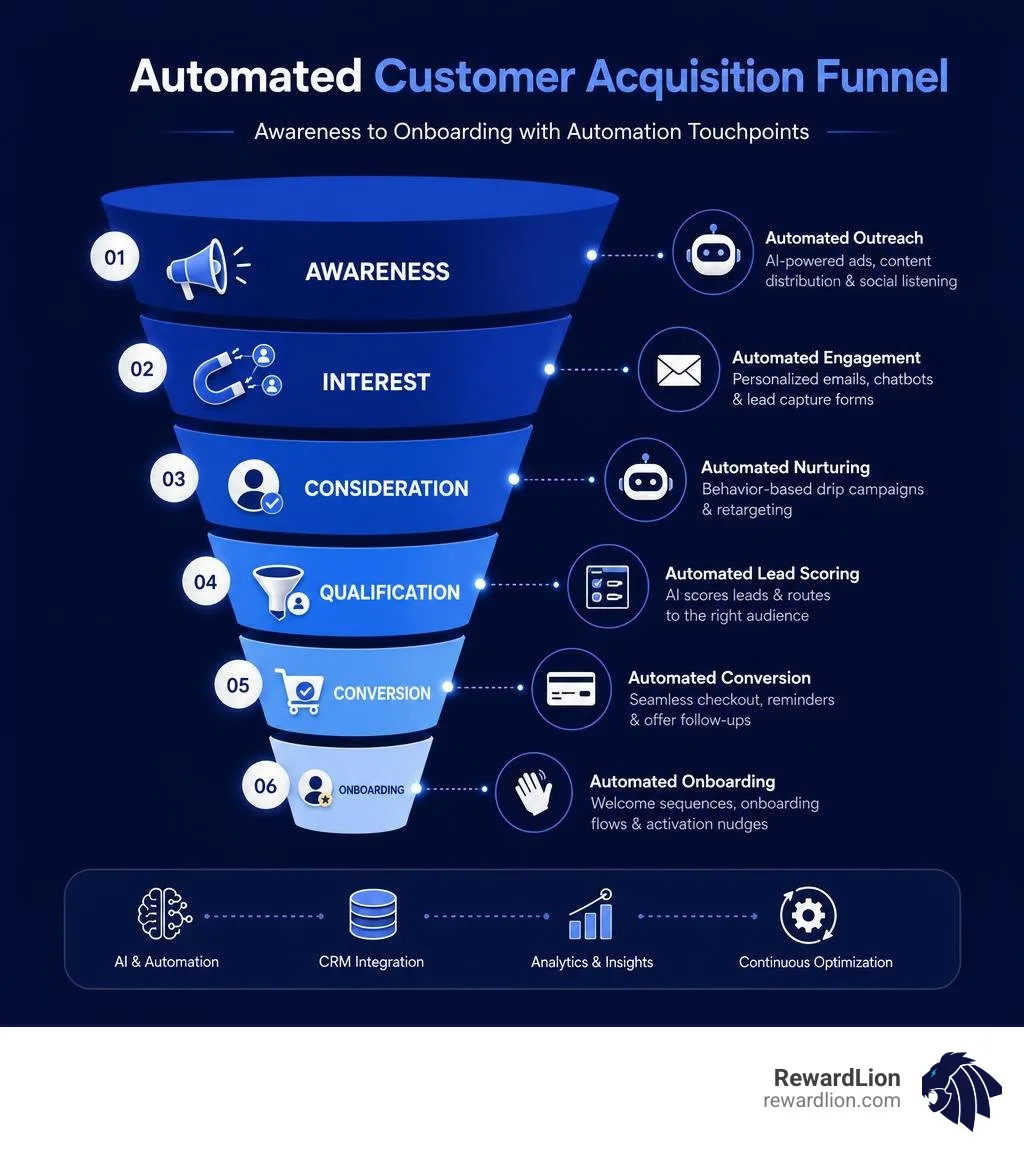
To effectively automate, we must first understand the journey a buyer takes. The customer acquisition funnel maps this progression across five distinct stages:
Awareness: The prospect first discovers your brand, often through search engines, social media, or advertising.
Interest: The prospect engages with your content, signs up for a newsletter, or downloads a resource.
Consideration: The buyer compares your offering against competitors, looking for specific features, pricing, and proof.
Conversion (Purchase): The prospect makes the decision to buy, transitioning into a customer.
Onboarding: The new customer is welcomed and set up for success, ensuring long-term retention.

To capture leads smoothly at the top and middle of this funnel, businesses deploy lead capture software. By automating the capture and categorization of leads at the awareness and interest stages, you ensure that no high-intent prospect slips through the cracks.
The Collaboration of Marketing, Sales, and Customer Success
A common mistake is treating customer acquisition as a solo sales sport. In reality, it requires tight, cross-functional collaboration between marketing, sales, and customer success teams.
Marketing is responsible for creating top-of-funnel awareness and driving qualified traffic. Sales steps in to manage deeper consideration and close the deal. Customer success ensures a seamless onboarding experience, turning a one-time buyer into a loyal advocate.
This entire ecosystem relies on seamless data sharing. When your teams operate out of a unified CRM, the handoff is frictionless. Sales reps gain instant visibility into how a lead interacted with marketing content, and customer success knows exactly what promises were made during the sales cycle. To continuously optimize this handoff and improve lead quality, we use advanced lead generation analytics to identify exactly which channels and interactions yield the highest-value customers.
How to Automate Your Customer Acquisition Process Without Losing the Human Touch
When business owners hear the word "automation," they often worry their outreach will become cold, robotic, and spammy. Nobody wants to receive a generic message that feels like it was blasted to ten thousand people at once.
The secret to modern automation is hyperpersonalization.

By leveraging generative AI and smart data structures, we can scale our outreach while making every single touchpoint feel deeply personal. This is achieved by combining powerful small business automation software with a structured "human-in-the-loop" approach. AI handles the heavy lifting of research, drafting, and scheduling, while your human experts step in to review, refine, and handle complex relationship-building conversations. This balance builds customer trust while keeping your operations highly efficient.
Deploying AI Agents to Automate Customer Acquisition Process Workflows
One of the most powerful advancements in 2026 is the use of autonomous AI agents. Unlike simple, rule-based chatbots of the past, modern AI agents understand context, user intent, and natural language.
By deploying AI agents on your website and communication channels, you ensure 24/7 availability. When a prospect visits your site at midnight, they don't have to wait until the next morning for a response. The AI agent can instantly answer complex questions, qualify the lead based on your specific criteria, and book a meeting directly onto your sales team's calendar.
For a complete breakdown of how to implement these systems, check out our ai lead generator guide 2026. Additionally, you can scale your middle-funnel conversions by providing interactive, personalized AI demos that dynamically adapt to show the prospect exactly how your solution solves their specific paint points.
Setting Up Multi-Channel Outreach and Nurturing Sequences
Because prospects require multiple touchpoints before making a purchase, a single follow-up email is no longer enough. We must build multi-channel nurturing sequences that span email, social media, and SMS.
A standard automated nurture flow might look like this:
Day 1: Automated welcome email delivering a lead magnet.
Day 3: A helpful, educational follow-up addressing a common industry pain point.
Day 5: Automated LinkedIn connection request and a personalized message.
Day 7: A quick SMS check-in with a link to book a brief discovery call.
Day 10: Retargeting ads showing case studies to prospects who haven't booked yet.
To manage this complex choreography seamlessly, we utilize drip email marketing software to deliver consistent, valuable content over time, paired with sms automation software for immediate, high-open-rate touchpoints. This multi-channel approach ensures you stay top-of-mind without manual effort.
Key Strategies and Channels to Automate Customer Acquisition
To build a truly resilient customer acquisition engine, we cannot rely on a single source of leads. We must implement an omnichannel strategy that diversifies our risk and maximizes our reach.
By leveraging digital marketing automation software, we can coordinate search engine optimization (SEO), paid search (PPC), social media, programmatic advertising, and referral marketing from a single, unified command center. This allows us to capture high-intent buyers wherever they choose to spend their time.
Automating Inbound Lead Capture and Website Personalization
Your website is your digital storefront, but if it is static, you are leaving money on the table. Today's consumers expect rapid, tailored experiences. In fact, 82% of customers spend less than 10 minutes searching for an item they need. If they cannot find what they want instantly, they leave.
To solve this, we automate the inbound experience:
Dynamic Landing Pages: Using sales funnels that automatically adjust headlines, images, and offers based on the visitor's traffic source or industry.
Mobile Optimization: Ensuring a lightning-fast, responsive experience that makes sign-ups effortless on any device.
Intelligent Lead Scoring: Automatically ranking leads based on their website behavior (e.g., visiting a pricing page vs. reading a blog post) so your sales team knows exactly who to contact first.
By implementing comprehensive lead automation software, you can automatically route high-intent leads to your top sales reps in real time, ensuring a near-instant response.
Scaling Outbound Prospecting to Automate Customer Acquisition Process Channels
While inbound marketing is incredible, outbound prospecting allows you to surgically target your exact ideal customer profile (ICP). Historically, outbound was a massive time sink, requiring SDRs to spend hours digging through LinkedIn, scraping contact info, and writing individual emails.
Today, we can automate the entire outbound pipeline:
Automated Research: AI tools scan prospect websites, recent news, funding rounds, and hiring signals to find perfect triggers for outreach.
Hyper-Personalized Copywriting: Systems draft tailored emails referencing these specific signals, ensuring the message feels uniquely written for the recipient.
Deliverability Safeguards: Utilizing native email authentication (SPF, DKIM, DMARC) and automated inbox warming to ensure your outreach lands in the primary inbox, not the spam folder.
By leveraging an advanced Automated BDR platform, businesses can run highly personalized outbound campaigns at a fraction of the cost of a traditional sales team. Managing this entire outbound workflow within a robust sales automation software saas ensures your pipeline remains full with minimal daily maintenance.
Measuring Success and Optimizing Your Automated System
An automated acquisition system is not a "set-it-and-forget-it" project. To achieve maximum ROI, we must adopt a highly data-driven approach, constantly running A/B tests and analyzing campaign performance.
Metric Category Manual Outreach Automated System (RewardLion OS) Daily Outreach Volume ~50 emails / day 250+ highly personalized touchpoints Response Rates 1% - 3% (untargeted) 15% - 45% (signal-based) Time Spent on Admin 67% of sales day <5% (automated data syncing) Lead Response Time Hours to days Under 2 minutes (24/7) Pipeline Visibility Fragmented spreadsheets Real-time unified dashboard
By unifying your marketing and sales data onto modern lead generation platforms, you gain absolute clarity over your customer journey, allowing you to double down on what works and cut what doesn't.
Essential Metrics to Track (CAC, CLV, Churn, and Conversion)
To understand the health of your customer acquisition engine, you must track and analyze these four critical metrics:
Customer Acquisition Cost (CAC): The total cost of sales and marketing divided by the number of new customers acquired. $$\text{CAC} = \frac{\text{Total Acquisition Spend}}{\text{Number of New Customers}}$$ Example: If we spend \$5,000 on ads and tools to acquire 100 customers, our CAC is \$50.
Customer Lifetime Value (CLV): The total revenue a customer generates throughout their relationship with your business. $$\text{CLV} = \text{Average Purchase Value} \times \text{Purchase Frequency} \times \text{Average Lifespan}$$
Churn Rate: The percentage of customers who stop doing business with you over a given time period.
Conversion Rate: The percentage of website visitors or leads who take a desired action (e.g., scheduling a demo or making a purchase).
To master these calculations and build a highly profitable business model, refer to our lead generation software complete guide. Ideally, you want a CLV-to-CAC ratio of 3:1 or higher, meaning a customer is worth at least three times what it cost to acquire them.
How to Reduce Customer Acquisition Costs (CAC)
High acquisition costs are the silent killer of growing businesses. Fortunately, automation and smart strategy provide several highly effective ways to drive CAC down while keeping quality high:
Invest in Organic Channels: Building a strong foundation in Local SEO and high-value content marketing brings in continuous, high-intent inbound traffic without a recurring cost-per-click.
Automate Referral Marketing: Happy customers are your best sales reps. By automating review requests and referral incentives, you can acquire new customers at a fraction of the cost of paid ads.
Prioritize Lead Quality Over Quantity: By using AI to score and qualify leads before they ever reach a human salesperson, you ensure your team only spends time on the highest-value prospects.
Focus on Retention: Because retaining a customer is significantly cheaper than acquiring a new one, a strong onboarding experience directly improves your overall business profitability.
Implementing a dedicated lead gen software stack allows you to track exactly which channels yield the lowest CAC, helping you allocate your marketing budget with surgical precision.
Frequently Asked Questions about Customer Acquisition Automation
Can AI completely replace human sales representatives?
No. While AI is incredible at handling repetitive, administrative, and early-stage qualification tasks, human sales representatives are still absolutely essential. Humans excel at deep relationship building, complex negotiations, and understanding the emotional nuances of a high-value purchase. The goal is not to replace your sales team, but to supercharge them. By utilizing sales automation ai tools, you free your reps from administrative bottlenecks, allowing them to spend 100% of their energy on active selling and closing deals.
How long does it take to set up an automated acquisition system?
With modern platforms, basic automation workflows can be deployed surprisingly fast. Simple templates, email sequences, and basic lead capture can often be set up in under a week. However, building a comprehensive, deeply integrated omnichannel system that connects your CRM, AI agents, paid advertising, and outbound engines typically takes 30 to 60 days to fully optimize. Moving to an ai driven sales platform simplifies this transition, offering pre-configured vertical templates that dramatically reduce setup and onboarding times.
Is customer acquisition automation compliant with data privacy laws?
Yes, provided you choose the right platforms and build compliance into your workflows. When running automated campaigns, you must adhere to regulations like GDPR, CCPA, CAN-SPAM, and TCPA. This means always providing clear opt-out options (like unsubscribe links), respecting "Do Not Call" registries, and securely encrypting user data. By partnering with experts who understand ai automation for agencies, you can ensure that your automated systems have built-in compliance gates, protecting your brand while driving consistent growth.
Conclusion: Hands-Free Growth with RewardLion
Automating your customer acquisition process is the single most effective way to scale your business, reduce overhead, and give your sales team their time back. But as we have covered, building, integrating, and managing all of these moving parts can quickly become a full-time job.
That is where RewardLion comes in.
We don't believe you should have to duct-tape five different software tools together or hire a massive team of expensive engineers. RewardLion provides an AI-powered, all-in-one OS platform that unifies your marketing, sales, automation, and analytics under a single dashboard.
Our unique differentiator is our hybrid SaaS + expert team management model. When you partner with us, you don't just get powerful software — you get a dedicated CAPSS team (your fractional, in-house marketing agency) based in Fort Lauderdale, FL. We handle the setup, optimization, and continuous management of your local growth engines, automated lead generation systems, PR, creative production, and AI sales automation.
It is the ultimate "done-for-you" solution for completely hands-off business growth across Florida and all 50 states.
Ready to stop chasing leads manually and start growing on autopilot? Get Your Quote today and let us build your automated acquisition engine!