Why Your Lead Generation Process Is Costing You Growth
The lead generation process is the system your business uses to attract strangers, capture their contact details, and turn them into paying customers — and if yours is fragmented or inconsistent, you're leaving real revenue on the table.
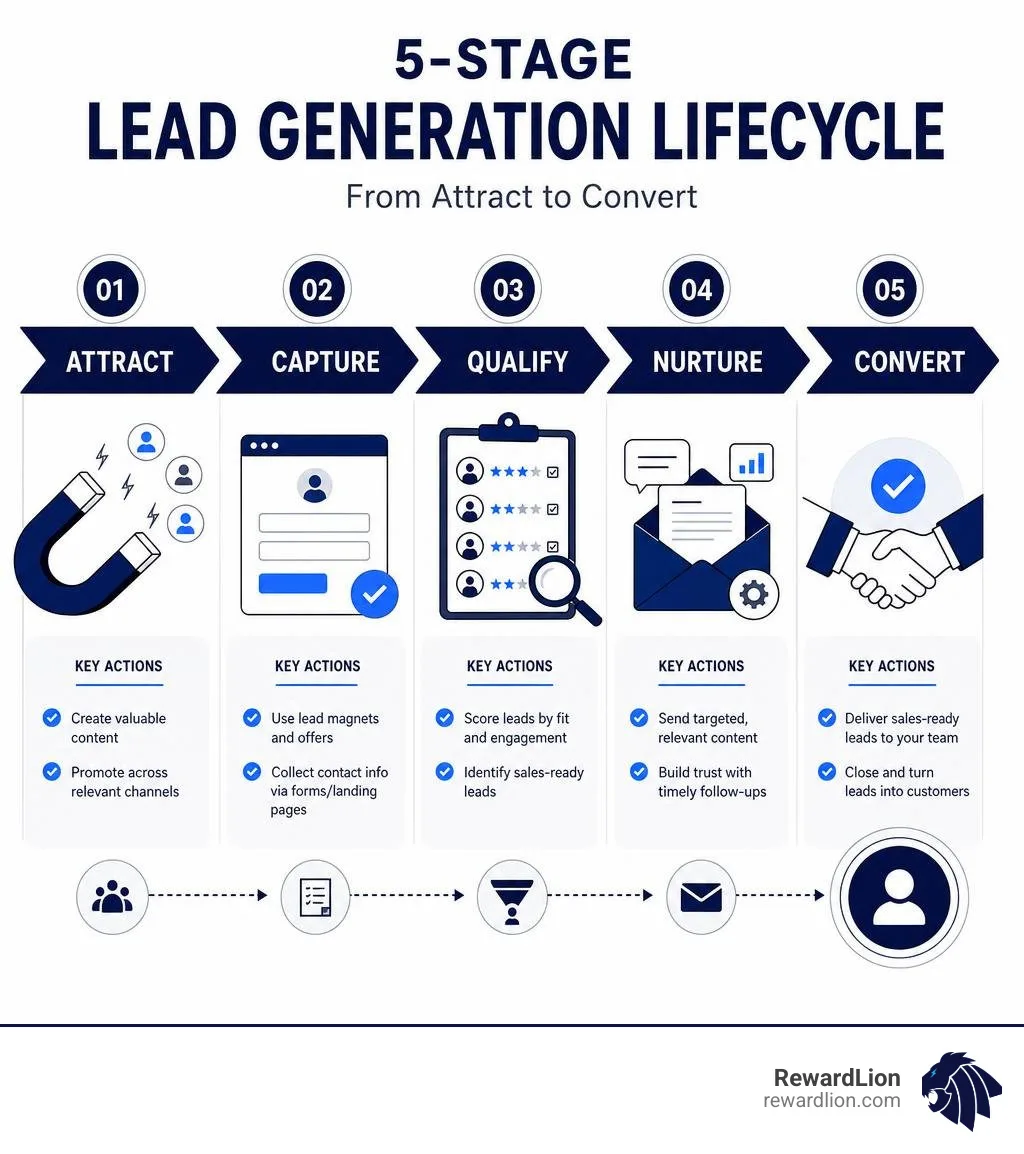
Here's a quick look at how the process works:
Attract - Pull the right people to your content, ads, or website
Capture - Collect contact information through forms, landing pages, or lead magnets
Qualify - Sort leads by fit and readiness to buy
Nurture - Build trust with relevant, timely content and follow-ups
Convert - Hand warmed, sales-ready leads to your team to close
Most businesses understand they need leads. The real problem is how those leads are being generated — or more often, how the system connecting each stage keeps breaking down.
Rising costs make this even more urgent. Google Ads cost-per-lead climbed from $66.69 in 2024 to $70.11 in 2025, and customer acquisition costs have jumped roughly 60% over the past five years. Meanwhile, 61% of marketers still rank generating traffic and leads as their top challenge.
The good news? A well-built, systematic lead generation engine doesn't just generate more leads — it generates better ones at a lower cost over time.
I'm Mike Ibrahim, Founder and CEO of RewardLion and Marketing Director for several companies, with over a decade of experience building and refining lead generation processes across diverse industries. In that time, I've seen how businesses transform their pipeline — not by doing more, but by building smarter systems that connect every stage of the lead generation process without the gaps where revenue quietly disappears.
Understanding Lead Generation vs. a Lead
Before we start tweaking dials and launching campaigns, we need to clear up some terminology. Many teams treat "leads" and "lead generation" as interchangeable buzzwords. They aren't. Misunderstanding the difference is exactly how marketing teams end up celebrating "record lead volume" while sales reps complain about "trash leads" that never close.
To build a reliable system, we must look at where these concepts sit within the broader buyer journey and how we gather first-party data. For a deeper dive into the foundational shifts happening in the market, check out our Lead Generation Guide: The Complete Playbook 2026.
What is a Lead and Why Does It Matter?
At its simplest, a lead is any person or organization that has expressed interest in your product or service by sharing their contact information (like an email or phone number). They are no longer an anonymous website visitor; they are a known entity.
However, not all leads are created equal. To avoid wasting your sales team's valuable hours, we divide leads into specific quality tiers:
Information Qualified Lead (IQL): A contact at the very beginning of their journey. They’ve likely downloaded a generic checklist or read a blog post but haven’t shown specific interest in your brand yet.
Marketing Qualified Lead (MQL): A lead who has interacted with your marketing materials multiple times — perhaps by attending a webinar or downloading a detailed case study. They fit your target demographic but aren't quite ready to buy.
Sales Qualified Lead (SQL): A lead who has been vetted by your team (or your automated systems) as actively looking for a solution and ready for a direct sales conversation.
Product Qualified Lead (PQL): Common in SaaS, these are users who have experienced real value through a free trial or freemium model and are primed to upgrade.
Vetting these leads properly is the key to sustainable customer acquisition. If your sales team is chasing cold IQLs, your pipeline velocity slows to a crawl.
Defining the Modern Lead Generation Process
If a lead is the "who," the lead generation process is the "how." It is a systematic workflow designed to spark audience interest, capture their contact details, and guide them smoothly toward sales readiness.
This is not a series of one-off, disconnected marketing tactics. It is a continuous, predictable revenue engine. The modern process relies heavily on first-party data — information your audience gives you willingly and transparently. In a world of tightening privacy laws, first-party data is gold.
To capture this data cleanly without annoying your prospects, you need the right tools. Implementing specialized Lead Capture Software ensures that every form, popup, and tracking pixel works together to feed accurate information directly into your database.
The 5 Essential Stages of the Lead Generation Process
Think of your lead generation process as a filtering system. You pour a broad audience into the top, and through a series of conversion checkpoints, you refine that audience until only highly qualified, motivated buyers emerge.
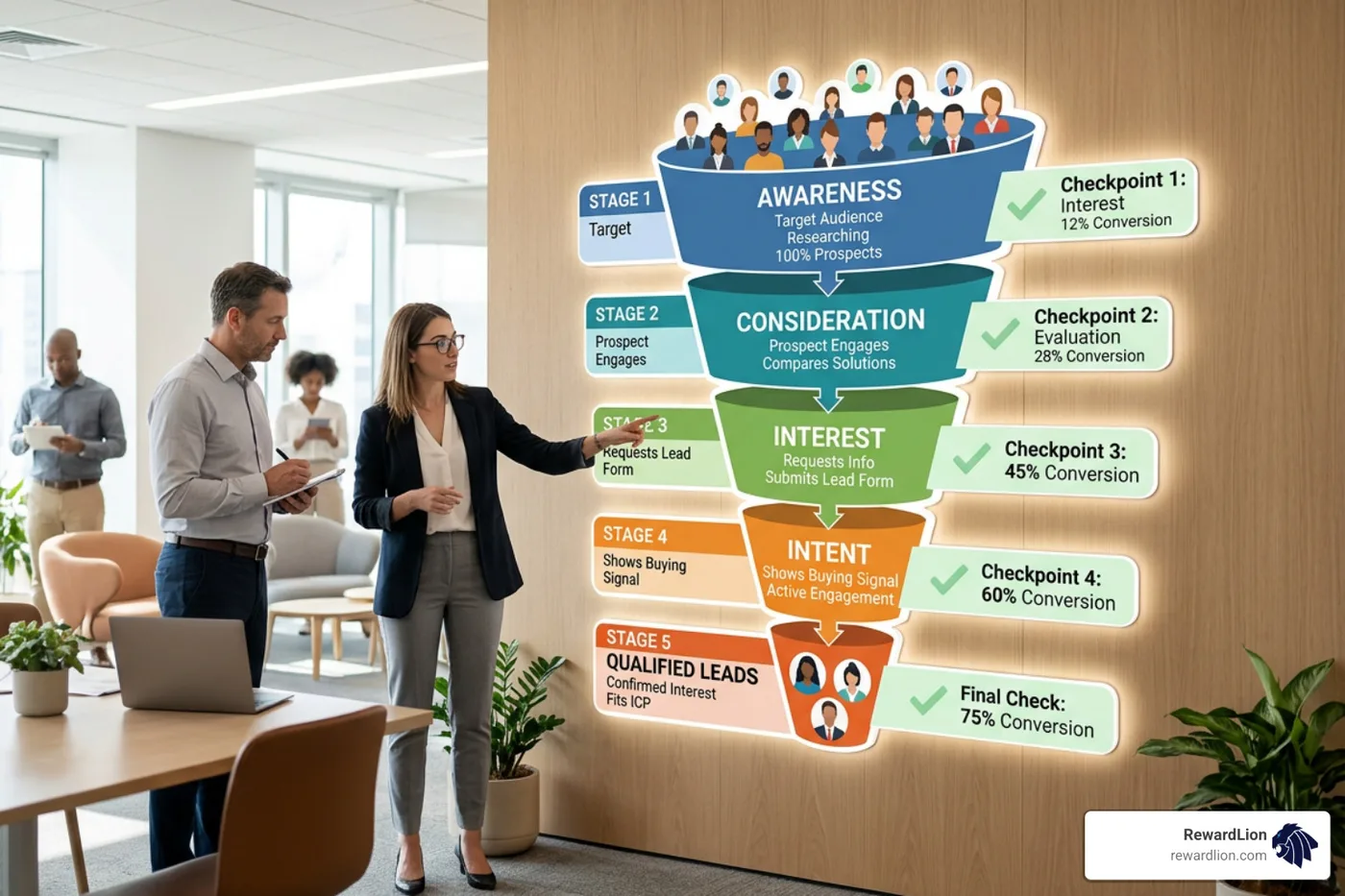
Let’s break down the five stages that make this funnel work. If you want to design this system for long-term growth, read our comprehensive resource on the Lead Generation Funnel: The Complete Guide.
Attracting and Capturing High-Intent Prospects
The first stage is all about traffic generation. You cannot capture contact details if nobody knows you exist. We focus on drawing high-intent prospects to our digital properties through SEO, targeted paid ads, and engaging organic content.
Once they arrive, your landing pages must do the heavy lifting. The math here is brutal: average landing pages convert around 4-5%, while top-performing pages exceed 10-11%.
To join the ranks of the top performers, you must optimize for mobile. Over half of all form submissions now happen on mobile devices. If your landing page has a clunky, multi-field form that is hard to tap on a smartphone screen, your conversion rates will plunge. Keep your initial forms short — ideally three fields or fewer — to maximize conversions.
Qualifying and Scoring Leads for Sales Readiness
Once you’ve captured a lead, you need to know if they are actually a good fit. This is where qualification and scoring come in.
We use the BANT framework to evaluate prospects:
Budget: Do they have the financial resources to buy?
Authority: Are they the decision-maker?
Need: Do they have a problem we can solve?
Timeline: Are they looking to buy soon?
To scale this, we implement a lead scoring model. We assign points based on two categories:
Explicit Scoring: Demographics and firmographics (e.g., job title, company size, location). A VP gets more points than an entry-level intern.
Implicit Scoring: Behavioral signals (e.g., visiting a pricing page, opening emails, downloading an integration guide).
When a lead crosses a set point threshold (say, 80 points), they are automatically graded as "sales-ready" and routed to your sales team.
Nurturing Leads Through Automated Workflows
What about the leads who aren't ready to buy today? Only about 3% of your market is actively buying at any given moment. Another 7% is open to it, while the remaining 90% needs time. If you ignore non-converters, you are tossing potential revenue into the trash.
We use automated email sequences to build long-term relationships. A highly effective nurture cadence uses a balanced content mix:
70% Educational Content: Helpful guides, industry insights, and tips that solve their immediate problems.
20% Social Proof: Case studies, customer testimonials, and success stories.
10% Promotional Offers: Direct calls-to-action like booking a demo, claiming a trial, or getting a quote.
By personalizing these workflows based on the lead's industry and behavior, you keep your brand top-of-mind. To make this hands-free, we recommend setting up dedicated Lead Automation Software to trigger the right emails at the exact moment your prospect is most receptive.
Inbound vs. Outbound vs. Hybrid Strategies in 2026
To keep your pipeline full, you must choose the right channel mix. Should you wait for customers to find you (inbound), or should you actively reach out to them (outbound)? In 2026, the smartest businesses don't pick sides — they build a hybrid strategy.
Strategy Primary Channels Budget Allocation Pros Cons Inbound SEO, Content Marketing, Organic Social, Podcasts 40% High-quality leads, compounding ROI, lower long-term cost Takes time to build momentum (6-12 months) Outbound Cold Email, LinkedIn Outbound, Account-Based Marketing 30% Immediate pipeline, highly targeted, great for enterprise High effort, requires strict deliverability hygiene Hybrid Intent-based outreach, Retargeting, Signal-based sequences 30% Highest conversion rates, extremely efficient, fast-acting Requires a modern, integrated tech stack
Inbound Channels: SEO, Content, and High-Converting Landing Pages
Inbound marketing remains the foundation of sustainable business growth. By targeting high-intent keywords with commercial or transactional intent, you attract prospects who are already searching for what you offer.
The secret to winning at inbound is content depth and authority. Instead of writing generic, short blog posts, focus on building topic authority through comprehensive pillar pages and content clusters.
Once visitors arrive, steer them toward high-converting landing pages. Because email marketing cost-per-qualified-lead still beats paid ads in most categories in 2026, building a massive, highly engaged email list through valuable lead magnets (like calculators or original data reports) is the most profitable inbound move you can make.
Outbound Channels: Cold Outreach and Account-Based Marketing
If you need pipeline in the next 30 days, you cannot wait for SEO to kick in. You need outbound.
The modern outbound playbook is built on precision, not spam. Cold email remains the backbone of outbound because of its scale and personalization capabilities, but you must maintain perfect deliverability hygiene (SPF, DKIM, DMARC, and keeping inboxes under 50 emails per day).
Pair your cold emails with LinkedIn outbound. By staying within safe platform thresholds (80-100 connection requests per week) and focusing on genuine, non-salesy conversations, you can build relationships with high-value targets.
This direct approach is essential because paid search channels have become incredibly expensive. For instance, Google Ads CPL climbed from $66.69 in 2024 to $70.11 in 2025. Outbound lets you bypass bidding wars and go straight to your ideal buyers.
Hybrid Models: Combining Signals and Intent Data
The real magic happens when you merge inbound and outbound into a hybrid, signal-based selling model.
By utilizing intent platforms (like G2, 6sense, or Bombora), you can see which target companies are actively researching your category or reading comparison pages.
Instead of cold calling blind lists, your team can launch multichannel sequences (combining email, LinkedIn touches, and phone calls) targeting those high-intent accounts. Multichannel sequences book 24% to 40% more meetings than single-channel email outreach because they meet the buyer wherever they are active.
The Role of AI and Automation in Modern Lead Generation
In 2026, the speed of your lead generation process is just as important as its quality. Buyers are impatient. If you don't respond to an inquiry almost instantly, they will move on to your competitor. This is where AI and automation become your unfair advantage.
Scaling Operations with Lead Automation Software
Automation is the glue that keeps your pipeline from leaking. When a prospect downloads a lead magnet, a modern system doesn't wait for a human to log in. It instantly enriches the lead data (pulling company size, revenue, and social profiles), scores the lead, and routes it to the right representative.
Integrating these workflows with your CRM ensures that no prospect slips through the cracks. To compare your options and build a stack that actually talks to each other, explore our guide on the best Lead Generation Platforms.
Real-Time Engagement with AI Lead Generators
Generative AI has evolved far beyond basic, scripted chatbots. Today's autonomous agents can engage inbound website visitors in real-time, natural conversations.
These AI assistants can:
Answer complex product questions 24/7.
Qualify leads using your custom BANT criteria.
Book meetings directly onto your sales team's calendars.
This dramatically improves your speed-to-lead. Leads contacted within 5 minutes are roughly 9x more likely to convert than those contacted after 30 minutes. By deploying 24/7 conversational AI, you ensure that every high-intent lead is captured and qualified the moment their interest is peaked. For a complete blueprint on setting this up, read our AI Lead Generator Guide 2026.
Overcoming Challenges and Measuring Lead Generation ROI
No matter how shiny your tech stack is, your lead generation process will face roadblocks. From dirty data to changing privacy regulations, success requires continuous measurement and optimization.
Solving Data Accuracy and Lead Quality Issues
One of the biggest silent killers of lead generation is inaccurate data. People change jobs, companies merge, and users type fake phone numbers into forms.
We solve this through a combination of tactics:
Regular List Cleaning: Automatically verify email addresses and phone numbers before they hit your CRM.
Progressive Profiling: Instead of asking for 10 pieces of information on the first visit, ask for 2 or 3. When that same lead returns to download another asset, ask for 2 more. This keeps conversion rates high while gradually building a rich profile.
Focusing on Lead Quality over Volume: Volume is vanity; pipeline value is sanity. It is far better to generate 50 highly qualified, high-intent leads than 500 junk submissions that waste your sales team's time.
To keep a close eye on these trends, you must implement robust Lead Generation Analytics to track exactly where your highest-value customers are coming from.
Key Metrics to Track in Your Lead Generation Process
To prove the direct business impact of your marketing efforts, you must look past simple click rates. Here are the core metrics we track and optimize:
Cost Per Lead (CPL): Total campaign spend divided by the number of leads generated.
MQL to SQL Conversion Rate: Vets the quality of your top-of-funnel targeting. A healthy target is 25% to 40%.
Pipeline Velocity: How quickly a lead moves from first touch to closed-won.
Customer Lifetime Value to Customer Acquisition Cost (LTV/CAC): The ultimate measure of business health. You want this ratio to be greater than 3:1.
Frequently Asked Questions about Lead Generation
What is the difference between lead generation and demand generation?
Demand generation is a broad brand play focused on building awareness, trust, and interest in your industry. It is about educating the market so they recognize they have a problem.
Lead generation is the specific conversion layer. It focuses on capturing contact details, running targeted sequences, and turning that general interest into a direct, trackable sales pipeline.
How does speed-to-lead impact conversion rates?
Speed-to-lead is everything. If you respond to a high-intent lead within 5 minutes, your qualification rates are 10x higher than if you wait 30 minutes. In modern sales, the fastest company to respond almost always wins the deal.
What is a good landing page conversion rate in 2026?
While the average landing page converts around 4-5%, top-performing pages built with minimal form fields, clear benefit-focused headlines, and mobile-first layouts routinely exceed 10-11%.
Conclusion: Let Us Build and Manage Your Growth Engine
Optimizing your lead generation process isn't about running more random campaigns. It’s about building a connected, automated system where marketing and sales work in perfect harmony.
But building this system on your own is hard. It requires managing disconnected tools, writing copy, building landing pages, configuring CRMs, and continuously optimizing campaigns.
At RewardLion, we do things differently. We provide an AI-powered, all-in-one OS platform that unifies your marketing, sales, automation, and analytics under one roof. Better yet, we don't just hand you the software and wish you luck.
With our hybrid model, you get a dedicated, fractional in-house marketing team (your CAPSS team) that implements, manages, and optimizes your entire growth engine for you. From local SEO domination in Florida (including Las Olas, Fort Lauderdale, Miami, and Boca Raton) to omnichannel paid ads and AI sales automation across all 50 states and internationally, we handle the complex work so you can focus on running your business.
Ready to build a predictable, hands-off lead generation engine that scales? Get Your Quote today and let's discuss how we can drive sustainable growth for your business.