What Is a Sales Funnel for Small Business? A Plain-English Guide
A sales funnel is the step-by-step path someone takes from first hearing about your business to becoming a paying customer. It's called a "funnel" because it narrows at each stage — lots of people enter at the top (they see your ad or find your website), and only a fraction make it all the way through to a sale (Business.com). If you have a website, run ads, or get phone calls from new customers, you already have a sales funnel. The question isn't whether you have one — it's whether it's working, or quietly leaking leads at every stage.
This guide covers:
- What a sales funnel is and why every small business already has one
- The stages of the funnel, from first awareness to repeat business
- How a funnel differs from a landing page and a website
- The three places funnels break down most often
- How to build, automate and measure a simple funnel on a small budget
Why Small Businesses Need a Sales Funnel (You Already Have One — It's Just Leaking)
The funnel you didn't design
Every business that gets customers has some version of a funnel, even if nobody designed it on purpose. A homeowner searches for "emergency plumber near me," lands on your website, maybe calls or fills out a form, and either books a job or disappears. That's a funnel. The problem for most small businesses isn't the absence of a funnel — it's that nobody mapped it out, so nobody can see where prospects are falling through the cracks.
Why writing it down matters
This matters more than it sounds. Businesses with a clearly documented sales funnel generate significantly more return on their marketing investment than those without one — yet only about 32% of businesses actually have a defined funnel (KhrisDigital). That leaves the other 68% of businesses without a fully defined or documented funnel (KhrisDigital). They're spending money on ads, referrals, and a website, but have never written down what should happen after someone shows interest.
A quick way to map your current funnel in one sitting:
- List every way new customers first find you: ads, search, referrals, social posts, signs.
- For each one, write down where they land: homepage, a landing page, a phone number, a booking link.
- Note what happens next when they call or fill in a form, and who is responsible for it.
- Mark any step where nothing happens automatically, or where nobody is sure who follows up.
- Those marked steps are your leaks. Fix the biggest one first.
The Stages of a Small Business Sales Funnel: Awareness to Loyalty
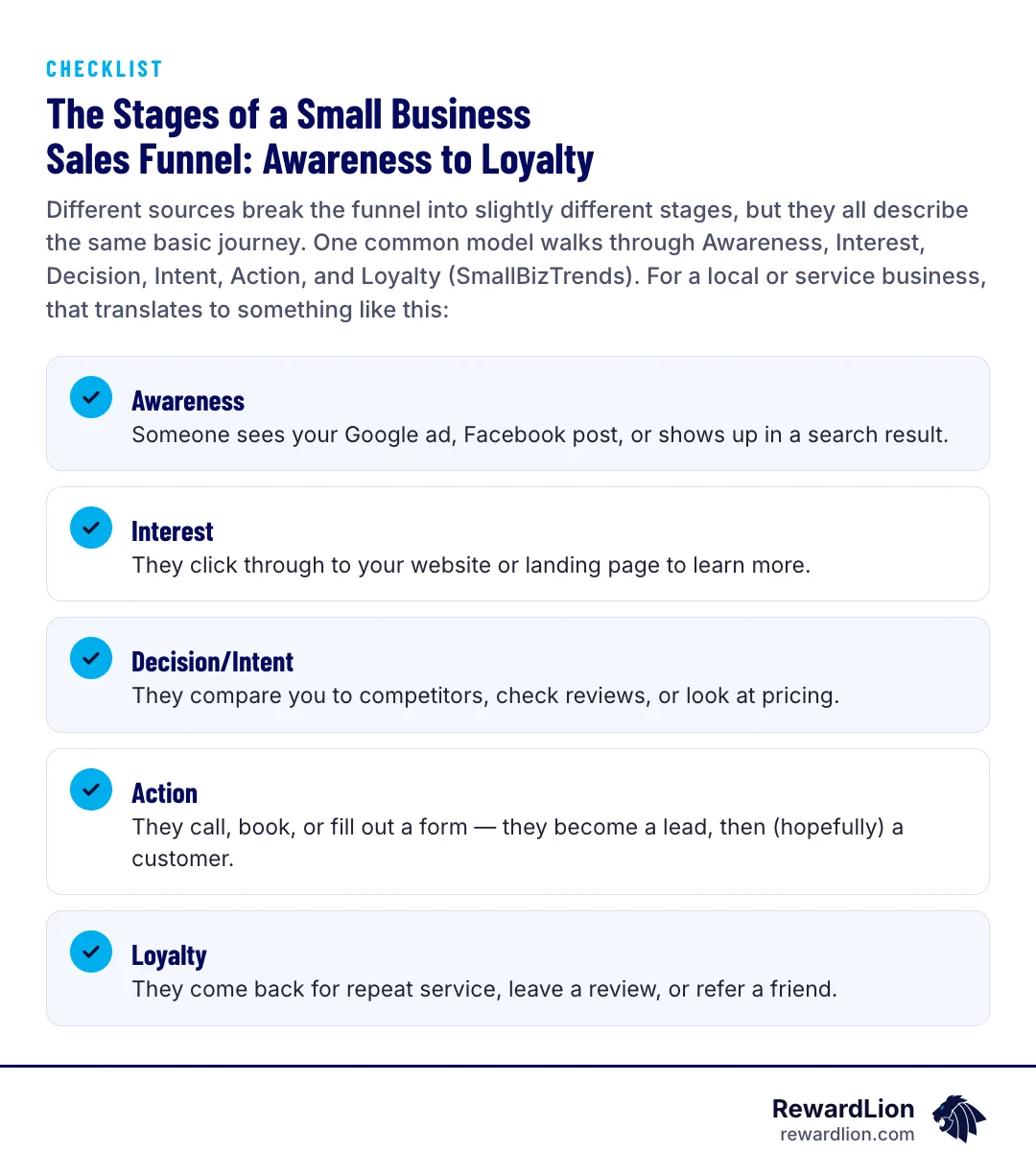
Different sources break the funnel into slightly different stages, but they all describe the same basic journey. One common model walks through Awareness, Interest, Decision, Intent, Action, and Loyalty (SmallBizTrends). For a local or service business, that translates to something like this:
- Awareness: Someone sees your Google ad, Facebook post, or shows up in a search result.
- Interest: They click through to your website or landing page to learn more.
- Decision/Intent: They compare you to competitors, check reviews, or look at pricing.
- Action: They call, book, or fill out a form — they become a lead, then (hopefully) a customer.
- Loyalty: They come back for repeat service, leave a review, or refer a friend.
A second way to look at the stages
Another framing, used by accounting and CRM platforms, describes the funnel in five business-development stages: qualification, proposal, negotiation, closing, and retention — and stresses tracking the conversion rate at each step to find exactly where prospects drop off (Xero). Whichever model you use, the point is the same: map the journey, then measure it.
What each stage needs from you
| Funnel stage | What the customer is doing | What your business needs in place |
|---|---|---|
| Awareness | Seeing an ad, a search result or a social post | Ads, local search presence and a clear message |
| Interest | Visiting your site or landing page | A fast page that matches the ad or search |
| Decision/Intent | Comparing you with competitors | Reviews, proof of past work and clear next steps |
| Action | Calling, booking or filling in a form | An easy form or booking link and instant follow-up |
| Loyalty | Coming back, reviewing or referring | Review requests, reminders and a referral ask |
Sales Funnel vs. Landing Page vs. Website: What's the Difference?
These three terms get used interchangeably, and that confusion costs small businesses leads.
A landing page is a single page built around one offer and one call to action — book a free consult, claim a discount, download a guide. A sales funnel is the entire multi-page journey, strung together with different pages and different calls to action at each stage, from first click to final sale (DashClicks). Your website is usually something else entirely: a general brochure about your business that tries to serve every visitor at once.
A common mistake is pouring the whole marketing budget into perfecting one landing page, while having no sequence of follow-up messages after someone opts in (Lilach Bullock). A great landing page with no follow-up is a dead end, not a funnel.
Side by side
| Website | Landing page | Sales funnel | |
|---|---|---|---|
| Scope | Your whole business | One offer | The full journey, first click to sale and beyond |
| Calls to action | Many | One | A different one at each stage |
| Best used for | Credibility and general information | Ad and campaign traffic | Turning interest into booked, repeat customers |
If you need help with the individual pieces, see our landing page services and website development services.
Where Small Business Funnels Break Down (And Why Leads Go Cold)
Three problems show up again and again in small business funnels:
- No dedicated landing pages. Ad traffic gets sent to a generic homepage instead of a page built for that specific offer, so visitors get confused and leave.
- No fast follow-up. A huge share of marketing leads — around 79% — never convert, largely because they're not nurtured or followed up with properly after the first contact (KhrisDigital). If a lead calls or fills out a form and hears nothing back for a day, they've likely already called a competitor.
- No tracking. Without knowing how many people enter the funnel at each stage, you can't tell whether the problem is your ads, your landing page, or your follow-up.
For context on why this matters: average sales funnel conversion rates across industries sit around 3–5% (KhrisDigital). With numbers that tight, small fixes to one weak stage can meaningfully change how many leads turn into paying customers.
Signs your funnel is leaking
- Ads get clicks, but the phone doesn't ring and forms stay empty
- Leads come in, but nobody can say how quickly each one was contacted
- Quotes go out and are never followed up
- Happy customers are never asked for a review or a referral
How to Build a Simple, Effective Sales Funnel on a Small Business Budget
You don't need a complex system to start. A workable funnel needs:
- One clear offer per campaign (not five options on a homepage)
- A landing page built specifically for that offer
- A way to capture contact information (form, call tracking number, chat)
- A defined next step — an email, text, or call that happens automatically
- A simple way to see how many people moved through each stage
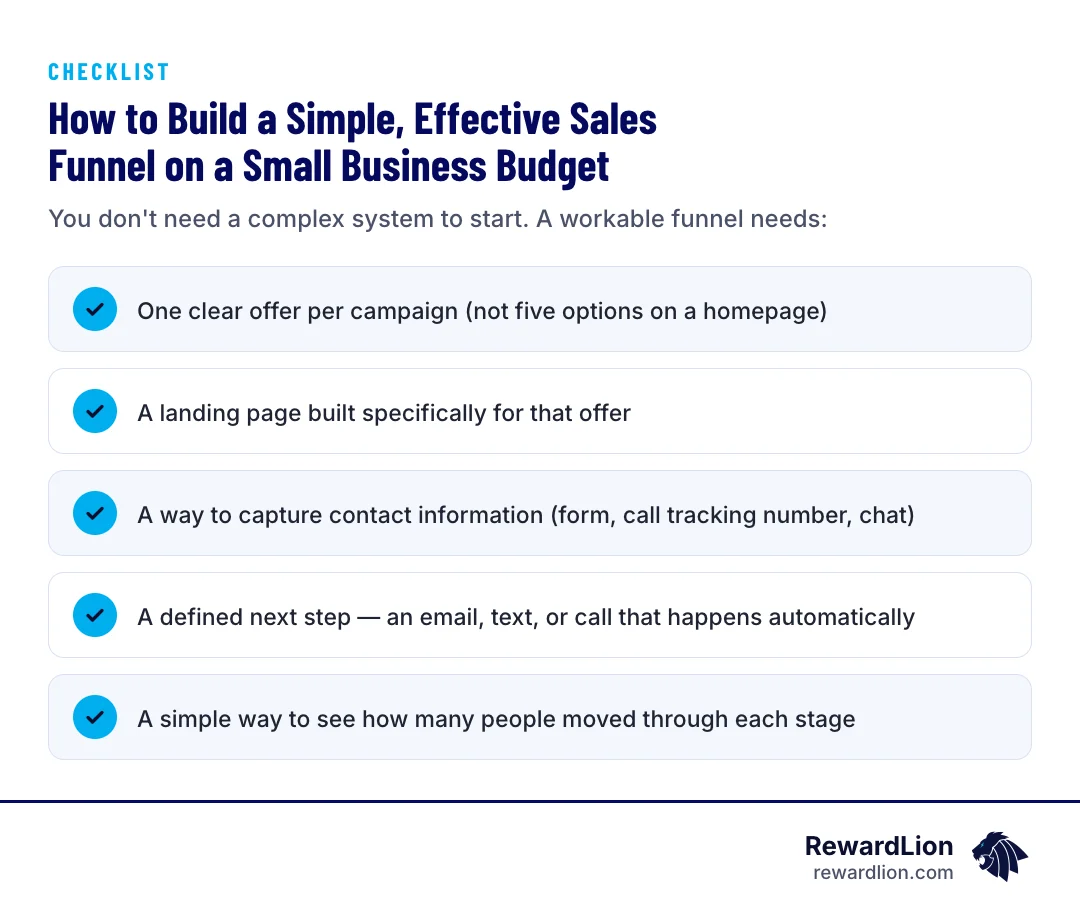
The goal at a small business level is a beginner's guide, not a tech stack (Adwave). Start with one offer, one landing page, and one follow-up sequence, then build from there.
A first funnel in five steps
- Pick one offer your best customers already ask for, such as a free estimate or a first-visit consult.
- Build one landing page for it, with a single form or booking button.
- Send one traffic source to that page — an ad campaign, a social post or an email to past customers.
- Set up one automatic follow-up, such as an instant text and an email confirming the next step.
- Review the numbers after a few weeks, then improve the weakest stage before adding anything new.
For a planning template, see our lead generation campaign plan.
Automating the Follow-Up: Why Speed-to-Lead Makes or Breaks Conversions
Follow-up is where most small business funnels quietly fail. Relying on a team member to remember to call every lead back is a plan that breaks the moment things get busy. Sales pipeline automation tools fix this by triggering a follow-up the instant a lead comes in, rather than depending on memory (ConvergeHub). Centralizing lead capture, automated follow-up, and reporting into one system is the core of what "automating your funnel" actually means (Monday.com).
What a basic automated follow-up looks like
- Instantly: a text and email confirming the request was received and what happens next
- Same day: a call or task assigned to a team member, with the lead's details attached
- Over the next few days: reminders for anyone who hasn't booked yet
- After the job: a thank-you message with a review request
Tools for this usually live in a CRM. Our CRM setup and automation service and our guide to SMS automation software explain the options.
Quick answers from this guide
| Question | Short answer |
|---|---|
| Do I need a separate landing page for every offer? | It helps. A landing page focused on a single offer and call to action converts better than sending traffic to a general homepage, because visitors aren't distracted by unrelated content (DashClicks). |
| How fast should I follow up with a new lead? | As fast as possible. A large share of marketing leads never convert because of insufficient follow-up, and automated systems that trigger a response the moment a lead comes in help prevent leads from going cold (KhrisDigital; ConvergeHub). |
| What's the difference between a sales funnel and a marketing funnel? | They describe overlapping ideas. A sales funnel typically tracks the buyer's journey through stages like qualification, proposal, negotiation, closing, and retention (Xero), while marketing funnel models often use Awareness, Interest, Decision, and Action to describe how content and ads move a prospect along (SmallBizTrends). |
| Can I build a sales funnel myself, or do I need an agency? | You can start small on your own — one offer, one landing page, one follow-up step. |
Real-World Sales Funnel Examples Small Businesses Can Copy
A simple four-stage model — Awareness, Interest, Desire/Decision, Action — also includes what happens after the sale: requesting feedback and enrolling customers in a loyalty or rewards program (Crowdspring). For a local business, that might look like:
- A dental practice runs an ad for a specific offer, sends clicks to a dedicated landing page, texts new leads within minutes, and follows up by email to request a review after the visit.
- A contractor uses a landing page for "free roof inspection," with an automated text sequence for anyone who doesn't book right away, and a referral request once the job is done.
More generic examples to adapt
- A home cleaning company offers a first-clean booking page from a local social ad, confirms by text, and sends a reminder the day before.
- A fitness studio promotes a trial class on a landing page, sends a welcome email series to people who sign up, and invites attendees to a membership consult.
- A landscaping business sends past customers a seasonal email with a booking link, and follows up with anyone who clicked but didn't book.
Each example uses the same building blocks: one offer, one page, one automatic follow-up and one step after the sale.
Tracking What Works: Analytics and Funnel Optimization
You can't improve what you don't measure. Tracking conversion at each stage — ad clicks to landing page visits, visits to leads, leads to booked appointments — shows you exactly where people are dropping off, so you know whether to fix the ad, the page, or the follow-up (Xero).
The four numbers to watch
- Clicks or visits to the landing page
- Leads — calls, forms and bookings
- Booked appointments or jobs
- Paying customers, plus repeat visits and referrals
Divide each number by the one before it to see the conversion rate at that step. The step with the sharpest drop is where to focus first. For more on measurement, see our lead generation analytics guide.
How RewardLion Builds a Done-For-You Funnel: Website, Landing Pages, Ads, Follow-Up & SEO Together
RewardLion builds the pieces of a working funnel as one connected system rather than disconnected projects: dedicated landing pages for each offer, AI-powered ad campaigns to drive the right traffic, automated lead follow-up so leads don't go cold, and SEO to keep bringing in organic traffic over time. The point is to close the gaps where most small business funnels break — no dedicated pages, no fast follow-up, no tracking — with one system built to work together.
Learn more about our sales funnel services and paid advertising, or contact our team to talk through your current funnel.
Related reading
- AI Sales Funnel Builder: Your 2-Minute Ticket to More Leads
- Stop Losing Leads: Top Automated Sales Funnel Solutions Compared
- The Lead Capture System Blueprint
- RewardLion lead generation solutions
FAQs: Sales Funnels for Small Business
Do I need a separate landing page for every offer?
It helps. A landing page focused on a single offer and call to action converts better than sending traffic to a general homepage, because visitors aren't distracted by unrelated content (DashClicks).
How fast should I follow up with a new lead?
As fast as possible. A large share of marketing leads never convert because of insufficient follow-up, and automated systems that trigger a response the moment a lead comes in help prevent leads from going cold (KhrisDigital; ConvergeHub).
What's the difference between a sales funnel and a marketing funnel?
They describe overlapping ideas. A sales funnel typically tracks the buyer's journey through stages like qualification, proposal, negotiation, closing, and retention (Xero), while marketing funnel models often use Awareness, Interest, Decision, and Action to describe how content and ads move a prospect along (SmallBizTrends).
Can I build a sales funnel myself, or do I need an agency?
You can start small on your own — one offer, one landing page, one follow-up step. Many small businesses eventually bring in help to connect the landing pages, ad campaigns, follow-up automation, and tracking into a single system, since each piece affects the others.

Sources
- Sales Funnel for Small Business: A Beginner's Guide (2026)
- What Is a Sales Funnel? Stages & Selling Best Practices
- What is a sales funnel? Stages and how to build one
- Key Stages of the Sales Funnel Explained
- 67+ CRAZY Sales Funnel Statistics for 2026 (+ Graphics)
- Sales Funnels vs. Landing Pages for Running Ads
- Is a Landing Page the Same as a Funnel? No, and Confusing Them Costs You Sales
- Automated Sales Funnel: Build One in 7 Steps (2026)
- Sales Pipeline Automation for Small Business: Stop Losing Leads & Close More Deals
- Marketing Funnels: The Definitive Small Business Guide (2024)
- What is a Sales Funnel? Stages & How to Create One
- What is a good sales conversion rate? B2B benchmarks for 2026