What Is Sales Funnel Automation and Why Static Funnels Fail
Sales funnel automation software is an integrated technology platform that automatically captures, scores, nurtures, and converts prospects across multi-channel buyer journeys without manual intervention. By connecting front-end capture assets with real-time behavioral triggers and CRM workflows, it eliminates lead drop-off and guides buyers seamlessly from initial awareness to closed sales.
Static marketing funnels rely on a linear path: a visitor lands on a page, fills out a form, and is redirected to a static "Thank You" screen. In 2026, this approach falls short because modern buyer journeys are rarely linear. Leads interact across social channels, leave pages mid-form, review pricing on mobile devices, and require multiple touchpoints before making an investment.
When a system lacks integrated automation, lead leakage occurs at every handoff. Prospects stall between form fills and sales team follow-ups, abandoned carts go unaddressed, and high-intent buyers receive the same generic outreach as top-of-funnel browsers.
Implementing robust lead automation software bridges these operational gaps by replacing static web assets with responsive, event-driven pipelines that adapt in real time to prospect behaviors.
Visual Page Builders vs Automated Conversion Engines
A basic landing page builder designs standalone web pages, but design alone does not drive revenue. A complete conversion engine integrates visual presentation with background logic, behavioral triggers, dynamic routing, and automated pipeline synchronization.
When choosing between a simple visual editor and a comprehensive platform, consider these core operational differences:
Trigger-Based Actions: Instead of collecting static submissions in an inbox, an automated system tags leads by interest, calculates real-time lead scores, and enrolls prospects into targeted nurturing sequences based on specific clicks or video watch duration.
Dynamic Pipeline Movement: As leads engage with content or schedule calls, their status updates instantly across your CRM pipelines without manual administrative entry.
Adaptive Content Delivery: High-intent visitors see personalized offers, dynamic order bumps, and custom CTAs tailored to their referral source, device type, or past browsing history.
Deploying an intelligent ai sales funnel builder ensures that every front-end page element connects directly to back-end logic, preventing prospects from falling through operational cracks.
The Impact of Mobile Speed and Infrastructure
Mobile devices now account for more than 64% of global web traffic. Despite this shift, many funnel systems remain bogged down by bloated scripts, uncompressed media, and inefficient hosting architectures.
Technical performance directly dictates acquisition costs and conversion efficiency:
The 3-Second Rule: Research from Think with Google shows that 52% of mobile users abandon a page that takes more than three seconds to load.
Conversion Drop-Off: A mere 1-second delay in mobile load times can slash conversions by 20%.
Core Web Vitals & Ad Costs: Slow-loading pages hurt search rankings and lower quality scores across ad networks like Google and Meta, driving up cost-per-click (CPC) and cost-per-acquisition (CPA).
Modern conversion engines utilize lightweight code structures, global content delivery networks (CDNs), and responsive layouts. Pairing speed-optimized front-end assets with digital marketing automation software allows businesses to capture mobile demand efficiently without losing visitors to technical latency.
Key Categories of Sales Funnel Automation Software Compared
Navigating the market requires understanding how different platform architectures handle data flow, operational workflows, and software costs. The global sales funnel software market is expanding rapidly, projected to grow from USD $35.9 billion in 2026 to USD $71.83 billion by 2031.
Platform Category Core Strengths Operational Trade-Offs Best Fit All-in-One Growth Platforms Unified CRM, email, SMS, page building, and native automation under one roof. Steeper initial configuration curve if migrating multiple legacy tools. Businesses seeking unified operations without managing dozens of separate subscriptions. Specialized Checkout & Funnel Builders High-converting checkouts, 1-click upsells, order bumps, and cart recovery. Requires external connections for advanced CRM, telephony, and deep email automation. Ecommerce stores, digital product sellers, and course creators. Enterprise Revenue & GTM Stacks Advanced data unification, agentic routing, predictive scoring, and governance. High software subscription costs and dedicated technical management required. Mid-market to enterprise B2B sales organizations with dedicated RevOps teams.
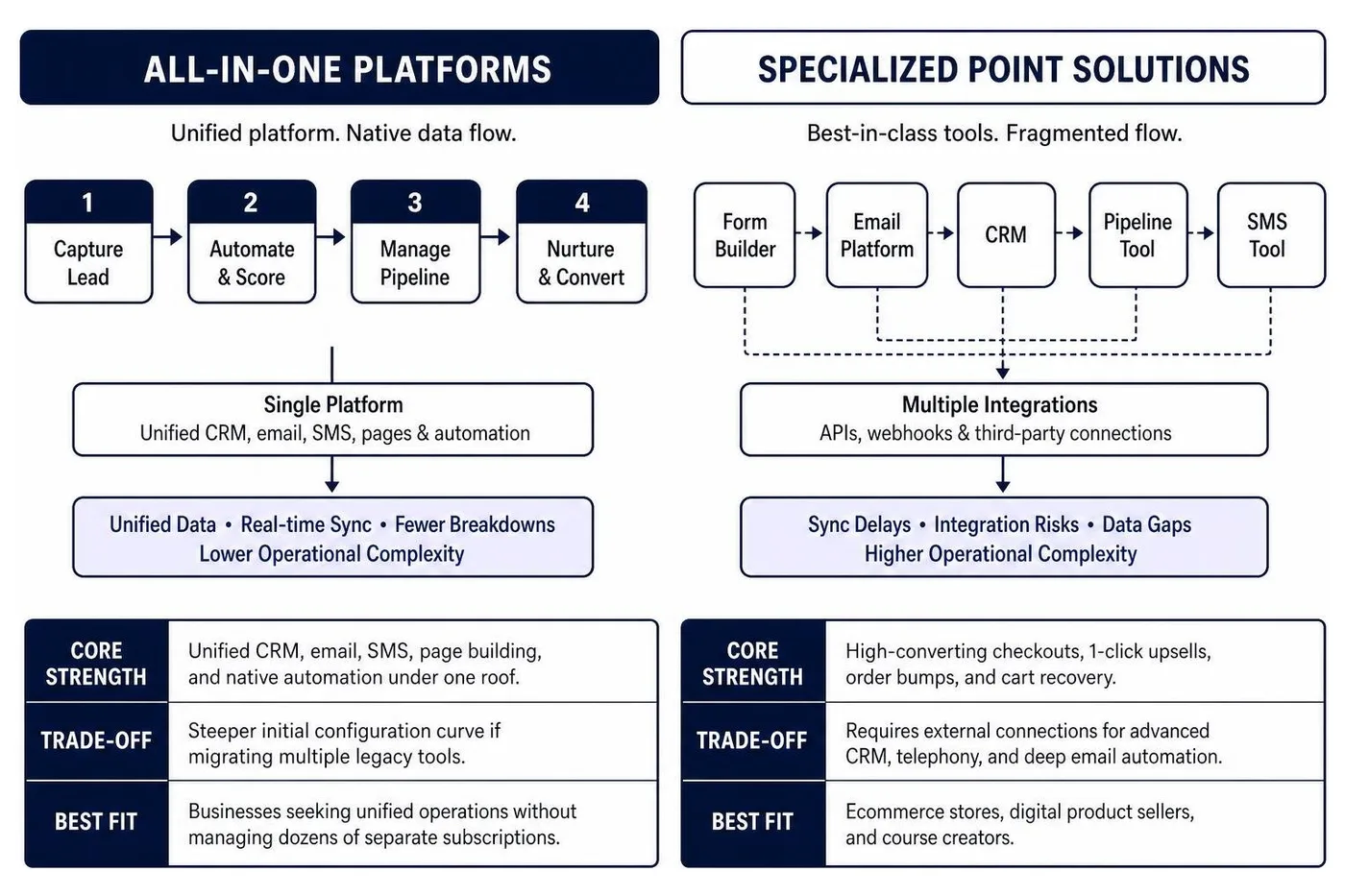
All-in-One vs Specialized Sales Funnel Automation Software
The average modern business utilizes 106 separate SaaS applications. While specialized point solutions excel at specific tasks, running an unintegrated tech stack introduces significant challenges:
Integration Breakdowns: Webhooks fail, API endpoints change, and sync delays cause critical lead data to vanish between capture forms, CRMs, and email platforms.
Subscription Bloat: Stacking distinct software tools for landing pages, email marketing, SMS outreach, call tracking, and billing creates an expensive monthly overhead burden.
Fragmented Reporting: Disconnected databases make tracking customer acquisition costs (CAC), lifetime value (LTV), and multi-touch attribution across channels difficult.
Consolidating your core toolset using marketing automation software for small business eliminates data silos, providing a single source of truth for all customer interactions.
Evaluating Sales Funnel Automation Software by Business Model
Different operational models demand distinct conversion mechanics:
Ecommerce & Digital Products: Requires friction-free single-page checkouts, dynamic order bumps, multi-tiered payment plans, and post-purchase one-click upsells. Adding optimized checkout sequences can increase average order value (AOV) by up to 118%.
Coaching & Course Delivery: Requires gated membership portals, automated content dripping, community access management, and automated failed-payment dunning sequences.
Agencies & B2B Service Providers: Demands multi-channel inbound qualification, native calendar booking, pipeline automation, review management, and sub-account provisioning.
Selecting an automated marketing platform tailored to your operational requirements ensures leads progress smoothly from acquisition to fulfillment.
Subscription SaaS vs Lifetime License Architectures
Software pricing models directly affect long-term profit margins as your audience expands:
Subscriber-Tiered SaaS Models: Many conventional platforms charge based on contact list size or monthly email volume. As your database grows from 2,000 to 50,000 contacts, monthly software costs can jump from double digits to thousands of dollars per month, penalizing top-of-funnel list growth.
Lifetime Licenses & Flat-Rate Architectures: Some specialized cart platforms or open architectures offer flat-rate pricing or lifetime licensing models. While requiring an upfront investment, they provide predictable operational costs without scaling penalties as contact databases expand.
Balancing feature breadth against total cost of ownership is essential when adopting sales automation software saas to ensure software overhead supports healthy margins.
Essential Automation Features That Prevent Lead Drop-Off
Modern automated funnels rely on integrated workflows that systematically capture, nurture, and convert prospects across every channel.
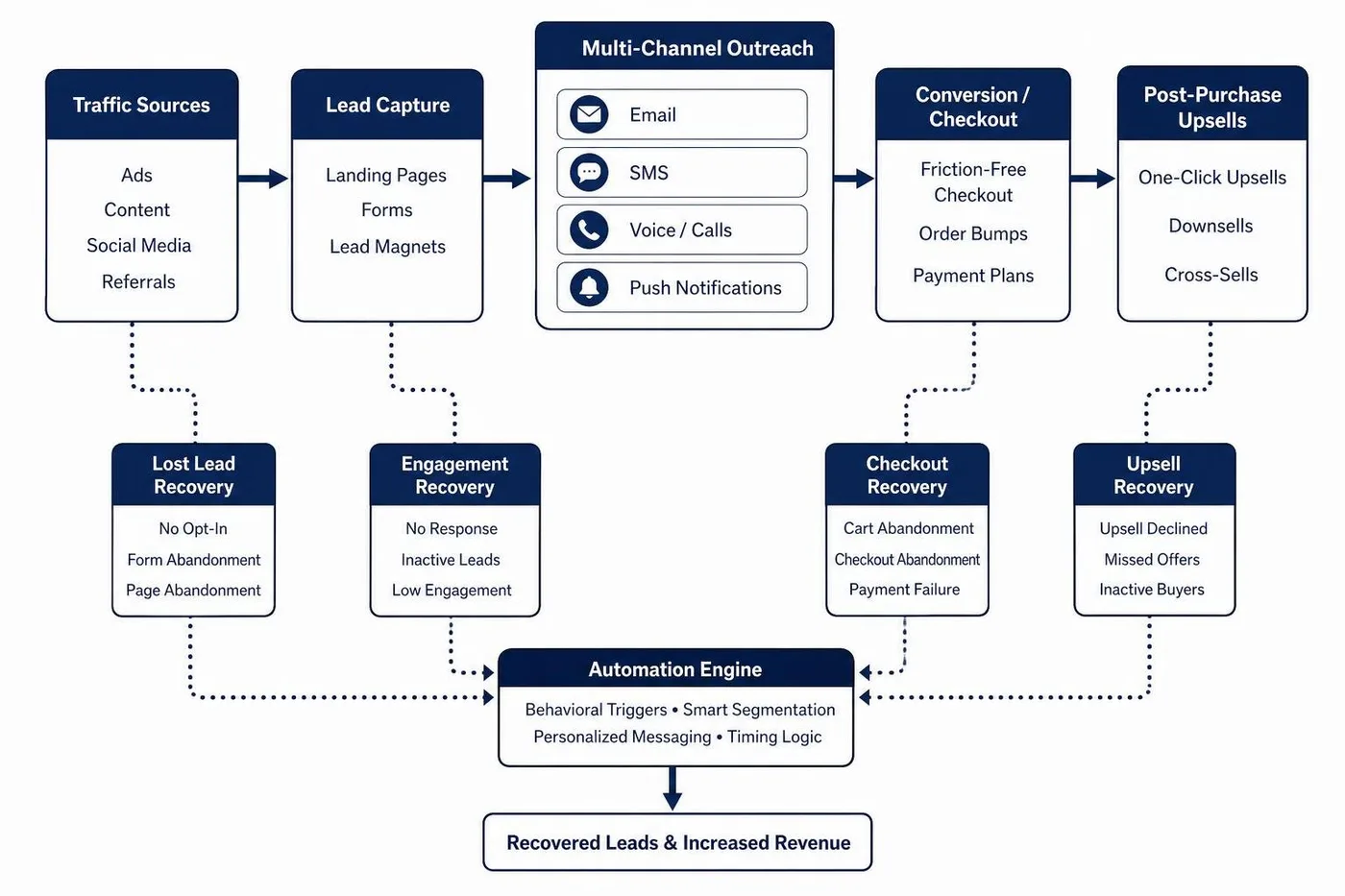
To build a reliable customer acquisition system, leverage this lead generation software complete guide to structure high-converting campaigns from the ground up.
Lead Nurturing, Automated Upsells, and Payment Recovery
Maximizing customer lifetime value requires responsive, behavioral triggers throughout the transaction cycle:
Post-Purchase Upsell Sequences: Present complementary offers immediately after checkout without requiring buyers to re-enter billing details.
Behavior-Based Email Sequences: Deploy automated follow-ups triggered by specific prospect actions—such as clicking a case study link, visiting a pricing page, or abandoning a checkout form. High-performing platforms regularly achieve high inbox placement rates (historically reaching up to 82% inbox placement across major ISPs).
Automated Dunning & Payment Recovery: Automatically retry failed recurring subscriptions, send smart SMS notifications, and update payment details to recover lost recurring revenue.
For businesses looking to avoid the technical learning curve of custom workflow configurations, adopting a professionally designed done for you sales funnel provides pre-optimized conversion sequences out of the box.
AI Routing, Unified Pipelines, and Outbound Orchestration
Sales automation has evolved beyond basic static rules into adaptive, AI-driven infrastructure. Advanced revenue teams now implement automated identity resolution to unify contact data across fragmented channels, enabling instantaneous lead routing and deterministic pipeline assignment.
Simultaneously, modern outbound acceleration systems pre-score prospects against ideal customer profile (ICP) criteria before enrolling them into personalized, multi-step sequences. Connecting these intelligent routing systems with sales automation ai tools and a centralized ai driven sales platform enables businesses to maintain unified data flows across marketing, outbound sales, and customer success teams.
Frequently Asked Questions About Sales Funnel Automation
What is the difference between a funnel builder and funnel automation software?
A basic funnel builder focuses primarily on front-end web page design, providing templates for opt-in pages, sales letters, and simple checkout screens. Funnel automation software provides the underlying operational engine: behavioral triggers, automated email and SMS workflows, lead scoring, telephony routing, two-way CRM data synchronization, and automated revenue recovery.
Are freemium sales funnel automation platforms viable for scaling businesses?
Freemium platforms offer an accessible starting point for early-stage solopreneurs and bootstrapped projects, typically supporting up to 2,000 contacts and basic funnel sequences. However, as an organization scales, freemium options present limitations, including strict contact caps, restricted custom domain usage, stripped-down automation logic, and missing enterprise integrations. Scaling brands eventually migrate to full-featured platforms to support multi-channel operations.
How do integrations impact lead velocity and checkout conversions?
Integrations serve as the connective tissue across your revenue stack. Slow or unreliable webhooks can delay lead delivery to sales reps by hours, significantly reducing close rates. Native, bi-directional API connections ensure immediate lead routing, real-time analytics attribution, and instant payment validation—minimizing drop-offs during checkout and onboarding.
Conclusion: Choosing Your Automated Growth Engine
Choosing the right software comes down to how your business operates:
For digital course creators and product sellers: Prioritize checkout-optimized platforms with built-in one-click upsells, order bumps, and native payment recovery.
For scaling agencies and service businesses: Focus on platforms combining multi-channel CRM capabilities, call tracking, appointment scheduling, and automated lead nurturing.
For growing enterprises: Prioritize agentic data infrastructure, bi-directional synchronization, deterministic routing, and enterprise-grade compliance.
Managing complex tool stacks, writing high-converting copy, configuring APIs, and maintaining automations can pull your team away from running your business. At RewardLion, we eliminate tool fatigue by pairing an AI-powered operating system with our dedicated fractional CAPSS team. We install, manage, and continuously optimize your entire sales funnel, CRM, local growth engine, and omnichannel marketing under one unified roof.
Accelerate revenue growth with the unified operating system and let our expert team deploy a fully connected growth engine for your business today.