Why Every Business Needs a Strong Lead Generation Campaign Plan
A solid lead generation campaign plan is the difference between a pipeline full of qualified prospects and a marketing budget that disappears with nothing to show for it. Yet 61% of marketers say generating quality leads is their single biggest challenge — and most of the time, the problem isn't effort. It's the lack of a structured plan.
Here's a quick overview of what a lead generation campaign plan covers:
Define your goal — Set a specific, measurable target (e.g., 75 MQLs by end of Q3)
Build your ICP — Identify exactly who you're targeting using firmographics and pain points
Create your offer — Choose a lead magnet or content asset that provides real value
Build your campaign engine — Set up landing pages, forms, and CRM tracking
Choose your channels — Decide on the right mix of inbound and outbound tactics
Qualify and score leads — Separate raw leads from MQLs and SQLs
Nurture and follow up — Build automated sequences before driving any traffic
Measure and optimize — Track CPL, conversion rates, and pipeline contribution
A lead generation campaign is not just running ads or publishing blog posts. It's a coordinated system — with a specific audience, a compelling offer, and a follow-up process that moves prospects toward a buying decision.
Without that system, you risk what one RevOps team experienced: generating over 400 MQLs that marketing celebrated, while sales called them worthless — with only 14 ever converting. The issue wasn't the traffic. It was the missing infrastructure behind it.
I'm Mike Ibrahim, Founder and CEO of RewardLion and Marketing Director for several other companies, with over a decade of hands-on experience building and optimizing lead generation campaign plans across diverse industries. In this guide, I'll walk you through a proven, step-by-step framework to build a campaign that generates qualified leads — not just volume.
What is a Lead Generation Campaign?
To understand how to build a successful lead generation campaign plan, we first need to define what a campaign actually is—and, more importantly, what it is not.
A lead generation campaign is a time-bound, coordinated marketing initiative designed to capture contact information from a specific target audience. It differs fundamentally from general prospecting or broad demand generation.
To keep our systems organized, we use a clear lead taxonomy:
Raw Lead: A contact who has provided basic information (like an email address) but hasn't been vetted for fit or intent.
Marketing Qualified Lead (MQL): A lead who meets your basic demographic criteria and has engaged with your marketing materials (e.g., downloaded a whitepaper or attended a webinar).
Sales Qualified Lead (SQL): A lead vetted by marketing or business development that displays high purchase intent and is ready for a direct sales conversation.
Product Qualified Lead (PQL): A lead who has experienced value through a free trial or freemium version of your software.
How does this differ from demand generation? Think of demand generation as the upstream work. It is an audience-building play focused on creating awareness, establishing authority, and building trust in your market. On the flip side, lead generation is the conversion layer. It focuses on forms, sequences, landing pages, and capturing contact info.
In 2026, the B2B buyer’s journey is increasingly complex. Buyers self-educate across multiple channels, often remaining anonymous until late in the process. In fact, roughly 95% of website traffic never converts on a form. This is why a strategic conversion layer is so critical. For a deeper dive into how these systems function, you can Learn more about modern B2B lead generation or read Lead Generation in 2026: The Complete B2B Playbook.
Phase 1: Building the Strategic Foundation for Your Lead Generation Campaign Plan
Before you build a single landing page or write a line of ad copy, you must lay a strategic foundation. Many campaigns underperform because they launch directly into tactics without defining who they are targeting or what success looks like.
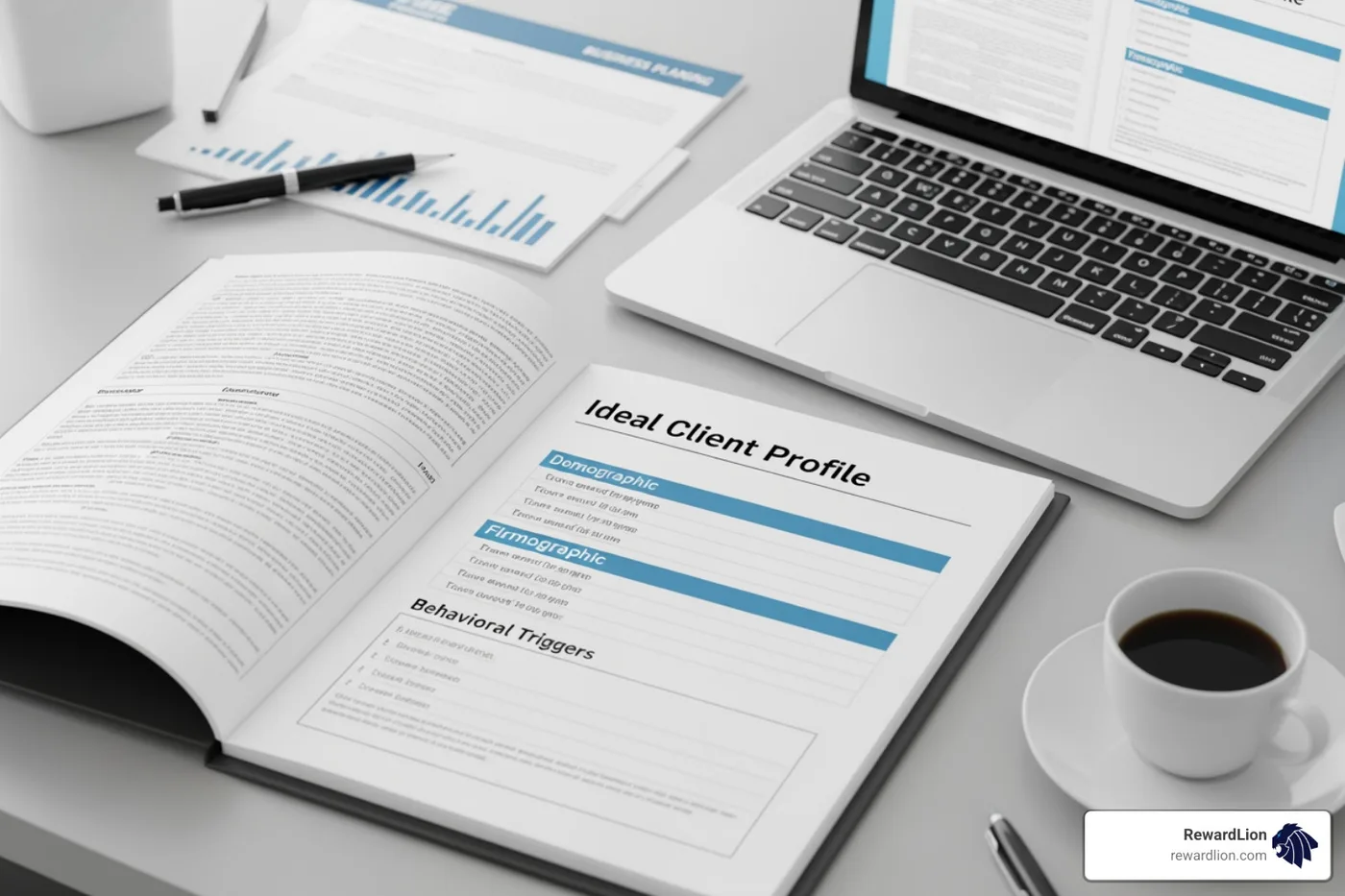
1. Document Your Ideal Client Profile (ICP)
Your ICP is a detailed profile of the perfect company you want to sell to, including firmographics (industry, company size, revenue), geographic location, and specific buying triggers.
Targeting a broad audience is a recipe for wasted budget. In fact, campaigns with a clearly documented ICP generate 68% more qualified leads than those targeting a broad audience. Once you define the target accounts, map out your buyer personas—the specific decision-makers within those companies (e.g., CFOs, VPs of HR) and the exact business challenges they face.
2. Set SMART Goals and Target Metrics
To measure success, you must set specific, measurable, achievable, relevant, and time-bound (SMART) goals. Avoid vague goals like "we want more leads." Instead, use a precise formula:
$$\text{[Metric]} \text{ of } \text{[Number]} \text{ by } \text{[Date]}$$
For example: Generate 75 Marketing Qualified Leads (MQLs) from the healthcare technology sector by September 30, 2026.
To ensure your campaign is profitable, work backward from your revenue goals to calculate your targets. Let's look at a concrete mathematical example:
Target New Revenue (ARR): $100,000
Average Deal Size: $10,000
$$\text{Deals Needed} = \frac{\$100,000}{\$10,000} = 10 \text{ closed-won deals}$$Sales Win Rate (SQL to Close): 20%
$$\text{SQLs Required} = \frac{10}{0.20} = 50 \text{ SQLs}$$MQL-to-SQL Conversion Rate: 25%
$$\text{MQLs Required} = \frac{50}{0.25} = 200 \text{ MQLs}$$
By mapping out these metrics before launch, you can align your budget and expectations with reality. To explore more about setting up these foundational structures, you can Discover how to run a successful campaign or review How to Run a Successful Lead Generation Campaign.
Phase 2: Designing the Campaign Engine and the 4 L's
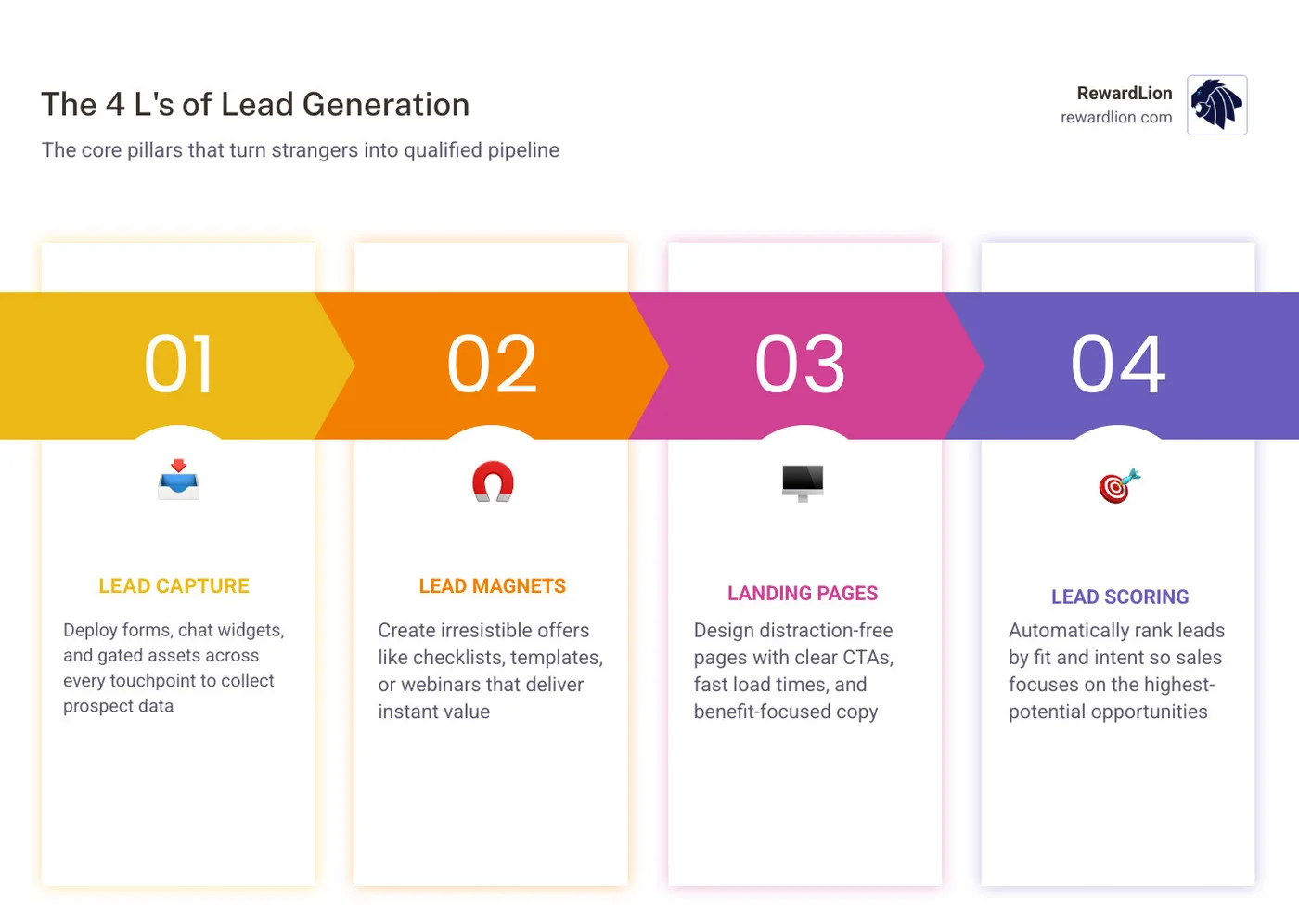
With your strategy in place, you can build your campaign engine. We structure this phase around a highly effective framework known as the 4 L's of Lead Generation:
Lead Capture: The mechanism (like a form or chat widget) used to collect user information.
Lead Magnets: The valuable asset offered in exchange for that information.
Landing Pages: The dedicated, distraction-free page where the conversion happens.
Lead Scoring: The methodology used to rank leads based on their engagement and fit.
Setting up these elements correctly ensures that you capture high-intent data without introducing unnecessary friction into the buyer's journey. To learn more about selecting the right tools for this setup, Explore our lead capture software guide.
Crafting Compelling Offers for Your Lead Generation Campaign Plan
Your offer is the heart of your lead generation campaign plan. If your offer is weak, no amount of ad spend or beautiful design will save your campaign.
In B2B, a generic "Book a Demo" button is rarely enough for cold prospects. Instead, align your offers with the buyer's stage of awareness:
Top of Funnel (Awareness): Educational resources, industry benchmark reports, or diagnostic tools.
Middle of Funnel (Consideration): Deep-dive guides, templates, webinars, or case study collections.
Bottom of Funnel (Decision): Free audits, product trials, custom assessments, or live demonstrations.
Your offer must provide genuine value and showcase your unique expertise. To explore how to deploy and manage these offers across your digital ecosystem, Read about lead gen software and check out How to Create a Lead Generation Campaign That Converts | Sales Mastery.
Building High-Converting Landing Pages
A landing page has one job: convince the visitor to take a single, specific action.
To maximize your conversion rates, follow these landing page best practices:
Remove Navigation: Eliminate main menus, footers, and external links that could distract the visitor.
Write a Clear Headline: Match the headline exactly to the ad or link copy that brought the user to the page.
Focus on Benefits: Use bullet points to highlight what the visitor will get, rather than listing technical features.
Keep Forms Short: Only ask for the information you absolutely need to qualify the lead (e.g., Name, Work Email, Company Name).
Make it Mobile-Friendly: Ensure fast loading speeds and a seamless experience across all device types.
By implementing strict conversion rate optimization (CRO) principles, you can significantly lower your customer acquisition costs. For a comprehensive look at the tools that power these pages, Check out our lead generation software complete guide.
Phase 3: Executing an Omnichannel Distribution Strategy
Relying on a single marketing channel is a risky approach. If that channel's costs rise or its algorithm changes, your pipeline can dry up overnight. A high-performing lead generation campaign plan combines multiple inbound and outbound channels to build a stable pipeline.
The Power of Inbound and Outbound Synergy
Inbound marketing (SEO, content marketing, organic social) is highly cost-effective and builds long-term brand equity, but it takes time to scale. Outbound marketing (paid ads, targeted email, direct outreach) provides immediate feedback and rapid lead flow.
Combining both creates a powerful compounding effect:
LinkedIn Ads: LinkedIn is the gold standard for B2B lead generation. In fact, 89% of B2B marketers use LinkedIn for lead generation, and 62% say it generates leads—over two times more than the next-highest social channel.
Intent Data Integration: Modern B2B buyer journeys involve 3.1 to 4.6 stakeholder groups. By utilizing intent data tools, you can identify accounts actively searching for your solution and target decision-makers across those departments. Companies using intent-driven strategies see conversion rates 78% higher than static lists.
Localized Targeting: If you target specific geographic areas—such as Miami, FL, Fort Lauderdale, FL, or Boca Raton, FL—you can combine localized paid ads with local SEO to dominate regional search results.
To understand how to map these channels to your broader business objectives, Learn how to build a B2B demand generation plan and review How to Build a B2B Demand Generation Plan in 2026.
If you are looking for localized expertise or regional execution in Florida, you can also explore professional networks like Hire Top Lead Generation Professionals in Boca Raton, FL LinkedIn or check out the Best Lead Generation Companies in Florida 2026 | Semrush.
Phase 4: Lead Qualification, CRM Integration, and Automation
Capturing a lead is only the first step. If your sales team doesn't follow up quickly, your campaign spend is wasted. This is where lead qualification, CRM integration, and automated marketing workflows come into play.
To prevent friction between marketing and sales, establish a clear Service Level Agreement (SLA) defining exactly when a lead transitions from marketing to sales:
Criteria Marketing Qualified Lead (MQL) Sales Qualified Lead (SQL) Demographics Fits basic industry and company size targets. Fits exact ICP; key decision-maker. Behavioral Signals Downloaded a guide or attended a webinar. Requested a demo or pricing information. Buying Intent Researching solutions; low immediate intent. Active project budget and timeline in place. Sales Readiness Needs automated nurturing. Ready for a direct discovery call.
To manage this process efficiently, we recommend syncing your lead capture systems with a robust CRM. For a detailed breakdown of how to automate these workflows, Read our lead automation software guide and explore our lead generation app complete guide.
Optimizing Your Lead Generation Campaign Plan with Analytics
Once your campaign is live, you must measure, optimize, and iterate based on real-world data.
Key performance indicators (KPIs) to track include:
Cost Per Lead (CPL): Total campaign spend divided by the number of leads generated.
MQL-to-SQL Conversion Rate: The percentage of marketing leads that progress to sales-ready opportunities.
Ad Platform Learning Phase: Platforms like Meta require at least 50 conversion events within a 7-day window to exit the learning phase and stabilize your CPL.
Conversion Event Optimization: Campaigns optimized against validated conversion events at the ad set level produce 25–40% lower CPL than click-optimized campaigns.
By continuously analyzing these metrics, you can scale high-performing channels and pause underperforming ones before wasting your budget. To dive deeper into campaign metrics and data tracking, Explore our lead generation analytics guide.
Frequently Asked Questions about Lead Generation Campaign Plans
What is the difference between lead generation and demand generation?
Demand generation is focused on creating awareness, interest, and trust in your market (the "upstream" brand play). Lead generation is the conversion layer focused on capturing contact details through landing pages, forms, and targeted campaigns (the "downstream" pipeline play).
Why do most lead generation campaigns fail?
Most campaigns fail due to structural issues rather than creative ones. Common pitfalls include targeting too broadly without a documented ICP, relying on a single marketing channel, using weak or purely promotional offers, and failing to build an automated follow-up sequence before driving traffic.
How do you calculate target cost per lead (CPL)?
To calculate your target CPL, work backward from your revenue goals. Divide your total campaign budget by the number of leads required to meet your sales targets (based on your historical conversion rates from lead to opportunity to closed-won deal).
Conclusion
Building a high-performing lead generation campaign plan requires aligning your goals, audience, offers, and automation systems into a single, cohesive engine. When done correctly, this system delivers a predictable, scalable stream of qualified opportunities to your sales team.
At RewardLion, we help businesses eliminate the headache of managing disconnected tools and multiple agencies. We install one fully connected growth system—powered by AI, executed by experts, and optimized continuously.
Our hybrid SaaS platform and dedicated expert team handle everything from high-converting landing pages and sales funnels to CRM automation, paid advertising, and advanced analytics.
Ready to build a predictable pipeline and accelerate your business growth? Get started with RewardLion's growth platform today.