Marketing Metrics Small Business Owners Should Actually Track

The marketing metrics small business owners should track are the ones tied directly to leads, customers, and revenue — not likes, impressions, or followers. That means watching numbers across the full funnel: how visible you are locally, how well your website or landing pages convert visitors, how fast your team follows up on leads, your reputation online, and how much a customer is actually worth over time. This guide breaks down each one and why it matters.
In this guide you'll find:
- The difference between vanity metrics and revenue metrics
- The key numbers for each funnel stage: visibility, conversion, follow-up, reputation and retention
- Plain-language formulas for CPL, CAC, ROAS and LTV
- A weekly and monthly dashboard you can copy
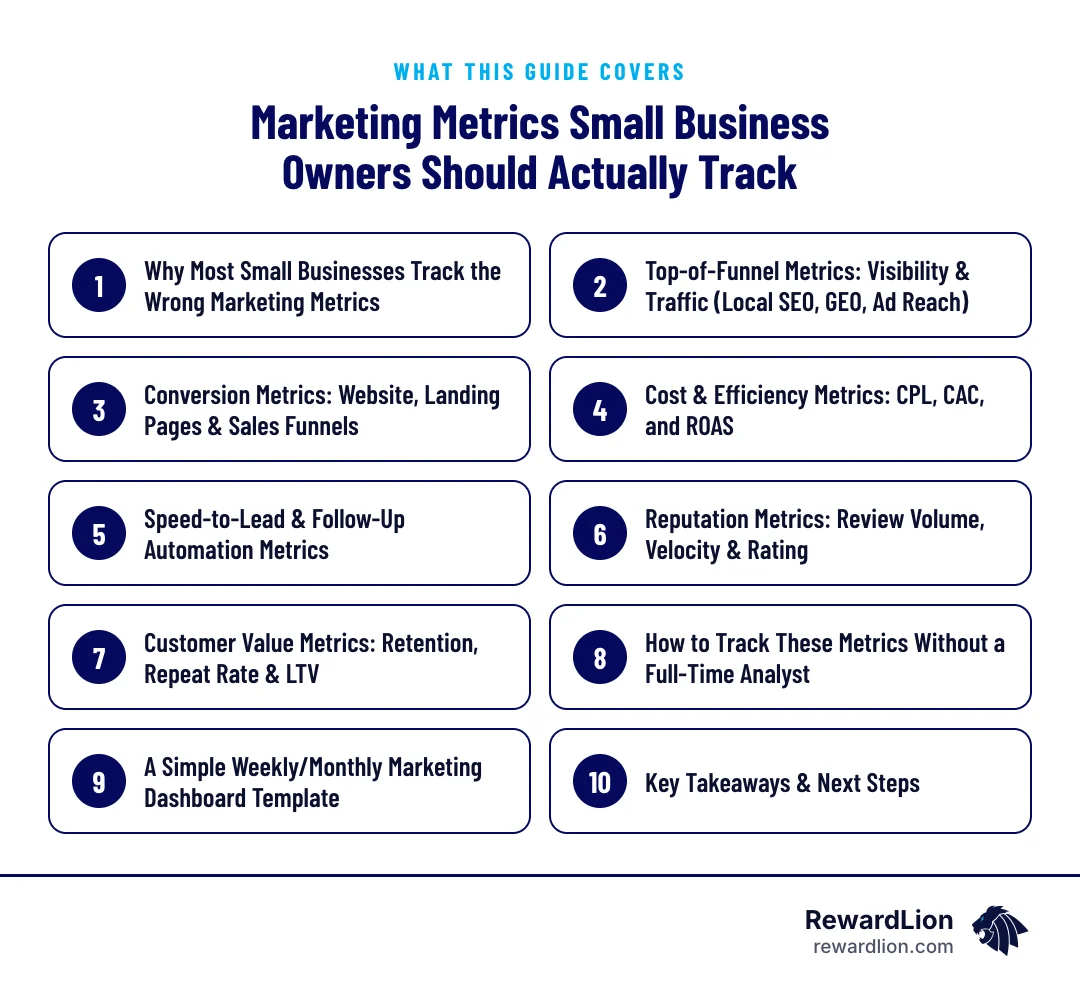
Why Most Small Businesses Track the Wrong Marketing Metrics
The vanity metric trap
It's easy to open a social media dashboard and feel good about rising follower counts or post engagement. But none of that tells you whether your business made money this month.
Vanity metrics measure attention. Revenue metrics measure outcomes. A small business with limited time and budget needs to focus on the second kind — numbers that point to a specific decision, like "should I increase ad spend" or "is my website losing leads before they ever call."
Here is how the two kinds compare in everyday terms:
| Vanity metric (attention) | Revenue metric (outcome) | The decision it supports |
|---|---|---|
| Followers and likes | Leads from social posts and ads | Keep, change or stop a channel |
| Page views | Website conversion rate | Fix the page or the offer |
| Ad impressions | Cost per lead and cost per customer | Raise, lower or move ad budget |
| Total reviews ever | New reviews in the last few months | How hard to push review requests |
| Email list size | Bookings from email campaigns | Whether email deserves more effort |
Organize metrics by funnel stage
The fix isn't tracking more metrics. It's tracking the right ones, organized by stage of the funnel: visibility, conversion, follow-up, and retention.
Top-of-Funnel Metrics: Visibility & Traffic (Local SEO, GEO, Ad Reach)
For most local and service businesses, visibility starts with local search, not generic website traffic. Metrics worth watching here include:
- Google Business Profile views, calls, and direction requests — these show how often people in your area are finding and acting on your listing.
- Map-pack rankings for your key services and city — where you show up matters more than how many total visitors land on your site.
- Ad reach and impressions from Google, Facebook, or Instagram campaigns — useful as a baseline, but only valuable when paired with conversion data further down the funnel.
Top-of-funnel numbers tell you if people can find you. They don't tell you if they become customers — that's the next stage.
Where to find these numbers
- Google Business Profile performance shows profile views, calls, website clicks and direction requests
- Your ad accounts show reach, impressions and clicks for each campaign
- Website analytics show where visitors came from and which pages they landed on
If your map-pack visibility is the weak spot, our local SEO service focuses on exactly that stage.
Conversion Metrics: Website, Landing Pages & Sales Funnels
Website and landing page conversion rate
Once someone finds you, the next question is: do they take action? Website and landing page conversion rate — the percentage of visitors who call, book an appointment, or fill out a form — is one of the most important numbers a small business can track.
If your site gets plenty of traffic but few conversions, the problem usually isn't visibility. It's the page itself: unclear offer, slow load time, missing phone number, or a form that's too long.
A quick conversion check you can run on any page:
- Read the headline — does a first-time visitor know what you offer and where?
- Look for the phone number and booking button without scrolling on a phone.
- Count the form fields and remove any you don't need before the first conversation.
- Load the page on a mobile connection and note anything slow.
- Submit a test form and make sure the lead actually arrives where your team will see it.
Pages built for one action, like a dedicated landing page, usually make this check easier to pass.
Funnel drop-off points
Also worth tracking: funnel drop-off points. If someone starts filling out a form but doesn't submit it, or starts a call but hangs up, that's a specific leak you can fix — often more valuable to know than overall traffic volume.
Cost & Efficiency Metrics: CPL, CAC, and ROAS
These three metrics answer the question every owner eventually asks: is this marketing spend worth it?
The formulas at a glance
| Metric | How to calculate it | What it tells you |
|---|---|---|
| Cost Per Lead (CPL) | Marketing spend ÷ number of leads | How efficiently a channel produces inquiries |
| Customer Acquisition Cost (CAC) | Marketing and sales spend ÷ new customers | What it really costs to win a customer |
| Return on Ad Spend (ROAS) | Revenue from ads ÷ ad spend | Whether a campaign earns back what it costs |
| Customer Lifetime Value (LTV) | Total revenue a customer brings over the relationship | How much you can afford to spend to win one |
- Cost Per Lead (CPL) — total spend divided by number of leads generated. Track this separately from CAC so you can see where money is being lost between generating a lead and closing it.
- Customer Acquisition Cost (CAC) — total marketing and sales spend divided by number of new customers. This tells you whether your ad spend on Google, Facebook, or Instagram is actually profitable, not just generating activity.
- Return on Ad Spend (ROAS) and Return on Investment (ROI) — the north star metrics for paid campaigns. These translate clicks and impressions into dollars earned versus dollars spent.
Reading CPL and CAC together
If CPL is reasonable but CAC is high, the problem is likely in your sales process, not your ads. These two numbers together point you to where to focus.
To calculate these by channel, every lead needs a source attached — Google, Facebook, referral, website form and so on. That's one reason paid advertising campaigns should always send leads into a system that records where each one came from.
Speed-to-Lead & Follow-Up Automation Metrics
Why response time matters
How fast your business responds to a new inquiry is one of the highest-leverage metrics you can track. Response time has a well-documented relationship with close rates — the faster you follow up, the more likely a lead turns into a customer.
Track:
- Average time to first response (call, text, or email)
- Percentage of leads contacted within your target window (for example, within minutes rather than the next day)
- Follow-up sequence completion rate for leads that aren't reached on the first attempt
Where automation helps
This is also where automation tools matter. A lead that falls through the cracks because no one followed up is a lost sale that never shows up in your CRM as a "no."
Practical ways to improve these numbers:
- Send an instant confirmation by text or email the moment a form comes in, using tools like SMS automation
- Route every lead to one inbox so nothing sits unseen in a personal email account
- Set a follow-up sequence for leads you can't reach on the first try
- Review missed leads weekly and note why each one slipped
Our marketing automation setups are built around these steps.
Reputation Metrics: Review Volume, Velocity & Rating
What to track
Reviews aren't just social proof — they're a ranking and conversion signal. Track:
- Review volume — total number of reviews across platforms
- Average rating
- Review velocity — how recently and how consistently new reviews come in
Why recency matters
A steady stream of recent reviews signals to both search engines and potential customers that your business is active and trustworthy. A business with a large pile of reviews from years ago sends a weaker signal than one with fewer reviews, several from the last month.
The easiest way to keep review velocity steady is to ask every happy customer at the same point in every job — for example, right after the work is finished — rather than in occasional bursts. A reputation management process makes that ask automatic.
Customer Value Metrics: Retention, Repeat Rate & LTV
Lifetime value
Acquiring a customer is only half the equation. Customer Lifetime Value (LTV) — the total revenue a customer generates over the course of their relationship with you — helps you decide how much you can profitably spend to acquire a new one.
The LTV to CAC relationship
Look at LTV alongside CAC. A healthy LTV:CAC ratio tells you your acquisition spend is sustainable. If CAC is climbing but LTV is flat, you're spending more to get less.
Repeat and rebooking rate
Also track repeat purchase or rebooking rate — for service businesses, a strong repeat rate often matters more than constantly chasing new leads.
Simple ways to lift repeat business include reminder messages when a service is due again, a short check-in after each job, and an easy way to rebook online.
Digital Business Card & Referral Metrics
If you use a digital business card for networking or referrals, engagement metrics — views, saves, shares, and click-throughs to booking — can serve as an early indicator of referral-driven lead flow, especially for service businesses that rely on word of mouth.
How to Track These Metrics Without a Full-Time Analyst
Most small businesses don't need a data team. What they need is a centralized view — one dashboard pulling data from your website, ad accounts, and CRM, rather than logging into five separate tools every week.
A four-step setup
- Pick your sources — website analytics, Google Business Profile, ad accounts and your CRM.
- Tag every lead with its source so you can compare channels fairly.
- Put the key numbers in one view, whether that's a dashboard or a shared spreadsheet.
- Set a fixed review time each week and each month, and write down one decision each time.
A well-organized CRM setup handles the second step for you, and our guide to lead generation analytics goes deeper on tracking sources.
A simple, centralized analytics setup is far more useful to a busy owner than scattered reports that never get looked at.
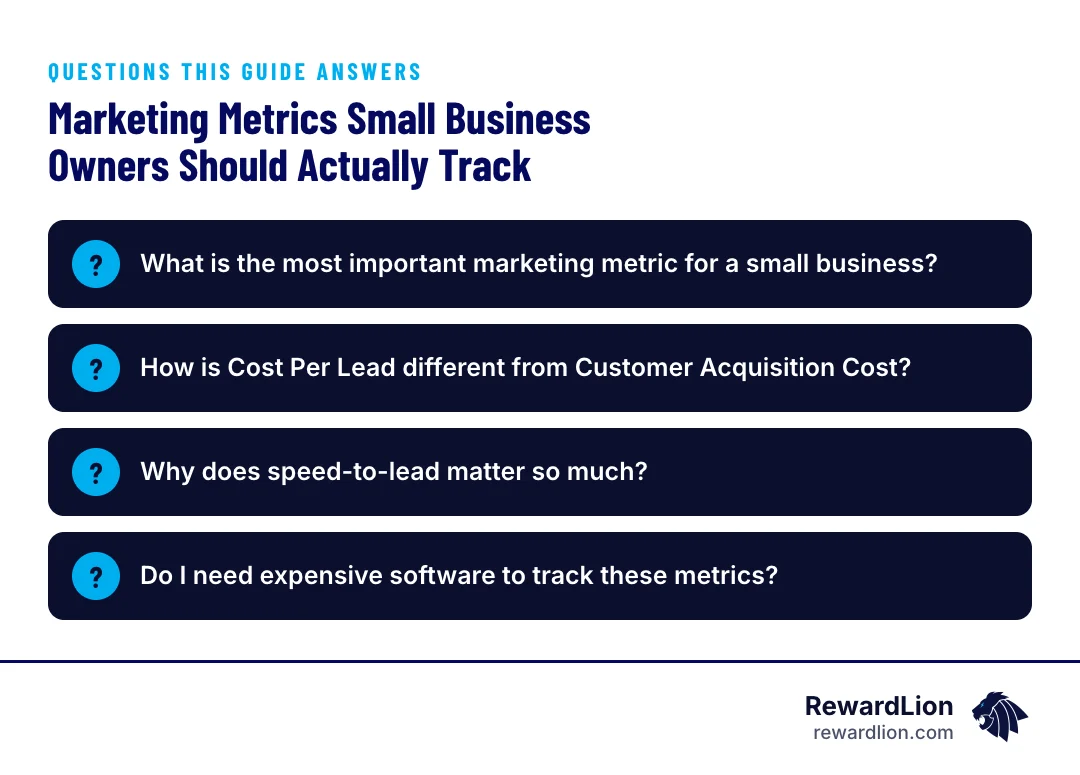
Quick answers from this guide
| Question | Short answer |
|---|---|
| What is the most important marketing metric for a small business? | There isn't one single metric that matters most for every business — it depends on your current bottleneck. |
| How is Cost Per Lead different from Customer Acquisition Cost? | CPL measures how much you spend to generate a single lead. CAC measures how much you spend, in total, to turn a lead into a paying customer. |
| Why does speed-to-lead matter so much? | How quickly you respond to a new inquiry has a well-documented relationship with whether that inquiry turns into a sale. |
| Do I need expensive software to track these metrics? | No. What matters more than the tool is consistency — pulling data from your website, ad platforms, and CRM into one place you actually check regularly, even if that's a simple spreadsheet or a basic dashboard. |
A Simple Weekly/Monthly Marketing Dashboard Template
Check weekly:
- New leads generated
- Average speed-to-lead
- New reviews received
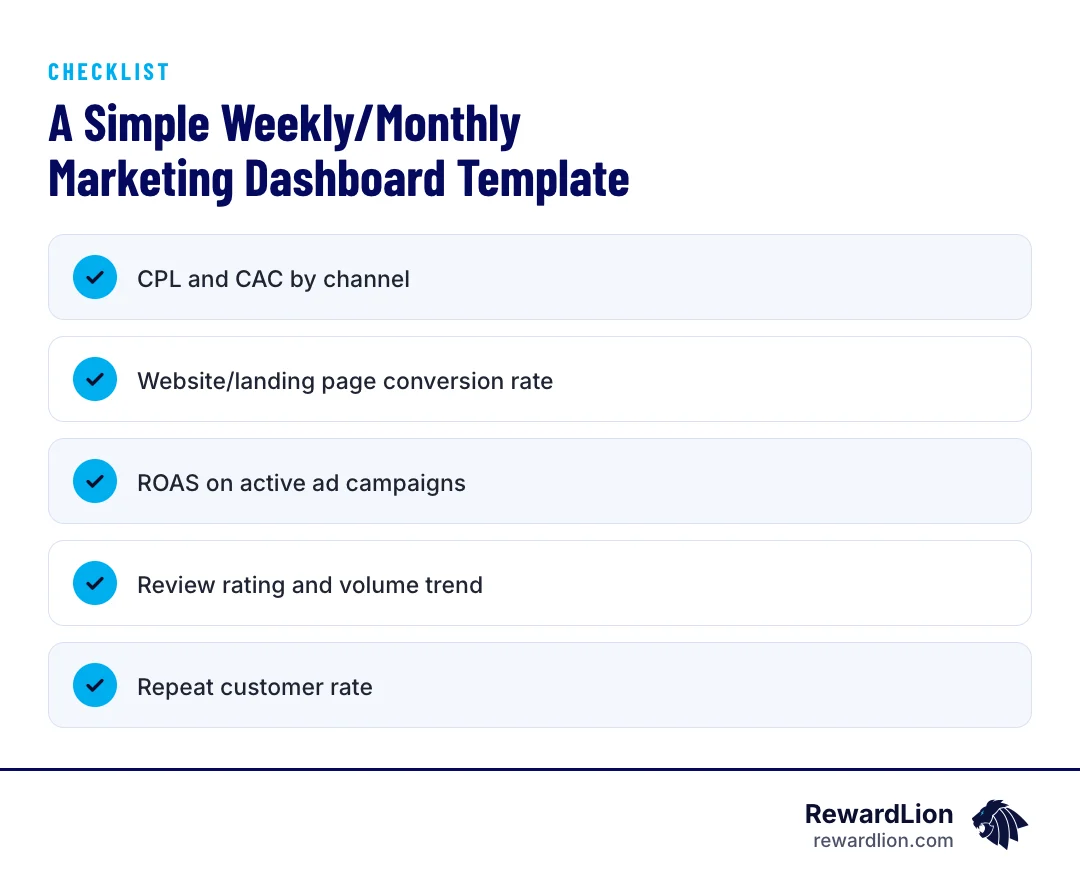
Check monthly:
- CPL and CAC by channel
- Website/landing page conversion rate
- ROAS on active ad campaigns
- Review rating and volume trend
- Repeat customer rate
You don't need every metric from this article tracked daily. Pick the handful that map to your current biggest bottleneck — visibility, conversion, follow-up, or retention — and start there.
How to use the dashboard
- Weekly, look for problems you can fix right away: a drop in leads, slower responses, no new reviews.
- Monthly, look at trends and spend: which channel's CPL and CAC improved, and which got worse.
- Each time, write down one action you'll take before the next check.
Key Takeaways & Next Steps
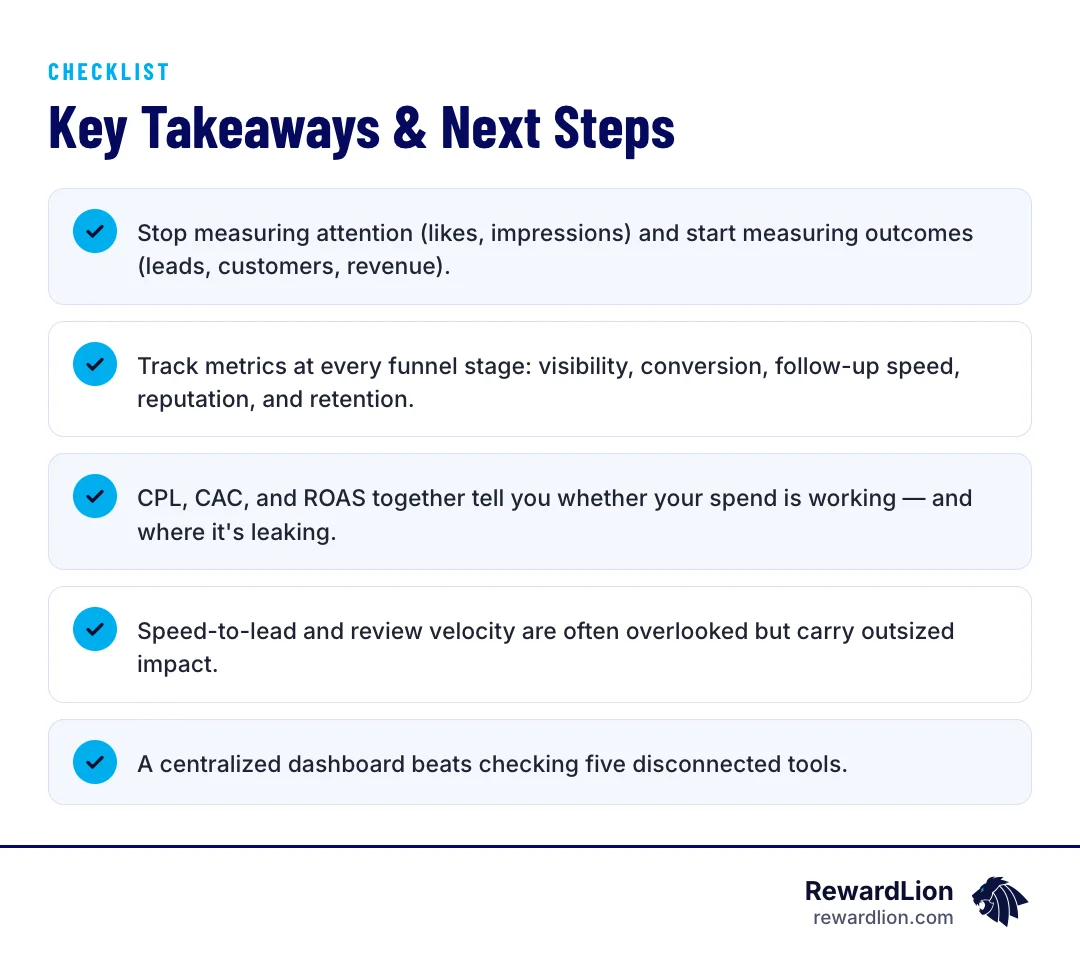
- Stop measuring attention (likes, impressions) and start measuring outcomes (leads, customers, revenue).
- Track metrics at every funnel stage: visibility, conversion, follow-up speed, reputation, and retention.
- CPL, CAC, and ROAS together tell you whether your spend is working — and where it's leaking.
- Speed-to-lead and review velocity are often overlooked but carry outsized impact.
- A centralized dashboard beats checking five disconnected tools.
If you want help setting up tracking across your website, ads, local SEO, and lead follow-up in one place, RewardLion works with local and service businesses to connect these pieces so the numbers actually drive decisions.
Ready to see your numbers in one place? Contact our team and we'll walk through what you're tracking today.
Related reading
- The Beginner Field Guide to Digital Marketing Analytics
- A Practical Guide to Sales and Marketing Analytics
- How to Build a Unified Data Analytics Engine for Sales and Marketing
- RewardLion RewardLion CRM
FAQ
What is the most important marketing metric for a small business?
There isn't one single metric that matters most for every business — it depends on your current bottleneck. If you're not getting enough leads, visibility metrics matter most. If you get leads but few customers, conversion rate and speed-to-lead matter more.
How is Cost Per Lead different from Customer Acquisition Cost?
CPL measures how much you spend to generate a single lead. CAC measures how much you spend, in total, to turn a lead into a paying customer. Tracking both separately helps you see whether a problem is in lead generation or in closing.
Why does speed-to-lead matter so much?
How quickly you respond to a new inquiry has a well-documented relationship with whether that inquiry turns into a sale. A slow follow-up process can undo the value of an otherwise strong marketing campaign.
Do I need expensive software to track these metrics?
No. What matters more than the tool is consistency — pulling data from your website, ad platforms, and CRM into one place you actually check regularly, even if that's a simple spreadsheet or a basic dashboard.