Digital Marketing Analytics Definition: What It Is and How It Works
When we examine the standard digital marketing analytics definition, we find that it goes far beyond taking a weekly glance at website pageviews. At its core, digital marketing analytics is the continuous process of ingesting, unifying, and interpreting customer touchpoints across all online properties. It transforms raw numbers into actionable business intelligence, allowing teams to see how ad spend, content distribution, and email sequences directly drive commercial pipeline.
Instead of evaluating each channel in a disconnected vacuum, modern analytics brings these touchpoints together. By examining customer behavioral journeys from the first click on an organic search result to an automated email sequence and a final checkout, we gain a clear view of our entire sales funnel. Unifying data analytics for sales and marketing ensures that commercial teams share one single source of truth rather than arguing over conflicting spreadsheets.
Core Components of the Digital Marketing Analytics Definition
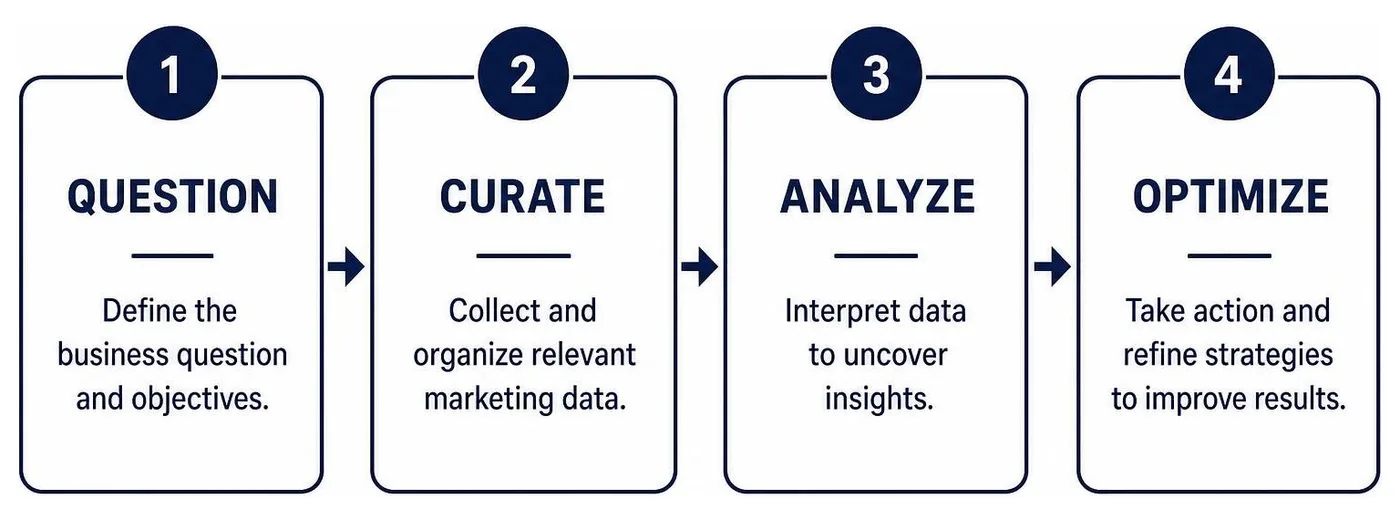
A practical framework for marketing analytics breaks down into four sequential stages:
Data Ingestion: Capturing raw events, user interactions, UTM parameters, and transactional data across web properties, ad platforms, and applications.
Metric Curation: Filtering out operational noise to organize data around concrete performance indicators.
Insight Interpretation: Applying statistical and behavioral modeling to understand why specific patterns, drops, or spikes occurred.
Tactical Optimization: Reallocating budget, adjusting ad creative, or refining customer onboarding based on empirical evidence.
Academic institutions such as the Bryan School of Business and Economics highlight this systematic flow in their UNCG research on digital marketing analytics frameworks. Their structured decision loop—question, curate, analyze, and optimize—reinforces that data collection without execution creates zero business value. Every step in this cycle must inform strategic decisions, ensuring that marketing experiments are grounded in reliable data rather than subjective speculation.
How the Digital Marketing Analytics Definition Differs from Web Analytics
A common source of confusion for growing businesses is mixing up web analytics with comprehensive digital marketing analytics:
Web Analytics: Focuses specifically on on-site user behavior. It tracks session duration, bounce rates, page scroll depth, navigation paths, and technical site performance.
Digital Marketing Analytics: Encompasses the broader commercial ecosystem. It integrates search engine marketing, paid social ads, programmatic media, offline transactions, CRM pipelines, and revenue attribution.
While web analytics tells you how users navigate a specific landing page, digital marketing analytics tells you which ad campaign brought high-intent prospects who eventually closed three months later. Bridging this gap is critical when using analytics to align sales and marketing teams, ensuring that marketing efforts are held accountable to actual revenue generation rather than isolated website sessions.
The Four Core Types of Marketing Analytics
To extract meaningful value from your data stack, you must apply different analytical lenses depending on the business question you need to solve. These fall into four distinct categories:
1. Descriptive Analytics
Descriptive analytics forms the foundation of historical reporting. It compiles historical data to illustrate baseline performance over a chosen timeframe. For example, reviewing how many leads your paid campaigns generated last month is a descriptive exercise.
2. Diagnostic Analytics
When performance deviates from the norm, diagnostic analytics uncovers the root cause. If checkout conversions suddenly plunge by 30%, a diagnostic deep-dive analyzes browser types, payment gateway errors, or form friction to explain the anomaly.
3. Predictive Analytics
By training machine learning models on historical customer records, predictive analytics projects future behavior. It calculates lead conversion probabilities, forecasts seasonal demand, and flags customer accounts showing early signs of churn.
4. Prescriptive Analytics
The most advanced stage, prescriptive analytics suggests specific actions to capture opportunities or mitigate risks. Modern AI systems use prescriptive models to automatically adjust bidding strategies across ad platforms when search interest surges in specific zip codes.
Comparing the Four Analytics Types
Analytics Type | Core Question Addressed | Typical Methodology | Primary Business Benefit |
|---|---|---|---|
Descriptive | What happened? | Historical aggregation & reporting | Performance baselines & milestone tracking |
Diagnostic | Why did it happen? | Anomaly detection & drill-down querying | Root-cause discovery & leak prevention |
Predictive | What is likely to happen? | Machine learning & regression models | Proactive forecasting & churn mitigation |
Prescriptive | What action should we take? | Algorithmic rules & automated decisioning | Continuous optimization & dynamic resource allocation |
Key Metrics: Actionable Data vs. Vanity Metrics
One of the quickest ways marketing budgets get wasted is by chasing metrics that look impressive on paper but do not generate revenue.

Tracking Metrics That Impact the Bottom Line
Sustainable business growth relies on metrics tied directly to financial return:
Customer Acquisition Cost (CAC): Total sales and marketing spend divided by the number of new customers acquired during a given period. Maintaining an optimal CAC-to-LTV ratio (ideally 1:3 or better) ensures profitable growth.
Customer Lifetime Value (LTV): The net revenue a customer generates over the entire span of their relationship with your business.
Return on Ad Spend (ROAS): Gross revenue generated directly per dollar invested in advertising campaigns.
Pipeline Velocity: The speed at which qualified opportunities move through your sales stages into closed revenue.
Payback Period: The exact number of months required for a newly acquired customer to generate enough gross margin to repay their initial acquisition cost.
Building scalable lead generation systems requires monitoring these economics continuously to ensure customer acquisition remains profitable as campaign spend scales.
Avoiding Vanity Traps in Campaign Reporting
Vanity metrics offer superficial validation without indicating true business health:
Ad Impressions vs. Qualified Pipeline: Generating 500,000 ad impressions is meaningless if none of those viewers match your ideal buyer profile.
Social Likes vs. Retention Rates: Viral social posts rarely translate into customer retention without structured conversion pathways.
Raw Traffic vs. Conversion Rate: A blog post driving 50,000 monthly visits that yields zero newsletter signups or sales leads delivers minimal commercial value.
Relying on unified all-in-one analytics helps teams filter out these vanity distractions and focus internal reporting on pipeline creation, customer retention, and net profit.
Modern Measurement Frameworks and Data Governance in 2026
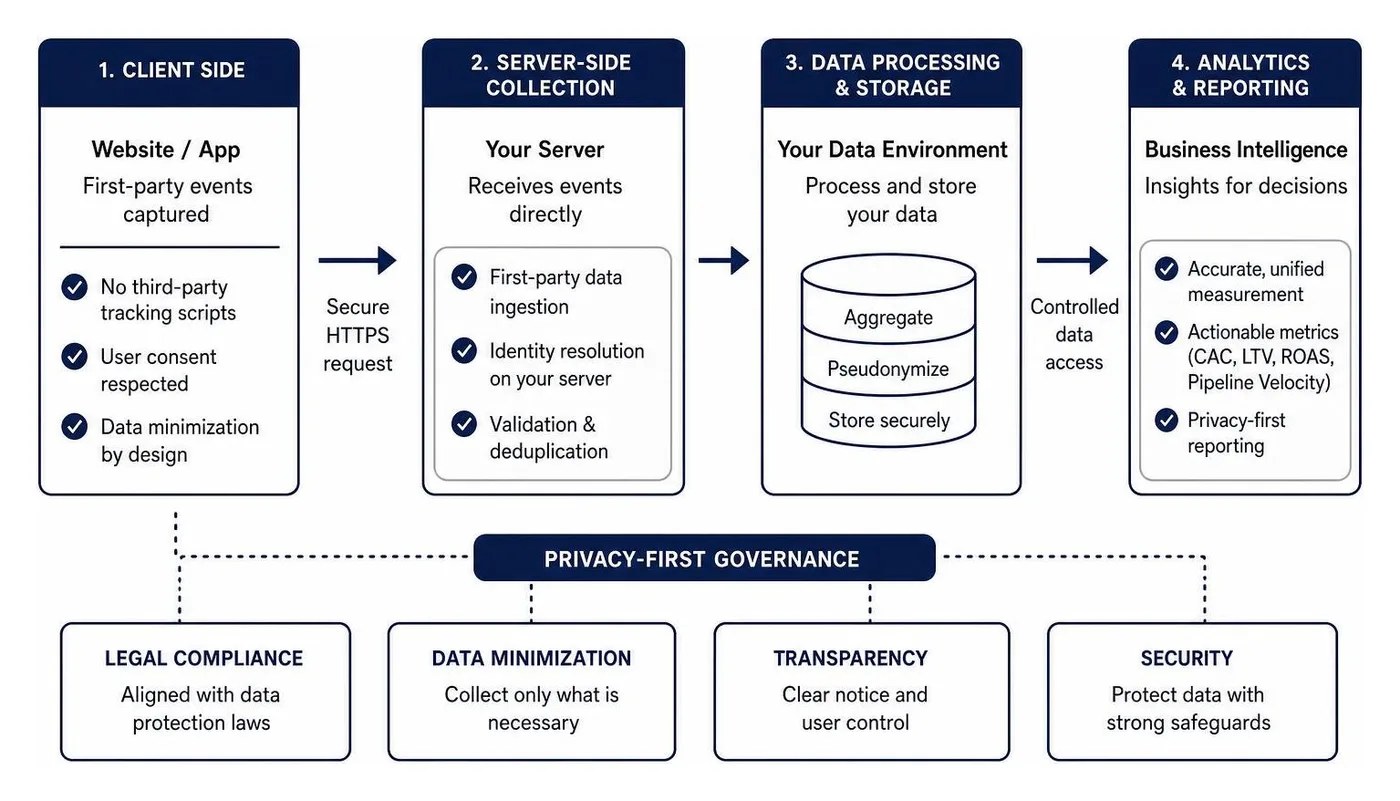
The analytics landscape has undergone a massive operational shift. With more than 79% of the global population now covered by stringent data protection laws, traditional tracking strategies that relied heavily on third-party tracking scripts are no longer viable.
The First-Party Data Advantage
Modern measurement architectures prioritize first-party data capture. Research shows that organizations incorporating first-party behavioral data into their marketing strategies improve customer acquisition costs by 83%, lift customer satisfaction by 78%, and boost overall marketing ROI by 72%.
Furthermore, privacy-first data governance is no longer just a compliance requirement—it is a competitive advantage. Organizations investing in structured privacy and transparent data governance see an average 1.6x return on their privacy investments.
Multi-Touch Attribution and Server-Side Tracking
Relying solely on "last-click" attribution paints an incomplete picture of modern customer journeys. Buyers frequently engage with content marketing pieces, review social proof, open email newsletters, and click retargeting ads before making a buying decision. Assigning 100% of the credit to the final ad touchpoint undervalues the top-of-funnel channels that originally created customer interest.
Implementing server-side tracking pipelines preserves data accuracy against ad-blockers and browser privacy controls while maintaining user consent. This data architecture provides the foundation for algorithmic multi-touch attribution, allowing businesses to justify marketing spend across every touchpoint. In fact, an academic study on digital analytics ROI underscores that marketing investments are unsustainable without clear, data-backed ROI frameworks that validate budget distribution across modern omnichannel marketing channels.
Frequently Asked Questions About Digital Marketing Analytics
What is the primary difference between digital analytics and traditional marketing measurement?
Traditional marketing measurement (such as television ratings, print circulation, or billboard traffic counts) relies on broad estimates, post-campaign surveys, and delayed feedback loops. In contrast, digital marketing analytics provides real-time event tracking, individual user journey mapping, and immediate conversion feedback. This allows marketers to adjust live budgets, test creative variations simultaneously, and calculate return on ad spend with granular accuracy.
How do modern privacy regulations impact marketing analytics collection?
Privacy frameworks mandate explicit user consent, strict data retention limits, and complete transparency regarding user tracking. Marketers can no longer rely on cross-site third-party cookies. Modern analytics setups utilize server-side tagging, Consent Management Platforms (CMPs), and first-party event tracking. This approach ensures user privacy rights are fully respected while maintaining data integrity for campaign optimization.
What are the most critical tools needed for marketing analytics in 2026?
A comprehensive modern analytics stack includes:
Event Ingestion & Web Tracking: Platforms that capture consented first-party event streams.
CRM & Pipeline Synchronization: Systems that link individual customer records to their acquisition source.
Marketing Automation Engines: Integrated marketing automation platforms that trigger personalized messaging based on real-time behavior.
Data Warehouses & Visualization Dashboards: Centralized data repositories paired with business intelligence dashboards for cross-channel reporting.
Conclusion
Understanding the true digital marketing analytics definition is about more than memorizing technical terms. It is about building a reliable feedback loop that connects marketing investments to business growth.
When you eliminate vanity metrics, implement privacy-first data collection, and unify sales and marketing data, analytics shifts from a confusing expense into your company's primary growth engine. At RewardLion, we deploy fully integrated growth systems that combine AI-powered marketing automation, multi-channel lead generation, and real-time revenue analytics—managed by an expert team dedicated to scaling your business predictably.