How to Write a Marketing Case Study That Actually Converts Leads

A marketing case study is a short, structured story about a real customer: the problem they had, what you did about it, and the result. To write one that actually converts leads, you pick a customer with a clear before-and-after, interview them for specifics (not just a quote), structure the piece around challenge-solution-result, and back every claim with real numbers. Skip the brochure language. Prospects trust a specific story more than a sales pitch.
If you run a clinic, a contracting business, or any local service company, you already have these stories sitting in your CRM, your review inbox, and your ad campaign reports. This guide shows you how to turn them into something prospects actually read and act on.
What Is a Marketing Case Study (and Why It Actually Works)
A case study is proof, told as a story. Instead of saying "we get great results," you show one customer's actual journey — with names, numbers, and context a prospect can relate to.
Why case studies work
This format works because buyers trust other buyers more than they trust ads. Roughly 75% of B2B marketers use case studies or customer stories as part of their content strategy, and they consistently rank among the highest-performing formats (magiclogix.com). Nearly 87% of B2B tech marketers publish case studies, and 62% consider them the most effective content format they produce (magiclogix.com). Separately, 53% of B2B marketers say case studies are the most effective format for moving prospects from consideration to decision (highervisibility.com), and nearly 90% of marketers say case studies and testimonials are the most effective formats for influencing sales (interodigital.com). Case studies are also among the most widely used B2B content types overall, behind only short articles and video, with 78% of B2B marketers using them (interodigital.com).
What it means for a local business
For a local business, the same logic applies: a prospective patient, homeowner, or client wants to see someone like them who had a problem, hired you, and got a result.
That makes case studies useful at several points in the buying process:
- On your website, as proof next to a service description or contact form
- In sales conversations, as a link or PDF to send after a first call
- In ads and landing pages, as a short quote or headline result
- In follow-up emails, to re-engage leads who went quiet
Step 1: Pick the Right Customer Story to Tell
Not every happy customer makes a good case study. Look for:
- A clear before-and-after. A new website that increased booked appointments, an ad campaign that filled a slow season, an SEO project that moved rankings, or a review generation push that changed how the business shows up online.
- A customer willing to talk. You need their time for an interview and their permission to publish specifics.
- A relatable situation. Pick customers whose starting problem will feel familiar to the prospects you want to attract next.
If you work with RewardLion-type services — websites, sales funnels, ads, SEO, lead follow-up — each discipline has its own natural case study: a redesigned site that improved lead capture, a funnel that reduced no-shows, a local SEO push that increased map visibility.
You can see how we structure our own stories on the RewardLion case studies page.
Step 2: Run a Case-Study-Ready Customer Interview
The interview is where most case studies fall apart. Two things matter most.
Build trust before you ask
First, build trust before you ask. Remove the words "case study" from your outreach and frame it as helping the customer tell their own story — this simple reframe improves participation and makes the resulting conversation more honest (smartbugmedia.com).
Talk to the person closest to the work
Second, talk to the right person. Interview whoever was closest to the actual work — the office manager who used the new booking system, the homeowner who called after seeing the ad — rather than only a marketing or PR contact. A too-polished answer from someone removed from the day-to-day reads as less credible (articulatemarketing.com).
Questions that produce usable answers
Ask open questions: What was happening before you called us? What almost stopped you from moving forward? What changed afterward? What would you tell someone in your shoes?
Map each question to the section of the case study it will feed, so you leave the interview with everything you need:
| Case study section | Question to ask | What you're listening for |
|---|---|---|
| Challenge | What was happening before you called us? | The problem in their own words |
| Hesitation | What almost stopped you from moving forward? | Objections your next prospect will have too |
| Solution | What stood out about how the work was done? | The decisions that mattered to them |
| Results | What changed afterward, and how do you know? | Numbers they can verify, plus day-to-day differences |
| Advice | What would you tell someone in your shoes? | A natural, quotable closing line |
Record the call (with permission) so you can quote accurately instead of paraphrasing from memory.
The 7 Essential Parts of a High-Converting Case Study
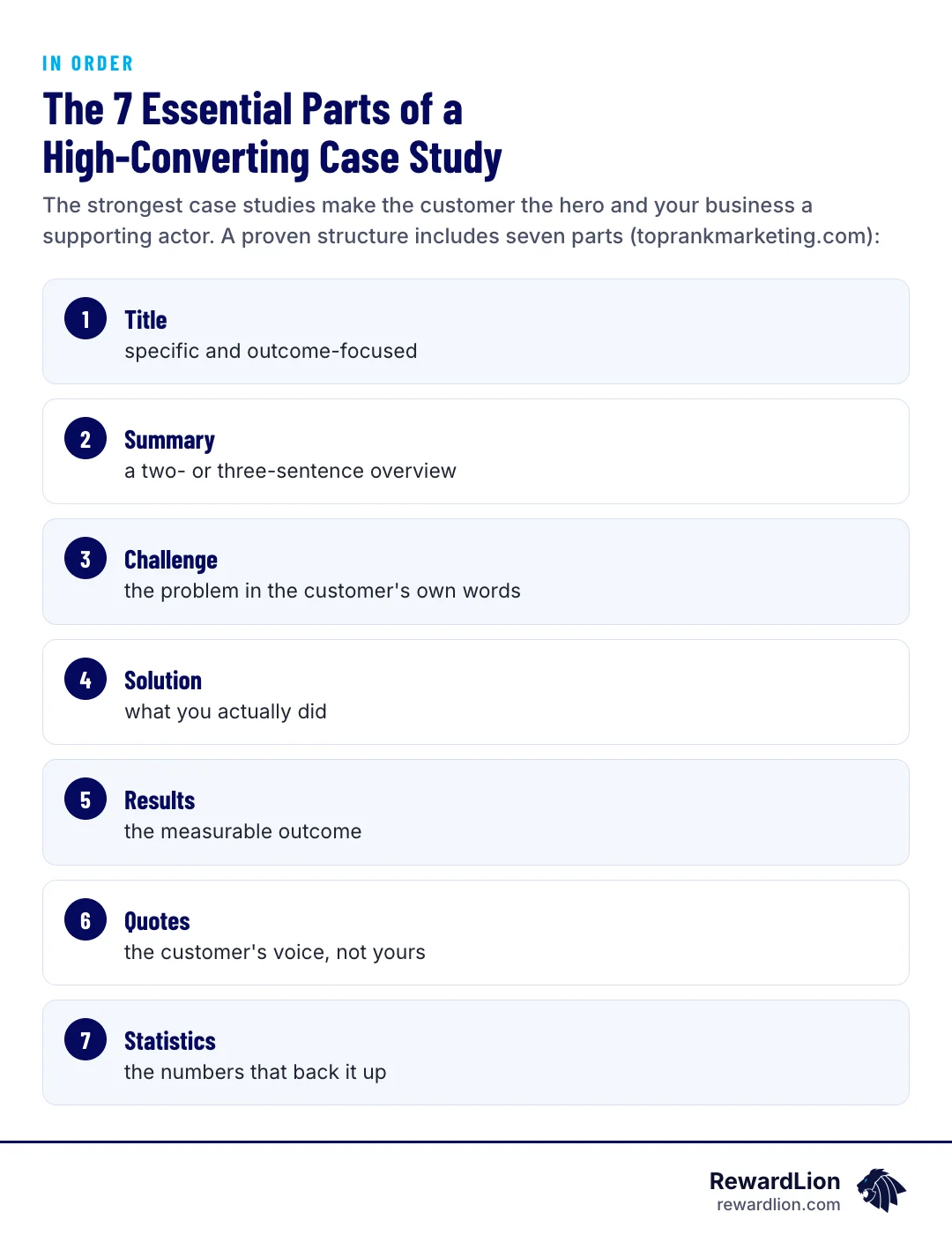
The strongest case studies make the customer the hero and your business a supporting actor. A proven structure includes seven parts (toprankmarketing.com):
- Title — specific and outcome-focused
- Summary — a two- or three-sentence overview
- Challenge — the problem in the customer's own words
- Solution — what you actually did
- Results — the measurable outcome
- Quotes — the customer's voice, not yours
- Statistics — the numbers that back it up
A simpler version of this same logic is Introduction, Problem, Solution, Results, Implications — with specific quantified metrics rather than vague claims (canva.com). Either way, the goal is the same: context, conflict, resolution, proof.
Step 3: Write It Like a Story, Not a Brochure
A case study should read like a story with a beginning, middle, and end — not a dry internal report. The best ones leave the reader with a replicable takeaway, something they can picture happening to their own business (simpletexting.com).
In practice: open with the customer's situation before you were involved. Describe what they tried, what wasn't working, and what made them reach out. Then walk through what you did — not as a list of features, but as decisions made to solve their specific problem. Close with what changed.
Brochure language vs. story language
Avoid: "Our team leveraged cutting-edge strategies to deliver exceptional results." Instead: "The clinic was missing roughly a third of its inbound calls after hours. We built an automated follow-up sequence so no inquiry went unanswered."
A few more swaps that make the same point:
- Instead of "best-in-class service," describe the specific thing you did differently.
- Instead of "a leading local business," say what kind of business it is and who it serves.
- Instead of "dramatically improved results," state the actual before-and-after number.
Step 4: Back Every Claim With Real Numbers and Visuals
Vague claims don't convert. Specific ones do. Put a specific, verifiable number in the headline, and present raw data alongside percentages so the numbers feel grounded, not cherry-picked — a structure of Headline → Challenge → Approach → Measurable Results → Customer Quote → CTA works well (magiclogix.com). Pair percentage changes with the underlying numbers (for example, don't just say "300% growth" — show what that grew from and to) so the result reads as real rather than marketing-speak (canva.com).
What counts as real proof
If you have before-and-after screenshots, call tracking data, booking numbers, or review counts, use them. Charts and screenshots do more work than another paragraph of adjectives.
Good proof sources most local businesses already have:
- Call tracking reports showing call volume before and after
- Booking or scheduling data showing appointments over the same period
- Review counts and ratings from your Google Business Profile
- Ranking or map visibility reports for the searches that matter
- Screenshots of the old and new website, ad or funnel
Always compare the same length of time before and after, and say what that timeframe was.
Formatting, Length, and Design Best Practices
Keep it scannable. Use short paragraphs, clear subheads for each section (Challenge, Solution, Results), and pull-quotes to break up text. Most readers skim before they commit — a one-page PDF or a single web page that someone can get through in a few minutes works better than a long report. Lead with the headline number, not your company history.
A quick layout checklist
- One headline result at the top, in large type
- A short summary box with the business type, the problem and the outcome
- Subheads for Challenge, Solution and Results
- At least one pull-quote from the customer
- A chart or screenshot next to the results section
- A clear call to action at the end
If you don't have in-house design help, our graphic design team can turn a written case study into a clean one-page layout.
Where to Publish and Repurpose Your Case Study
Once it's written, don't let it sit in one place. A finished case study should be repurposed across formats — blog posts, PR talking points, and sales decks — and named with SEO in mind, since prospects typically search for solution-based terms ("dentist website redesign results") rather than vendor-success headlines ("Acme Agency case study") (toprankmarketing.com, smartbugmedia.com).
Practical places to put it: a dedicated case studies page on your site, a blog post optimized for the terms prospects actually search, a PDF your sales team can email, and short excerpts for social proof on landing pages.
A simple repurposing plan
| Format | Where it goes | What to pull from the case study |
|---|---|---|
| Full web page | Your case studies page | The complete story, optimized for solution-based search terms |
| Blog post | Your blog | The challenge and lessons, linking to the full case study |
| Sales emails and proposals | The one-page version with the headline result | |
| Short quote | Landing pages and ads | One customer quote plus one number |
| Video clip | Social media and your website | The customer telling the story in their own words |
| PR talking point | Pitches and interviews | The most newsworthy result |
Turning case studies into authority articles, public relations pitches or short customer videos multiplies the value of a single interview. On landing pages, place the excerpt right next to the form.
Common Case Study Mistakes That Kill Credibility
- Vague results. "Significant improvement" means nothing. Use real, specific numbers.
- Over-polished quotes. If every sentence sounds like marketing copy, readers stop trusting it.
- No clear next step. Every case study needs a path forward — a CTA, contact link, or next action for the reader.
- Skipping the challenge. Jumping straight to results without showing the real problem makes the story feel hollow.
- Ignoring SEO. A great case study nobody finds doesn't generate leads.
Quick answers from this guide
| Question | Short answer |
|---|---|
| How long should a marketing case study be? | There's no fixed rule, but most effective case studies are short enough to read in a few minutes — long enough to cover the challenge, solution, and results, and no longer. |
| Do I need permission from the customer to publish their story? | Yes. Always get explicit, written approval for the details, numbers, and quotes you plan to publish before the case study goes live. |
| What if I don't have exact numbers for the results? | Use whatever verifiable data you do have — call counts, booking numbers, review counts, ranking positions — and be transparent about the timeframe. |
| Where should I feature my case studies first? | Start with your own website and sales materials, since that's where most prospects will look for proof before contacting you. |
Marketing Case Study Template You Can Copy
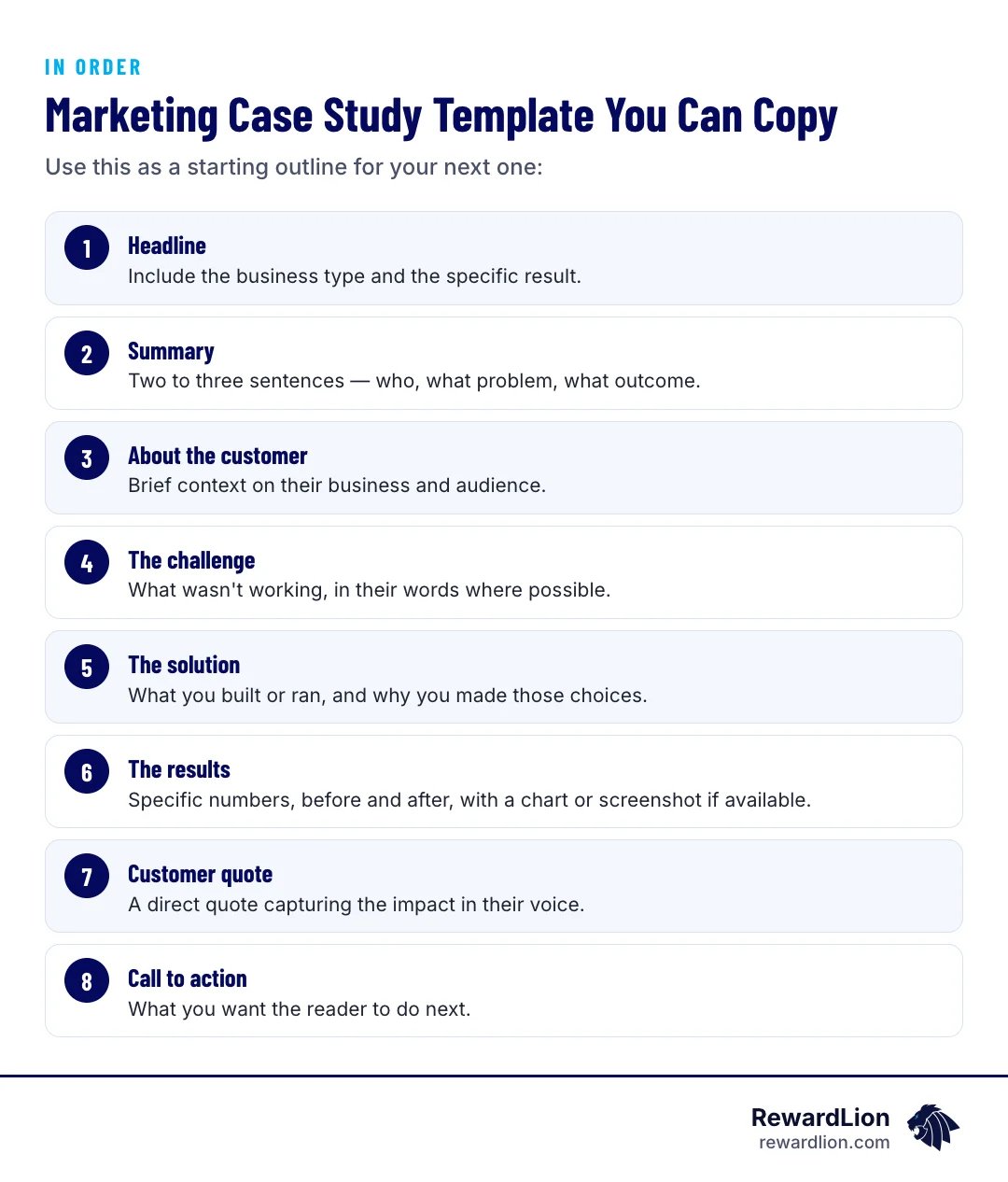
Use this as a starting outline for your next one:
- Headline: Include the business type and the specific result.
- Summary: Two to three sentences — who, what problem, what outcome.
- About the customer: Brief context on their business and audience.
- The challenge: What wasn't working, in their words where possible.
- The solution: What you built or ran, and why you made those choices.
- The results: Specific numbers, before and after, with a chart or screenshot if available.
- Customer quote: A direct quote capturing the impact in their voice.
- Call to action: What you want the reader to do next.
A useful case study needs customer context, the challenge, the solution, the outcome, and a clear next step — leave any of those out and the piece loses persuasive power (articulatemarketing.com).
Before you publish: a final approval checklist
- The customer has approved the full text, numbers and quotes in writing
- Every number can be traced back to a real report or record
- The timeframe for each result is stated
- Nothing in the piece promises the same result to every reader
- The page has a clear call to action and a link to contact you
Related reading
- The Ultimate Guide to Marketing Services (And No, It's Not Just Spam)
- The Lead Generation Campaign Plan Template
- Stop Being the Best Kept Secret by Overhauling Your Personal Branding Strategies
- RewardLion lead generation solutions
FAQ: How to Write a Marketing Case Study
How long should a marketing case study be?
There's no fixed rule, but most effective case studies are short enough to read in a few minutes — long enough to cover the challenge, solution, and results, and no longer. Prioritize clarity over length.
Do I need permission from the customer to publish their story?
Yes. Always get explicit, written approval for the details, numbers, and quotes you plan to publish before the case study goes live.
What if I don't have exact numbers for the results?
Use whatever verifiable data you do have — call counts, booking numbers, review counts, ranking positions — and be transparent about the timeframe. Don't estimate or round up numbers you can't back up.
Where should I feature my case studies first?
Start with your own website and sales materials, since that's where most prospects will look for proof before contacting you. From there, repurpose the content into blog posts and shorter social proof snippets for landing pages.

Sources
- How to Write a Marketing Case Study (With Examples)
- The Customer Hero: Keys to Creating Case Studies That Get Results
- 5 Steps for Writing a Killer Marketing Case Study
- Six Keys to Writing a Great Case Study
- What is a marketing case study? (How-tos and tips)
- The ultimate guide to writing case studies that drive leads
- 17 Case Study Examples for B2B Marketers
- 10+ Marketing Case Study Templates for B2B Growth Stories
- 75% of B2B Marketers Use Case Studies: Write and Scale Them
- 30 Content Marketing Statistics for 2024 and Beyond
- 29 Stats to Make the Case for Content Marketing ROI in 2024
- 57+ Content Marketing Statistics To Help You Succeed in 2025
- 16 case study examples (+ 3 templates to make your own)
- Marketing Case Studies: Real-world examples of 3 low-cost marketing strategies you can implement now
- Use Customer Success Stories to Bolster your Sales and Marketing Efforts
- 5 Amazing Small Business Case Study Examples for Marketers