How to Write an About Us Page That Builds Trust and Generates Leads
To write an effective About Us page, cover who you are, what you do and why it matters, who you serve, your mission or values, and the people behind the business — in roughly 300-500 words (per Morningscore), with natural local keywords and a clear path for visitors to contact you. Get those pieces right and your About page stops being a formality and starts doing real work for your business.
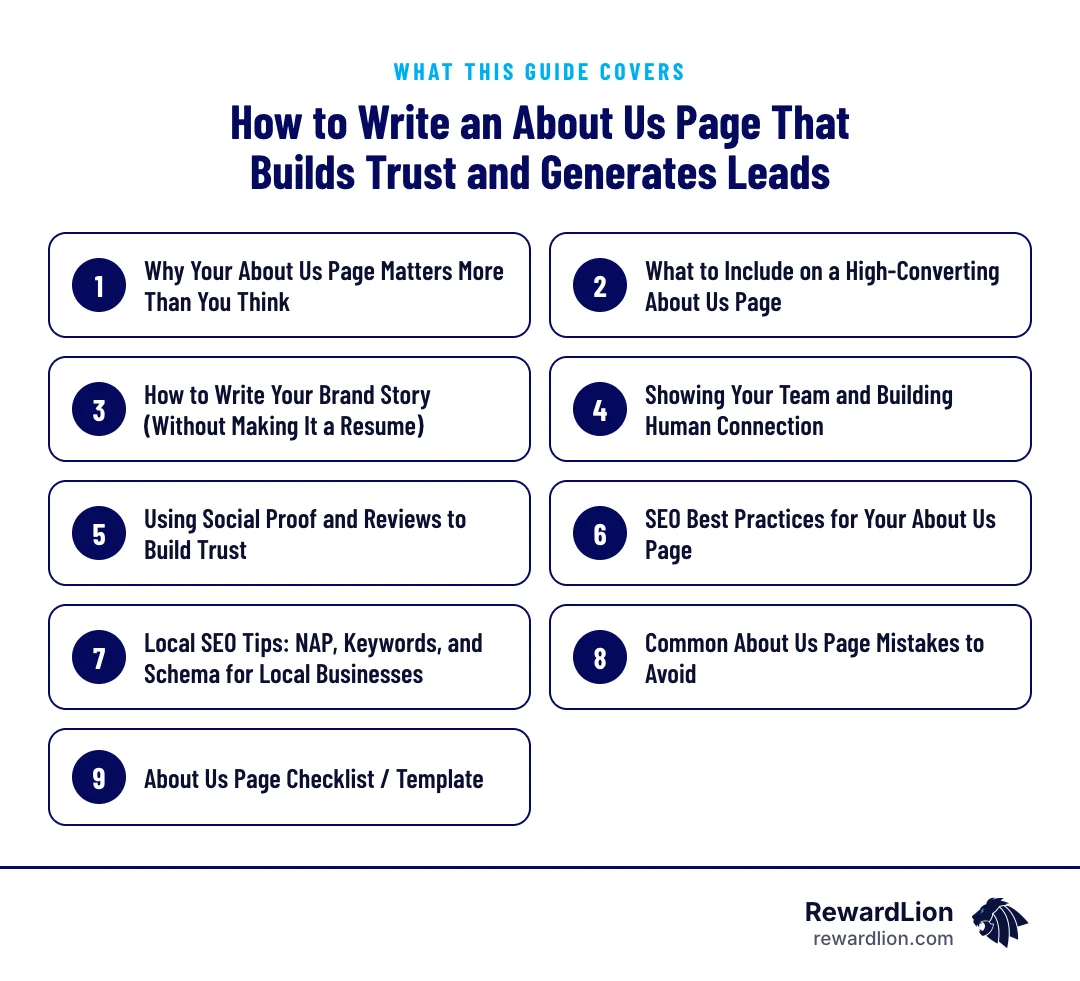
This guide covers:
- Why the About page influences whether a visitor calls you
- What to include, section by section
- How to write your story, show your team and use social proof
- How to optimize the page for local SEO
- A copy-ready template and checklist
Why Your About Us Page Matters More Than You Think
Many business owners treat the About Us page as an afterthought. That's a mistake. According to a KoMarketing study cited by GetUplift, 52% of website visitors say the About Us page is the first thing they want to see when they land on a site. And it's not just curiosity — a BBMG report cited by GetUplift found that 73% of consumers care about the company behind a product, not just the product itself, when deciding to purchase.
For a local clinic, contractor, or service business, this is an opportunity. People hiring a dentist, plumber, or attorney want to know who they're trusting with their problem. Your About page is often the deciding factor between a call and a bounce.
What visitors are really checking
When someone opens your About page, they're usually trying to answer a handful of quiet questions:
- Are you real? A named team, real photos and a real address or service area.
- Are you local? The towns and neighborhoods you work in.
- Are you experienced? How long you've been doing this and what you specialize in.
- Do other people trust you? Reviews, testimonials and recognition.
- What do I do next? A clear way to call, book or ask a question.
What to Include on a High-Converting About Us Page
According to Wix, an effective About page should cover five core elements:
- Who you are
- What you do and why it matters
- Who you serve
- Your mission and values
- The people behind the business
Don't try to cram in everything about your company's history. Focus on what helps a potential customer decide to work with you. Every section should answer a visitor's unread question: "Can I trust this business to solve my problem?"
Turning the five elements into sentences
| Element | Question it answers | Example opening line |
|---|---|---|
| Who you are | Who is this business? | "[Business name] is a family-owned [business type] based in [city]." |
| What you do and why it matters | What problem do you solve? | "We help homeowners [solve a specific problem] without [common frustration]." |
| Who you serve | Is this for someone like me? | "We work with [type of customer] across [city] and nearby towns." |
| Mission and values | What do you stand for? | "We believe [a value your customers care about]." |
| The people behind the business | Who will I actually deal with? | "Meet the team you'll talk to when you call." |
Fill in the brackets with your own details, then edit until it sounds like you talking to a customer.
How to Write Your Brand Story (Without Making It a Resume)
A common mistake is turning the About page into a company timeline or founder resume. Instead, use problem/solution storytelling: show how your business has solved real customer problems, and back it up with credibility markers. Brafton recommends pairing this kind of storytelling with testimonials and social proof so the story isn't just a claim — it's demonstrated.
Keep the story focused on the customer's experience, not just your milestones. Lead with the problem your customers face, explain how your business approaches it, and let the "why it matters" come through naturally.
Resume-style vs. story-style writing
| Resume-style (avoid) | Story-style (use) |
|---|---|
| "Founded in [year], we expanded to a second office in [year]." | "We started because local customers kept telling us [the problem you saw]." |
| "We offer a full range of services." | "Most of our customers call us when [specific situation]. Here's how we handle it." |
| "Our team has extensive experience." | "Our technicians have handled [type of job] across [city] for years." |
A simple four-part story structure
- The problem your customers kept running into
- Why you started — or what you decided to do differently
- How you work today — your approach, in plain language
- What customers can expect when they call you
Showing Your Team and Building Human Connection
Local businesses compete on trust and relationships, not just price. Including team photos and short bios humanizes your business and helps visitors feel they're dealing with real people, not a faceless company, according to Brafton and Shopify.
For a local service business, this matters even more. A homeowner choosing a contractor or a patient choosing a provider wants to see the face of the person who might show up at their door or treat them. A simple photo and two-sentence bio for each key team member goes a long way.
What to include in a short team bio
- Name and role
- What they handle for customers (for example, estimates, scheduling or the work itself)
- Relevant experience or training, stated plainly
- One personal detail that makes them relatable, if they're comfortable sharing it
Use real photos of your team rather than stock images; visitors can usually tell the difference. A short team intro video can do the same job for businesses that want to go further.
Using Social Proof and Reviews to Build Trust
Squarespace recommends using visual hierarchy — clear headings and subheadings — along with a dedicated social proof section for testimonials, awards, or media mentions. This doesn't need to be elaborate. A short block featuring a few real testimonials, any awards you've received, or press coverage adds credibility without disrupting your story.
Also worth noting: 82% of consumers want to support businesses whose values align with their own, according to WordStream. That means your About page should clearly state what your business stands for, not just what it sells.
Social proof options for an About page
- Two or three short testimonials that mention the service and the experience
- Your Google review rating with a link to read more reviews
- Awards, certifications or licenses relevant to your trade
- Media mentions or community involvement
If you don't have many reviews yet, a consistent reputation management process will build them over time.
SEO Best Practices for Your About Us Page
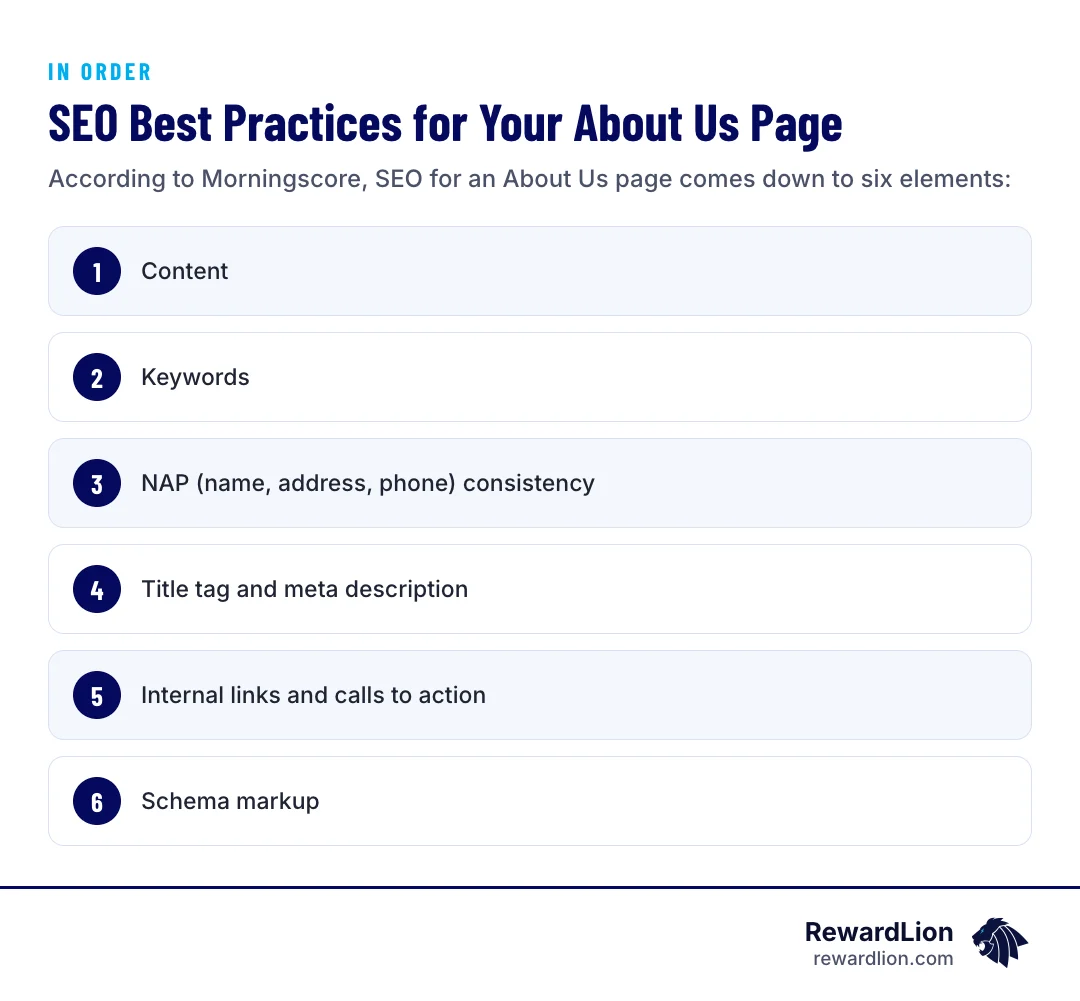
According to Morningscore, SEO for an About Us page comes down to six elements:
- Content
- Keywords
- NAP (name, address, phone) consistency
- Title tag and meta description
- Internal links and calls to action
- Schema markup
Morningscore also recommends keeping About Us content between 300 and 500 words, and targeting long-tail keywords that support local SEO rather than trying to rank for broad, competitive terms. Think "family dentist in [city]" rather than just "dentist."
Don't forget the basics: a clear title tag, a meta description that invites a click, and at least one internal link pointing to your services or contact page.
Local SEO Tips: NAP, Keywords, and Schema for Local Businesses
For local and service businesses, three things matter most:
NAP consistency
NAP consistency. Your business name, address, and phone number should match exactly across your website and all directory listings.
Schema markup
Schema markup. SEOPital recommends including your NAP in schema markup so search engines can understand and trust your business's local identity.
In practice, that usually means LocalBusiness structured data on the page with your business name, address (or service area), phone number, website URL and opening hours — the same details that appear on your Google Business Profile.
Natural keyword use
Natural keyword use. WordStream and Flying V Group both recommend working keywords — including your business type and location — naturally into your About Us copy. Avoid keyword stuffing; write for the human reader first, and the search engines will follow.
Our local SEO services and our guide to service area pages cover how the About page fits alongside the rest of your local pages.
Common About Us Page Mistakes to Avoid
- Writing a resume instead of a story focused on the customer
- Skipping team photos or bios, leaving the business feeling faceless
- Ignoring NAP consistency, which hurts local search trust
- Stuffing keywords instead of using them naturally
- Leaving out a call to action, so engaged visitors have nowhere to go next
- Making the page too long — stick close to the 300-500 word range recommended by Morningscore
Quick answers from this guide
| Question | Short answer |
|---|---|
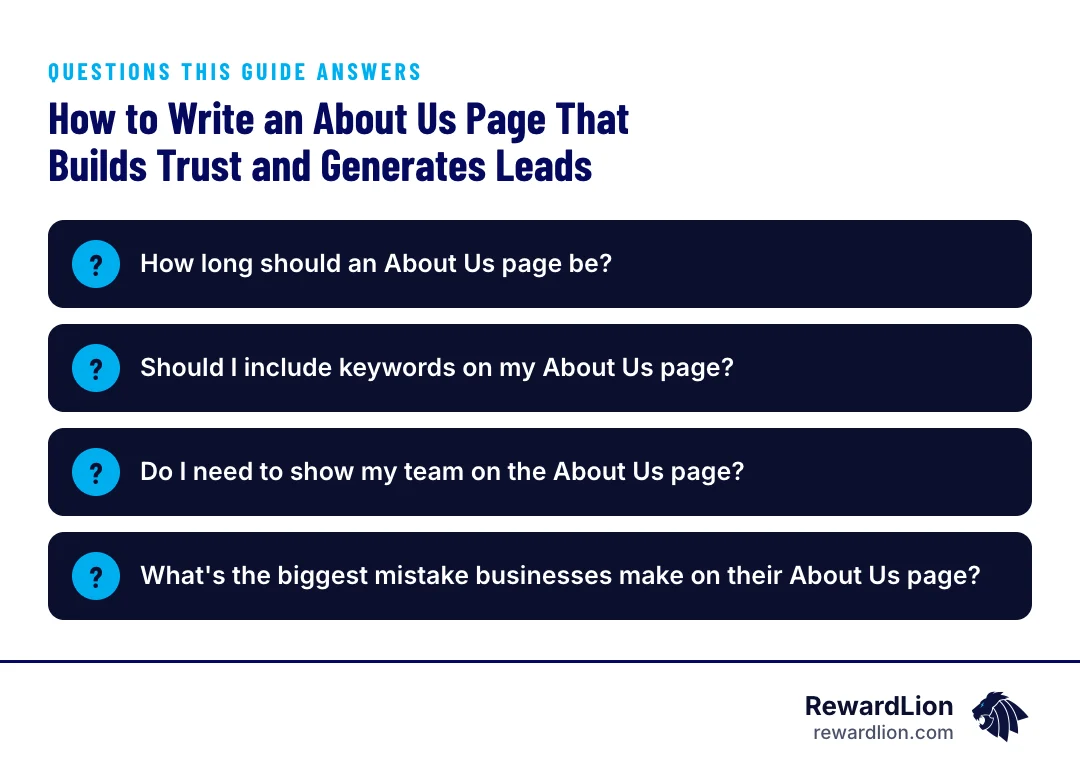
| How long should an About Us page be? | Morningscore recommends keeping About Us content between 300 and 500 words. |
| Should I include keywords on my About Us page? | Yes, but naturally. WordStream and Flying V Group both recommend working in keywords related to your business type and location without stuffing them in. |
| Do I need to show my team on the About Us page? | It's strongly recommended. Brafton and Shopify both note that team photos and short bios humanize your business and help visitors feel they're dealing with real people. |
| What's the biggest mistake businesses make on their About Us page? | Treating it like a resume or company history instead of a story focused on the customer's problem. |
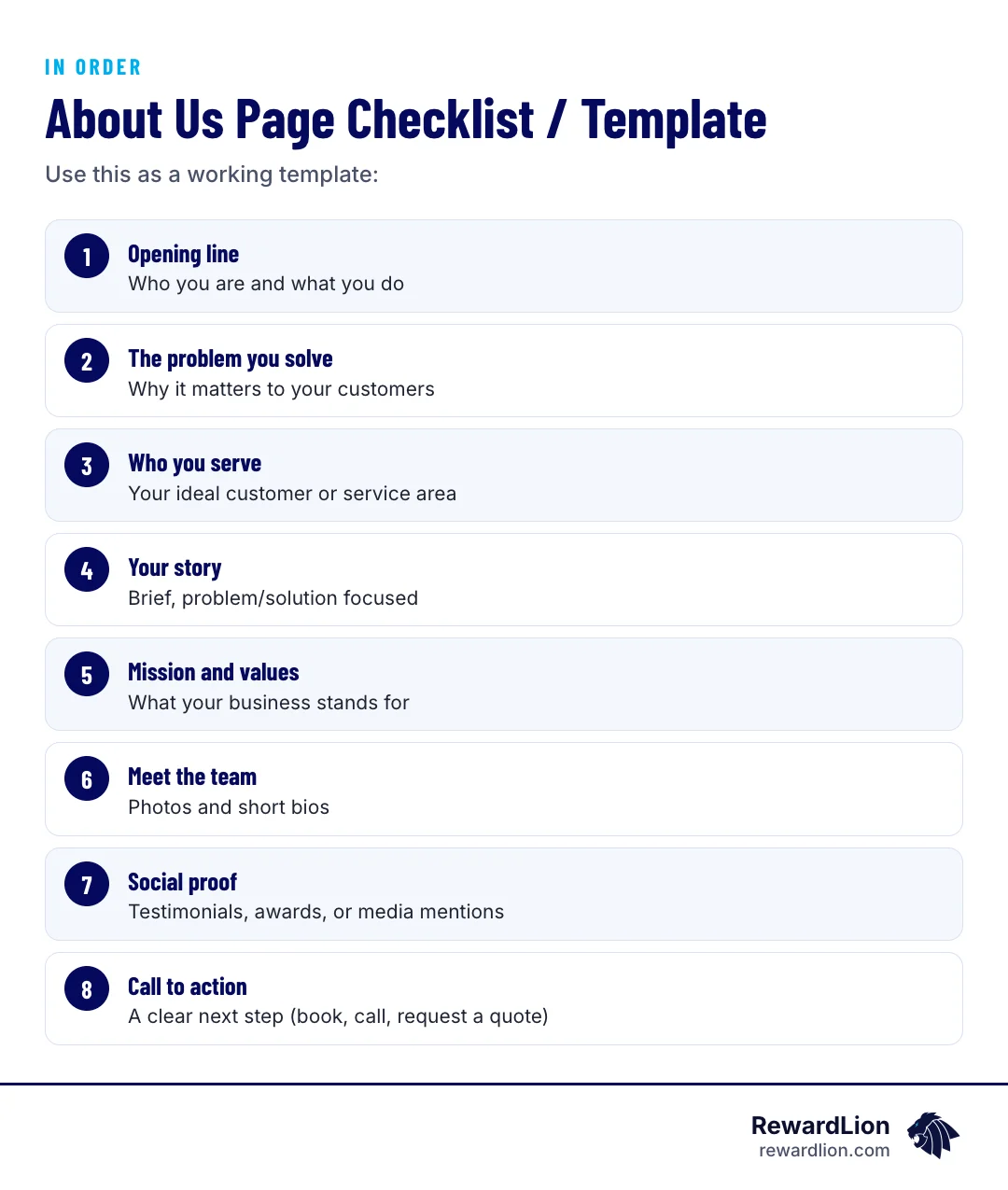
About Us Page Checklist / Template
Use this as a working template:
- Opening line: Who you are and what you do
- The problem you solve: Why it matters to your customers
- Who you serve: Your ideal customer or service area
- Your story: Brief, problem/solution focused
- Mission and values: What your business stands for
- Meet the team: Photos and short bios
- Social proof: Testimonials, awards, or media mentions
- Call to action: A clear next step (book, call, request a quote)
A good real-world example comes from a long-running fish and chips restaurant cited by Digitaloft, which strengthens trust by noting how long it's operated, that it's still family-run, and by citing third-party media coverage — simple, honest signals that build credibility for a local business.
Before you publish: a final check
- Read the page out loud — does it sound like a person, or a brochure?
- Does every section help a visitor decide to contact you?
- Do your name, address and phone match your Google Business Profile exactly?
- Is there a call to action at the end, and ideally one near the top?
- Are the photos current and of your actual team?
For a reference point, see how we describe ourselves on the RewardLion About page.
How RewardLion Helps You Build a Website That Converts
An About Us page is one piece of a website that should be working to generate leads, not just describe your business. RewardLion builds websites, sales funnels, and digital business cards for local and service businesses, paired with SEO and lead follow-up so the traffic your site attracts actually turns into booked appointments. If your About page — or the rest of your site — isn't pulling its weight, that's worth a conversation.
Whether you need a refreshed brand identity, a full website build, or just a second opinion on your current About page, get in touch with our team.
Related reading
- Stop Being the Best Kept Secret by Overhauling Your Personal Branding Strategies
- All About Branding Services
- Demystifying Branding Services: Meaning, Core Components, and Real Examples
- RewardLion lead generation solutions
FAQ
How long should an About Us page be?
Morningscore recommends keeping About Us content between 300 and 500 words. Long enough to cover who you are, what you do, and why it matters — short enough that visitors actually read it.
Should I include keywords on my About Us page?
Yes, but naturally. WordStream and Flying V Group both recommend working in keywords related to your business type and location without stuffing them in. Write for your reader first.
Do I need to show my team on the About Us page?
It's strongly recommended. Brafton and Shopify both note that team photos and short bios humanize your business and help visitors feel they're dealing with real people.
What's the biggest mistake businesses make on their About Us page?
Treating it like a resume or company history instead of a story focused on the customer's problem. Pairing your story with testimonials and social proof, as Brafton recommends, makes it far more effective.

Sources
- How to write an about us page for a business
- How to Write an About Us Page (Template and Examples)
- How to Write an About Us Page Like a Pro (+8 Examples)
- 17 Stand-Out About Us Page Examples (+Why They Work)
- About Us Page for Local Businesses
- How to Write a Great About Us Page (+Template)
- About Us Page SEO: How Do You Write Perfect 'About Us' Page Content?
- How To Write the Best About Us Page (With 50+ Examples & A Free Template)
- About Us Page Examples and How To Write One (2026)
- 4 Rules for Creating a High-Converting About Us Page
- How To Create an Effective 'About Us' Page for Your Website
- 11 'About Us' page examples that show E-E-A-T
- About Us Page SEO: Effective Tips & Examples
- Optimizing About Us Page SEO for Better Search Engine Visibility