To understand branding services meaning, we first have to look at what a brand actually is. The formal Merriam-Webster definition of branding describes it as the promoting of a product or service by identifying it with a particular brand. But in modern commerce, a brand is far more than a name tagged onto a product; it is the total emotional and psychological perception a customer carries about your business.
Your core identity shapes your business reputation. When potential customers encounter your company, your branding dictates whether they perceive you as a high-end industry authority, an aggressive discount provider, or an unreliable operation. Building continuous consumer trust requires aligning your visual presentation, strategic messaging, and daily operations into one cohesive whole.
Decoding Branding Services Meaning in Modern Business
When we look closely at branding services meaning, we are talking about specialized strategic and creative disciplines delivered by experts to build, refine, or transform a business identity. Professional branding services systematically solve positioning problems so your business doesn't get lost in a crowded market.
Instead of throwing random colors and slogans at the wall, professional branding agencies look at target audience alignment. They analyze who your ideal buyers are, what pain points drive their decisions, and how your strategic differentiation sets you apart from direct competitors. Modern agency deliverables do not end with a single image file; they provide a complete blueprint covering strategic positioning, voice parameters, graphic standards, and cross-channel execution rules.
How Historical Evolution Shapes the Branding Services Meaning
The concept of branding was not invented by modern advertising agencies. The word itself originates from the Old Norse word brandr, which means "to burn." Historically, livestock owners burned unique symbols into the hides of cattle to prove ownership and deter theft. Evidence of this practice dates back to ancient Egyptian tombs around 2,700 BCE.
As trade networks expanded across centuries, proto-branding began appearing on trade goods:
Ancient Amphorae Marks: Roman producers stamped distinct symbols on fish sauce jars and wine amphorae to signal origin and build international buyer trust.
Compulsory Maker Marks: In 1266, English law mandated that bakers place unique marks on every loaf of bread sold so weight and quality could be traced back to the baker.
19th-Century Industrial Production: Mass manufacturing during the Industrial Revolution detached goods from local craftsmen. To reassure skeptical buyers, manufacturers added mascots, human names, and distinct labels to packaged items.
First Registered Trademarks: In 1876, Bass Brewery's red triangle became the very first officially registered trademark in Great Britain. Brands like Twinings tea have maintained their continuous script logo since 1787.
Today, corporate identity expansion has evolved beyond physical packaging into complete digital ecosystems, voice interfaces, and AI platform presences.
Core Components and Deliverables Included in Professional Branding
When hiring professional services, businesses should expect a structural framework rather than one-off design assets. A comprehensive branding services list spans strategic research, visual asset creation, tone of voice frameworks, and internal operational rollout documentation.
Brand Strategy and Market Positioning
Brand strategy is the structural foundation of the entire identity system. If visual design is created without strategy, it is merely temporary decoration. Professional strategy development starts with a detailed SWOT analysis (Strengths, Weaknesses, Opportunities, Threats) and competitive benchmarking to see where rival brands are failing to satisfy consumer expectations.
From there, we define target demographics and outline your core value proposition. Strategy work establishes your central brand promise—the absolute expectation you guarantee to fulfill during every single customer interaction.
Visual Identity and Graphic Systems
Visual identity translates abstract business values into immediate visual recognition. A complete visual graphic system includes:
Primary and Secondary Logo Design: Distinct logo variations optimized for diverse applications, from large building signage down to a 32-pixel mobile browser favicon.
Typography Hierarchy: Selected fonts, weight rules, and structural line-spacing for titles, body copy, and digital user interfaces.
Color Palettes: Defined primary, secondary, and accent color codes mapped out in HEX (web), RGB (screens), CMYK (print), and Pantone (exact ink matching).
Imagery Guidelines: Rules governing photography styles, lighting choices, vector illustration aesthetics, and icon sets.
Brand Messaging and Verbal Identity
A business cannot rely on visual presentation alone; how your organization speaks is just as important. Verbal identity systems establish a clear brand voice that outlines your communication style—whether authoritative, empathetic, humorous, or direct.
Strategic copywriters develop core messaging pillars that summarize what your company does, how it works, and why it matters. This phase includes crafting memorable taglines, an overarching brand narrative (your origin and mission story), and explicit communication rules that prevent off-brand tone slips across public relations and customer service channels.
Brand Activation and Guidelines Documentation
The final deliverable of a core branding project is a master brand style guide or brand identity manual. This document serves as an internal operational manual for your entire company, preventing inconsistent presentation across departments.
Brand guidelines specify minimum logo clearance spaces, color balance ratios, font rules, and explicit "don'ts" showing incorrect usages. These documentation systems allow internal teams, outside content creators, and marketing partners to build compliant collateral templates without diluting brand equity.
Branding Services vs. Marketing: Key Differences and Benefits
A common source of confusion for business owners is distinguishing branding from general marketing services. While the two fields work hand in hand, they serve fundamentally different strategic functions.
Branding defines who you are, what values you represent, and how you are perceived. Marketing takes that defined identity and runs targeted promotions, ad campaigns, and sales activities to generate leads and short-term revenue.
Dimension Branding Services Marketing Services Core Focus Identity, positioning, values, and reputation Lead generation, immediate traffic, and sales conversions Primary Goal Build long-term brand equity and customer loyalty Drive short-term campaign engagement and measurable ROI Time Horizon Multi-year strategic stability Daily, weekly, or quarterly campaign cycles Key Deliverables Strategy documents, style guides, logos, voice guides Ad creatives, PPC campaigns, email sequences, social posts Impact on Pricing Establishes brand authority to justify premium pricing Drives traffic volume to consume active offers
How Branding Services Differ From Standalone Design and Marketing
Relying purely on standalone graphic design or tactical ad campaigns without a foundational brand identity often leads to wasted ad budget. A freelance graphic designer may create an aesthetically pleasing logo, but they rarely conduct competitive market analysis or define voice guidelines.
When you launch performance ads using inconsistent visuals and messaging, your conversion rates plummet because potential buyers sense a lack of corporate maturity. Investing in Done For You Marketing backed by a fully integrated brand identity ensures every ad campaign, landing page, and sales funnel reinforces your overall market position.
Driving Business Value and Long-Term Brand Equity
The true financial power of strategic branding lies in brand equity—the commercial value derived from consumer perception rather than physical machinery, real estate, or inventory assets.
Consider these historical and modern examples of brand equity in action:
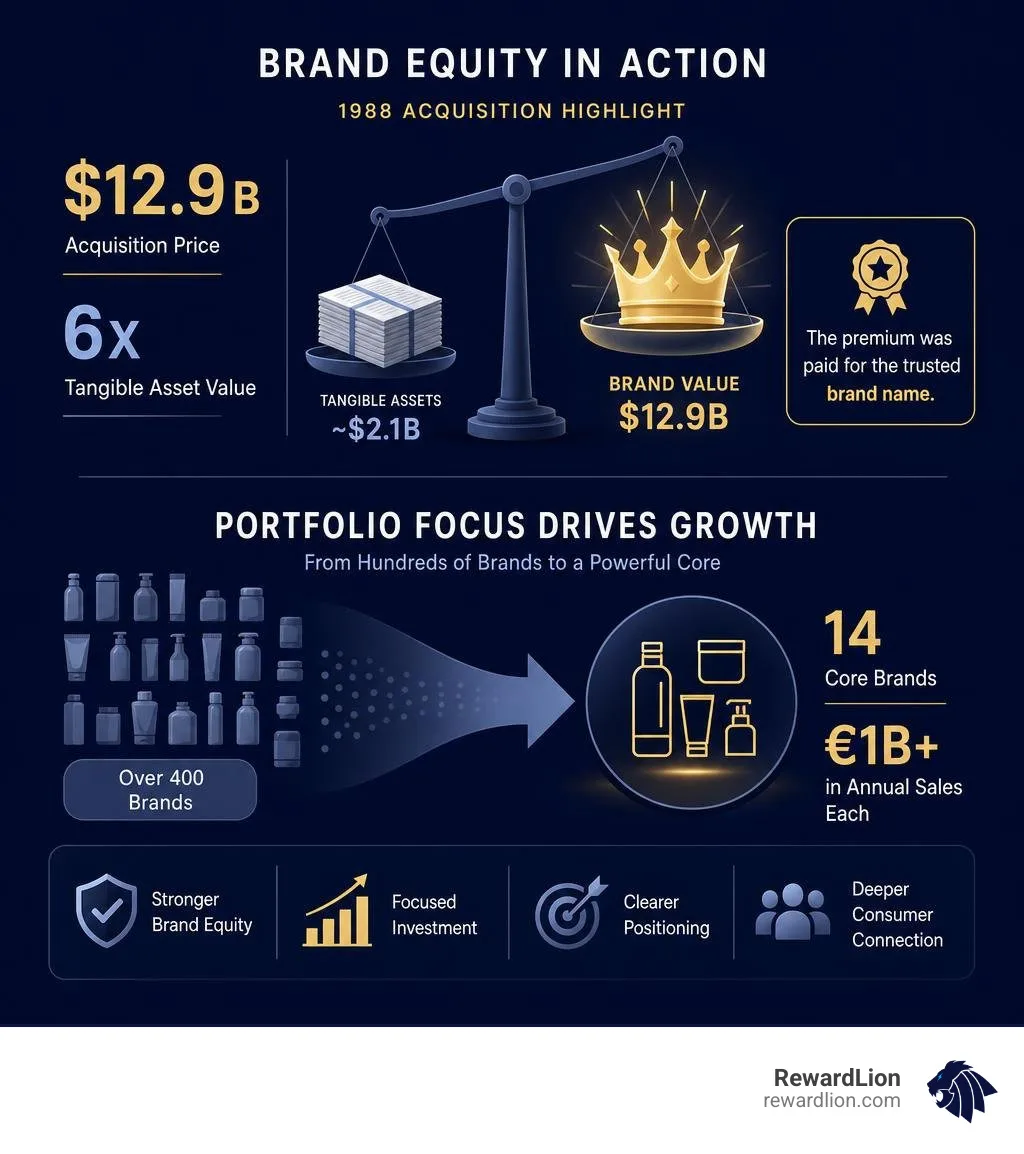
Philip Morris & Kraft (1988): Philip Morris acquired Kraft Foods Inc. for $12.9 billion—roughly six times Kraft's tangible paper asset value. Financial analysts reported that the valuation premium was paid almost entirely for the trusted "Kraft" brand name.
Unilever Brand Streamlining: Unilever strategically trimmed its active product line from over 400 regional brands down to focus resources on 14 core master brands that each generate over 1 billion euros in annual sales.
Huggies Brand Extensions: By leveraging built-in trust in its core identity, the Huggies brand extension into baby wipes generated over $500 million in additional annual global sales.
Pandemic Loyalty Shifts: Market research indicates that 75% of US consumers tested new shopping channels or brands during the COVID-19 pandemic, with 60% expecting to keep these new brands integrated into their post-pandemic lives. This shift highlights how vulnerable weak brand identity systems are during market disruptions.
Agency Processes, Industry Adaptation, and Cost Structures
Executing a successful identity project requires disciplined workflows, strategic risk management, and clarity regarding financial investment tiers.
The 5-Phase Professional Branding Process
Top-tier branding agencies follow a structured process to take projects from initial discovery to long-term market activation:
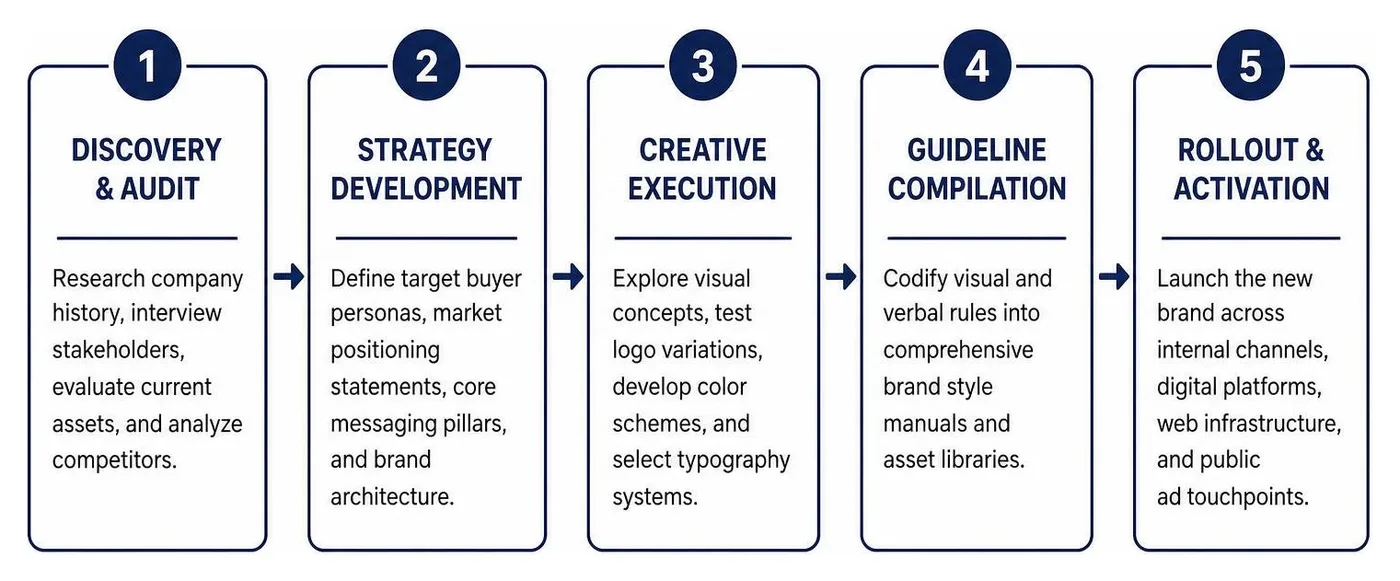
Discovery & Audit: Researching company history, conducting stakeholder interviews, evaluating current assets, and analyzing direct competitors.
Strategy Development: Defining target buyer personas, market positioning statements, core messaging pillars, and functional brand architecture.
Creative Execution: Exploring visual concepts, testing logo variations, developing color schemes, and selecting typography systems.
Guideline Compilation: Codifying visual and verbal rules into comprehensive brand style manuals and asset libraries.
Rollout & Activation: Launching the new brand identity across internal team channels, digital platforms, web infrastructure, and public ad touchpoints.
Adapting Branding Across Sector Nuances and Managing Rebrand Risks
Branding services are not one-size-fits-all; they require adaptation depending on your industry context:
Public Sector & Government: Must emphasize accessible design standards, strict compliance, regulatory transparency, and public trust without appearing overly commercial.
NGOs & Non-Profits: Need positioning centered around social impact, mission alignment, donor accountability, and volunteer engagement.
International & Multi-Market Expansion: Cross-border ventures must evaluate cultural color symbolism, regional naming translations, and local market nuances. The MotionPoint international branding study emphasizes that global brands must balance universal brand equity with localized messaging to succeed in diverse markets.
Managing Rebranding Risks
Rebranding an established company carries operational and financial risks. Rushing into visual changes without strategic auditing can confuse existing customers and erode established brand equity.
A high-profile lesson occurred when a global apparel retailer abruptly changed its classic logo to a plain sans-serif typeface, triggering massive public backlash that forced the company to revert to its original logo within days. Successful rebrands focus on refining positioning to solve strategic growth bottlenecks rather than introducing change for change's sake.
Integrating Branding with Digital Channels and AI Trends

In today's digital landscape, a static brand manual sitting in a digital folder is not enough. Your brand identity system must operate seamlessly across online touchpoints, automated workflows, and modern digital channels.
Aligning Brand Systems with Digital Marketing and Social Media
Maintaining absolute visual and messaging consistency across social platforms builds long-term recall. Reviewing our social media management ultimate guide 2026 highlights how multi-channel campaigns rely on standardized visual templates, consistent color codes, and unified voice parameters to convert audience attention into brand equity.
When your brand deploys effective advertising strategies, every digital touchpoint—from short-form video ads down to dynamic retargeting graphics—should look and sound like it comes from the same cohesive company.
AI Search Optimization and Future Branding Trends in 2026
As we navigate 2026, AI technologies are actively redefining how branding systems operate:
AI Search Engine Legibility: Generative AI search systems (such as ChatGPT, Perplexity, and Google AI Overviews) pull scattered brand data from across the web. If your messaging, corporate description, and product positioning are inconsistent across public directories, AI search engines struggle to summarize your business accurately. Consistent, structured digital branding directly influences how AI platforms recommend your services to prospective buyers.
Dynamic Digital Branding: Modern visual systems use adaptive layout rules that reformat graphic elements in real time based on user devices, display settings, and platform contexts.
Sensory Marketing Integration: Modern brands are incorporating custom audio signatures, distinct sonic logos, and tactile unboxing designs to trigger multi-sensory brand recognition.
Frequently Asked Questions About Branding Services
What is included in standard branding services packages?
Standard professional branding packages typically include thorough market research, competitive analysis, brand positioning strategy, target persona definition, primary and secondary logo designs, custom color palettes, typography hierarchy, voice guidelines, and comprehensive brand style documentation. Higher-tier agency packages also include complete website development, dynamic marketing templates, and internal staff training.
How much do professional branding services cost in 2026?
Branding service costs vary significantly based on company size, market complexity, and agency scope:
Freelance Marketplace Packages: $500 – $2,500 (Basic visual assets, minimal strategy).
Boutique Agency / Mid-Market Packages: $5,000 – $25,000 (Comprehensive strategy, visual identity, and messaging guidelines for growing small businesses).
Full-Service Regional / Enterprise Agencies: $25,000 – $100,000+ (Deep market research, international trademark audits, multi-brand architecture, and cross-channel implementation).
What is the difference between a brand refresh and a full rebrand?
A brand refresh is a subtle modernization of existing visual elements (refining your logo, updating typography, or modernizing your color palette) while keeping your core business model, target audience, and underlying values unchanged. A full rebrand is an extensive structural overhaul that transforms your positioning, strategic messaging, visual identity, and potentially your business name. Full rebrands are typically triggered by major corporate events such as mergers, acquisitions, entering entirely new markets, or overcoming severe brand equity damage.
Conclusion
Understanding branding services meaning reveals that professional branding is not an optional aesthetic upgrade; it is a fundamental business engine that drives market differentiation, customer trust, and long-term brand equity. A well-crafted visual and strategic identity provides the clarity needed to power high-converting sales funnels, unified social media presences, and effective ad campaigns.
However, growing businesses face a major hurdle: managing separate branding agencies, performance marketing specialists, and isolated software tools creates operational friction and fragmented execution.
That is why we built RewardLion. We eliminate the frustration of managing disconnected vendors by delivering an all-in-one operating system that unifies sales pipelines, AI automation, analytics, and done-for-you execution. Through our dedicated CAPSS fractional team model, we manage your complete brand identity, website development, local SEO, content production, and paid ad campaigns inside a single, connected growth platform.
If you are ready to elevate your brand identity and install a predictable, scalable lead generation system, explore the RewardLion Platform today and let our team build your modern growth engine.