How to Turn Website Visitors Into Leads: A Full-Funnel Guide for Local Businesses
To turn website visitors into leads, you need more than traffic — you need a clear, fast path from the moment someone lands on your page to the moment they contact you. That means conversion-focused pages, offers matched to intent, strong local visibility, visible trust signals, and fast follow-up once a lead comes in. Getting any one of these right helps. Getting them all working together is what actually moves the needle for local and service businesses.
Here's the full funnel at a glance — each stage answers a different question in the visitor's mind:
| Funnel stage | What the visitor is asking | What fixes it |
|---|---|---|
| Arrive | "Is this relevant to what I searched for?" | Targeted ads, local SEO and GEO |
| Understand | "Do they offer exactly what I need, here?" | Conversion-focused pages and dedicated landing pages |
| Trust | "Can I rely on them?" | Recent reviews and visible proof |
| Act | "How do I get in touch right now?" | Click-to-call, click-to-book and short forms |
| Follow-up | "Did anyone get my request?" | Instant, automated responses |
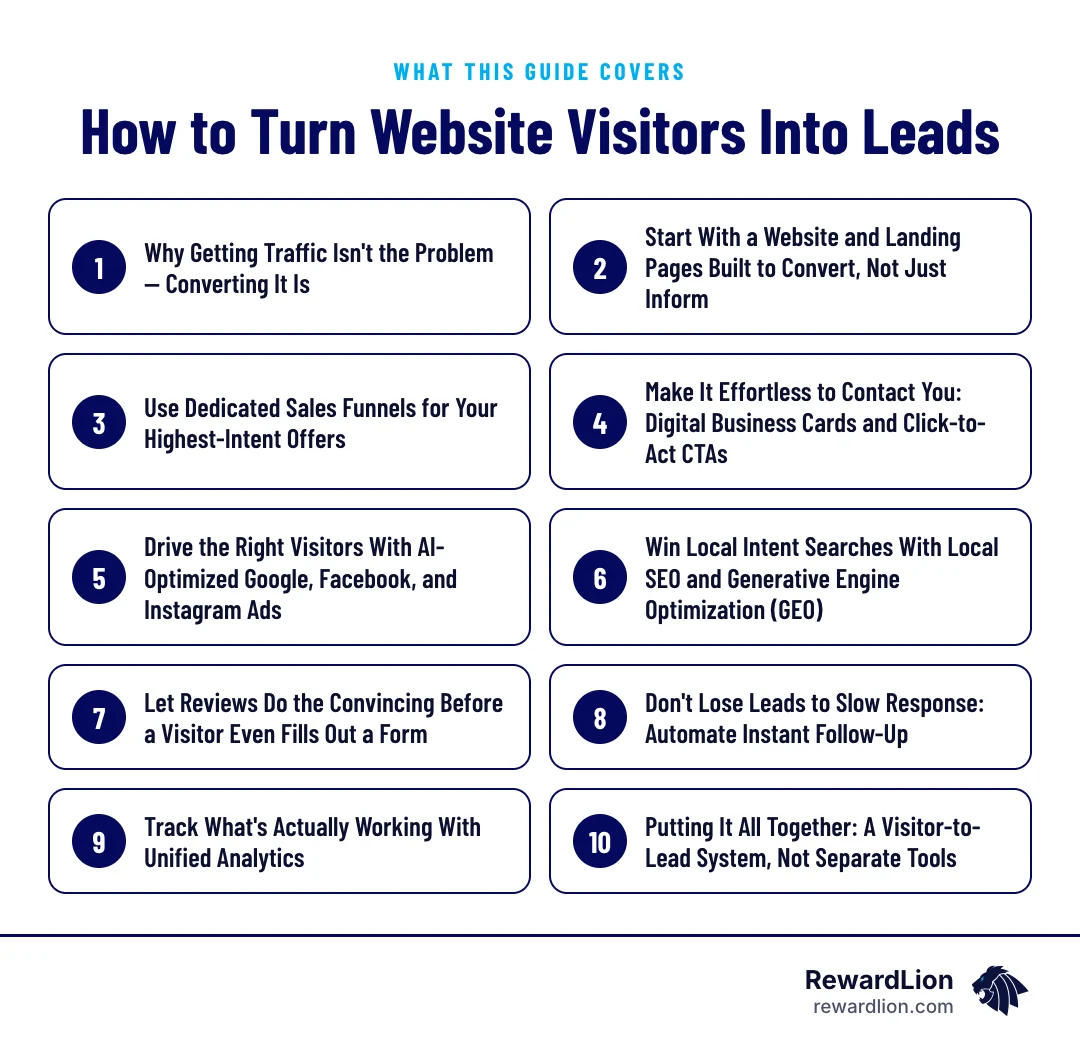
Why Getting Traffic Isn't the Problem — Converting It Is
Where visitors drop off
Many local businesses focus on driving more visitors: more ad spend, more SEO content, more social posts. But most website traffic leaves without converting, regardless of how it arrived. This is standard conversion-rate-optimization reality — a slow page, a confusing layout, or a long form can undo the value of every click you paid for.
Fix the page before buying more traffic
Before spending more to get people to your site, it's worth asking whether your site gives them a clear reason and an easy way to act once they're there. Clear calls to action, minimal-friction forms, and fast load times matter as much as the traffic itself.
A quick self-audit you can do in ten minutes on your own phone:
- Open your homepage on mobile. Is the main action — call, book or request a quote — visible without scrolling?
- Tap the phone number. Does it start a call?
- Fill out your own contact form. How many fields did it ask for, and what happened after you pressed send?
- Check how long the page took to load on a mobile connection.
- Ask someone outside your business to find your pricing, service area and hours. Note where they got stuck.
Start With a Website and Landing Pages Built to Convert, Not Just Inform
A website that looks professional but reads like a brochure isn't doing its job. Every page should answer: what do I want this visitor to do next? For most local businesses, that's calling, booking, or filling out a short form.
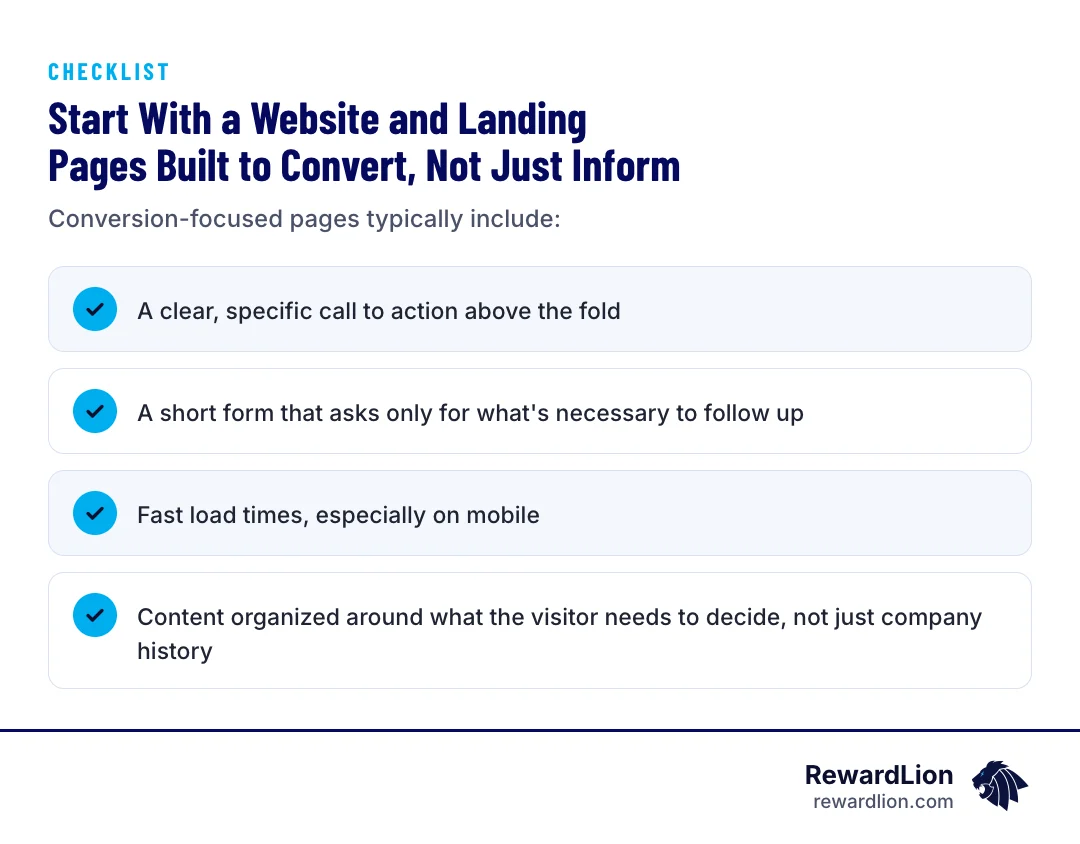
Conversion-focused pages typically include:
- A clear, specific call to action above the fold
- A short form that asks only for what's necessary to follow up
- Fast load times, especially on mobile
- Content organized around what the visitor needs to decide, not just company history
This doesn't mean sacrificing information — it means putting the action in front of the information, not after it.
If your current site was built mainly as an online brochure, a website rebuilt around conversion is often a better investment than more traffic.
Use Dedicated Sales Funnels for Your Highest-Intent Offers
Homepage vs. dedicated page
Your homepage has to serve everyone — new visitors, returning customers, people just browsing. A dedicated landing page or funnel doesn't have that burden. It exists for one offer, one audience, and one action.
When to send traffic to a dedicated page
This is a standard funnel design principle: single-offer pages generally outperform generic homepage traffic for lead capture because they remove distractions and match visitor intent to a single, obvious next step. If you run a promotion, offer a free consultation, or want to capture leads from a specific ad campaign, send that traffic to a dedicated page built for that exact purpose — not your general homepage.
Good candidates for a dedicated page include:
- A paid ad campaign for one service
- A seasonal promotion or limited-time offer
- A free consultation, estimate or assessment
- A specific service in a specific area, such as one city you're trying to grow in
Landing pages and sales funnels built for one offer each make it much easier to see which campaigns produce leads.
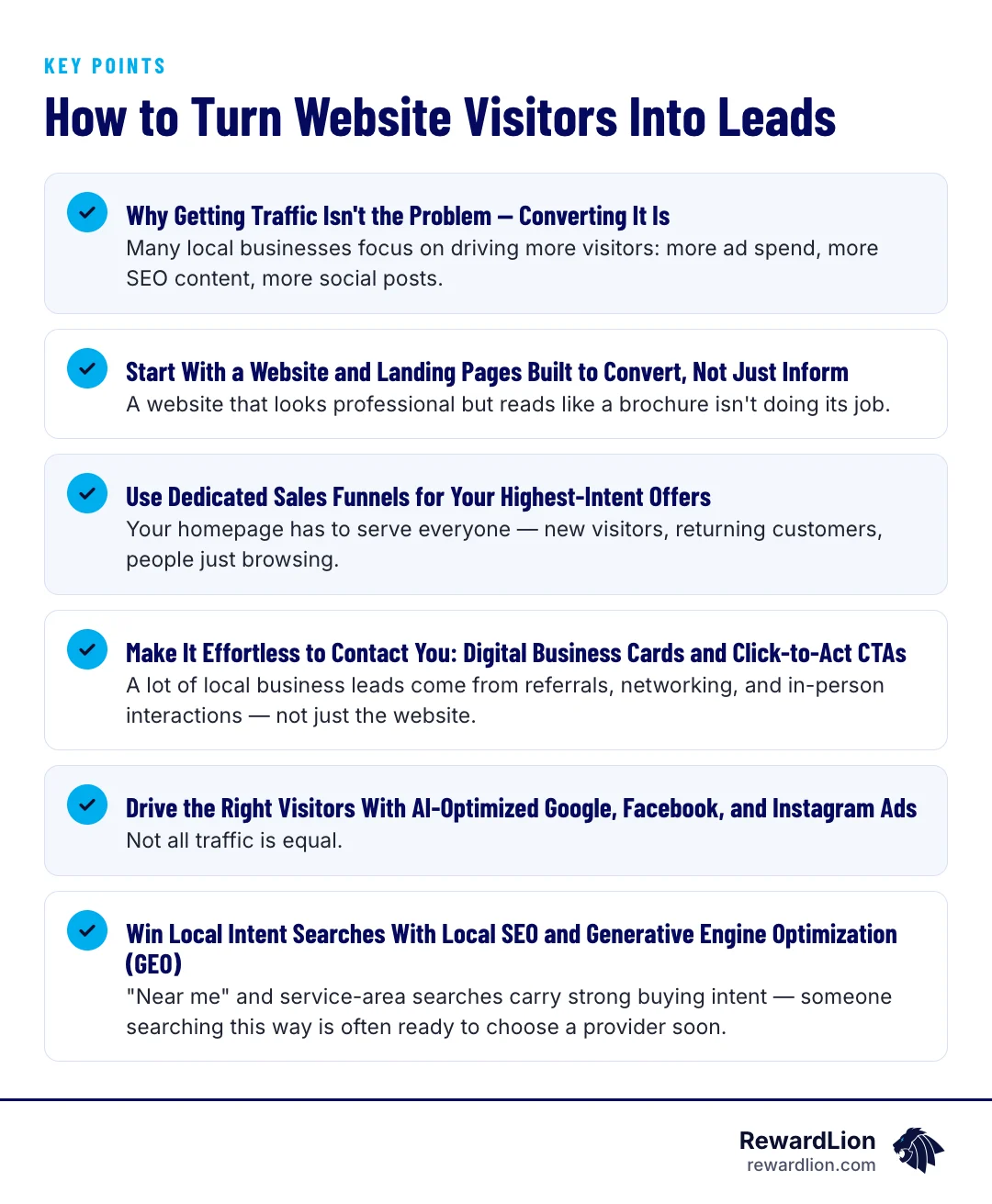
Make It Effortless to Contact You: Digital Business Cards and Click-to-Act CTAs
A lot of local business leads come from referrals, networking, and in-person interactions — not just the website. Digital business cards reduce friction in these moments by letting a prospect save your contact details and click directly into a booking or contact flow, instead of manually typing a phone number or email into their phone.
The same principle applies on your website and ads: every call to action should be one click away from completing, whether that's tapping to call, tapping to text, or tapping to book — not navigating through multiple pages first.
Click-to-act options to offer
- Tap to call — the phone number is a live link on every page
- Tap to text — for customers who prefer messaging over calling
- Tap to book — a booking link that opens straight to available times
- Tap to save — a digital business card that adds your details to the visitor's contacts
Drive the Right Visitors With AI-Optimized Google, Facebook, and Instagram Ads
Not all traffic is equal. A visitor searching with buying intent is worth more than someone who clicked by accident. AI-assisted ad campaigns on Google, Facebook, and Instagram can continuously optimize targeting and bidding toward the audiences most likely to convert, rather than relying on static campaigns that are set once and rarely adjusted.
For local businesses, this means ad spend is directed toward people more likely to actually need your service in your area — which supports everything downstream: your landing pages, your funnels, and ultimately your follow-up process.
Match the ad to the page
Whatever platform you use, the page an ad sends people to should repeat the ad's promise in its headline. If the ad mentions a specific service and area, the landing page should too. A mismatch between ad and page is one of the most common reasons paid clicks don't turn into leads. Our AI Ads Pro campaigns are built with this match in mind.
Win Local Intent Searches With Local SEO and Generative Engine Optimization (GEO)
"Near me" and service-area searches carry strong buying intent — someone searching this way is often ready to choose a provider soon. Local SEO fundamentals, including an optimized Google Business Profile, accurate local citations, and location-specific pages, remain critical for capturing this intent.
At the same time, more consumers are researching locally through AI assistants and chat-based search tools. Generative Engine Optimization (GEO) — making sure your business is accurately represented and cited by these AI answer engines — is an emerging complement to traditional SEO. Together, they help ensure your business shows up wherever local searches are happening, whether that's a search engine results page or an AI-generated answer.
Local visibility basics to cover first
- A complete, accurate Google Business Profile
- Consistent name, address and phone details across directories
- Location-specific pages for the areas you genuinely serve
- Clear, factual answers on your site to the questions customers ask most
See our local SEO services and our guide to optimizing your website for LLMs for more on each.
Let Reviews Do the Convincing Before a Visitor Even Fills Out a Form
By the time someone reaches your contact form, they've often already checked your reviews. Online reviews function as social proof, and actively generating and showcasing recent reviews can reduce hesitation at the decision point.
For local and service businesses, this is especially important — reviews often carry more weight than anything written on your own website, simply because they come from other customers. A steady stream of recent reviews, visible on your site and your Google Business Profile, supports conversion at every stage of the funnel.
Where to show reviews on your site
- Near the main call to action on your homepage
- On each service page, using reviews that mention that service
- On landing pages, right next to the form
- On your contact or booking page, where hesitation peaks
A steady reputation management process keeps fresh reviews coming so these spots never go stale.
Don't Lose Leads to Slow Response: Automate Instant Follow-Up
Capturing a lead is only half the job. Speed to lead — how quickly you respond to a new inquiry — is one of the most well-established principles in sales follow-up. The longer a business waits to respond, the colder that lead gets and the lower the odds of conversion.
Automated follow-up sequences, using text, email, or chat, help ensure no lead goes untouched, especially outside business hours. This is particularly valuable for small businesses without staff available 24/7 to answer every inquiry the moment it comes in.
A simple automated follow-up sequence
- Instant reply — a text or email confirming the request was received and saying what happens next.
- Notify your team — the right person gets an alert with the lead's details.
- Booking link — the follow-up message includes a way to book a time directly.
- Reminders — if the lead doesn't respond, a short series of reminders over the next few days.
- Hand-off — once the lead books or replies, the automation stops and a person takes over.
Marketing automation handles these steps the same way every time, including nights and weekends.
Quick answers from this guide
| Question | Short answer |
|---|---|
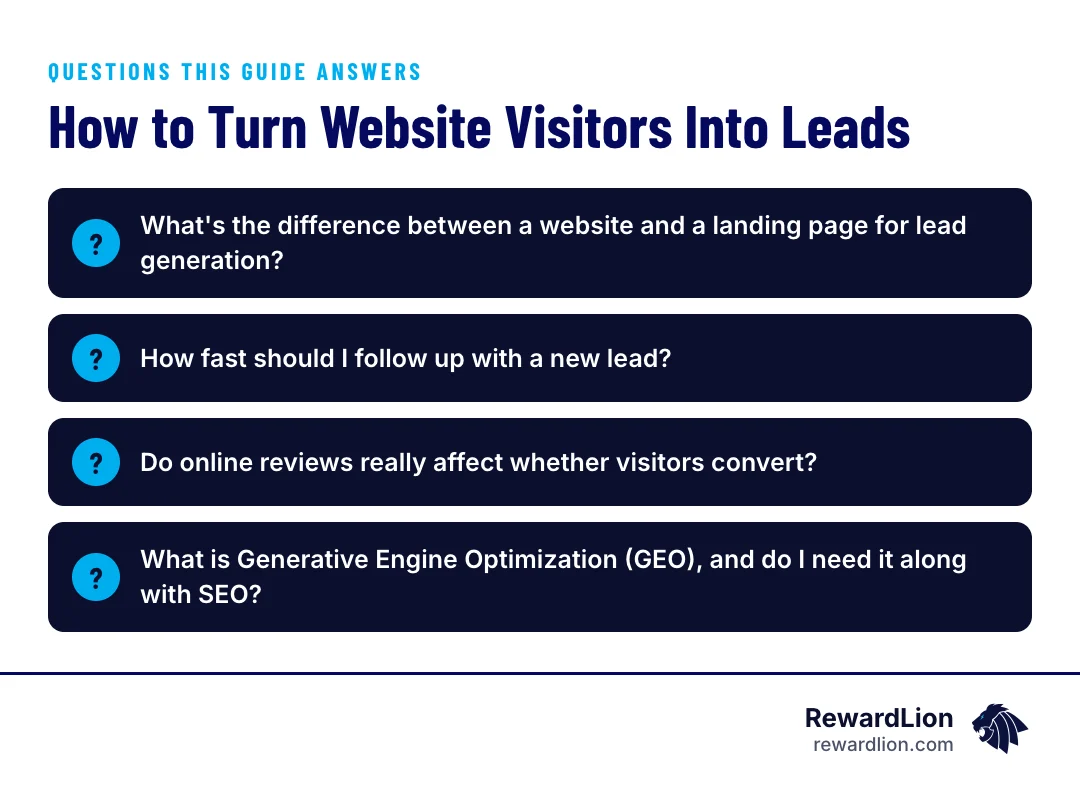
| What's the difference between a website and a landing page for lead generation? | A website typically serves many purposes and visitor types, while a landing page is built around a single offer and a single action. |
| How fast should I follow up with a new lead? | There's no universal guarantee on exact timing, but speed to lead is a well-established sales principle: the longer you wait to respond, the colder the lead gets and the lower the odds of conversion. |
| Do online reviews really affect whether visitors convert? | Reviews act as social proof that many visitors check before filling out a form or calling. |
| What is Generative Engine Optimization (GEO), and do I need it along with SEO? | GEO focuses on ensuring your business is accurately cited by AI answer engines and chat-based search tools, as more consumers use these to research local businesses. |
Track What's Actually Working With Unified Analytics
Without analytics tying ad spend, website behavior, and actual lead or sale outcomes together, it's difficult to know which channels — SEO, paid ads, referrals — are actually producing leads versus just producing traffic. Unified reporting across your website, funnels, and ad campaigns lets you see what's working and where leads are falling through, instead of guessing.
The numbers worth watching
- Visitors by source — SEO, ads, referrals, social
- Conversion rate by page — which pages turn visitors into leads
- Leads by source — where your actual inquiries come from
- Response time — how quickly each lead was contacted
- Booked or closed leads by source — which channels produce customers, not just inquiries
Our guide to analytics platforms for marketing covers how to bring these into one view.
Putting It All Together: A Visitor-to-Lead System, Not Separate Tools
A fragmented stack — a website here, an ad tool there, a separate CRM for follow-up — creates gaps where leads fall through at every handoff point. For local service businesses specifically, the combination of strong local visibility (SEO, GEO, and reviews) with fast, automated follow-up tends to matter more for actual lead conversion than traffic volume alone.
RewardLion builds this as one connected system for local and service businesses: websites and landing pages designed to convert, dedicated funnels for high-intent offers, digital business cards for frictionless contact, AI-optimized ad campaigns, local SEO and GEO for visibility, review generation for trust, automated follow-up for speed, and unified analytics to show what's actually working. The goal isn't more disconnected tools — it's closing the gap between a visitor arriving and a lead being captured and followed up on.
If you'd like a second look at where your own visitors are dropping off, contact our team.
Related reading
- The Lead Capture System Blueprint
- How to Use a Lead Generation Landing Page Builder to Double Conversions
- Lead Capture Solutions That Integrate With Your CRM
- RewardLion lead generation solutions
FAQ
What's the difference between a website and a landing page for lead generation?
A website typically serves many purposes and visitor types, while a landing page is built around a single offer and a single action. Dedicated landing pages generally convert better for specific campaigns because they remove distractions and match the page directly to visitor intent.
How fast should I follow up with a new lead?
There's no universal guarantee on exact timing, but speed to lead is a well-established sales principle: the longer you wait to respond, the colder the lead gets and the lower the odds of conversion. Automated follow-up helps close this gap, especially outside business hours.
Do online reviews really affect whether visitors convert?
Reviews act as social proof that many visitors check before filling out a form or calling. Actively generating and displaying recent reviews is a widely recognized way to reduce hesitation at the decision point, though results vary by business and market.
What is Generative Engine Optimization (GEO), and do I need it along with SEO?
GEO focuses on ensuring your business is accurately cited by AI answer engines and chat-based search tools, as more consumers use these to research local businesses. It's considered a complement to traditional local SEO, not a replacement for it.