Generative Engine Optimization Explained: A Plain-English Guide for Local Businesses
Generative engine optimization (GEO) is the practice of structuring your business information so AI tools like ChatGPT, Google AI Overviews, Perplexity, and Gemini will cite, quote, or recommend you when someone asks a question — instead of (or in addition to) showing up in a list of blue links. If SEO is about ranking on a results page, GEO is about becoming the answer itself.
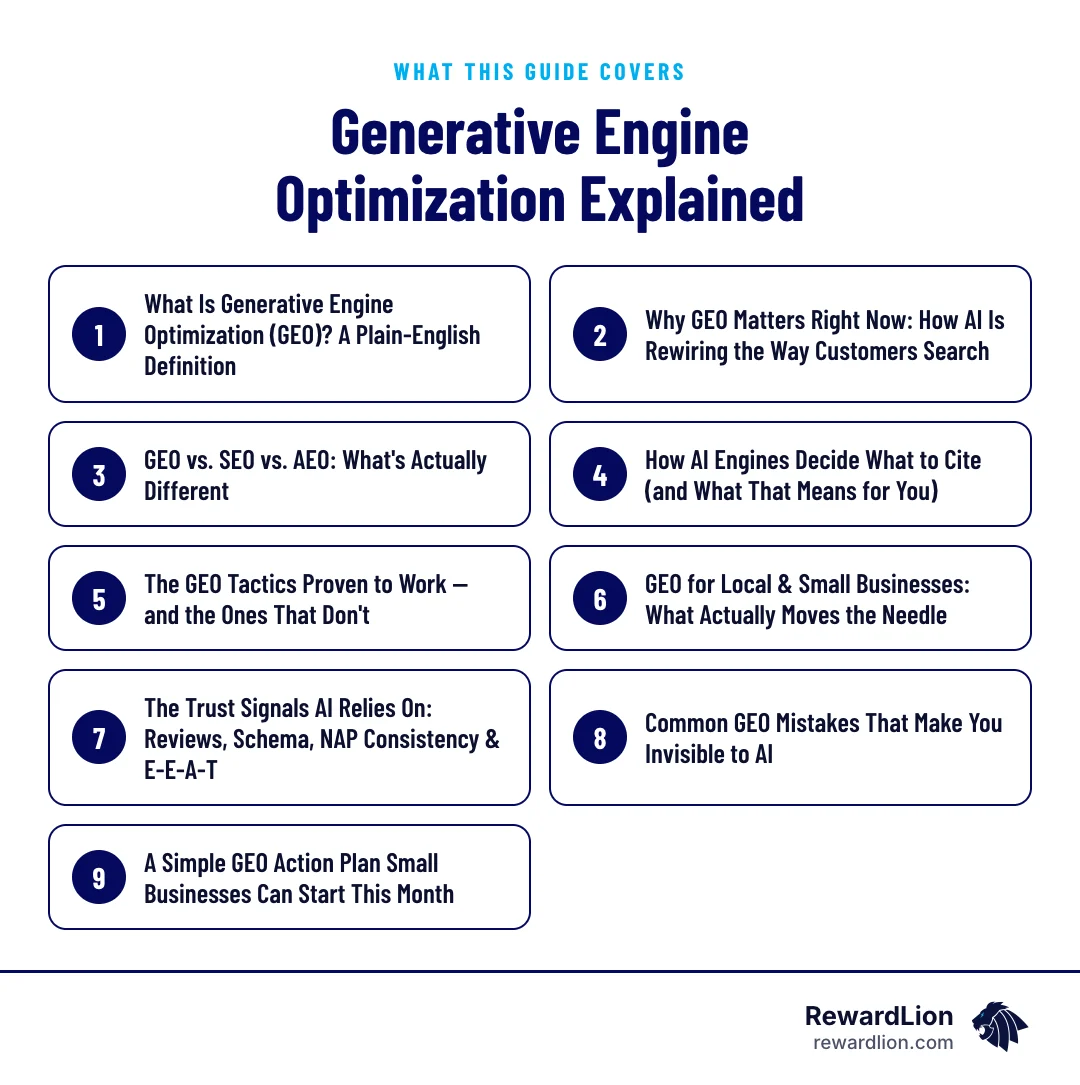
This guide breaks GEO down without the jargon, and shows what local and service businesses can actually do about it.
By the end, you'll know:
- What GEO is, where it came from, and how it differs from SEO and AEO
- How AI engines decide which sources to quote
- Which trust signals a local business controls today
- The mistakes that quietly hide a business from AI answers
- A short action plan you can start this month, plus how to keep it going
What Is Generative Engine Optimization (GEO)? A Plain-English Definition
Where GEO came from
GEO was formally introduced in a 2024 academic paper by researchers from Princeton, Georgia Tech, the Allen Institute for AI, and IIT Delhi, who framed it as a new discipline for improving visibility inside AI-generated answers (Directive Consulting, citing the original arXiv paper).
Ranking vs. being quoted
The core idea: traditional SEO optimizes content to rank well and earn a click. GEO optimizes content so AI engines like ChatGPT, Perplexity, Gemini, and Google AI Overviews will pull it into their generated responses and attribute it to your brand (Directive Consulting; Search Engine Land).
In other words — the goal isn't just to be found. It's to be quoted.
Here's a simple way to picture it. A homeowner asks an AI assistant, "Who does same-week furnace repair near me, and what should I ask before hiring them?" The assistant writes a short answer and names a few businesses. GEO is the work that makes your business one of the names it is confident enough to mention — because your facts are clear, consistent and backed up by other sites.
Why GEO Matters Right Now: How AI Is Rewiring the Way Customers Search
AI answers are now mainstream
AI-generated answers are no longer a niche experience. AI Overviews now trigger on roughly a quarter of all Google searches, a 57% jump versus the prior quarter, making AI-mediated answers a mainstream part of everyday search (Elite Content Marketer).
At the same time, ChatGPT's weekly active user base reached 900 million by February 2026 — more than double the 400 million reported a year earlier (Wellows).
Fewer clicks, more answers
More searches are also ending without a click to any website at all, which means simply ranking on page one isn't enough anymore. If AI answers the question before someone ever sees your listing, you need your business to be part of that answer (Peec AI; Wellows).
For a local business, that changes what "being visible" means. Your Google Business Profile, your reviews and the facts on your website now do double duty: they help you rank in normal results, and they give AI tools the material they need to describe and recommend you.
GEO vs. SEO vs. AEO: What's Actually Different
The three disciplines side by side
SEO, AEO (answer engine optimization), and GEO overlap, but they're not the same thing:
- SEO optimizes for search engine rankings and click-throughs.
- AEO optimizes for direct answers in featured snippets and voice search.
- GEO optimizes for being cited, quoted, or recommended inside AI-generated conversations.
| SEO | AEO | GEO | |
|---|---|---|---|
| Main goal | Rank and earn the click | Be the direct answer | Be cited or recommended in an AI response |
| Where you show up | Search results pages | Featured snippets and voice answers | ChatGPT, Perplexity, Gemini, Google AI Overviews |
| What it leans on | Relevant pages, technical health, links | Clear question-and-answer content | Reputation, third-party mentions, consistent facts, quotable content |
| What a local business should do | Keep pages fast, relevant and well linked | Answer real customer questions plainly | Earn reviews and mentions, keep facts identical everywhere |
Strategy outweighs code
According to Writer.com, GEO is roughly 80% strategic work — brand positioning, third-party presence, authority-building — and only 20% technical. That means reputation and ecosystem presence matter more than code or markup alone (Writer.com).
The good news: GEO builds directly on the same foundation as solid local SEO. You're not starting from zero.
If you already invest in local SEO, most of that work carries straight over.
How AI Engines Decide What to Cite (and What That Means for You)
What the research tested
AI engines don't pull answers out of thin air — they synthesize information from sources they trust. In the original KDD 2024 GEO study, researchers found that optimization tactics could boost a source's visibility in generative-engine responses by up to 40%, with adding quotations producing the single largest lift (+41% on the simulated engine) (Peec AI; Wellows).
Why smaller sites can win
Even more notable: this can level the playing field. In the same study, a 5th-ranked website gained +115% visibility from a citation-based tactic, while the #1-ranked site actually lost visibility (-30%) using the same tactic (Peec AI). Being the biggest or highest-ranked site isn't a guarantee — the content and trust signals matter more.
What that means in practice: a small business that writes clear, quotable, well-sourced answers to the questions its customers ask is not automatically shut out by bigger competitors.
The GEO Tactics Proven to Work — and the Ones That Don't
What helps and what doesn't
What tends to help: clear, quotable, well-sourced content that answers specific questions directly. What doesn't help: keyword-stuffed pages built purely for rankings, with no real information an AI could confidently cite.
A quick quotability check for any page on your site:
- Does the first paragraph answer the page's main question in one or two plain sentences?
- Are your service, your area, your hours and how to book stated as clear facts, not hidden in marketing copy?
- Does the page point to where its claims come from, where that applies?
- Could someone lift a single paragraph and still understand it without the rest of the page?
Earned media beats paid
One data point worth remembering — earned, third-party media (press mentions, reviews, independent sites) supplies the vast majority (84%) of links AI engines actually cite, while paid content supplies only a fraction (0.3%) (Wellows, citing Muck Rack data). You can't buy your way into AI answers. You earn your way in through reputation and third-party validation.
That is why press coverage, local media mentions and independent articles are worth more effort than they used to be. Services such as public relations and authority articles are built around exactly this kind of earned presence.
GEO for Local & Small Businesses: What Actually Moves the Needle
Consistent business facts
For local and multi-location businesses, GEO depends heavily on consistent business facts — your name, address, phone number, hours, and categories — kept identical across your website and every directory. AI engines are far less likely to reliably mention or recommend a business when its data conflicts across the web (Uberall; Seven Seas Web Design).
If you serve several towns without a storefront in each, the same rule applies to how you describe your coverage. Our guide to service area pages explains how to keep your website and your Google Business Profile in agreement.
Answer-first content
Beyond consistency, content that directly answers the questions your customers actually ask performs better in AI citations. That means question-style headings, direct answers near the top of the page, bullet or numbered lists, dedicated FAQ sections, and structured schema markup that helps AI systems extract and quote your information cleanly (LocalIQ; Go Fish Digital).
A good source of questions is your own front desk: the things customers ask on the phone, in emails and in reviews. Each one can become a heading with a short, direct answer underneath.
The Trust Signals AI Relies On: Reviews, Schema, NAP Consistency & E-E-A-T
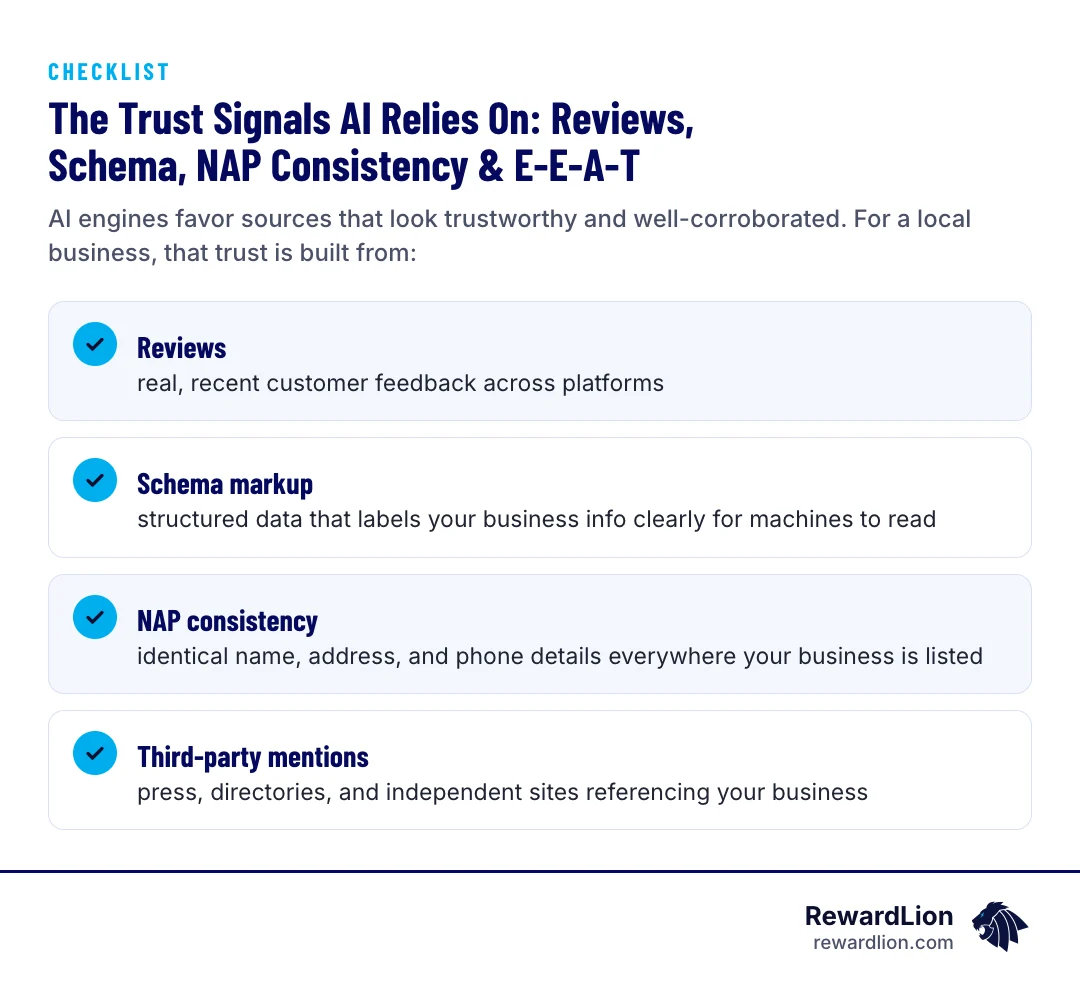
AI engines favor sources that look trustworthy and well-corroborated. For a local business, that trust is built from:
- Reviews — real, recent customer feedback across platforms
- Schema markup — structured data that labels your business info clearly for machines to read
- NAP consistency — identical name, address, and phone details everywhere your business is listed
- Third-party mentions — press, directories, and independent sites referencing your business
These are the same assets that strengthen traditional local SEO — GEO just raises the stakes on getting them right.
Putting each signal to work
| Trust signal | What to do first | How often to revisit |
|---|---|---|
| Reviews | Ask every completed customer for honest feedback through a simple, rule-following review process | Every week |
| Schema markup | Mark up your business name, services, hours, location and FAQs | Whenever your details change |
| NAP consistency | Compare your website, Google Business Profile and main directories line by line | Every quarter |
| Third-party mentions | Pitch local news, industry sites and partner businesses | Ongoing |
Common GEO Mistakes That Make You Invisible to AI
A few mistakes quietly remove businesses from AI answers entirely:
- Inconsistent business listings across directories, which confuses AI engines about which facts are accurate.
- Thin or vague website content that never directly answers a customer's question.
- Blocking AI crawlers by default. For example, Cloudflare began blocking AI bots by default for new sites in July 2025 — a setting that can remove a business entirely from ChatGPT and Perplexity results if it isn't deliberately reconfigured (Reporter Outreach).
- Relying only on paid content instead of earning reviews and third-party mentions.
How to check your crawler settings
- Ask whoever manages your website or hosting whether any bot-blocking or "AI crawler" setting is turned on.
- Open your site's robots.txt file (your domain followed by /robots.txt) and look for rules that block AI crawlers by name.
- Decide deliberately which crawlers you want to allow, rather than leaving a default in place.
- Re-check after any hosting, security or website platform change.
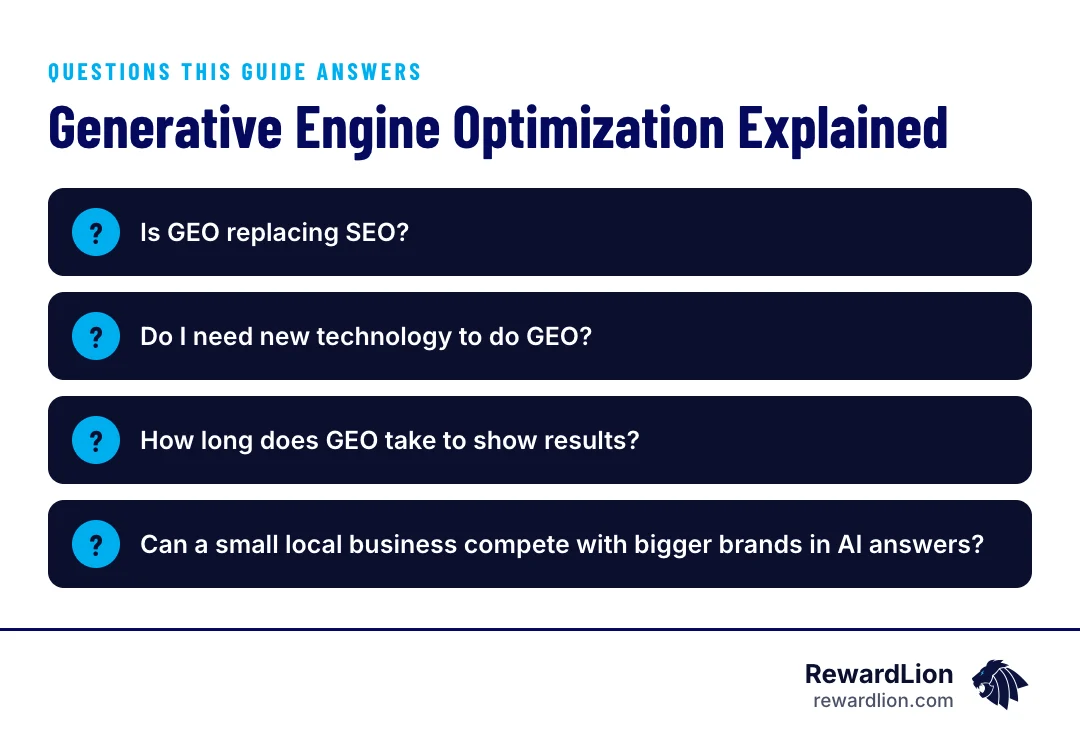
Quick answers from this guide
| Question | Short answer |
|---|---|
| Is GEO replacing SEO? | No. GEO builds on SEO fundamentals — structured content, trust signals, and good local data — rather than replacing them. |
| Do I need new technology to do GEO? | Not necessarily. Much of GEO is strategic work — consistent business information, clear content, and earned trust — rather than new software or tools. |
| How long does GEO take to show results? | There's no fixed timeline, and no outcome can be guaranteed. Consistency across your listings and content is an ongoing practice, not a one-time fix. |
| Can a small local business compete with bigger brands in AI answers? | The original GEO research found that lower-ranked sites can gain significant visibility from certain tactics, sometimes more than top-ranked sites. |
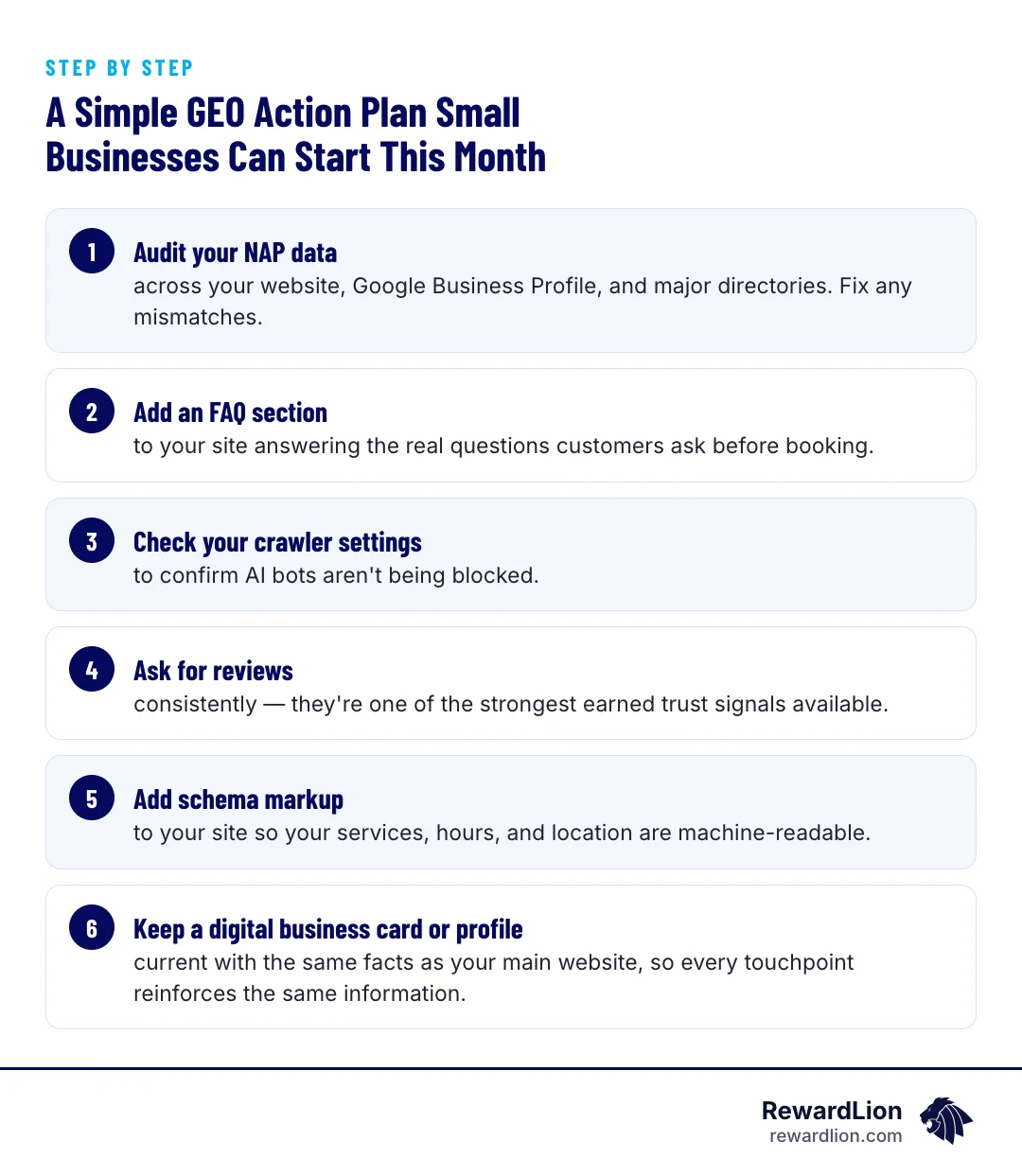
A Simple GEO Action Plan Small Businesses Can Start This Month
- Audit your NAP data across your website, Google Business Profile, and major directories. Fix any mismatches.
- Add an FAQ section to your site answering the real questions customers ask before booking.
- Check your crawler settings to confirm AI bots aren't being blocked.
- Ask for reviews consistently — they're one of the strongest earned trust signals available.
- Add schema markup to your site so your services, hours, and location are machine-readable.
- Keep a digital business card or profile current with the same facts as your main website, so every touchpoint reinforces the same information.
Keeping it going after month one
GEO is not a one-time project. A light routine keeps your information trustworthy:
- Weekly: request reviews from recent customers and reply to new ones.
- Monthly: add or update one FAQ answer based on a question customers keep asking.
- Quarterly: re-audit your listings and your crawler settings, and update your website after any change to hours, services or service area.
- Whenever possible: look for a local publication, partner or industry site that could mention your business.
How RewardLion Builds GEO Into Every Service We Offer
At RewardLion, the local SEO, website structure, digital business cards, review management, and lead follow-up systems we build for clinics, contractors, and service businesses are the same assets that make a business citable in AI answers: consistent NAP data, structured content, real reviews, and a clear, trustworthy online presence. GEO isn't a separate project bolted on top of your marketing — it's a natural result of doing the fundamentals well.
That work runs through our website development and SEO authority programs. If you'd like to know where your business stands today, contact our team.
Related reading
- The Ultimate Guide to Understanding the SEO Impact of LLMs
- AI Search Platform SEO: Why Standard Optimization Isn't Enough Anymore
- Teaching Large Language Models to Love and Cite Your Website
- RewardLion AI Search Pro
FAQ
Is GEO replacing SEO?
No. GEO builds on SEO fundamentals — structured content, trust signals, and good local data — rather than replacing them. Most businesses need both.
Do I need new technology to do GEO?
Not necessarily. Much of GEO is strategic work — consistent business information, clear content, and earned trust — rather than new software or tools.
How long does GEO take to show results?
There's no fixed timeline, and no outcome can be guaranteed. Consistency across your listings and content is an ongoing practice, not a one-time fix.
Can a small local business compete with bigger brands in AI answers?
The original GEO research found that lower-ranked sites can gain significant visibility from certain tactics, sometimes more than top-ranked sites. Rank alone isn't the deciding factor — trustworthy, well-structured content matters just as much.

Sources
- Generative Engine Optimization Explained: A Complete Guide
- What is Generative Engine Optimization (GEO)?
- Generative engine optimization: What we know so far about generative SEO
- Generative engine optimization for small business: How to win with a small budget in 2026
- What is generative engine optimization? The complete 2026 guide
- Generative Engine Optimization (GEO): What It Is & How to Do It
- GEO, AEO, and SEO in 2026: The enterprise guide to AI visibility
- How to Rank in ChatGPT and AI Overviews (2025 Guide)
- AI Search Optimization: AI Overviews & ChatGPT Guide
- 70+ Generative Engine Optimization (GEO) Statistics for 2026
- 59 Generative Engine Optimization Statistics (2026)
- Generative Engine Optimization Statistics (2026) - GEO
- Generative Engine Optimization Statistics: What the Data Says
- GEO for SMBs: What It Is & How to Do It Right
- Your GEO Strategy for Local Marketing
- Generative Engine Optimization for Local Business | 2026 Guide
- GEO: Generative Engine Optimization