Why SEO & LLMs Matter for Your Business
SEO & LLMs work together to help your business appear when people ask ChatGPT, Google AI Overviews, Perplexity, Gemini, and similar tools for answers or recommendations. Traditional SEO helps your pages rank in search indexes. LLM SEO helps AI systems understand, retrieve, and cite the most useful parts of those pages - and your brand across trusted third-party sites.
For a practical starting point:
Make important pages easy to crawl in plain HTML.
Lead each section with a direct, fact-based answer.
Publish original data, clear comparisons, and real expertise.
Keep product details, pricing, and business information current across your website, review sites, and industry listings.
This matters because more research now happens inside AI answers, often without a click to a traditional search result. AI referrals may still be smaller than Google organic traffic for many businesses, but they can bring highly motivated visitors who are already comparing options and looking for a solution.
SEO is no longer only about winning a blue-link ranking. It is also about becoming a source an AI system can confidently use, summarize, and recommend.
I am Mike Ibrahim, Founder and CEO of RewardLion and a marketing leader with more than a decade of experience in growth, sales, e-commerce, and customer acquisition. In this guide, I will break down SEO & LLMs in plain language so you can build visibility without adding more fragmented marketing work.
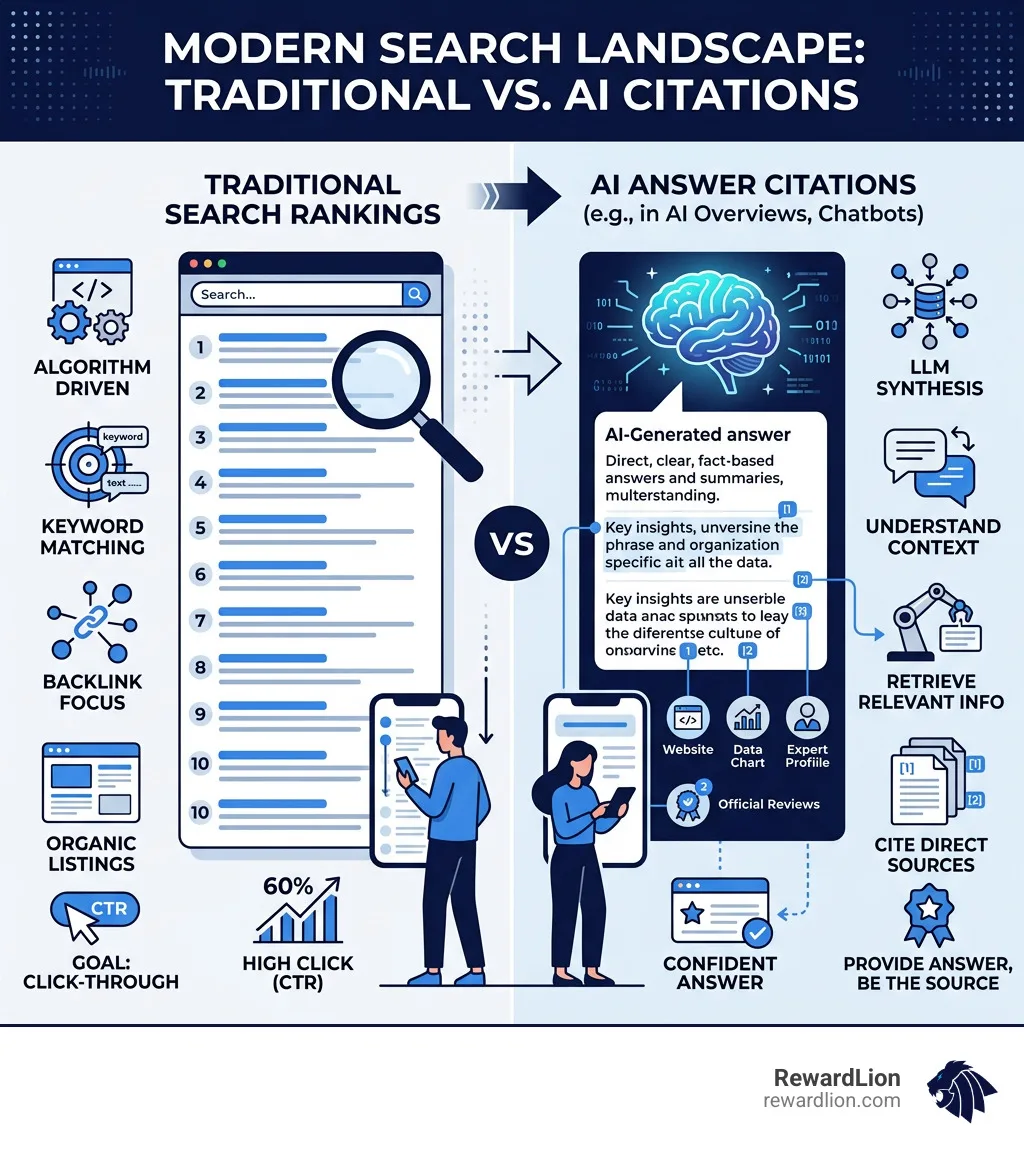
The Evolution of SEO & LLMs in Modern Search
The search landscape is undergoing its most profound transformation since the invention of the web crawler. For decades, marketing teams focused entirely on climbing a list of ten blue links. Today, generative models synthesize full answers directly on the screen, changing user behavior forever.
Around 69% of Google searches now conclude without a traditional click. Gartner projects that traditional search engine query volume will drop 25% by 2026 as conversational AI interfaces absorb discovery queries. Meanwhile, platforms like ChatGPT process 2.5 billion daily prompts across hundreds of millions of active users, and Google AI Overviews appear on more than 25% of all searches.
Dimension | Traditional SERP Optimization | Generative AI Optimization (LLM SEO) |
|---|---|---|
Primary Target | Full-page URL rankings in organic SERPs | Passage-level citation and entity recommendations |
Primary Mechanism | Keyword density, domain backlinks, URL metadata | Semantic vectors, entity salience, RAG extraction |
Traffic Characteristics | Broad top-of-funnel discovery, lower conversion (~1.76%) | Pre-qualified shortlist buyers, high conversion (~15.9%) |
Content Evaluation | Page-level topical relevance and dwell time | Standalone factual clarity, quotes, proprietary data |
Visibility Scope | On-site domain signals and link graphs | 85% off-site brand corroboration and third-party consensus |
While gross referral volumes from AI engines are currently smaller than legacy search indexes, the commercial intent behind them is remarkably high. ChatGPT referrals convert at an astounding 15.9% compared to Google organic’s 1.76%—a ninefold increase in buyer qualification. When an AI engine suggests your brand, it has already done the comparison work for the user.
The Core Mechanics of SEO & LLMs
To understand how language models evaluate your website, we must look past simple keyword matching. Large language models do not view web pages as single blocks of text. Instead, they parse content into semantic passages, evaluate contextual relevance through high-dimensional vector embeddings, and determine whether specific sentences represent factual, citable answers.
Research into Large Language Model Search Engine Optimization highlights that modern search interfaces operate as answer engines. Rather than asking "Which URL has the highest PageRank?", an LLM asks: "Which specific passage provides the most accurate, unambiguous, and corroborated response to this prompt?"
When models read your content, they perform entity extraction. They identify the brand, the product attributes, the authors, and the verifiable facts. If your copy relies on ambiguous fluff or complex corporate jargon, the model's extraction confidence drops, causing it to pass over your page in favor of a source that states the answer plainly.
Traditional Search vs. Generative Engine Optimization
Traditional search optimization relies heavily on matching string keywords and accumulating domain authority through backlink networks. In contrast, Generative Engine Optimization (GEO) focuses on information architecture, modular passage design, and multi-source corroboration.
Our team often gets asked how to optimise your website for LLMs without destroying current search rankings. The reality is that the two disciplines reinforce one another.
When an LLM prepares a response, it pulls top-performing URLs from search indexes, breaks those documents into distinct chunks, scores each chunk for semantic directness, and synthesizes the most authoritative excerpts into the final output. If your page ranks organically but buries its core facts beneath conversational filler, you will win the classic indexation battle while losing the generative citation war.
How AI Models Discover, Retrieve, and Ground Content
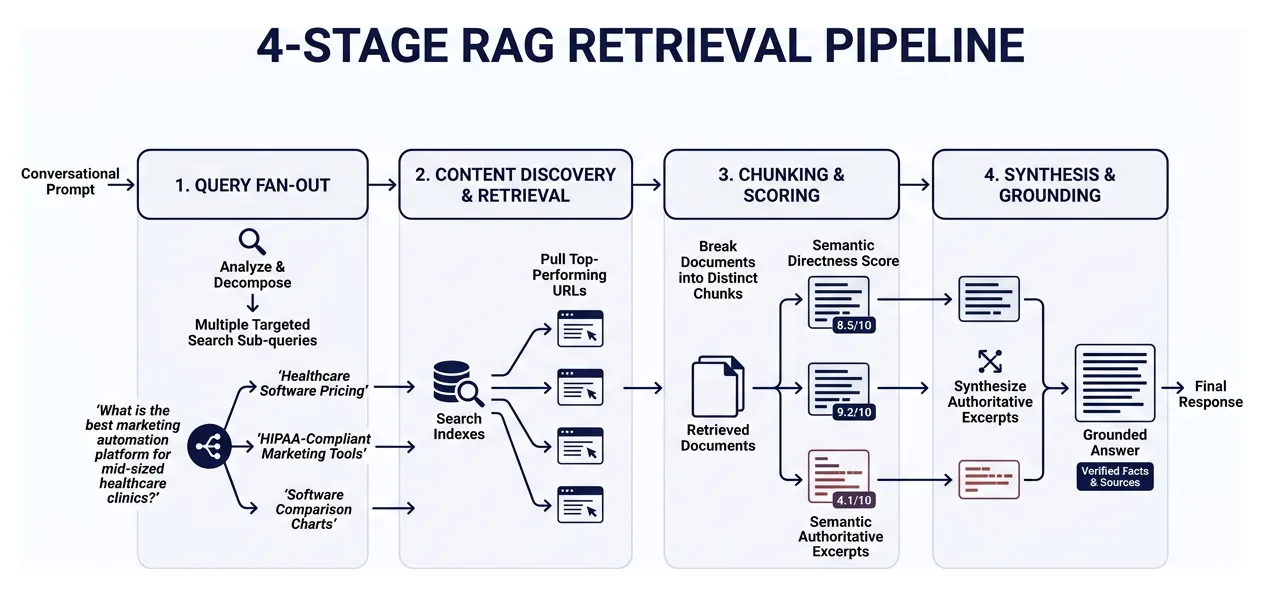
Understanding how an AI generates a response prevents costly marketing missteps. When a buyer enters a prompt, the system does not simply query a static database of historical text; it initiates a dynamic Retrieval-Augmented Generation (RAG) pipeline.
This retrieval process unfolds in four distinct stages:
Query Fan-Out: The AI engine analyzes the conversational prompt and decomposes it into multiple targeted search sub-queries. A prompt like "What is the best marketing automation platform for mid-sized healthcare clinics?" fans out into separate queries regarding healthcare software pricing, HIPAA-compliant marketing tools, and software comparison charts.
Document Retrieval: The engine queries underlying search indexes (predominantly Bing for ChatGPT and Google for Gemini/AI Overviews) to pull the top candidate web pages for each sub-query.
Passage Chunking and Scoring: Retrieved HTML documents are stripped of unnecessary code and divided into 150- to 200-word passages. The model evaluates each chunk for factual density, semantic clarity, and source authority.
Synthesis and Grounding: The model synthesizes the highest-scoring chunks into a cohesive narrative, attributing citations to the specific domains that supplied the foundational facts.
Dual Pathways: Parametric Memory vs. Live RAG Retrieval
Every AI platform relies on two distinct pathways to surface information:
Parametric Memory (The Training Data Pathway): This represents the internal knowledge encoded into the model's neural weights during its multi-billion-token pre-training runs (ingesting sources like Common Crawl, Wikipedia, and verified digital archives). Winning visibility in parametric memory requires long-term brand equity, sustained media coverage, and historical entity presence across the web.
Live RAG Retrieval (The Real-Time Pathway): This occurs at query execution time. The model searches the live web, indexes fresh content, and extracts real-time answers. Live retrieval is where technical optimization, content freshness, schema markup, and crawl accessibility yield rapid results.
Brands that ignore either pathway cut their visibility potential in half. Parametric memory gives the model baseline confidence that your brand exists, while live retrieval feeds it the exact, up-to-date specifications required to cite you in real-time purchasing conversations.
The Critical Role of Bing and Search Index Feeding
A surprising blind spot for many digital marketers is neglecting alternative search indexes. While Google retains massive global volume, Bing powers the live search backend for ChatGPT’s browsing features.
If your website suffers from indexing issues, canonical errors, or sitemap omissions in Bing Webmaster Tools, you remain practically invisible to hundreds of millions of ChatGPT users searching for vendor recommendations. Ensuring complete indexation across both Google and Bing is the absolute technical baseline for modern AI discovery.
Proven Content Structures and On-Page Factors That Win Citations

Large language models prioritize documents structured for algorithmic extraction. AI bots do not read articles linearly from start to finish like humans; they scan for modular chunks that can resolve specific user queries without requiring broader context.
Academic research in Generative Engine Optimization indicates that specific on-page optimizations drastically improve citation likelihood:
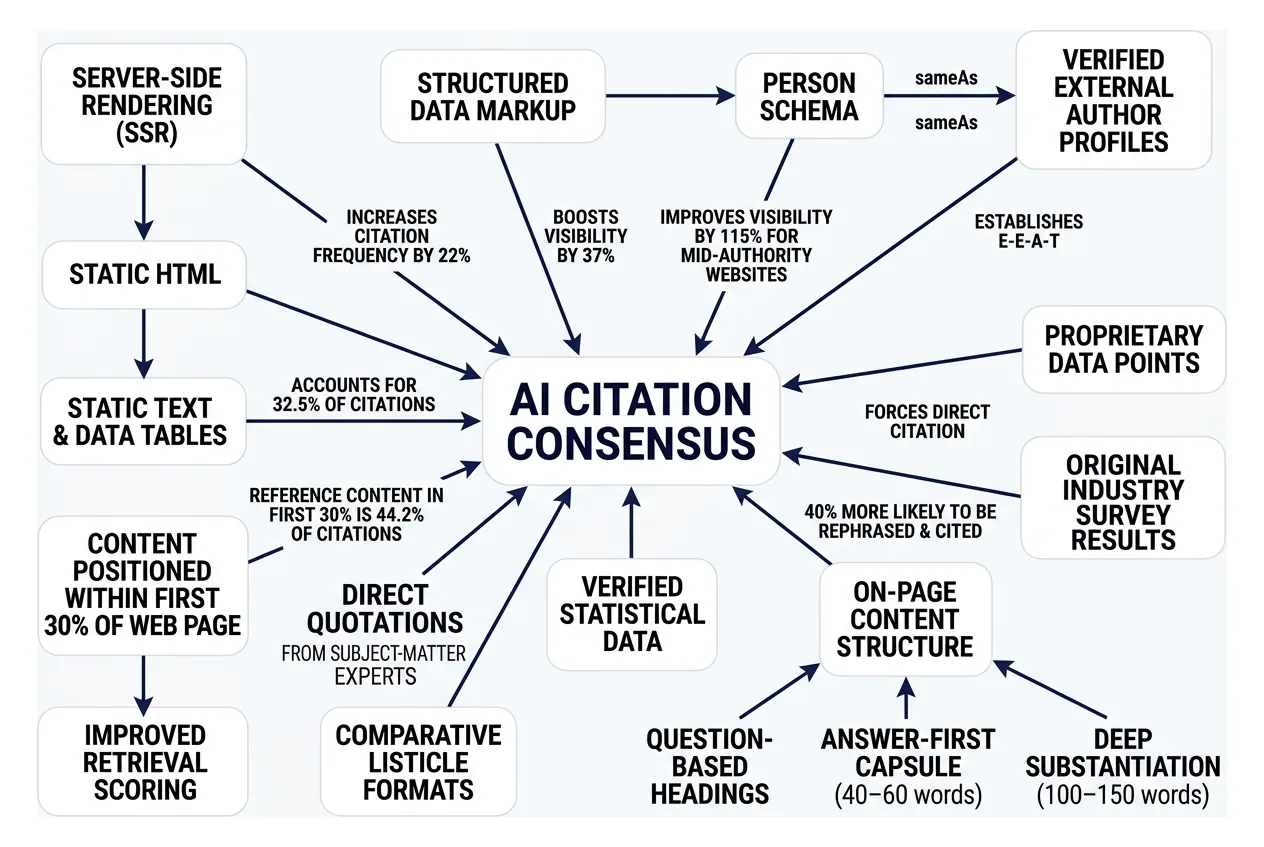
Including verified statistical data increases AI citation frequency by 22%.
Integrating direct quotations from recognized industry subject-matter experts boosts visibility by 37%.
Adding structured references and external citations improves visibility by 115% for mid-authority websites.
Comparative listicle formats (such as "Best X for Y") account for 32.5% of all AI citations.
Furthermore, location matters: 44.2% of all citations reference content positioned within the first 30% of a web page. If your primary answer is buried five paragraphs beneath introductory storytelling, retrieval algorithms will discard it before scoring its relevance.
Structuring Data for Extraction and Passage Scoring
To secure consistent citations, structure your informational pages using the Answer Capsule Framework. Each core section should function as an independent, modular Q&A unit:
Question-Based Headings: Use explicit H2 and H3 headings matching real natural-language buyer prompts (e.g., "How Much Does Enterprise AI Automation Cost?").
Answer-First Capsule (40–60 words): Deliver a direct, factual answer in the first two sentences immediately beneath the header. Avoid backward-referencing pronouns like "as mentioned above" or "this approach"; state the entity, the action, and the outcome explicitly.
Deep Substantiation (100–150 words): Provide granular context, supporting data, and step-by-step methodologies.
Structured Tables and Bulleted Lists: Summarize comparisons, pricing tiers, or feature matrices in clean HTML tables. Content structured with consistent heading hierarchies is 40% more likely to be rephrased and cited by generative engines.
Following a comprehensive guide to ranking in AI search ensures your site adheres to the structural formats AI systems prioritize.
Integrating Original Research, Data, and Expert Authority
Generative models strive to avoid factual hallucinations. When multiple websites repeat generic advice, the model synthesizes the concept without attributing credit to any single domain—a phenomenon known as a "ghost citation."
To force an engine to cite your domain directly, you must publish proprietary data points that exist nowhere else. When an AI needs to cite a specific statistic—such as a proprietary industry benchmark or survey result—it has no choice but to link directly to your URL as the originating source.
Pair proprietary research with transparent author entity signals. Utilize Person schema markup that links your contributors to verified external profiles via sameAs properties, establishing unmistakable Experience, Expertise, Authoritativeness, and Trustworthiness (E-E-A-T).
Technical Foundation and Off-Site Signals for AI Visibility
Winning in AI search requires equal attention to backend machine readability and cross-web brand validation. If your technical architecture blocks AI crawlers, or if your off-site footprint is nonexistent, on-page optimizations will fail to deliver results.
Crawlability, Static Rendering, and Schema Markup
One of the most catastrophic yet widespread technical failures in AI optimization is client-side JavaScript rendering. Almost no AI retrieval bots execute complex JavaScript during live RAG retrieval runs. If your content requires client-side hydration to appear in the DOM, AI crawlers will see an empty page.
Server-Side Rendering (SSR) & Static HTML: Ensure all critical text, data tables, and informational sections are rendered directly in the initial raw HTML payload.
Robots.txt Permissions: Verify that your web servers do not inadvertently block key AI search crawlers. You should explicitly allow user-facing search bots including
OAI-SearchBot,PerplexityBot,Claude-SearchBot, andGoogle-Extended.Schema.org Integration: Deploy valid JSON-LD schema across all pages, emphasizing
Article,FAQPage,HowTo, andOrganizationmarkup. Structured data reduces semantic ambiguity, allowing retrieval engines to parse entity relationships instantly.Server Response and FCP: Maintain a First Contentful Paint (FCP) under 0.4 seconds. Pages meeting this performance threshold average 6.7 citations compared to just 2.1 citations for slower sites.
Visible Timestamps: Include clean
datePublishedanddateModifiedmetadata. Models strongly prioritize fresh data; content updated within the past two months earns 28% more citations than older material.
Off-Site Brand Authority and Third-Party Consensus
Here is an uncomfortable reality of modern AI discovery: for broad category queries, approximately 85% of citations come from off-site sources, not your own website.
Generative models rely heavily on third-party corroboration to confirm that a company is reputable before recommending it. Brands are 6.5 times more likely to be cited through an authoritative third-party page than through their own domain alone.
To build unstoppable off-site consensus:
Cultivate Review Profiles: Maintain active, verified listings across industry directories (G2, Capterra, Trustpilot, Google Business Profile).
Participate in Community Hubs: Models frequently ingest discussions from Reddit, specialized forums, and developer communities to gauge genuine user sentiment.
Secure Placements in Authoritative Listicles: Ensure your software or service is featured within third-party comparison guides across top industry publications. Sites present across four or more independent platforms are 2.8 times more likely to appear in ChatGPT category recommendations.
Unify Entity Signals: Ensure your corporate name, address, leadership bios, and core service descriptions remain perfectly identical across all digital directories.
For regional enterprises, combining these digital entity signals with targeted local SEO domination ensures AI assistants surface your business for geographic prompts.
Strategic Execution: Tracking, Auditing, and Avoiding Costly Mistakes
Deploying a modern AI visibility strategy requires operational discipline. Rather than relying on disconnected tactics, forward-thinking organizations implement structured workflows that continuously measure, optimize, and protect their brand presence across generative interfaces.
Practical Implementation of SEO & LLMs for Modern Marketers
To systematically capture market share in generative engines, marketing teams should execute a repeatable 90-day implementation cadence:
Days 1–30 (Baseline Audit & Technical Remediation): Unblock AI crawlers in your server configurations, transition money pages to server-side static HTML, validate structured schema, and benchmark your current brand citation rate across major engines.
Days 31–60 (Content Architecture & Proprietary Research): Re-engineer priority content assets using the Answer Capsule framework. Publish an original benchmark report or proprietary survey to establish an unassailable data anchor.
Days 61–90 (Off-Site Expansion & Continuous Iteration): Seed brand mentions across high-signal review platforms, participate in industry community hubs, and refresh temporal data points.
Organizations seeking end-to-end growth often rely on comprehensive SEO authority strategies that unify on-page engineering, content production, and digital PR into a single operational system.
Tracking AI Visibility, Citation Accuracy, and Pipeline Impact
Because LLMs generate dynamic, non-deterministic responses, tracking generative visibility differs from tracking traditional rank positions. Approximately 70% of response content varies between repeated runs of identical prompts, and only 30% of brands maintain visibility across back-to-back queries without proactive maintenance.
To track generative impact accurately:
Isolate AI Referrals in GA4: Configure custom channel groupings to aggregate sessions from domains like
chatgpt.com,android-app://com.openai.chat,perplexity.ai, andgemini.google.com.Deploy Prompt Panels: Establish a monthly testing matrix of 50 to 100 conversational buyer prompts across ChatGPT, Perplexity, Gemini, and Claude to monitor Share of Voice (SoV) and citation accuracy.
Capture Self-Reported CRM Attribution: Add an open-text "How did you first hear about us?" field to your demo and contact forms. High-intent buyers frequently state "ChatGPT recommended your platform"—a critical conversion signal that traditional cookie-based analytics miss.
Audit Citation Accuracy: Monitor how engines describe your pricing, feature sets, and target customer profiles. If an AI misstates your core offering, it can derail enterprise sales conversations before leads reach your pipeline.
Critical Pitfalls That Sabotage AI Visibility
Avoid these five widespread mistakes that undermine visibility across generative search engines:
Publishing Generic AI Content: Flooding your domain with unedited, AI-generated blog posts creates zero citation value. Models seek novel, human-authored facts and skip generic text.
Blocking AI Crawlers via CDN Defaults: Many enterprise firewalls and CDNs quietly block automated crawlers by default, severing your website from live retrieval pipelines.
Allowing Content to Stale: Approximately 65% of AI crawl activity targets material published or refreshed within the past twelve months. Stale pages lose citation eligibility rapidly.
Focusing Solely on Your Own Domain: Neglecting digital PR, review portals, and third-party listicles leaves you invisible across 85% of AI retrieval pathways.
Treating LLM Optimization as a Disconnected Channel: Generative visibility relies on search index grounding. Isolating AI tactics from your broader organic search foundation guarantees underperformance.
Frequently Asked Questions About SEO and Generative AI
Does optimizing for LLMs replace traditional organic SEO?
No. Optimizing for language models expands and modernizes traditional SEO rather than replacing it. Generative search engines rely directly on traditional search indexes to find sources during live RAG retrieval; for instance, Google AI Overviews cite top-10 organic results over 93% of the time, and ChatGPT relies on Bing's search index.
A high-performing organic foundation is a mandatory prerequisite for generative citations. Businesses must deploy holistic digital solutions that align technical search fundamentals with generative extraction standards.
How long does it take to see citations and traffic from AI engines?
Technical enhancements—such as unblocking crawlers in robots.txt, implementing server-side rendering, and deploying structured schema—often yield initial citations within 30 to 60 days as AI bots re-index your pages.
Earning widespread, authoritative citations for competitive category queries typically requires 3 to 6 months of sustained publishing, proprietary data distribution, and third-party brand building.
How do I correct inaccurate or hallucinated brand information in AI answers?
To correct hallucinations or outdated business information in AI responses, you must address the underlying consensus sources:
Update Authoritative Brand Anchors: Ensure your pricing, service definitions, and product features are clearly stated in static HTML on your primary website and marked up with valid Organization schema.
Correct Third-Party Profiles: Update outdated descriptions across high-weight entity directories, including Crunchbase, Wikidata, G2, Capterra, and verified industry platforms.
Distribute Verified Digital PR: Publish authoritative press releases and articles to establish fresh, indexable documentation that AI retrieval models can use to overwrite outdated information.
Conclusion: Dominating the New Era of AI Discovery
The convergence of search engines and generative AI represents a permanent shift in how consumers discover solutions and how enterprise buyers evaluate vendors. The organizations winning the largest share of high-converting pipeline in 2026 are not those trying to manipulate legacy keyword algorithms, but those engineering their digital footprint to be effortlessly parsed, trusted, and cited by intelligent machines.
Winning this new frontier requires technical precision, authoritative passage structuring, proprietary data publishing, and broad off-site brand consensus.
At RewardLion, we remove the complexity of managing disconnected tools and fragmented agencies. Our AI-powered operating system, combined with our dedicated expert teams, deploys fully connected growth engines that dominate traditional search, generative AI platforms, and local markets simultaneously. Explore our platform today to claim your brand's rightful authority across the next generation of search.