Introduction
AI search platform SEO is the practice of structuring, verifying, and distributing content so large language models such as ChatGPT, Gemini, and Perplexity cite your brand as an authority inside synthesized answers. Standard optimization is no longer enough because generative engines do not simply rank pages; they retrieve, compare, and summarize information from multiple sources, which means visibility now depends on earning citations in AI-generated responses rather than just holding a top position on a traditional results page.
Search behavior has shifted dramatically. Where search engines once offered a clean list of ten blue links, generative engines now summarize the web in real time. In 2026, AI assistants such as ChatGPT and Claude handle at least 10% of all searches made in the US, while Google AI Overviews appear on more than 40% of search queries.
Buyers no longer sift through several pages of results when an answer engine can synthesize solutions, compare competitors, and extract pricing in seconds. Bain & Company research indicates that 95% of US companies now use AI tools—a jump of 12 percentage points in just a single year. Furthermore, nearly 89% of B2B buyers rely on generative AI tools at some stage during their evaluation cycle.
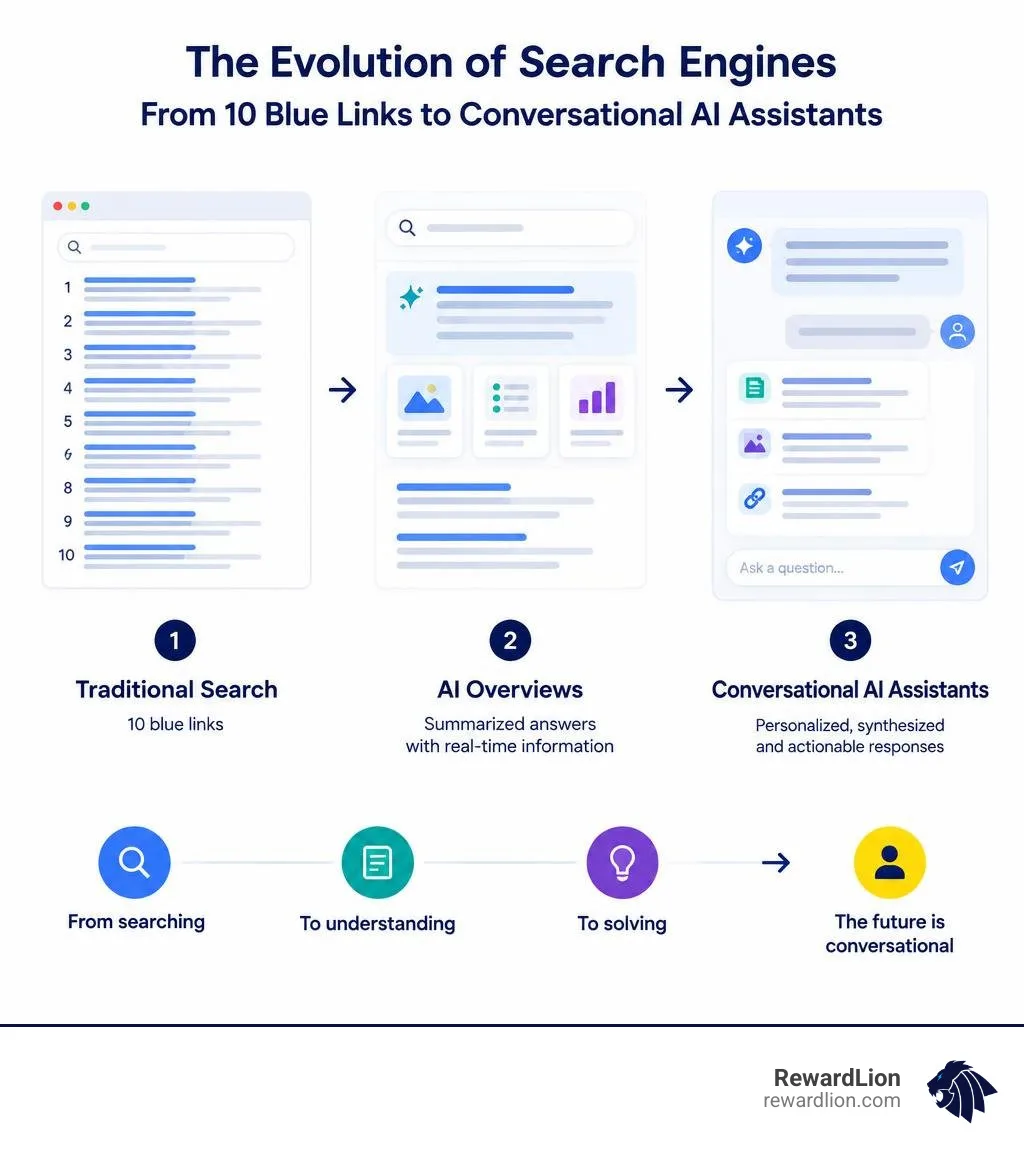
To maintain visibility, businesses must expand beyond traditional search rankings and understand how AI platforms select, summarize, and cite online content.
What Is AI Search Platform SEO and How Does It Differ from Traditional SEO?
AI search platform SEO (often called Generative Engine Optimization or GEO) is the process of structuring, verifying, and distributing content so large language models (LLMs) cite your brand as an authority. While classic search engine optimization focuses on positioning specific URLs at the top of a Search Engine Results Page (SERP), generative optimization focuses on earning citations inside synthesized answers.
Traditional search relies on keyword matching, page-level backlinks, and technical indexation. Generative search engines rely on semantic entity mapping, Retrieval-Augmented Generation (RAG), and source corroboration across multiple independent platforms.
Evaluation Metric | Traditional Organic SEO | AI Search Platform SEO (GEO/AEO) |
|---|---|---|
Primary Discovery Mechanism | Keyword index matching & PageRank | RAG extraction, entity relationships & embeddings |
Optimization Focus | Metadata, target keywords, URL backlinks | Unambiguous factual answers, schema & co-citations |
Success Metrics | SERP rank positions, impressions, organic CTR | Citation frequency, model share & sentiment context |
Content Structure | Long-form articles optimized for keyword density | Direct-answer prose, structured tables & scannable data |
User Interaction | Single search queries leading to external site clicks | Multi-turn conversational dialogue with zero-click answers |
The Shift from Blue Links to Generative Syntheses
Traditional search sessions are transactional: a user searches, scans links, clicks a result, and navigates back if the page fails to deliver. Conversational search changes this dynamic. ChatGPT users spend an average of 13+ minutes per session exploring follow-up questions, compared to 6+ minutes on traditional Google Search.
These multi-turn interactions compress research timelines. A prospect who once spent weeks reviewing whitepapers can now prompt an engine: "Compare the top three marketing automation platforms for a mid-market healthcare company." The engine delivers a comparative summary right away. Adapting your digital footprint requires optimizing website architecture for SEO LLMs so your core differentiators appear clearly during model synthesis.
Ranking Factors vs. Citation Triggers in Large Language Models
LLMs do not assess web pages the same way standard crawlers do. Instead of tracking exact-match keywords, they look for semantic confidence and factual consistency across the web.
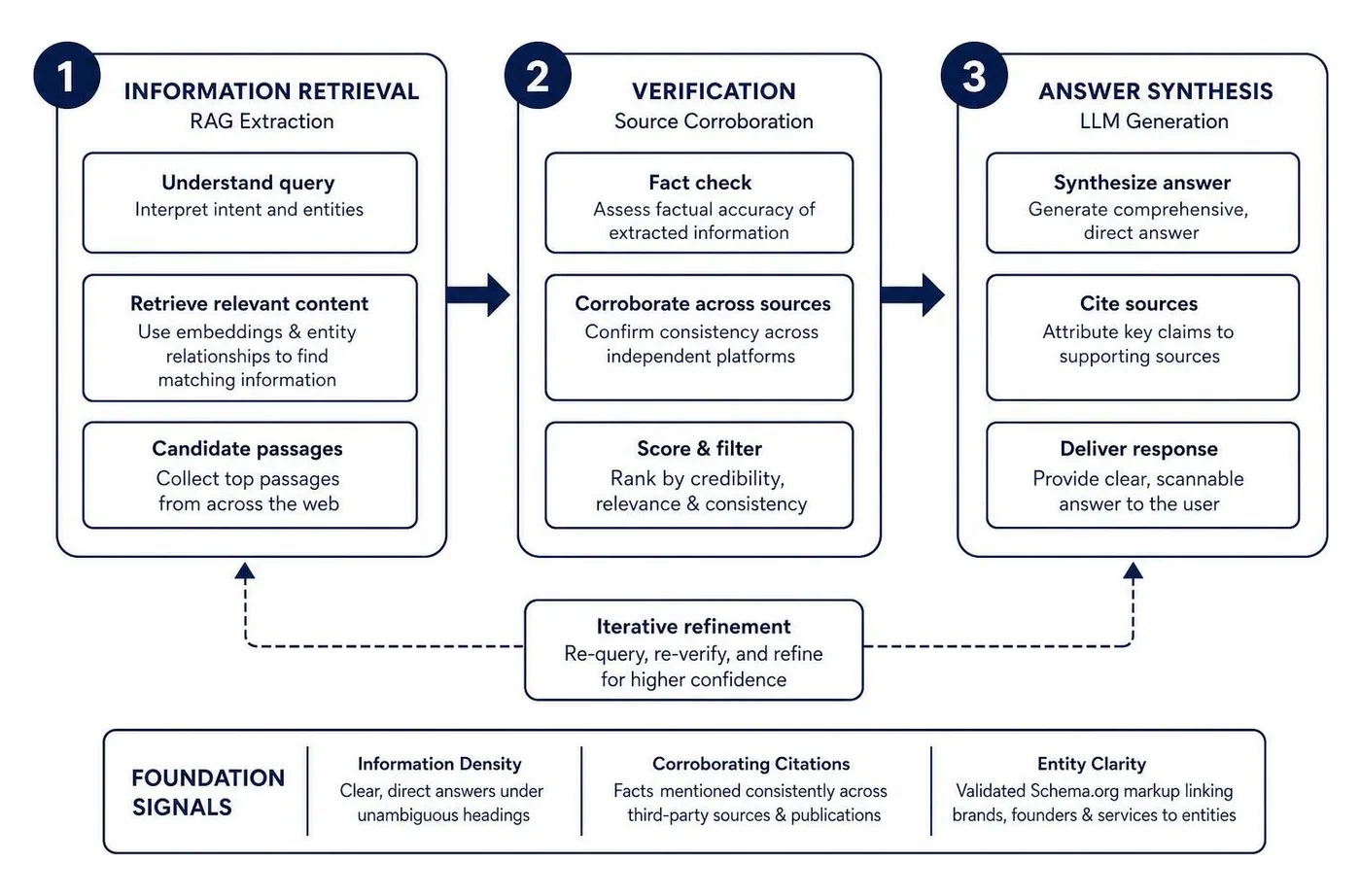
Key citation triggers include:
Information Density: Clear, direct answers placed under unambiguous H2 and H3 headings.
Corroborating Citations: Brand facts mentioned consistently across third-party sources, directories, and industry publications.
Entity Clarity: Validated Schema.org markup linking brands, founders, and services to clear entity definitions.
Following a clear framework on how we optimise our website for LLM discovery ensures that AI crawlers can easily parse, verify, and cite your brand data.
Comparative Breakdown of the Leading AI Engines
The AI search market has expanded into a multi-platform ecosystem with distinct search habits across engines.
Over the past twelve months, ChatGPT's market share shifted from 86.7% to 64.5%, while Google Gemini expanded nearly fourfold to 21.5%. Specialized tools like Perplexity maintain a 2.5% market share focused heavily on technical, research-driven queries.
Search Platform | Estimated Reach | Primary Search Intent | Citation Mechanics | Conversion Profile |
|---|---|---|---|---|
ChatGPT (Search) | ~800M Weekly Actives | Problem-solving, planning, buying evaluations | Select inline web citations via live search crawling | High conversion rate; high intent traffic |
Google Gemini / AIO | ~520M Monthly Actives | Everyday discovery, local services, broad research | Knowledge Graph & top-ranking organic URLs | High volume; broad awareness reach |
Perplexity AI | ~15M Monthly Actives | Academic research, technical vetting, validation | Source-first numbered citations for every claim | Very high conversion among technical buyers |
Microsoft Copilot | Enterprise-integrated | Enterprise workflows, data analysis, B2B procurement | Direct integration with Bing index and MS Graph | High B2B value from enterprise workspaces |
Core Tactics for AI Search Platform SEO Across ChatGPT and Gemini
Reaching ChatGPT's 800 million weekly active users and Gemini's 520 million monthly users requires targeted adjustments:
For ChatGPT Visibility: The platform prioritizes reputable domains with strong backlink profiles, clear brand footprints, and structured topical authority. Integrating dedicated tools like AI Search Pro helps brands monitor their presence across conversational threads.
For Google Gemini & AI Overviews: Gemini relies heavily on Google's Knowledge Graph, standard organic top-10 rankings, and multimodal assets (including video transcripts and structured product schemas). If a page ranks in the top five organic results, its probability of appearing in an AI Overview increases significantly.
Optimizing for Perplexity, Copilot, and Privacy-Focused AI Engines
Perplexity functions with an explicit citation-first architecture. It extracts direct statements, bullet points, and data tables to build source-backed answers.
To improve pickup across Perplexity, Copilot, and privacy-first engines like Brave Search:
Provide Clear Data Points: Place exact metrics, pricing details, and feature comparisons high up on your key pages.
Support Machine Extraction: Platforms like Ray9 — turn any website into a live, structured dataset illustrate why clean, structured data is essential for modern search crawlers and data pipelines.
Synchronize Bing Indexing: Ensure your technical setup is verified in Bing Webmaster Tools, which powers citations across Microsoft Copilot and various enterprise tools.
Technical and Content Architecture for Maximum AI Engine Visibility
Securing consistent citations requires both clean technical access and structured content. If AI crawlers are blocked in your technical configuration, models must rely on older training data or third-party mentions rather than your direct site copy.

Verify that your robots.txt file grants crawling access to key AI user-agents:
GPTBot(OpenAI retrieval and training crawler)PerplexityBot(Perplexity indexing engine)Google-Extended(Google Gemini AI ingestion)ClaudeBot(Anthropic AI parsing crawler)
Advanced Entity Structuring and AI Search Platform SEO Best Practices
Unstructured content is difficult for LLMs to parse and cite accurately. Clear semantic context makes information retrieval seamless.
Key technical steps include:
Nested JSON-LD Schemas: Add structured markup across all core pages (
Organization,Service,Product,FAQPage,TechArticle).Direct-Answer Formatting: Open sections with a clear 40- to 60-word answer before expanding into deeper explanations.
Comparative Data Tables: Present feature sets, compatibility details, and service tiers in clean markdown or HTML tables that RAG systems can quote directly.
Building this foundation works alongside establishing comprehensive SEO authority across your core product lines.
Content Freshness, Real-Time Crawlers, and Digital PR Signals
AI platforms actively check external brand mentions to verify factual accuracy. A single uncorroborated claim on your website carries less weight than one supported across multiple industry publications, review directories, and independent reviews.
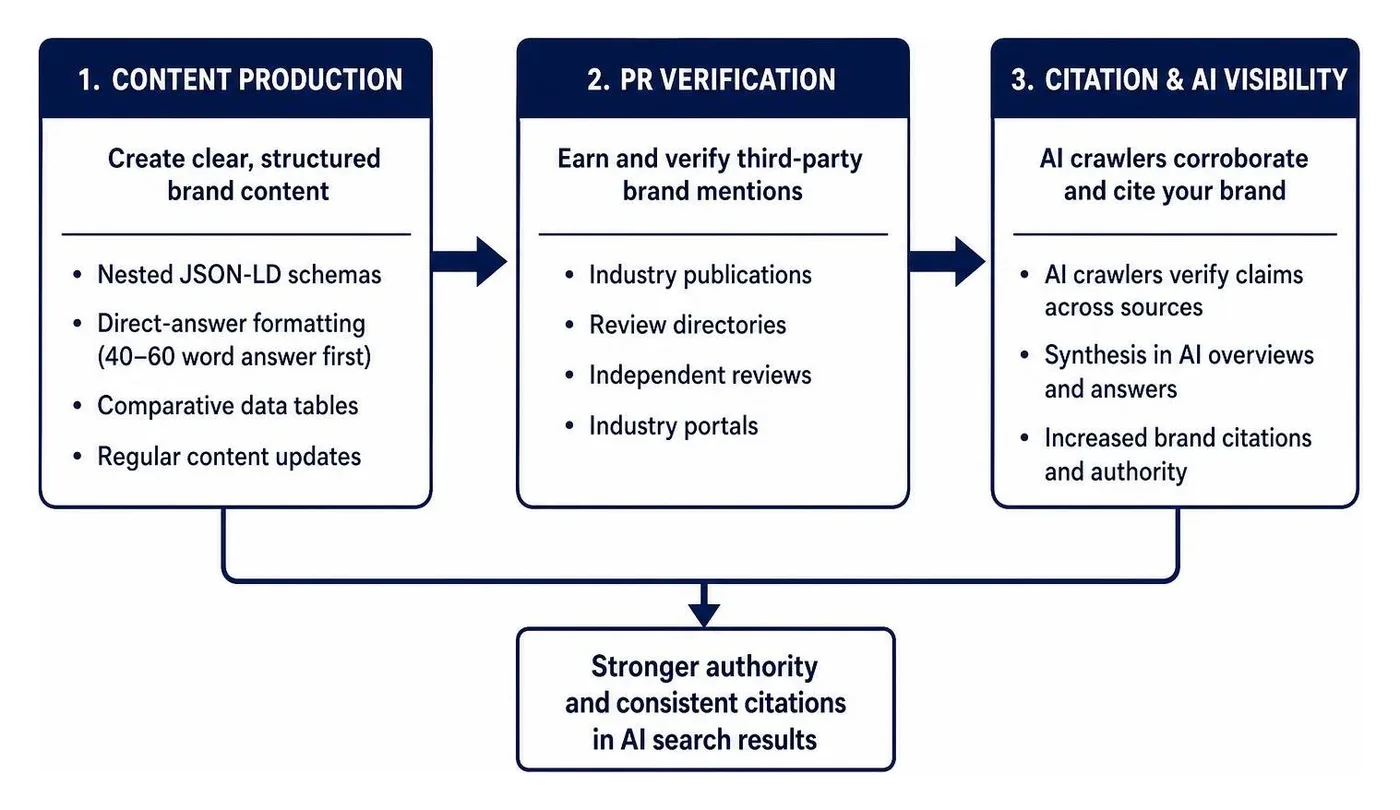
A comprehensive content marketing strategy combines fresh website updates with digital PR to earn brand mentions across industry portals. When an AI crawler synthesizes an industry overview, it corroborates your authority across these verified third-party references.
Measuring Visibility, Tracking Citations, and Setting Realistic Timelines
Traditional rank-tracking tools measure keyword positions on a static SERP. However, conversational engines generate personalized, context-dependent answers for every query.
Effective AI visibility tracking focuses on:
Prompt Cluster Monitoring: Testing prompts with varied phrasing across ChatGPT, Gemini, and Perplexity.
Sentiment and Context Analysis: Checking whether your brand is recommended as a preferred choice, a niche tool, or an alternative.
Citation Share: Measuring the percentage of generative responses in your category that include a verified link to your domain.
Key Metrics Beyond Traditional Organic Click-Through Rates
As zero-click responses grow, organic click-through rates provide only a partial picture of overall search impact. Many buyers evaluate software tools, request pricing, or book discovery calls based entirely on an AI engine's recommendation.
Reviewing your sales attribution alongside a modern lead generation process helps tie AI visibility back to revenue. Tracking referral traffic, assisted conversions, and brand-name search volume reveals the business impact of your AI citations.
Overcoming Common Myths and Misconceptions
Several persistent myths can lead teams astray when planning their search strategy:
Myth 1: "Traditional SEO is dead." Reality: Generative engines depend directly on classic SEO fundamentals, including high crawlability, clean site architecture, and authoritative backlink profiles.
Myth 2: "You can optimize for individual prompts." Reality: Conversational queries vary widely. Optimizing around broad entity topics and clear use cases produces better visibility than chasing single prompt variations.
Myth 3: "AI optimization only works for enterprise budgets." Reality: LLMs value clear, authoritative answers. A focused business with deep, well-structured documentation can regularly win citations over generic corporate pages.
For teams looking for specialized agency support, directories of the best ChatGPT SEO agencies to increase AI visibility highlight how modern agencies are evolving their services for generative search.
Frequently Asked Questions About AI Search Optimization
How long does it take to see measurable results from AI search engine optimization?
Initial citation signals on real-time platforms like Perplexity can appear within 3 to 6 weeks following content updates and schema validation. Broader visibility across ChatGPT and Google AI Overviews typically takes 3 to 6 months as models update their indexes and verify domain authority.
Can smaller B2B businesses compete against enterprise brands in AI citations?
Yes. AI platforms reward topical depth, specific answers, and structured comparisons. A specialized business that publishes clear data, detailed case studies, and transparent technical documentation can frequently earn citations over large competitors whose content remains generic.
How does optimizing for AI search impact traditional Google organic traffic?
The two strategies reinforce each other. Improving structured data, cleaning up headings, and increasing information density directly supports standard Google organic rankings while expanding eligibility for AI Overviews and conversational answer engines.
Conclusion: Building a Future-Proof Search Strategy
Search is no longer a simple race for rank positions on a single results page. As user behavior diversifies across ChatGPT, Gemini, Perplexity, and standard search engines, businesses need an integrated strategy that covers every channel.
At RewardLion, we build integrated systems that combine AI-driven search visibility, technical structure, and conversion marketing into a single managed operating system. Producing high-impact media like product advertisement video examples creates the brand signals and multimodal assets modern generative engines prioritize.
Connecting your technical foundation, authoritative content, and multi-channel marketing ensures your business stays visible, credible, and recommended wherever your customers search.