Understanding White Label Marketing Automation Services and How They Work
To win big with white label marketing automation services, secure a wholesale multi-tenant license, bundle the software with managed high-margin retainers, and deploy pre-built snapshot templates across client accounts. This approach lets your agency launch a fully branded platform in days, own the client relationship, and convert fragmented tools into recurring monthly revenue.
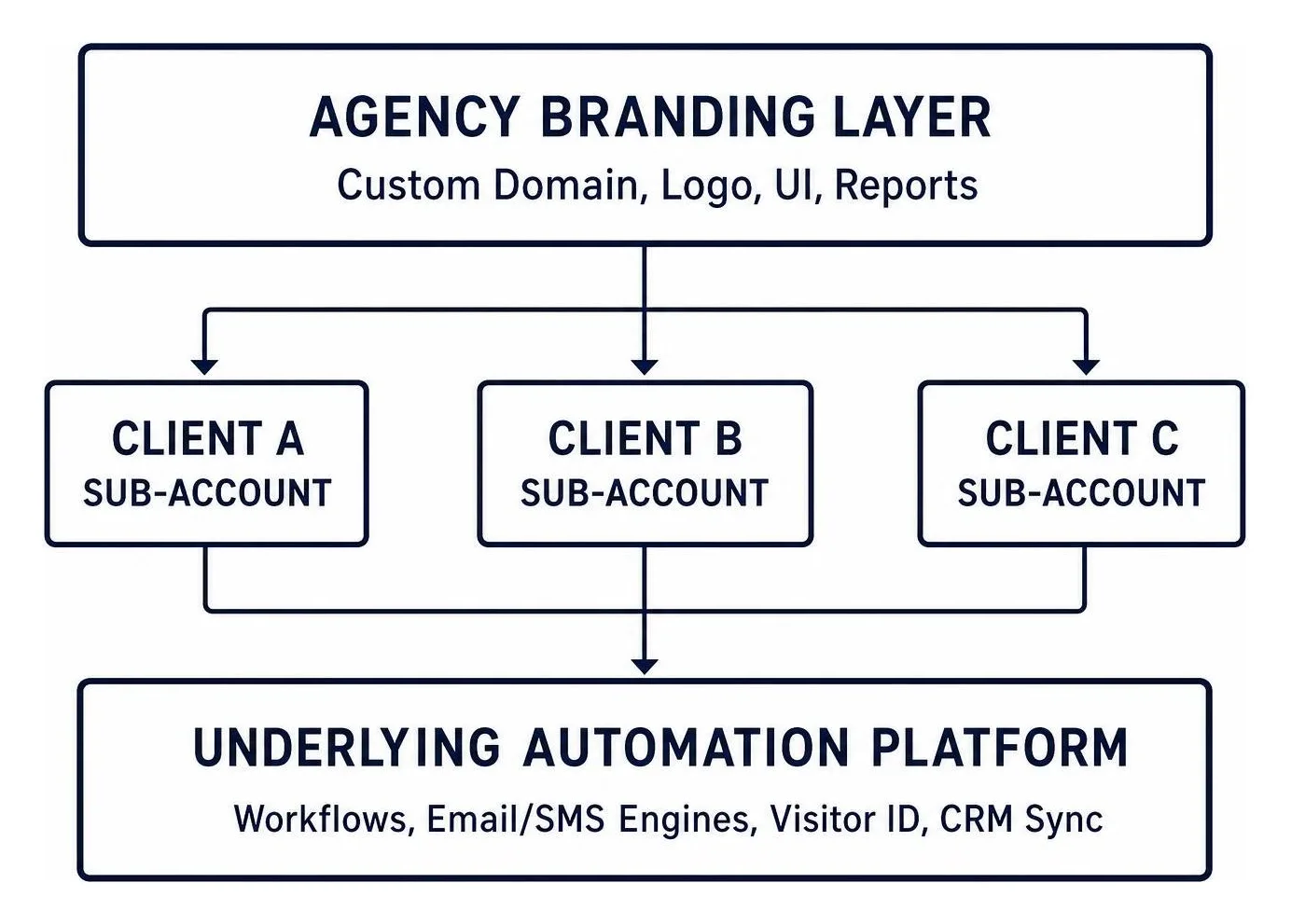
When you resell marketing automation, you license an existing, fully developed software engine from a technology vendor, apply your agency's logo, colors, and custom domain, and present the entire infrastructure to your clients as your proprietary platform.
Instead of juggling fragmented software tools across dozens of client logins, an agency tech stack powered by digital marketing automation software allows you to consolidate operations under one central command center. A clear understanding of marketing automation services starts with recognizing that your agency stops acting as an unpaid affiliate for third-party tools. Instead, you become the primary technology provider your clients rely on every day.
Core Capabilities of White Label Marketing Automation Services
Modern automation platforms give your agency the tools to execute complex, multi-touch campaigns on autopilot. Rather than manually exporting CSV files or copying lead data between systems, your agency can deploy pre-built workflows that trigger instantly based on user behavior.
Key capabilities include:
Omnichannel campaigns spanning email, SMS, push notifications, and social messaging
Automated nurture sequences tailored to user actions and conversion intent
Trigger-based workflows that automatically update pipelines, assign sales tasks, and notify account managers
Visual campaign builders that make launching a turnkey automated marketing system seamless for any client vertical
Scalable AI automation for agencies that enables automated content generation, dynamic message personalization, and smart workflow optimization
White Label vs. Private Label and Traditional SaaS
Agencies often confuse white label platforms with private label technology or traditional SaaS tools. While all three options allow you to deliver marketing solutions, their licensing structures, operational overhead, and revenue potential vary significantly.
Criteria | White Label Marketing Automation | Private Label Software | Traditional SaaS Tools |
|---|---|---|---|
Branding Control | Rebranded with your agency domain, logo, and theme | Custom UI built exclusively for your business specs | Third-party vendor branding visible to all clients |
Development Cost | Zero proprietary code or maintenance expenses | High initial build cost and ongoing developer overhead | Zero development cost, but zero equity built |
Client Ownership | Agency owns the client relationship and billing | Agency owns the IP and complete tech stack | Vendor owns the software account; agency manages access |
Deployment Speed | Turnkey setup; launch in days or hours | Months or years of custom development | Instant setup, but no white-label presentation |
Margin Control | Full control over retail pricing and packaging | Full control, but constrained by maintenance overhead | Fixed vendor margins or small affiliate cuts |
Traditional SaaS applications force your clients to pay third-party subscription fees, which leaves your agency vulnerable if the client decides to bring management in-house. Building proprietary, private label software gives you full control, but the continuous development costs and server maintenance can quickly drain agency cash reserves.
White-label platforms strike the right balance: they deliver the power of enterprise SaaS marketing automation software without the engineering headaches, giving your agency instant credibility and higher margins.
Core Business Benefits: Scaling Agency Revenue and Client Retention
Running an agency on project-based retainers often leads to unpredictable cash flow. One month you are overwhelmed with fulfillment work, and the next you are scrambling for new deals. Transitioning to white-label automation turns your agency into an indispensable technology partner, driving significant margin expansion and long-term client stickiness.
Industry benchmarks from top digital marketing companies show that agencies packaging proprietary or white-labeled tech solutions retain clients longer than agencies offering manual, commoditized services alone.
Unlocking Recurring Revenue and Eliminating the Per-Seat Tax
One of the most frustrating barriers to scaling an agency is the traditional SaaS "per-seat tax." As your client grows and adds sales reps, account managers, and administrative users, third-party software vendors increase their monthly fees. This setup penalizes your agency for scaling your accounts.
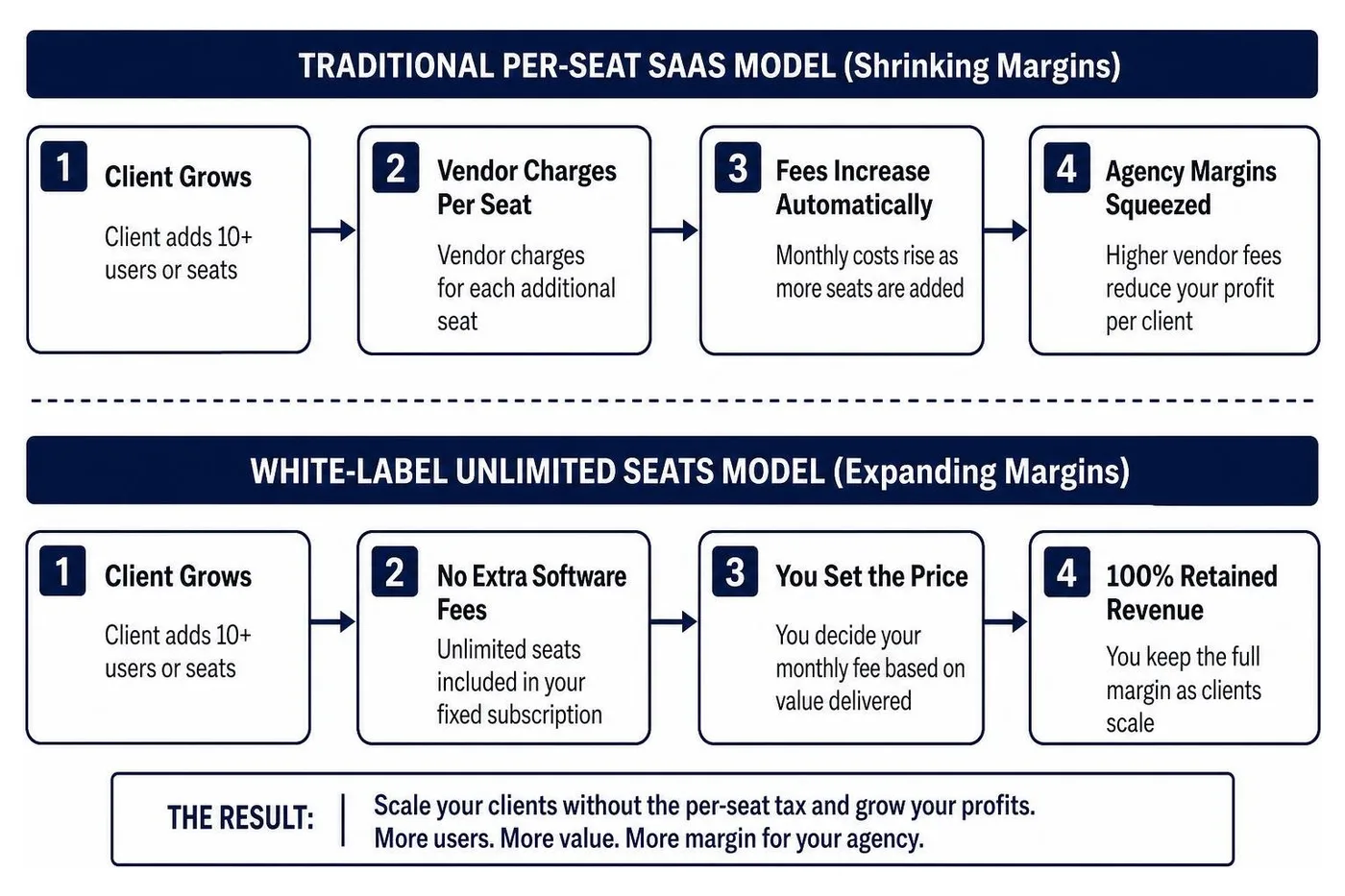
White-label platforms typically offer unlimited client sub-accounts and user seats under a fixed agency subscription. This creates a powerful licensing arbitrage opportunity:
You purchase the software at a predictable wholesale cost.
You bundle the software alongside your managed sales automation services.
You bill the client a predictable monthly subscription fee, retaining 100% of the software margin.
As outlined in our marketing automation consulting guide for 2026, moving away from billable hours toward technology-backed recurring monthly revenue (MRR) increases your agency's overall enterprise valuation.
Scaling Operations and Agency Delivery Without Adding Headcount
The traditional agency model suffers from delivery bottlenecks: every new client requires hiring more account managers, copywriters, and media buyers.
By pairing standardized automation workflows with fractional fulfillment, your team can manage dozens of accounts from a single interface.
Instead of building campaigns from scratch for every new account, our hybrid OS model allows you to deploy pre-configured snapshots across multiple client portals instantly. Combining automated campaign execution with an in-house marketing agency fulfillment structure lets you deliver end-to-end done-for-you marketing services while keeping your internal headcount lean.
Essential Features to Look for in a Resellable Automation Platform
Not all automation software supports the multi-tenant demands of a growing agency. If you select a tool designed solely for single-business use, you will quickly face administrative headaches and security issues. When evaluating platforms, prioritize systems engineered specifically for agency management and small business automation software environments.
Multi-Client Architecture and Granular Permission Controls
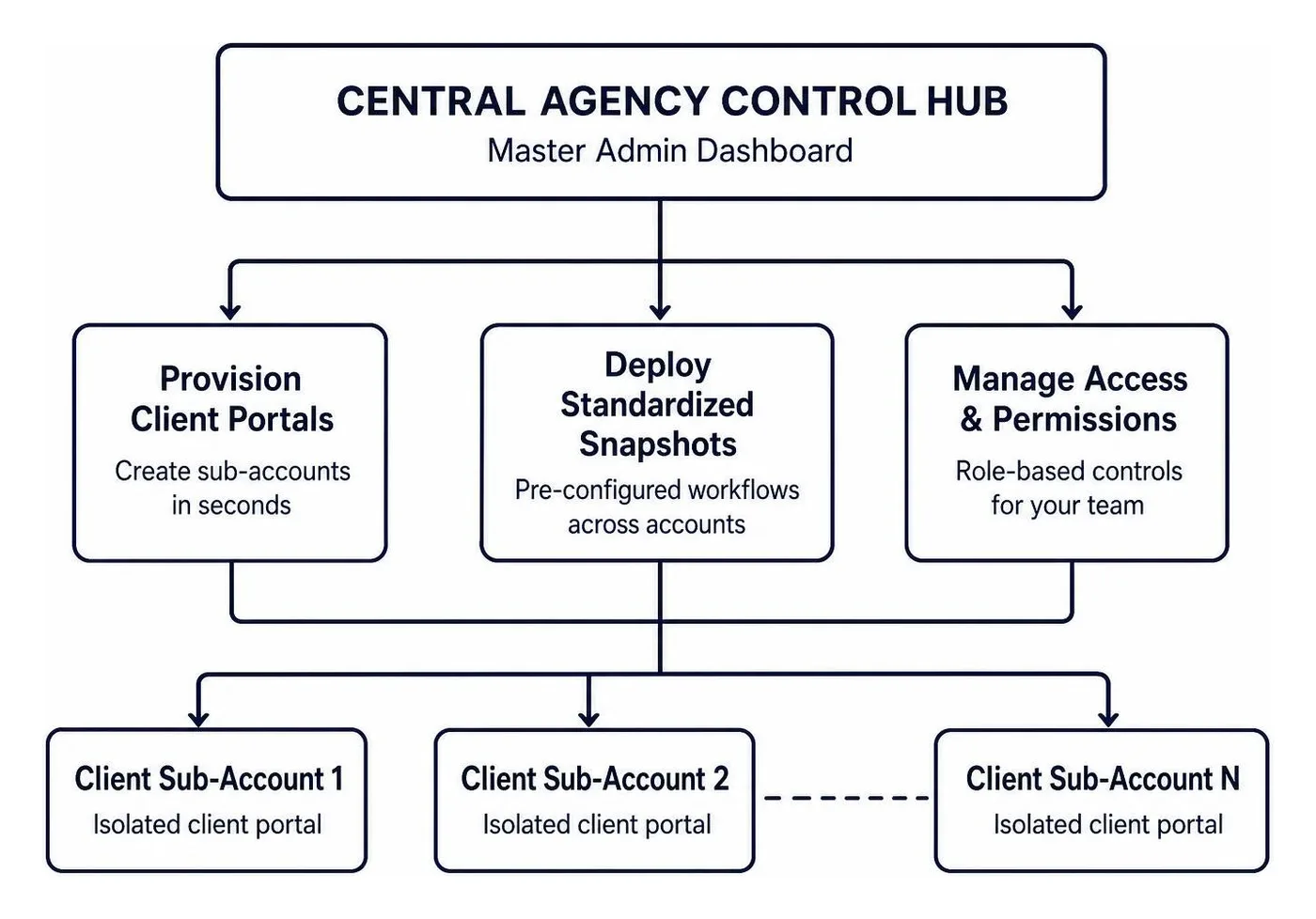
A true agency platform requires a robust multi-client architecture. You need a master administrative dashboard that allows you to provision separate client workspaces in just a few clicks.
Essential governance controls include:
Role-Based Access Control (RBAC): Restrict client access to specific features (e.g., allow them to view conversation pipelines while locking workflow automation logic).
Sub-Account Isolation: Keep all client data, contacts, and assets secure and partitioned across accounts.
Snapshot Deployment: Push proven funnels, automations, and messaging templates from a master library into new sub-accounts instantly.
Centralized Billing: Manage your client subscriptions, add-ons, and usage charges directly within your automated marketing platform.
Integrating White Label Marketing Automation Services with CRM and Sales Funnels
Marketing automation performs best when connected directly to an active sales pipeline. Your white-label solution should integrate lead capture, messaging, and deal tracking into one continuous system.
To build an efficient pipeline, ensure your platform seamlessly integrates:
Complete CRM setup and automation to track deal progress, schedule calls, and record client touchpoints
High-converting sales funnels and landing pages designed to drive qualified form submissions
Multi-channel email marketing workflows that engage and nurture leads based on campaign interactions
Robust sales funnel automation software to automate lead routing, send follow-up notifications, and convert opportunities into paying clients
Advanced Visitor Identification, Data Enrichment, and 2026 AI Trends
Marketing automation technology has advanced beyond basic email autoresponders. Today's competitive agency platforms leverage artificial intelligence and real-time data enrichment to capture opportunities that traditional tools miss.
Key technical capabilities include:
Anonymous Visitor Identification: De-anonymize website traffic to reveal company names, firmographic details, and high-intent prospect behavior before a form is submitted.
Automated Data Enrichment: Append missing phone numbers, verified corporate email addresses, and LinkedIn profiles to new CRM records automatically.
24/7 AI Conversational Assistants: Deploy intelligent chatbots that qualify inbound leads, answer complex product questions, and book calendar appointments in real time.
Predictive Lead Scoring: Use machine learning to rank leads based on their engagement patterns, alerting sales teams to focus on the hottest opportunities.
Adopting modern AI marketing automation keeps your agency ahead of the curve. Combining visitor identification with our comprehensive B2B marketing automation guide helps clients achieve higher lead-to-opportunity conversion rates, while outperforming regional industry benchmarks, such as those found among marketing automation agencies in Fort Lauderdale.
Strategic Implementation, Pricing Models, and Client Onboarding
Selecting your platform is only half the battle; packaging and pricing your services effectively is what drives sustainable profit. To maximize margins, avoid selling your software as an unmanaged tool. Instead, combine the software with strategic execution to build comprehensive lead generation systems.
Choosing the Right Pricing Model for High-Margin Retainers
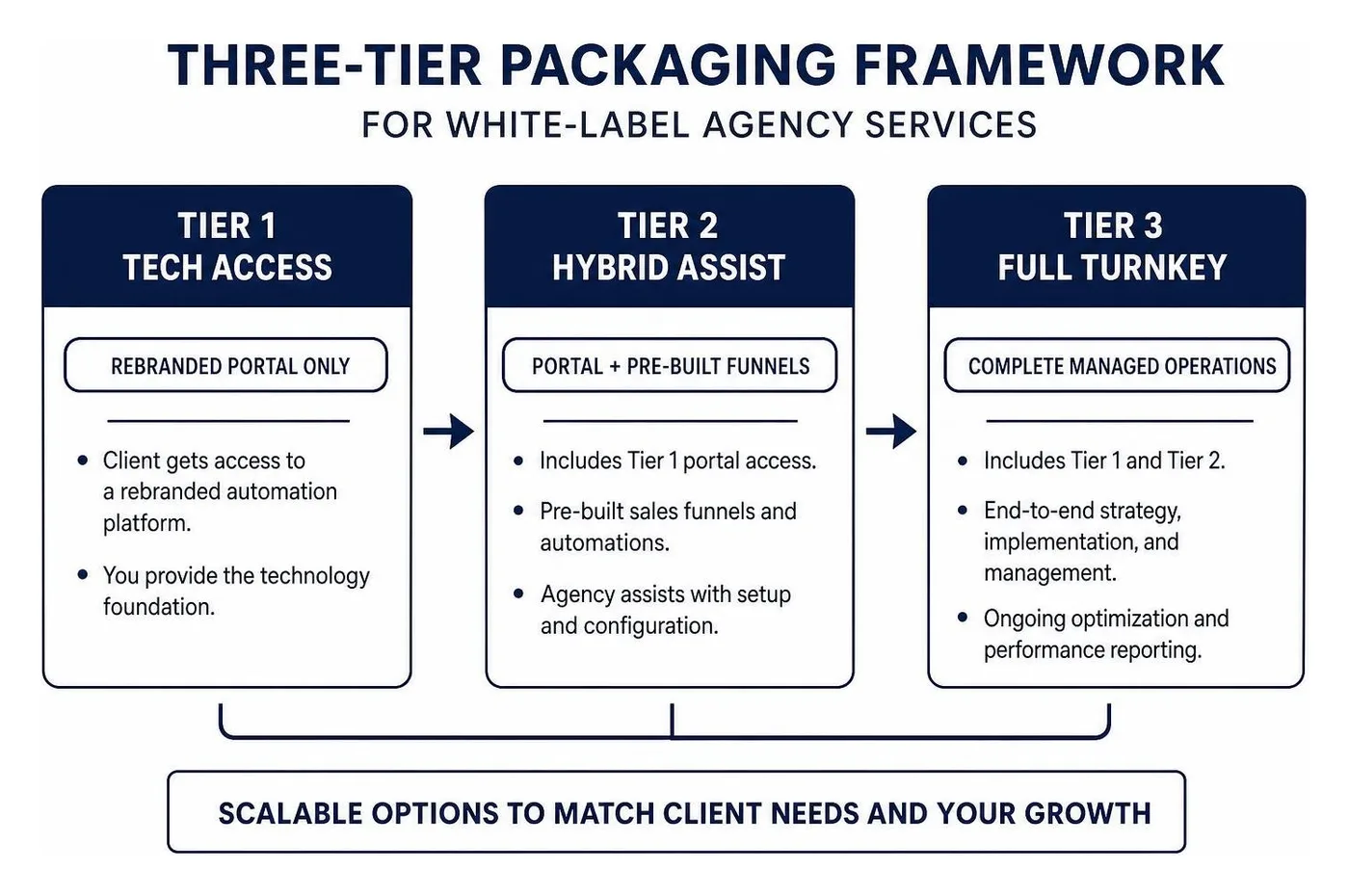
Agencies typically package white-label automation using one of three proven pricing frameworks:
Packaging Strategy | Structure | Target Margin | Best For |
|---|---|---|---|
Pure SaaS Reseller | Flat software subscription ($199–$499/mo) | 70% – 85% | Tech-savvy clients who manage their own marketing |
Hybrid Retainer | Software access + template management ($997–$1,997/mo) | 60% – 75% | Growing businesses needing both software and occasional technical support |
Fully Managed Growth OS | Turnkey fulfillment + CRM + ad campaigns ($2,500–$5,000+/mo) | 50% – 65% | Established businesses looking to outsource their entire acquisition engine |
Adopting a hybrid or fully managed model allows you to build automated customer acquisition processes that make your agency indispensable, securing consistent, long-term retainers.
Smooth Client Onboarding, Brand Consistency, and Technical Setup
A disorganized onboarding process can quickly lead to client churn. Establishing a systematic technical checklist ensures smooth delivery and protects your deliverability rates across all client accounts.

Follow these technical onboarding steps for every new client:
Custom Domain and SSL Mapping: Point client access portals to subdomains on your brand (e.g.,
app.youragency.com) to reinforce brand authority.DNS and Email Authentication: Configure SPF, DKIM, DMARC, and custom MX records to maintain high email deliverability.
Tracking Pixel and Visitor ID Installation: Place your agency's tracking snippet on the client's site to power real-time visitor identification.
Pipeline and Snapshot Configuration: Import standardized sales stages, tags, and pre-written nurture campaigns.
Team Training and User Provisioning: Grant restricted logins to the client's sales team and deliver a branded walkthrough video explaining daily workflows.
Pairing automated setup procedures with managed done-for-you email marketing guarantees consistent quality across every client account.
Frequently Asked Questions About White Label Automation
What is the difference between white-label and traditional marketing automation?
Traditional marketing automation platforms license their software under their own brand, bill you per user seat, and control the client relationship. In contrast, white-label marketing automation allows your agency to rebrand the software with your own logo, domain, and custom styling. You purchase the software at wholesale rates and resell it at your own price point, building equity in your agency's brand rather than a third-party vendor's.
How do agencies price white-label automation services to maximize profit margins?
Agencies maximize profit margins by bundling white-label software into multi-tiered service packages. Rather than reselling software access alone, pair the platform with strategic setup, custom funnel building, automated lead nurturing, and ongoing optimization. This approach allows you to charge monthly retainers ranging from $997 to upwards of $5,000, achieving healthy 60% to 80% gross profit margins while scaling predictable monthly recurring revenue (MRR).
Do white-label marketing tools require advanced technical or coding expertise?
Most modern white-label platforms use intuitive drag-and-drop workflow builders, pre-configured campaign snapshots, and no-code visual editors. While basic knowledge of DNS records (such as SPF, DKIM, and CNAME settings) is helpful during initial domain setup, running everyday client automations does not require custom coding or dedicated software development teams.
Conclusion
Scaling an agency successfully no longer requires hiring large fulfillment teams or developing expensive custom software from scratch. By adopting white label marketing automation services, your agency can launch a fully branded, enterprise-grade technology suite that drives scalable client results and builds predictable monthly recurring revenue.
At RewardLion, we help agencies eliminate operational bottlenecks by providing an AI-powered all-in-one growth operating system. Combining enterprise-grade automation software with our dedicated fulfillment teams gives you a complete, hands-off solution to scale your agency and win big in 2026 and beyond.