Why Marketing Automation B2B Services Matter for Revenue Data
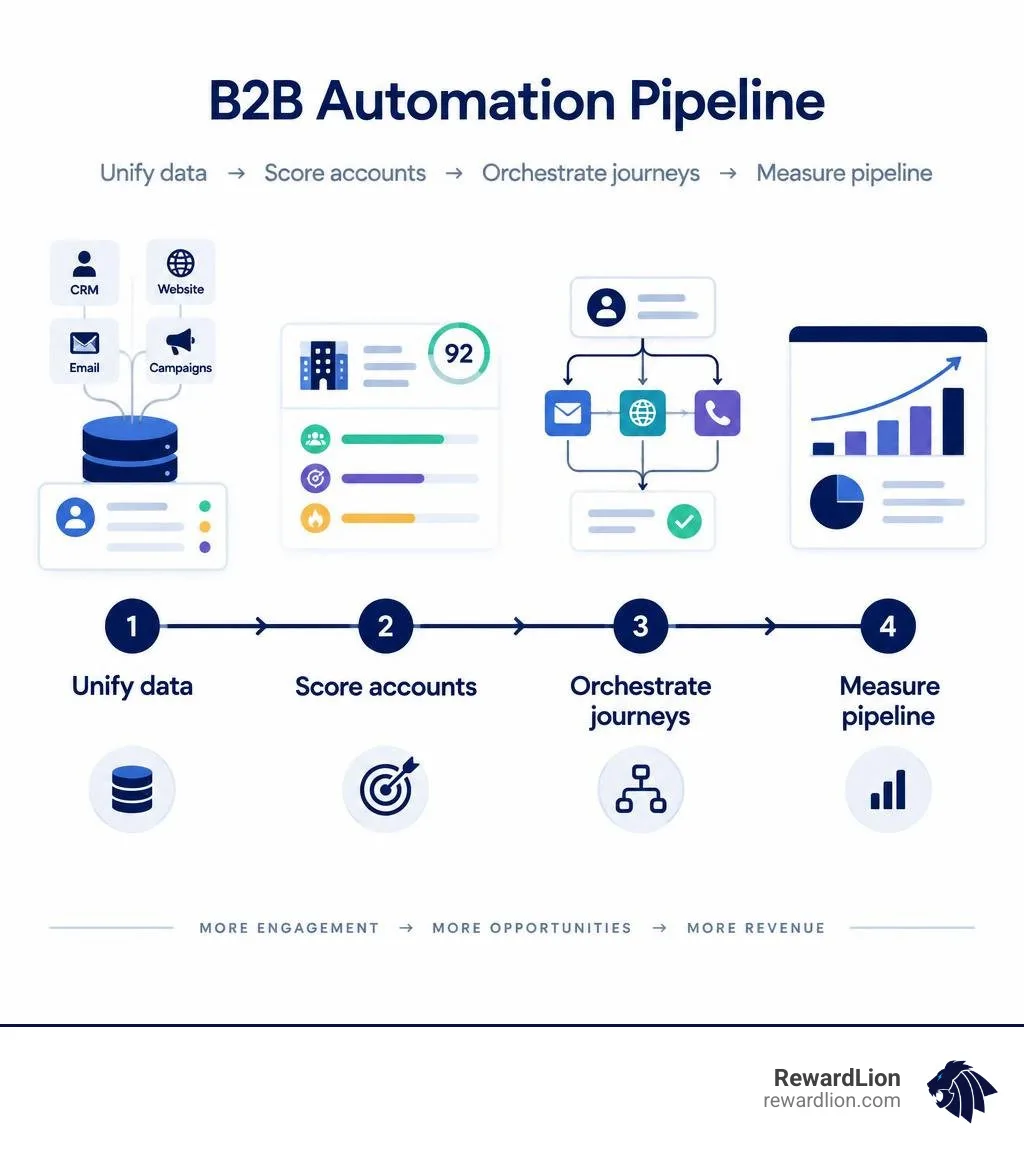
Marketing automation B2B services help revenue teams turn scattered CRM, website, email, and campaign data into coordinated action. Start by connecting your CRM and customer data, defining lead and account scores, then building triggered journeys across email, web, and sales follow-up. Measure every step from first engagement to pipeline so your team can improve what actually creates opportunities.
This matters because B2B deals rarely involve one person or one quick decision. Buying groups now often include more than ten stakeholders, while complex buying journeys can last close to a year. A simple email tool cannot show the full account story. A connected automation system can.
For a small or mid-sized business, the goal is not to buy the most complex platform. It is to create one reliable view of each prospect and account:
Capture engagement signals from forms, site visits, emails, and sales activity.
Match those signals to the right contact and company.
Score fit and intent so sales knows where to focus.
Trigger useful, timely follow-up across the channels buyers use.
Track which campaigns and accounts produce qualified pipeline.
The strongest systems combine a unified customer profile, multi-step journey building, lead scoring, coordinated multi-channel execution, and performance dashboards. Newer AI features can also help, but buyers should separate tools that merely recommend next steps from those that can safely execute approved actions with human oversight. For a broader view of how these systems fit into modern revenue operations, see marketing automation on Wikipedia.
I am Mike Ibrahim, founder and CEO of RewardLion, with more than a decade of experience building sales and marketing strategies, improving customer relationships, and driving revenue growth. In this guide, I will break down how to assess marketing automation B2B services through the lens that matters most: clean data, practical workflows, and scalable pipeline results.
Core Architecture of Marketing Automation B2B Services
At its heart, marketing automation is an ingestion and decision engine. When we look beneath the surface of slick user interfaces, we find a complex data structure designed to capture disparate touchpoints and convert them into revenue signals. Understanding what marketing automation services provide starts with this foundational architecture.
Data nerds know that disconnected data creates operational drag. An enterprise-grade automation engine relies on four primary layers:
Unified Data Ingestion: Gathering events across your digital footprint (web analytics, product usage, form submissions, ad clicks, chat logs).
Contextual Identity Resolution: Merging anonymous session IDs with known CRM contact records and parent account domains.
Dynamic Logic & Decision Engine: Evaluating multi-criteria conditions in real time using predictive lead scoring models.
Multi-Channel Orchestration: Dispatching assets across email, outbound sales sequences, programmatic ads, SMS, and webhook endpoints.
Gartner-Defined Mandatory Platform Capabilities
When evaluating the market, industry standards help cut through vendor marketing noise. According to Gartner's enterprise requirements, modern B2B marketing automation platforms must deliver five core capabilities:
Unified Customer Profile: Synchronizing bi-directional attributes between marketing touchpoints and CRM records without data loss.
Multi-Step Journey Builder: A visual canvas capable of branching logic, wait states, split testing, and cross-channel triggers.
Lead and Account Scoring: Multi-dimensional scoring combining explicit demographic/firmographic data with implicit behavioral engagement.
Coordinated Multi-Channel Execution: Native delivery or robust API dispatch across email, mobile, social, and web personalization channels.
Performance Dashboards and Attribution: Granular visibility into campaign performance, velocity metrics, and full-funnel revenue impact.
Implementing these components requires solid foundation work, which is why configuring your CRM setup and automation correctly from day one is vital to avoiding broken pipelines later.
Agentic AI vs. Traditional Rule-Based Triggers
Historically, marketing automation operated on static "IF/THEN" logic. If a contact downloaded an eBook, THEN wait three days and send an email. If they clicked a link, THEN create a CRM task.
In 2026, the paradigm has shifted from reactive triggers to agentic AI.
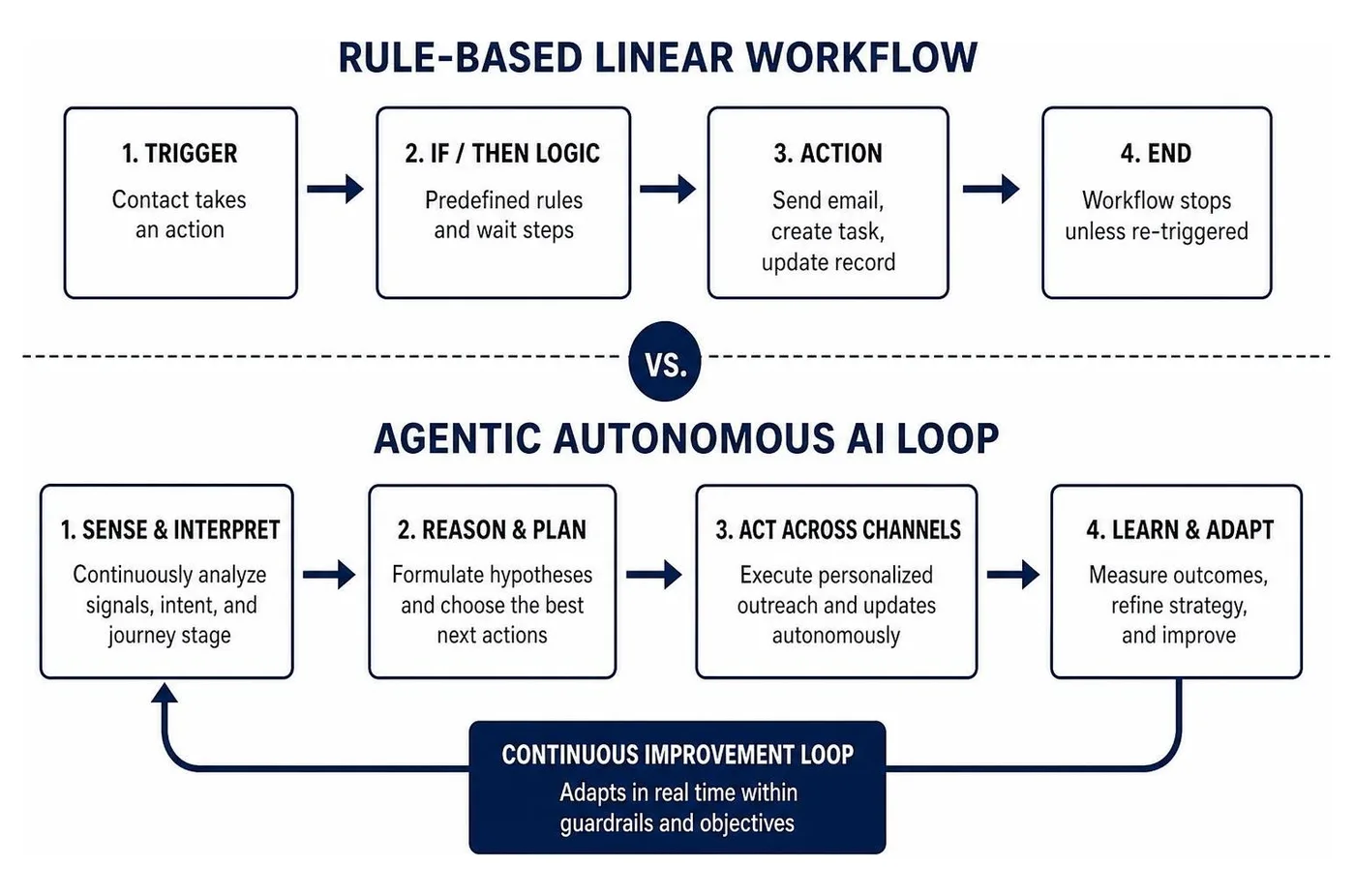
While traditional systems simply follow linear instructions, agentic AI actively interprets intent, formulates hypotheses, and executes workflows autonomously within bounded guardrails:
Autonomous Execution vs. Suggestions: Standard tools display a notification that an account is surging; agentic systems research the buying committee, draft hyper-personalized context, and trigger customized outreach across channels.
Autonomous Prospect Triage: Deploying intelligent email agents allows revenue operations teams to handle up to 85% of initial prospect inquiries autonomously, drastically speeding up response times.
Massive Capacity Multipliers: Scaling organizations report up to a 14x boost in BDR bandwidth when repetitive manual qualification tasks are offloaded to intelligent agents.
Explore our dedicated AI marketing automation solutions to see how agentic workflows operate in production environments.
Data Models: Lead-Centric vs. Account-Based Architectures
One of the costliest architecture mistakes revenue leaders make is mismatching their platform data model with their Go-To-Market (GTM) motion.
In a traditional Lead-Centric model, the individual contact record is the sun around which all data orbits. This model functions adequately for transactional, high-velocity sales with single decision-makers. However, because modern enterprise buying groups average more than ten distinct stakeholders across IT, finance, procurement, and operations, a lead-centric model creates massive blind spots.
An Account-Based (ABM) architecture maps individual behavior to the parent account entity. If five different managers from the same target enterprise visit your pricing page and read security documentation, an ABM engine aggregates those fragmented signals into a unified account intent score.
Capability / Attribute | Lead-Centric Architecture | Account-Based Architecture (ABM) |
|---|---|---|
Primary Data Object | Contact / Individual Lead | Company / Parent Account Entity |
Scoring Aggregation | Single-user interaction threshold | Multi-stakeholder engagement roll-up |
Buying Stage Detection | Triggered by isolated form fills | Triggered by intent surges across multiple personas |
Sales Handoff | Lead-to-MQL conversion | Account-to-Opportunity matching |
Attribution Complexity | Single-touch / Linear multi-touch | Account-level multi-touch journey mapping |
Ideal GTM Fit | High-velocity PLG / Low ACV sales | Complex B2B sales cycles (>60-365 days) |
Aligning these models is essential for effective lead generation for B2B companies navigating enterprise sales environments.
Orchestrating Enterprise ABM and Buying Group Signals
When orchestrating an enterprise ABM motion, automation engines must ingest both first-party data (website activity, email opens) and third-party intent data (content consumption across external publisher networks).
When intent spikes:
The platform automatically triggers matched display advertising to the target accounts.
The system initiates persona-specific email sequences to key stakeholders in the buying group.
Contextual tasks are routed to sales reps using integrated sales automation services, arming them with the exact topics the account is researching.
Evaluating Marketing Automation B2B Services by Tech Stack Complexity
Integrating automation software into an enterprise ecosystem requires evaluating your underlying data plumbing. Data nerds should run technical audits across three primary criteria:
API Rate Limits and Webhook Latency: Ensure your marketing platform does not experience rate-limiting when streaming high-volume behavioral events to your CRM or data warehouse.
Bi-Directional Field Mapping: Prevent field overwrite loops by configuring master records appropriately (e.g., CRM owns lifecycle stages, while marketing automation owns engagement metadata).
Data Warehouse Synchronization: Determine whether your SaaS marketing automation software supports direct syncing with modern cloud data warehouses like Snowflake or BigQuery for advanced BI modeling.
Strategic Framework for Implementation and Economics
Deploying marketing automation is an operational transformation, not just a software install. A successful rollout requires clear revenue attribution modeling and a structured approach to change management.

To build a reliable attribution model:
Track First-Touch to measure brand discovery efficiency.
Track Lead-Creation Touch to evaluate content offer performance.
Track Opportunity-Creation Touch to verify pipeline acceleration.
Apply W-Shaped or Algorithmic Attribution to reward mid-funnel nurture workflows that shorten 365-day buying cycles.
For a comprehensive strategic roadmap on building out these frameworks, review our marketing automation consulting guide.
Total Cost of Ownership for Marketing Automation B2B Services
When assessing the economics of marketing automation, the monthly subscription fee is just the tip of the iceberg. Hidden costs often balloon the real Total Cost of Ownership (TCO):
Mandatory Onboarding Fees: Many legacy vendors require mandatory implementation packages ranging from $3,000 for mid-market plans to upwards of $7,000 to $15,000 for enterprise tiers.
Contact Database Scaling: Pricing structures that charge exponentially as your contact database crosses arbitrary thresholds (e.g., jumping from 10k to 50k contacts).
Agent Seat and API Overage Charges: Add-on fees for specialized AI agent utilization, sandbox environments, and custom API call limits.
Dedicated Administrative Overhead: Enterprise tools frequently demand full-time, certified marketing operations specialists simply to build campaigns and maintain integrations.
Data Hygiene and Governance Across Multi-Touch Pipelines
No automation workflow can fix bad data. In fact, automation accelerates the negative impact of bad data. A robust data governance framework requires:
Automated Deduplication: Algorithmic merging of records based on email domains, corporate domains, and CRM IDs.
Contact Enrichment: Real-time programmatic enrichment to backfill missing titles, company revenue, and tech stack attributes.
Regulatory Compliance Orchestration: Automated consent tracking and geographic suppression honoring GDPR, CCPA, and global privacy standards.
Frequently Asked Questions about B2B Marketing Automation
What is the core difference between basic email marketing and full B2B marketing automation?
Basic email marketing tools focus strictly on list-based broadcasts, basic autoresponders, and open/click metrics. Full B2B marketing automation systems provide multi-channel event listening, dynamic multi-dimensional lead scoring, deep bi-directional CRM integration, behavioral website personalization, and complex multi-touch revenue attribution.
How does agentic AI differ from standard automated recommendations in B2B systems?
Standard automated systems provide passive recommendations—such as suggesting a contact might be interested in a specific topic. Agentic AI platforms can act autonomously within set business rules: researching buying committee members, generating tailored outreach copy, triggering real-time multi-channel interactions, and qualifying inbound responses without requiring manual intervention for every step.
How should enterprise revenue teams evaluate platform total cost of ownership?
Enterprise teams must calculate the total cost by including base software fees, contact tier expansion costs, mandatory onboarding or implementation retainers, custom API access limits, and the administrative personnel required to manage the platform daily.
Conclusion
B2B revenue operations is no longer about running disjointed email blasts or collecting static form fills. When buying groups include ten or more stakeholders and sales cycles span an entire year, success belongs to teams that treat marketing data as an integrated engineering discipline.
At RewardLion, we eliminate the complexity of managing fragmented point solutions and bloated enterprise stacks. Through our hybrid model—combining our AI-powered all-in-one OS platform with our dedicated CAPSS fractional growth teams—we deploy, manage, and continuously optimize your entire sales, marketing, and automation pipeline.
Explore the RewardLion growth operating system and let our team build your end-to-end revenue engine.