Marketing Automation Services Explained: From Zero to Expert
Marketing automation services are tools and strategies that use software to handle repetitive marketing tasks automatically — so your business keeps running even when you're not watching.
Here's the quick answer:
What are marketing automation services?
Definition: Software and expert services that automate marketing tasks like emails, social media posts, lead nurturing, and ad campaigns
How it works: Triggers based on customer behavior send the right message to the right person at the right time
Who it's for: Any business that wants to generate more leads, save time, and grow without hiring a bigger team
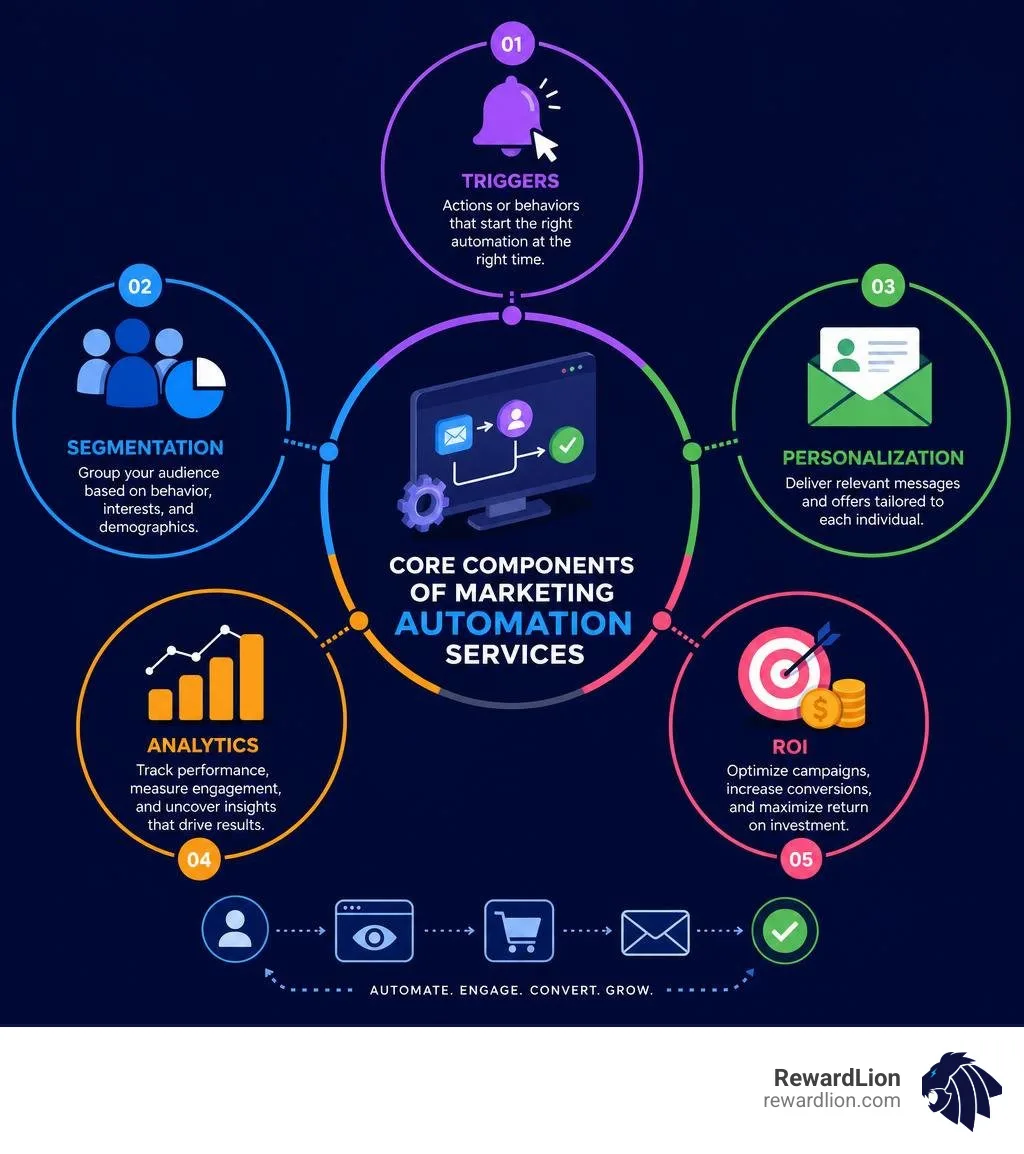
Core functions: Email automation, lead scoring, customer segmentation, campaign management, and analytics
Key benefit: Businesses that implement it see up to a 451% increase in qualified leads — and 76% generate positive ROI within the first year
Think of it this way: every time a customer visits your website, downloads something, or abandons a cart, something should happen next. Without automation, that follow-up depends on someone remembering to do it. With automation, it happens instantly — every time, for every customer.
That's the core idea. And it scales. Whether you have 50 contacts or 50,000, the same system handles them all without extra effort on your part.
I'm Mike Ibrahim, Founder and CEO of RewardLion and Marketing Director for several companies, with over a decade of hands-on experience designing and implementing marketing automation services across diverse industries. I've seen how the right automation strategy transforms fragmented, manual marketing into a predictable, revenue-generating machine — and I'll walk you through exactly how it works.
What is Marketing Automation Services?
When we talk about what is marketing automation services, we are describing the intersection of technology, strategy, and execution. At its core, marketing automation refers to software platforms and technologies designed for marketing departments and organizations to more effectively market on multiple channels online (such as email, social media, websites, and text) and automate repetitive tasks.
However, the "services" aspect introduces the human element. While having the software is fantastic, configuring, managing, and optimizing it requires a strategic touch. That is why many businesses partner with a specialized team or utilize our hybrid model at RewardLion to ensure their systems run flawlessly.
The core functions of these services include:
Lead Generation and Capturing: Using dynamic forms, landing pages, and tracking to pull prospects into your ecosystem.
Campaign Management: Organizing and executing multi-channel efforts from a single dashboard.
Audience Segmentation: Grouping your contacts dynamically based on their behaviors, demographics, and buying signals.
Analytics and Reporting: Having a centralized system to see exactly which campaigns are driving revenue.
To dive deeper into the technical infrastructure, you can read this Comprehensive Guide to Marketing Automation. If you want to understand how the software itself fits into your overall tech stack, explore our breakdown of Digital Marketing Automation Software.
Demystifying what is marketing automation services for beginners
If you are new to this space, don't let the jargon intimidate you. Marketing automation is like having a tireless assistant who works 24/7, never sleeps, makes zero data-entry errors, and speaks to thousands of customers individually all at the same time.
For a beginner, the most common starting point involves automating repetitive, manual tasks:
The Welcome Series: When someone signs up for your newsletter, the system immediately sends a welcome email, followed by an educational email three days later, and a special promotional offer a week after that.
Social Media Scheduling: Instead of logging in every day to post updates, we can schedule an entire month of content in one sitting.
Form Follow-ups: If a prospect requests a quote on your website, they receive an instant text message confirming we received it, while your sales rep gets an automated notification to call them.
By offloading these basic tasks, you prevent leads from falling through the cracks. Small businesses, in particular, find that this completely levels the playing field against enterprise competitors. If you are running a growing company, check out our guide on Small Business Automation Software to see how simple it is to get started.
Advanced capabilities of what is marketing automation services for experts
For the marketing geniuses and seasoned operations leads, modern marketing automation in June 2026 goes far beyond simple linear drip campaigns. Today, we are looking at hyper-personalized, multi-branch customer journeys driven by real-time data, predictive machine learning models, and generative AI.
Advanced systems leverage:
Process Mining: Using AI to analyze your entire marketing funnel, identify bottlenecks, and suggest structural workflow optimizations.
Hyper-personalization at Scale: Dynamically altering website content, email copy, and ad creatives in real-time based on the specific visitor's past behavior, firmographic data, and predictive intent.
Predictive Scoring and Send-Time Optimization: Evaluating a lead's likelihood to buy based on thousands of data points and automatically delivering messages at the exact minute that contact is historically most likely to open and engage.
In regions with highly competitive digital landscapes, such as South Florida, businesses are rapidly adopting these cognitive systems to maximize their efficiency and scale their operations.
How Marketing Automation Works Behind the Scenes
Behind every successful automated campaign lies a structured logical framework often referred to as "If This, Then That" (IFTTT) logic. The system continuously listens for specific customer actions—known as behavioral triggers—and executes predefined workflows in response.
Here is how the data flows behind the scenes:
Data Collection: The system tracks user interactions across your website, social media, emails, and offline touchpoints (like a CRM update or an in-store purchase).
Segmentation: Based on those interactions, the contact is automatically placed into a highly specific bucket (e.g., "High-Intent B2B Prospect" or "Cart Abandor - Warm").
Workflow Activation: A trigger event occurs (e.g., the user views your pricing page twice in 24 hours).
Action Execution: The system automatically executes the next step, such as sending a personalized email, triggering an SMS, or assigning a task to a sales representative.
Continuous Optimization: The system logs the response to the action, feeding the data back into your analytics platform to refine future triggers.

To build these complex pathways successfully, you need a robust foundation. Explore how to set up these automated triggers with our dedicated resource on Lead Automation Software.
The Role of AI and Machine Learning in Modern Workflows
The integration of artificial intelligence has completely revolutionized how we design automation. Historically, marketers had to manually map out every single branch of a customer journey. If a user did X, send Y. If they did Z, send A.
Today, generative AI and natural language processing (NLP) handle the heavy lifting. AI can write hundreds of variations of a subject line, test them dynamically, and automatically scale the winning version.
Furthermore, machine learning models continuously evaluate your database to calculate predictive lead scores. Instead of relying on arbitrary point systems (e.g., assigning 10 points for an ebook download), AI looks at historical conversion patterns to identify the exact behaviors that signal a hot lead. To explore the tools making this possible, read about the latest Sales Automation Ai Tools.
Key Benefits and ROI of Implementing Automation
The business case for marketing automation is incredibly clear. According to industry statistics, businesses that implement marketing automation see a 451% increase in qualified leads. Furthermore, 76% of companies that adopt these tools generate a positive ROI within the first year of rollout.
Let's break down the tangible benefits of transitioning from manual processes to automated systems:
Marketing Function Manual Marketing (The Hard Way) Automated Marketing (The RewardLion Way) Lead Follow-Up Sales reps manually email leads when they find time, often hours or days later. Instant, personalized email and SMS sent within seconds of form submission. Audience Segmentation Manually exporting CSV files and uploading lists to different tools. Dynamic, real-time segmentation based on active user behavior. Data Integrity High risk of human error, missed follow-ups, and duplicate contacts. Clean, standardized data syncing seamlessly across all systems. Scalability Team is limited by the number of hours in a day; growth requires hiring. Manage campaigns for 100,000 leads as easily as managing 1,000. Personalization Generic, batch-and-blast emails sent to your entire database. Hyper-personalized content tailored to individual customer lifecycles.
To understand how to implement these email-specific workflows to maximize retention, take a look at our insights on Email Marketing Automation Software.
How Automation Directly Improves Marketing ROI
Marketing automation does not just save your team time; it directly impacts your bottom line by optimizing your marketing spend.
First, it significantly increases your conversion rates. By delivering highly relevant, targeted messages at the exact moment a prospect is interested, you reduce friction in the buying cycle.
Second, it boosts Customer Lifetime Value (LTV). Automation makes customer retention effortless by setting up post-purchase onboarding sequences, automated check-ins, and personalized cross-sell or upsell offers.
Finally, it provides unmatched pipeline visibility. With integrated tracking, you can trace a closed deal all the way back to the initial ad click, allowing you to allocate your budget to the channels that actually drive revenue. To master these measurement frameworks, explore our guide on Lead Generation Analytics.
Essential Features to Look For in Automation Software
When shopping for marketing automation services or platforms, it is easy to get overwhelmed by feature lists. To build a high-performing marketing engine, we recommend focusing on these core capabilities:
Robust Email Builder & Workflows: Drag-and-drop editors, pre-built templates, and visual workflow builders that allow you to map out customer journeys without needing a computer science degree.
Dynamic Lead Scoring: The ability to rank leads based on their profile fit (job title, company size) and behavioral actions (pages visited, emails opened).
Omnichannel Capabilities: Seamless integration of email, SMS, web tracking, and social media scheduling so you can meet your customers wherever they are.
Landing Page & Form Builders: High-converting, mobile-responsive page templates that automatically capture and feed lead data directly into your database.
Advanced Analytics Dashboards: Real-time reporting on open rates, click-through rates, pipeline velocity, and overall campaign ROI.

Selecting the right platform is critical to ensuring your team actually adopts the technology. To compare your options, view our detailed breakdown of Online Marketing Automation Software.
Integrating Marketing Automation with CRM Systems
A marketing automation platform is only as good as the data feeding into it. To unlock its full potential, it must be deeply integrated with your Customer Relationship Management (CRM) system.
While your marketing automation software tracks top-of-funnel activities and nurtures cold prospects, your CRM manages sales-cycle information and active deals. When these two systems are perfectly synchronized, your sales team gets a 360-degree view of every prospect's history before they even pick up the phone. They can see exactly which whitepapers the lead downloaded, which pricing pages they viewed, and what emails they opened.
This seamless handoff ensures your sales reps are only calling highly qualified, sales-ready leads. To find out how to choose a SaaS stack that supports this integration out of the box, check out Sales Automation Software Saas.
Best Practices and Common Mistakes to Avoid
Implementing marketing automation is as much a strategic change management project as it is a technology deployment. To ensure your rollout is a massive success, we recommend following these battle-tested best practices:
Define Clear, Numerical Goals: Do not automate for the sake of automation. Define exactly what you want to achieve (e.g., "Reduce lead response time to under 5 minutes" or "Increase email-driven revenue by 25%").
Clean Your Data First: If you import a messy, outdated contact database, you will just be automating spam. Take the time to clean your email lists and standardize your data fields before turning on workflows.
Use Progressive Profiling: Instead of overwhelming visitors with a 10-field form, use progressive profiling to ask for 2-3 pieces of information at a time over multiple interactions.
Collaborate Across Teams: Ensure your marketing and sales departments are fully aligned on lead definitions, scoring thresholds, and the sales handoff process.
Conversely, the most common mistake we see is "setting and forgetting" your workflows. Even the best automation systems require continuous monitoring, A/B testing, and optimization to prevent performance decay. If you want to focus on local growth, learn how to build localized campaigns with Local Marketing Automation Software.
Your 30/60/90-Day Rollout Strategy
Trying to automate your entire marketing department overnight is a recipe for disaster. Instead, take a phased approach to build momentum and prove early ROI:
Days 1-30 (The Foundation): Select your software, clean your contact database, configure your technical integrations (CRM, website tracking), and set up your very first, high-impact workflow (like a simple welcome series).
Days 31-60 (Nurture & Score): Launch 2-3 targeted email nurture campaigns based on customer personas. Define your initial lead scoring model and establish Standard Operating Procedures (SOPs) for your sales team.
Days 61-90 (Optimize & Scale): Review your analytics, run A/B tests on your subject lines and send times, introduce advanced triggers (like cart abandonment or re-engagement campaigns), and scale your budget.
To support your lead-nurturing efforts during this rollout, explore the power of Drip Email Marketing Software.
Frequently Asked Questions about Marketing Automation
What is the difference between marketing automation and email marketing?
While email marketing is a core component of marketing automation, they are not the same thing.
Email marketing is typically linear and batch-focused—think of sending a monthly newsletter to your entire subscriber list at once.
Marketing automation, on the other hand, is multi-channel, dynamic, and behavior-driven. It tracks interactions across your website, social media, and ads, using those behaviors to trigger highly personalized, timely messages across email, web, and text. To learn more about expanding your messaging beyond just email, read about Sms Automation Software.
Can small businesses benefit from marketing automation services?
Absolutely. In fact, small businesses often see the most dramatic impact from automation because they face the tightest resource constraints.
When you are running a small team, you cannot afford to spend hours manually qualifying leads or sending follow-up emails. Automation acts as a force multiplier, allowing a team of two to operate with the marketing power of a team of twenty.
For businesses looking for localized growth, partnering with a regional expert can make all the difference. If you are based in South Florida, working with a local team that understands the regional market dynamics is key to scaling your campaigns effectively and driving hands-off growth.
How does marketing automation support compliance like GDPR and CCPA?
Modern marketing automation platforms are designed with strict data privacy regulations in mind. They help you maintain compliance with laws like GDPR and CCPA by centralizing consent management.
We can configure our systems to automatically record opt-in consent, manage cookie tracking preferences, and provide users with easy ways to update their communication preferences or request that their data be deleted. To ensure your tracking and reporting systems remain fully compliant, check out our guide on choosing an Analytics Platform For Marketing.
Conclusion
Understanding what is marketing automation services is the first step toward transforming your business from a manual, time-consuming operation into a highly efficient, scalable growth engine.
But here is the honest truth: managing multiple disconnected software tools, writing email copy, designing landing pages, and configuring complex API integrations is incredibly overwhelming. Most businesses end up paying thousands of dollars for software they only use at 10% capacity.
That is why we built RewardLion.
We don't just sell you another software subscription and expect you to figure it out. RewardLion provides a hybrid SaaS model. You get our state-of-the-art, AI-powered all-in-one operating system unifying your marketing, sales, automation, and analytics—plus a dedicated, expert team of marketing professionals to manage, optimize, and execute it all for you.
Whether you are looking for local SEO domination in Fort Lauderdale, predictive lead generation systems across the United States, or an entirely automated AI sales assistant that closes deals while you sleep, we install, manage, and optimize the entire system for hands-off growth.
Stop wasting time managing disconnected tools and multiple agencies. Let us build your predictable, high-velocity revenue engine today.
Ready to scale your business on autopilot? Get Your Quote and let's talk about how we can drive massive growth for your brand.