Why the Gap Between Sales and Marketing Is Costing You Revenue
Using analytics to align sales and marketing teams is one of the highest-leverage moves a growing business can make. Here is a quick answer if that is what you came for:
How to use analytics to align sales and marketing teams:
Build a single source of truth — connect your CRM and marketing automation into one unified data system
Define shared metrics — agree on MQL/SQL definitions, pipeline contribution, and win rates that both teams own
Map the full customer journey — use data to track every touchpoint from first click to closed deal
Set enforceable SLAs — create lead handoff agreements with measurable response times and consequences
Review together, regularly — run monthly revenue reviews using shared dashboards, not separate reports
Most business owners assume the problem between sales and marketing is communication. It is not. It is data.
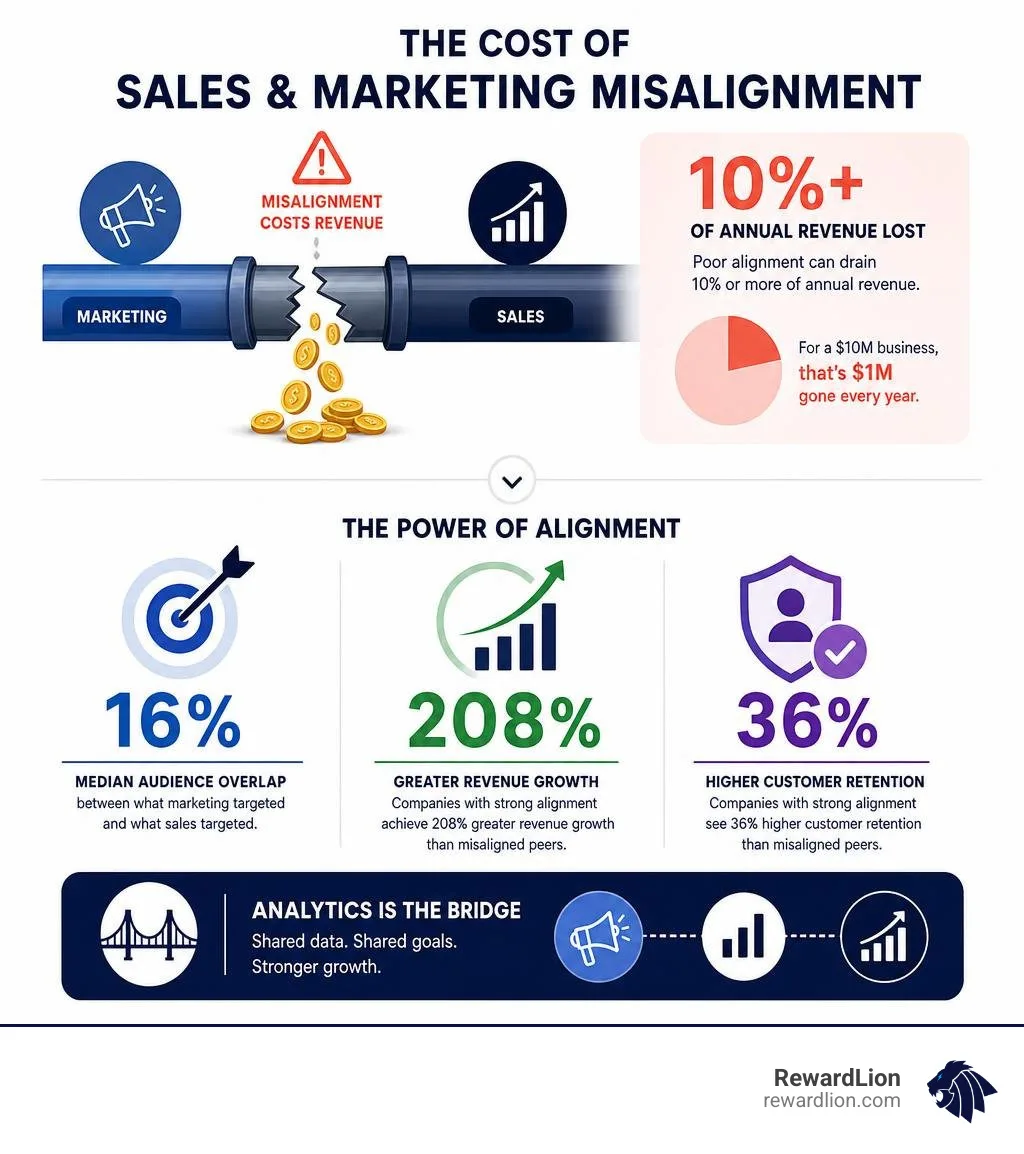
When your teams are looking at different numbers, using different definitions, and chasing different goals, the result is predictable: wasted budget, poor-quality leads, and finger-pointing. Research across 7,046 B2B companies found the median audience overlap between what marketing targeted and what sales targeted was just 16%. That is not a communication gap. That is a structural one.
The business cost is real. Poor alignment can drain 10% or more of annual revenue — for a $10M business, that is $1M gone every year. On the flip side, companies that get alignment right report 208% greater revenue growth and 36% higher customer retention than their misaligned peers.
The good news? Analytics is the bridge.
I'm Mike Ibrahim, Founder and CEO of RewardLion and Marketing Director for several companies, with over a decade of hands-on experience using analytics to align sales and marketing teams across diverse industries. I have seen how connecting the right data transforms two competing departments into a single, revenue-generating machine — and in this guide, I will walk you through exactly how to do it.
The Cost of Disconnection: Why Sales and Marketing Misalignment Happens
For decades, organizations have allowed sales and marketing to operate as two completely separate kingdoms. Marketing sits upstream, launching creative campaigns, buying ads, and measuring success in clicks, impressions, and Marketing Qualified Leads (MQLs). Sales sits downstream, working the phones, conducting discovery calls, and measuring success in closed deals.
This structural separation creates deep data silos. Because each team uses different software and tracks different metrics, they develop completely different views of the customer. Marketing looks at a prospect as a set of web interactions and content downloads. Sales looks at that same prospect as a budget, authority, need, and timeline (BANT) profile.

When these two views don't talk to each other, the customer experience suffers. A prospect might download an educational whitepaper, only to be immediately bombarded by aggressive, sales-heavy cold calls offering major discounts. This inconsistent experience erodes brand trust and causes friction in the buying journey. As outlined in HBR's analysis on commercial analytics, digital channels have multiplied the number of customer touchpoints, meaning the risk of delivering a disjointed, fragmented experience is higher today in 2026 than ever before.
Overcoming the Trust Tax by Using Analytics to Align Sales and Marketing Teams
When data is fragmented, organizations pay a hidden "Trust Tax." This is the time, energy, and productivity wasted when sales and marketing leaders spend their meetings arguing over whose data is correct rather than focusing on how to grow the business.
For example, marketing presents a report showing they generated 1,000 high-quality leads. Sales counters by claiming that 90% of those leads were completely unqualified, junk contacts. Without a unified data architecture, there is no objective way to resolve this dispute. The root of the problem is almost always a lack of agreed-upon lead definitions. In fact, 49% of Chief Sales Officers (CSOs) report that their sales organization's definition of a qualified lead differs greatly from marketing's definition.
By implementing unified lead generation analytics, we can eliminate this subjectivity. Analytics acts as an objective, neutral arbiter. Instead of relying on gut feelings or defensive finger-pointing, both teams can look at real-time conversion data to see exactly which campaigns, channels, and behaviors yield the highest-value opportunities.
The Four Stages of Revenue Unification
Achieving alignment is not an overnight transformation; it is a journey. To help organizations map their progress, we look at the four distinct stages of marketing and sales alignment maturity.
Stage Focus Data Integration Collaboration Level Stage 1: Strategic Alignment Shared priorities & target audiences Completely siloed, manual exports Occasional leadership check-ins Stage 2: Technology Integration Connecting core software stacks CRM & marketing automation sync Automated lead handoffs Stage 3: Operational Integration Unified processes & shared metrics Single source of truth, custom attribution Joint planning & shared KPIs Stage 4: Revenue Unification One cohesive revenue engine Real-time predictive analytics & AI Full shared accountability
Moving from Strategic Alignment to Technology Integration
The journey begins at Stage 1: Strategic Alignment, where leadership agrees on shared priorities, target audiences, and consistent messaging. However, at this stage, the actual execution remains siloed because the data systems are disconnected.
To progress to Stage 2: Technology Integration, we must bridge the gap between our Customer Relationship Management (CRM) system and our marketing automation tools. This integration ensures that when a prospect engages with marketing content, that activity history is immediately visible to the sales representative inside the CRM.
Selecting the right analytics platform for marketing is critical here. It allows us to pipeline clean, structured data directly into our core systems. For teams leveraging enterprise CRMs, following a structured Salesforce Analytics Guide for Marketing Teams (2026) can help configure custom schemas, map tracking parameters like UTMs, and ensure that marketing interactions are mapped directly to sales opportunities without manual data entry.
Achieving Operational Integration and Full Revenue Unification
Once our technology is integrated, we move to Stage 3: Operational Integration. Here, we design shared processes around the entire customer lifecycle. Instead of marketing simply handing off a lead and walking away, both teams co-own the demand management process. Marketing helps nurture existing sales opportunities, and sales provides feedback on lead quality.
The ultimate destination is Stage 4: Revenue Unification. At this peak level of maturity, sales and marketing no longer act as separate entities. They function as a single, unified revenue engine under a shared accountability framework.
Every team member is aligned around the same ultimate goal: driving sustainable revenue growth. By deploying advanced sales automation software saas, we can automate complex workflows, predict pipeline bottlenecks, and ensure that both teams are working from the exact same playbook in real time.
Using Analytics to Align Sales and Marketing Teams: The Core Metrics
To maintain alignment, sales and marketing teams must commit to tracking and owning a shared set of Key Performance Indicators (KPIs). When both teams' bonuses and performance reviews are tied to the same metrics, collaboration happens naturally.
According to The Starr Conspiracy's 2025 alignment benchmarks, tightly aligned organizations achieve a 38% higher sales win rate and 36% higher customer retention. These outcomes are made possible because aligned teams focus on metrics that measure actual revenue impact rather than vanity engagement numbers.

Pipeline Contribution and Velocity Metrics
Rather than tracking raw lead volume, aligned organizations measure how marketing activities contribute to the health and speed of the sales pipeline.
Marketing-Sourced Pipeline: The total dollar value of active sales opportunities where marketing generated the original lead. This proves marketing's direct impact on pipeline growth.
Marketing-Influenced Pipeline: The value of opportunities that were touched by a marketing program (e.g., an email newsletter, webinar, or retargeting ad) at any point during the sales cycle. This highlights marketing's role in supporting sales-led deals.
Pipeline Velocity: How quickly a prospect moves from an initial lead to a closed-won customer. We calculate this using the formula: $$\text{Pipeline Velocity} = \frac{\text{Number of Opportunities} \times \text{Average Deal Value} \times \text{Win Rate}}{\text{Sales Cycle Length (Days)}}$$
To monitor these complex dynamics without getting lost in separate spreadsheets, implementing an all-in-one analytics system is essential. It provides a real-time, consolidated view of pipeline health, showing exactly where deals are stalling and which marketing touchpoints are speeding up the sales cycle.
Lead Quality and Conversion Benchmarks
By tracking conversion rates between funnel stages, teams can pinpoint exactly where lead quality or sales execution is falling short.
MQL to SQL Conversion Rate: The percentage of Marketing Qualified Leads that sales accepts and converts into Sales Qualified Leads. A low conversion rate here indicates a mismatch in lead quality definitions.
SQL to Opportunity Conversion Rate: The percentage of SQLs that progress to a formal, active sales opportunity.
Sales Acceptance Rate (SAR): The percentage of marketing-generated leads that sales accepts for follow-up. Tightly aligned teams maintain a Sales Acceptance Rate of 50% or higher.
To master these handoffs and ensure your conversion benchmarks match industry standards, consult a lead generation software complete guide. This helps set up automated scoring systems that ensure only high-intent, sales-ready prospects are passed to your reps. For more historical context on these trends, review the Sales and Marketing Alignment: Stats and Trends for 2023 - LXA Hub to see how the industry has shifted from volume-based metrics to quality-and-value-focused KPIs over the years.
Building a Unified Customer Journey with Data Integration
To build a truly seamless customer experience, we must map out the entire customer journey and back it with integrated data. Every touchpoint — from the first time a prospect clicks an ad, to their interactions on our website, to their conversations with an account executive — must be recorded in a single, accessible profile.
This requires establishing a "Single Source of Truth." When sales and marketing share a unified data foundation, it eliminates discrepancies and ensures that both teams have the context they need to engage prospects effectively.
Step-by-Step Implementation: Using Analytics to Align Sales and Marketing Teams
To turn your disparate data into a unified alignment engine, follow this step-by-step implementation blueprint:
Conduct a Data Truth Audit: Map out every software tool in your stack (CRM, marketing automation, email platforms, web analytics) and identify where customer data is being collected and where silos exist.
Standardize Your Data Vocabulary: Create a shared dictionary defining exactly what constitutes a "lead," an "MQL," an "SQL," and an "opportunity." Ensure these definitions are coded identically across all platforms.
Map Your Marketing Schema: Align your marketing data fields (such as UTM parameters, lead sources, and campaign IDs) to match the standard objects inside your CRM.
Deploy Multi-Touch Attribution (MTA): Move away from outdated "last-click" attribution models. Implement an MTA model that distributes revenue credit fairly across all touchpoints in the buyer's journey.
For organizations looking to scale this setup quickly, leveraging an ai-driven sales platform can automate data mapping and attribution modeling. To dive deeper into the strategic frameworks behind this process, read the Sales Mastery Series Part 12: Sales & Marketing Alignment - Wasil Zafar for practical exercises and downloadable strategy canvases.
Leveraging AI and Customer Data Platforms
In 2026, artificial intelligence has moved from a futuristic luxury to the core engine of commercial excellence. By deploying a Customer Data Platform (CDP), we can unify millions of disconnected data points into clean, real-time customer profiles.
With this foundation, we can deploy advanced AI capabilities:
Predictive AI: Analyzes historical customer data to forecast lead conversion likelihood, identify at-risk deals, and suggest the optimal "next best action" for sales reps.
Generative AI: Autonomously drafts hyper-personalized outreach emails, sales assets, and follow-ups based on the prospect's exact marketing interaction history. Business leaders anticipate revenue gains of 8% or more from implementing generative AI across commercial functions.
Agentic AI: Takes over repetitive administrative tasks, such as automatically updating CRM records, retrieving compliance documents, and routing highly qualified inbound leads to the right account executive in seconds.
Establishing Long-Term Accountability and Feedback Loops
Achieving alignment is one thing; maintaining it over quarters and years is another. To prevent teams from sliding back into old, siloed habits, we must establish formal accountability frameworks and continuous feedback loops.
Structuring Enforceable SLAs and Lead Handoff Frameworks
A Service Level Agreement (SLA) is a formal, written contract between sales and marketing that outlines exactly what each team commits to delivering.
Marketing's Commitment: Delivering a specific volume of high-quality MQLs that fit the agreed-upon Ideal Customer Profile (ICP).
Sales's Commitment: Following up on those MQLs within a strict, measurable timeframe.
To govern this handoff, we use the L.E.A.D. Handoff Framework:
L - Lead Intelligence Package: Marketing provides sales with a complete background on the lead, including their website activity, content downloads, and lead score.
E - Engagement Window: Sales commits to contacting high-intent leads within a strict window (such as under 5 minutes for hot inbound requests, which yields a 9x higher conversion rate than a 30-minute delay).
A - Acceptance or Recycling: Sales must formally accept the lead as an active opportunity or recycle it back to marketing for further nurturing, accompanied by a clear, coded reason for rejection.
D - Decay and Scoring Rules: Implement score decay rules so that if a lead becomes inactive, its score decreases automatically, preventing sales pipelines from getting cluttered with stale contacts.
Fostering a Data-Driven Culture and Executive Leadership
Sustained alignment requires active championing from executive leadership. Many progressive companies are now uniting sales, marketing, and customer success under a single executive role: the Chief Growth Officer (CGO) or Chief Revenue Officer (CRO). This leader's sole focus is optimizing the entire revenue engine as a single, connected system.
To build a truly data-driven culture, leadership must prioritize data literacy across both departments. Teams should hold joint monthly Revenue Reviews where sales and marketing leaders sit down together to review shared dashboards, analyze pipeline velocity, and collaborate on optimizing the conversion funnel. This shifts the internal narrative from "us vs. them" to "how do we win together."
Frequently Asked Questions about Revenue Alignment
What is the average MQL to SQL conversion rate in B2B?
The median B2B MQL to SQL conversion rate sits at approximately 13%. However, top-quartile organizations that utilize unified analytics, strict lead scoring, and automated handoffs regularly achieve conversion rates of 25% or higher.
How does multi-touch attribution help align marketing and sales teams?
Traditional "last-click" attribution gives 100% of the credit to the final action (usually a sales call or demo booking), making marketing's early-stage awareness efforts invisible. "First-click" attribution does the opposite. Multi-touch attribution (MTA) solves this conflict by using data to distribute revenue credit across every touchpoint. This proves the value of marketing's educational content while validating the sales team's execution in closing the deal.
What is a good sales-marketing SLA compliance rate?
Top-performing B2B organizations achieve an SLA compliance rate of 91% or higher (meaning sales reps follow up on leads within the agreed timeframe 91% of the time). The median across the industry sits much lower, at around 54%. Raising this compliance rate is one of the fastest ways to boost lead-to-opportunity conversion rates.
Conclusion: The Path to Unified Growth
Using analytics to align sales and marketing teams is no longer optional for businesses aiming to thrive in 2026. By breaking down data silos, establishing shared revenue metrics, and automating your customer journey, you can eliminate the "Trust Tax" and unlock massive, predictable growth.
At RewardLion, we help businesses build this exact revenue engine. Our AI-powered, all-in-one OS platform unifies your marketing, sales, automation, and analytics into a single, cohesive system. You don't have to manage disconnected tools or hire multiple, competing agencies. Our dedicated fractional expert teams (your in-house marketing agency) implement, manage, and continuously optimize your entire growth engine for you.
Ready to unite your teams and accelerate your revenue? Get a custom quote today, and let's build your alignment blueprint together.