The Local SEO Checklist for Dentists: A Step-by-Step Guide to More New Patients
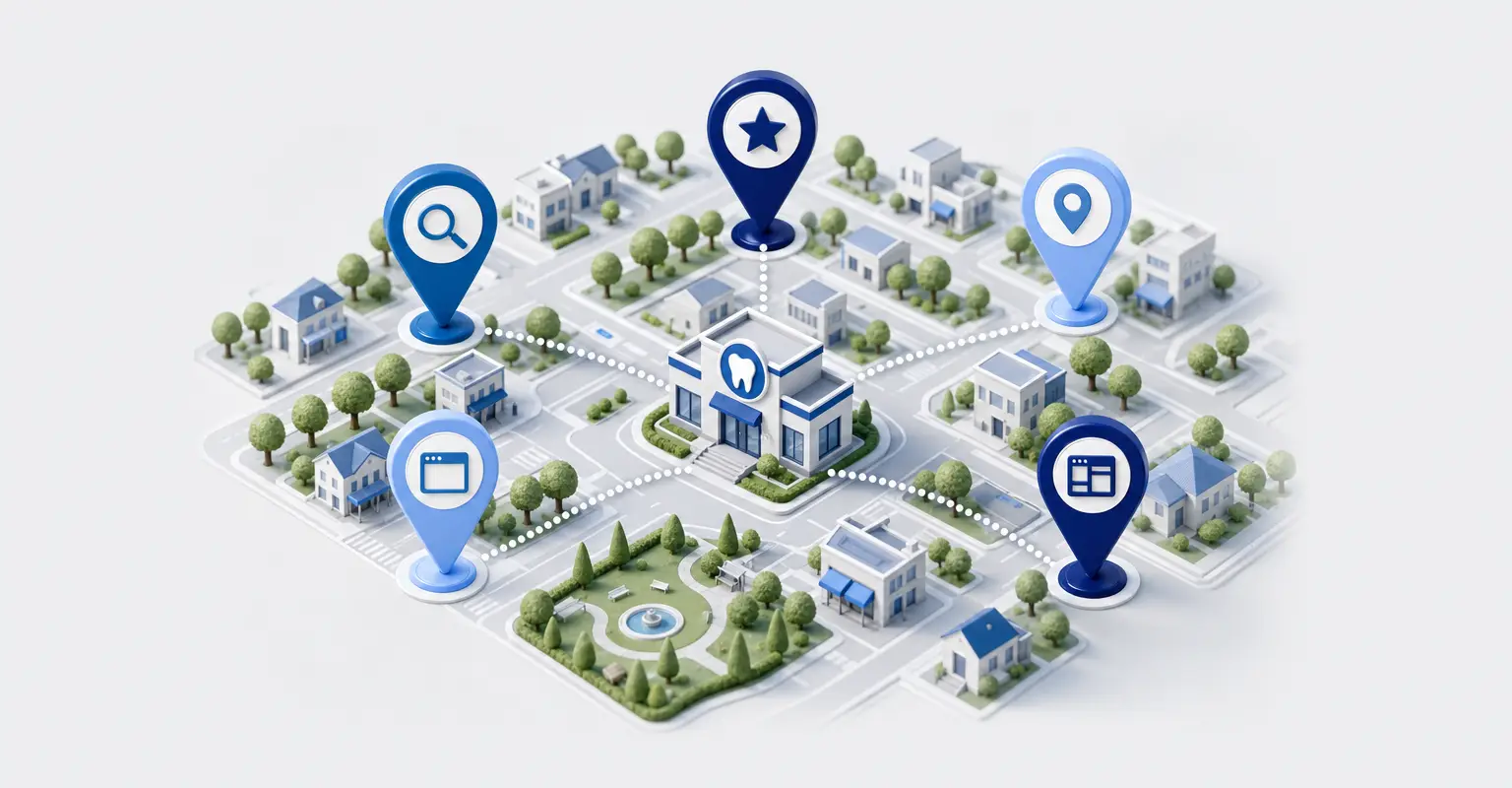
A local SEO checklist for dentists needs to cover eight things: your Google Business Profile, NAP consistency, location and service pages, reviews, schema markup, mobile and Core Web Vitals, citations and local backlinks, and a system for tracking and following up on every lead. Get these right and your practice shows up when nearby patients search for a dentist. Skip them and you're invisible no matter how good your dentistry is.
This isn't a theoretical list. Each step below is tied directly to what actually moves the phone to ring and the schedule to fill. You can hand this to your office manager as a to-do list, or skip to the end if you'd rather have it handled for you.
The eight steps at a glance:
- Google Business Profile — claim it and complete every field
- NAP consistency — the same name, address and phone everywhere
- Location and service pages — one real page per office and key service
- Review generation — a system, not an occasional ask
- Schema markup — structured data that describes your practice
- Mobile and Core Web Vitals — a fast, tappable site
- Citations and local backlinks — mentions from real local sources
- Tracking and follow-up — turning calls and forms into booked appointments

Why Local SEO Is a Core Growth Lever for Dental Practices
How patients look for a dentist
According to Webtonic's Dental SEO 2026 statistics, 93% of all patient journeys now start with a search engine, and roughly 113,000 searches happen every day across the U.S. for "dentist near me." Dental Marketing Guy's SEO guide adds that 97% of consumers research local businesses online before visiting, and 46% of all Google searches carry local intent.
Why the map results matter
Showing up matters, too. Per Hibu's local SEO analysis, cited in Dental Marketing Guy's guide, businesses that appear in Google's local 3-pack get 93% more calls and 126% more website traffic than practices that don't. If your practice isn't in that top cluster of map results, you're losing patients to the practice down the street that is.
Step 1: Claim and Fully Optimize Your Google Business Profile
Why the profile comes first
Your Google Business Profile (GBP) is the single highest-leverage asset in local SEO. A Google stat cited by Webtonic shows that complete profiles are 70% more likely to attract visits and 50% more likely to drive appointment bookings than incomplete ones.
Profile checklist
Checklist items:
- Claim and verify your listing if you haven't already.
- Choose the correct primary category — StoreRocket's 2026 ranking factors guide identifies GBP primary category as widely regarded as the single most influential local ranking signal.
- Fill out hours, services, insurance accepted, and photos completely.
- Post updates regularly (new services, hours changes, team news).
- Add a booking link so searchers can schedule directly from the listing.

Google has explicitly named relevance, distance, and prominence as the three core local ranking factors, per StoreRocket. A complete, active profile feeds all three.
| Ranking factor | What it means | What your practice can control |
|---|---|---|
| Relevance | How well your listing matches what the patient searched | Primary category, services listed, a clear description |
| Distance | How close your office is to the searcher or the searched area | Accurate address and a correct map pin |
| Prominence | How well known and trusted your practice appears | Reviews, citations, local links and an active profile |
Step 2: Lock Down NAP Consistency Across Every Directory
NAP stands for Name, Address, Phone number. If your practice name is listed differently on Yelp, Healthgrades, your website footer, and your GBP, it confuses both patients and Google's ranking algorithm.
- Audit every directory listing where your practice appears.
- Fix mismatches in spelling, suite numbers, and phone formatting.
- Use the exact same format everywhere, including your website.
eSEOSpace's 2026 checklist flags a NAP audit as one of the three highest-leverage starting actions a practice can take — it's quick, and it directly affects how confidently Google displays your listing.
How to run a NAP audit in an afternoon
- Write down your official format once: the exact practice name, suite number style and phone format.
- Search your practice name and phone number to find every listing that mentions you.
- Log each listing in a spreadsheet with what it shows and whether it matches.
- Correct the mismatches on the platforms you control, starting with the largest directories.
- Note any old addresses or phone numbers from past moves and update those too.
Step 3: Build Location and Service Pages That Match Patient Search Intent
Location pages
If you have more than one location, each one needs its own dedicated page — not a templated page with the city name swapped out. eSEOSpace warns that thin, duplicated location pages get ignored by Google.
Each location page should include:
- Unique team photos for that office
- Specific hours and a map embed
- Reviews specific to that location
Service pages
Same logic applies to services. A page for "dental implants" and a separate page for "emergency dentist" each target a different search and a different patient intent — don't bury them all on one generic "services" page.
A useful service page explains what the visit involves, who it's for, what to expect at the appointment and how to book. Keep the language factual and avoid promising outcomes. The same principle — real, unique content per page — is covered in our guide to service area pages.
Step 4: Launch a Review Generation System (Not Just a Review Ask)
Why reviews matter
Reviews aren't a nice-to-have — they're a ranking and conversion factor. Dental Marketing Guy reports that practices averaging 4+ stars receive 3x more calls than lower-rated competitors, and that Birdeye's 2025 State of Online Reviews found nearly 1 in 2 patients have avoided a provider due to poor or unanswered reviews.
Patientfy's 2026 Dental Industry Statistics, citing BrightLocal, adds that two-thirds of consumers filter out businesses rated under 4 stars — and 45% now ask AI tools like ChatGPT for local recommendations, up from just 6% a year earlier.
Building the system
Build a system, not a one-off ask:
- Request reviews within 24 hours of the visit, per ClickGuru's 2025 Local SEO Checklist.
- Respond to every review, positive or negative, within two business days — Google treats responsiveness as a trust signal.
- Make the review request automatic (text or email) so it doesn't depend on staff remembering.

Step 5: Add Schema Markup and Technical Local SEO Signals
Schema markup is code that tells search engines exactly what your business is, where it's located, and what services you offer. For dental practices, this includes LocalBusiness and Dentist schema, with your address, hours, and services marked up clearly. It won't make your site look different to a patient, but it helps Google understand and trust your listing — which supports the relevance and prominence factors mentioned above.
The basic details to mark up on each location page:
- Practice name exactly as it appears on your GBP
- Address and phone number in your official NAP format
- Opening hours for that office
- Services offered at that location
- Website and booking URLs
After adding it, test the page with Google's Rich Results Test to confirm the markup is read correctly.
Step 6: Optimize for Mobile, Core Web Vitals, and Zero-Click/AI Search
Mobile first
Dental Marketing Guy reports that 68% of dental searches happen on mobile. The same guide notes that a site that isn't mobile-optimized loses more than half its potential traffic before a patient even considers calling.
Separately, BizIQ research cited by Propellant Media found that "near me" mobile searches for dentists grew 900% over a two-year period — proximity-based mobile search is one of the highest-intent channels a practice has access to.
- Test your site on a phone, not just a desktop.
- Confirm pages load fast (Core Web Vitals).
- Make your phone number and booking button easy to tap, above the fold.
Step 7: Build Local Citations and Community Backlinks
Citations are mentions of your practice name, address, and phone number on other websites — directories, local news, chamber of commerce pages. Backlinks from legitimate local sources (sponsorships, community events, local press) signal to Google that your practice is a real, established part of the community. Consistency here reinforces everything in Step 2.
Where local links come from
Good sources are usually things a practice already does: sponsoring a school or youth sports team, taking part in a community health fair, joining the local chamber of commerce, or being mentioned in local news. Each of these can earn a genuine mention or link. Avoid paid link schemes; they carry risk and don't reflect real community ties.
Step 8: Track, Respond, and Follow Up — Turning Visibility Into Booked Patients
Close the follow-up gap
Ranking well and getting calls doesn't help if those calls and form submissions go unanswered. eSEOSpace recommends pulling a missed-call report as one of the three highest-leverage quick wins a practice can act on immediately.
- Review missed calls weekly and call back same-day.
- Set up automated text/email follow-up for web form leads.
- Track which pages and searches are actually producing booked appointments, not just traffic.
A simple maintenance rhythm
Once the setup work is done, local SEO becomes a routine. A weekly check of missed calls and new reviews, a monthly GBP post and listing review, and a quarterly NAP and citation audit keep the eight steps from slipping. Our article on SMS automation explains how automated text follow-up can support the weekly part.
Quick answers from this guide
| Question | Short answer |
|---|---|
| How long does local SEO take to show results for a dental practice? | Local SEO is a cumulative effort — profile completeness, reviews, citations, and content all build on each other over time. |
| Do I need a website if my Google Business Profile is already optimized? | Yes. Your GBP is often the first thing a patient sees, but your website is where location pages, service pages, and schema markup live — all of which support your GBP's ranking and give patients the detail they need to book. |
| How often should we ask patients for reviews? | ClickGuru's 2025 Local SEO Checklist recommends requesting reviews within 24 hours of the visit, while the experience is fresh, and responding to every review — positive or negative — within two business days. |
| What's the single highest-leverage first step if we're starting from scratch? | eSEOSpace's checklist points to three quick wins: run a NAP consistency audit, set up a weekly review-request routine, and pull a recent missed-call report. |
The Full Local SEO Checklist for Dentists (Printable Recap)
- [ ] Claim and fully complete your Google Business Profile
- [ ] Set the correct GBP primary category
- [ ] Audit and fix NAP consistency across all directories
- [ ] Build a unique page for every location
- [ ] Build dedicated pages for key services
- [ ] Set up automated review requests within 24 hours of each visit (ClickGuru)
- [ ] Respond to every review within two business days
- [ ] Add LocalBusiness/Dentist schema markup
- [ ] Confirm mobile usability and page speed
- [ ] Build local citations and community backlinks
- [ ] Pull a recent missed-call report and close the gaps
- [ ] Set up automated lead follow-up for calls and form fills

How RewardLion Handles This For You
This checklist works — but running it consistently, week after week, on top of running a practice is a lot to ask of front-desk staff. RewardLion builds and manages this for dental practices as a done-for-you system: Google Business Profile management, review generation, local SEO and GEO (optimizing for how AI tools surface local recommendations), and automated lead follow-up so missed calls and unanswered forms don't turn into lost patients.
If you'd rather hand this off than DIY it, that's exactly the gap RewardLion fills.
We work with general dentists, cosmetic dentists, orthodontists and pediatric dentists, and pair local search work with reputation management and CRM setup and automation.
Related reading
- Unlocking Local Search: The Ultimate SEO Jacksonville FL Guide
- Top Florida Local SEO Companies to Help Your Business Dominate Search
- Local Marketing Automation Software: The Secret to Community Growth
- RewardLion local SEO services
FAQ
How long does local SEO take to show results for a dental practice?
Local SEO is a cumulative effort — profile completeness, reviews, citations, and content all build on each other over time. We can't promise a specific timeline or outcome, since results depend on your market, competition, and how consistently the checklist is maintained.
Do I need a website if my Google Business Profile is already optimized?
Yes. Your GBP is often the first thing a patient sees, but your website is where location pages, service pages, and schema markup live — all of which support your GBP's ranking and give patients the detail they need to book.
How often should we ask patients for reviews?
ClickGuru's 2025 Local SEO Checklist recommends requesting reviews within 24 hours of the visit, while the experience is fresh, and responding to every review — positive or negative — within two business days.
What's the single highest-leverage first step if we're starting from scratch?
eSEOSpace's checklist points to three quick wins: run a NAP consistency audit, set up a weekly review-request routine, and pull a recent missed-call report. All three can be done without a website rebuild.

Sources
- The 2025 Local SEO Checklist for Dental Practices
- Local SEO for Dental and Medical Practices: A 2026 Checklist That Actually Fills the Schedule
- Easy Ways To Optimize Google Business Profile for Dentists: A Complete Guide
- How to Set Up a Fully Optimize Google Business Profile for a Dental Practice (The Complete Ranking Guide)
- Dental SEO in 2026: Data & Statistics
- Dental SEO Guide: How Patients Find Your Practice Online
- Local SEO Ranking Factors: What Actually Matters in 2026
- Top Local SEO Ranking Factors for 2025
- Local SEO for Dentists - Online Reviews
- Local SEO for Dentists: A Practical Guide
- Dentist Near Me SEO for Dental Clinics
- Dental Industry Statistics 2026: Where Patients Are Won