Core Architecture of Predictive Analytics for Sales and Marketing
Predictive analytics sits at the intersection of historical data, statistical modeling, and machine learning. Instead of waiting for a quarterly review to see which campaigns converted, modern go-to-market teams use algorithmic scoring and forward-looking indicators to guide everyday revenue operations. Exploring the academic foundations of predictive modeling shows that these techniques rely on probability theory to project future outcomes from past patterns.
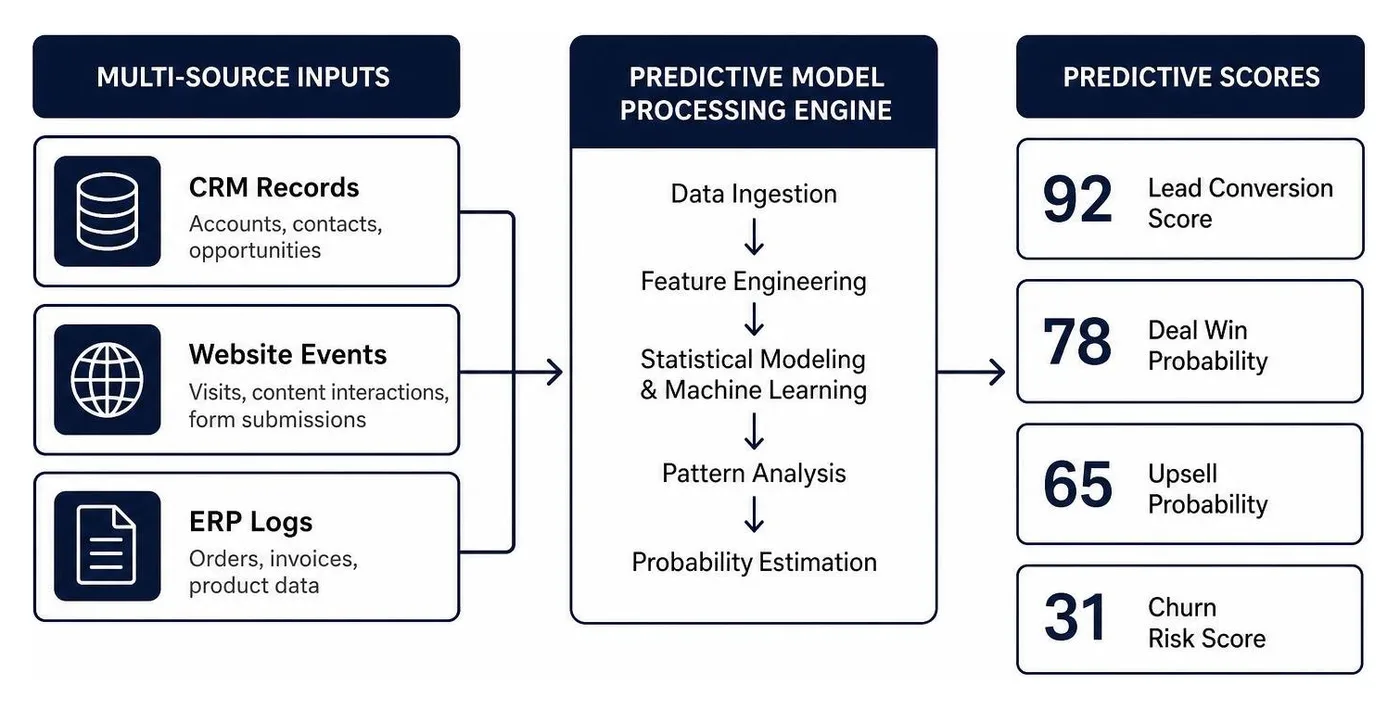
When we look at unified sales and marketing analytics, the core architecture connects multiple systems—CRM records, website events, and ERP logs—into a single ingestion layer. Machine learning algorithms process this data, identifying patterns that human analysts might miss across thousands of customer touchpoints.
Descriptive vs Predictive Intelligence
Traditional business intelligence looks backward. It tells you how many leads downloaded an ebook last month or how many deals closed in Q3. While diagnostic analytics helps explain why those results occurred, it still leaves sales reps and marketers guessing about what will happen tomorrow.
Predictive intelligence transforms static data into active guidance. By evaluating historical trajectories alongside live buyer signals, it assigns numeric probabilities to future events, such as a lead requesting a demo or an active client cancelling their subscription.
Analytics Dimension | Descriptive Analytics | Diagnostic Analytics | Predictive Analytics |
|---|---|---|---|
Primary Question | What happened? | Why did it happen? | What is likely to happen next? |
Data Inputs | Historical CRM logs, past revenue | Historical data, multi-touch attribution | Historical records, real-time intent, product telemetry |
Operational Focus | Retrospective reporting | Root cause analysis | Real-time prioritization and automated workflows |
Decision Speed | Monthly or quarterly cadence | Ad-hoc post-mortem reviews | Instantaneous, algorithmic decisioning |
Mathematical Frameworks and Statistical Models
Predictive modeling uses established mathematical frameworks tailored to specific commercial goals:
Linear Regression: Estimates continuous numeric values, such as future pipeline revenue or customer lifetime value (LTV).
Logistic Regression: Calculates binary probabilities, such as whether an account will convert or churn.
Time Series Analysis (e.g., ARIMA): Evaluates recurring trends and seasonal variations to generate demand and revenue forecasts. Modern organizations evaluate different enterprise sales forecasting methodologies to match their sales cycle length.
Decision Trees and Random Forests: Break down multi-variable buyer behaviors into clear, rule-based branching paths to identify key conversion drivers.
Clustering Algorithms (e.g., K-Means): Uncover natural groupings within audience data for behavioral segmentation.
Collaborative Filtering: Identifies cross-sell opportunities by comparing buying patterns across similar accounts.
Marketing Mix Modeling (MMM): Measures the aggregate impact of various media investments to simulate budget allocations before spending.
Key Data Sources Powering Predictive Analytics for Sales and Marketing
A predictive algorithm is only as good as the information powering it. Effective systems integrate several distinct data streams:
First-Party Behavioral Data: Website visits, content interactions, pricing page views, and form submissions.
Product Telemetry and Usage Metrics: Login frequency, feature adoption, and user seat expansion in digital platforms.
CRM and Pipeline Records: Historical win/loss records, opportunity velocity, deal size, and sales interaction logs.
ERP and Transaction History: Past invoice amounts, purchase frequency, discount rates, and contract renewal timelines.
Third-Party Intent Data: Content consumption across external research networks, showing when prospective accounts are researching solutions.
Integrating these sources through comprehensive marketing automation gives predictive models the context needed to separate real buying interest from casual browsing.
High-Impact GTM Use Cases Across the Revenue Engine
Deploying predictive models across the go-to-market funnel bridges the traditional gap between pipeline generation and deal execution. When both groups share objective, data-backed conversion probabilities, prioritizing accounts becomes straightforward. In fact, using analytics to align sales and marketing teams creates operational clarity that helps shorten sales cycles.
Predictive Lead Scoring and Opportunity Prioritization
Traditional lead scoring relies on arbitrary point assignments—like adding 10 points for a webinar registration and 5 points for an email click. This often fills the pipeline with low-intent prospects.
Predictive lead scoring replaces manual points with machine learning models trained on historical closed-won opportunities. The algorithm evaluates firmographic fit alongside intent signals to assign conversion probabilities.
This helps address a major B2B reality: the average B2B buying journey lasts 10 months, with six of those months spent in anonymous research. Research shows that 95% of the time, the ultimate vendor winner is determined by shortlists formed during this initial research phase. Connecting predictive scoring with automated lead generation systems allows revenue teams to identify and engage high-intent accounts long before a formal inquiry is submitted.
Churn Forecasting and Proactive Retention Workflows
Customer retention protects recurring revenue. Predictive churn models track account health metrics to flag dissatisfaction long before an account requests cancellation.
By monitoring signals like login drop-offs, declining feature usage, and unresolved support tickets, predictive systems assign risk scores across your customer base. Customer success managers receive automated alerts to intervene with targeted support or product check-ins. Integrating these early indicators through intelligent CRM setup automation turns reactive account saves into structured, proactive retention workflows.
Dynamic Sales Forecasting and Demand Planning
Traditional sales forecasting often depends on subjective sales rep estimates. Reps tend to mark deals as "likely to close" based on gut feeling, leading to missed revenue targets and unexpected variances.
Predictive forecasting looks at past sales patterns, pipeline speed, seasonal cycles, and active engagement to generate data-backed revenue projections. These systems adjust forecasts dynamically as accounts move through each pipeline stage. Our Sales Marketing Analytics Guide 2026 highlights how companies use dynamic forecasting to align sales goals with marketing spend and operational capacity.
In retail and e-commerce, predictive demand planning also optimizes inventory levels and manages return rates. With roughly 30% of all online purchases returned—and 92% of consumers willing to buy again if the return process is easy—predictive returns modeling helps manage stock placement and minimize logistics costs.
Predictive Segmentation and Next-Best-Action Personalization
Blanket marketing messages rarely deliver strong returns. Research shows that 80% of consumers are more likely to purchase from brands that provide tailored experiences.
Predictive segmentation groups prospects and existing accounts by predicted customer lifetime value, engagement habits, and purchase timing. Rather than sending the same monthly campaign to an entire list, marketing teams can trigger automated next-best-action workflows. Pairing these dynamic segments with AI sales automation ensures leads receive relevant content, product recommendations, and outreach based on their actual buying stage.
Overcoming Enterprise Implementation Challenges and Privacy Compliance

While the benefits are significant, adopting predictive analytics involves real operational hurdles. Teams often run into dirty data, siloed platforms, and changing privacy laws.
Data Hygiene, Technical Debt, and Integration Barriers
Predictive models require clean, well-structured data. Common roadblocks include:
Fragmented Data Silos: Customer data split across disconnected CRM, marketing, and support tools prevents models from seeing the full customer journey.
Model Drift: Market conditions and buyer habits change over time. Models trained on outdated behaviors lose accuracy unless retrained regularly.
Interpretability and Team Trust: If sales reps cannot see why an account received a high score, they often ignore the recommendation. Using explainable models with clear scoring factors builds internal trust.
Building automated data pipelines and continuous validation helps keep predictive outputs reliable and actionable for field teams.
Navigating Data Privacy Regulations Under GDPR and CCPA
Predictive modeling must respect consumer privacy regulations like GDPR, CCPA, and emerging state frameworks. Modern compliance requires clear operational guardrails:
Explicit Consent Management: Track and verify opt-in preferences for behavioral tracking and model training.
Data Minimization: Collect only the customer attributes necessary to generate accurate predictions.
Algorithmic Transparency: Maintain clear documentation on how personal data informs automated profiling and segmentation.
Secure Infrastructure: Use modern encryption, access controls, and privacy-preserving data workflows to safeguard customer records.
Prioritizing privacy compliance preserves consumer trust and shields your business from costly regulatory penalties.
Strategic Roadmap for GTM Revenue Teams

Adopting predictive analytics should be a structured rollout rather than an overnight overhaul. Focus first on high-value use cases, refine your models, and expand system integrations systematically.
Step-by-Step Implementation of Predictive Analytics for Sales and Marketing
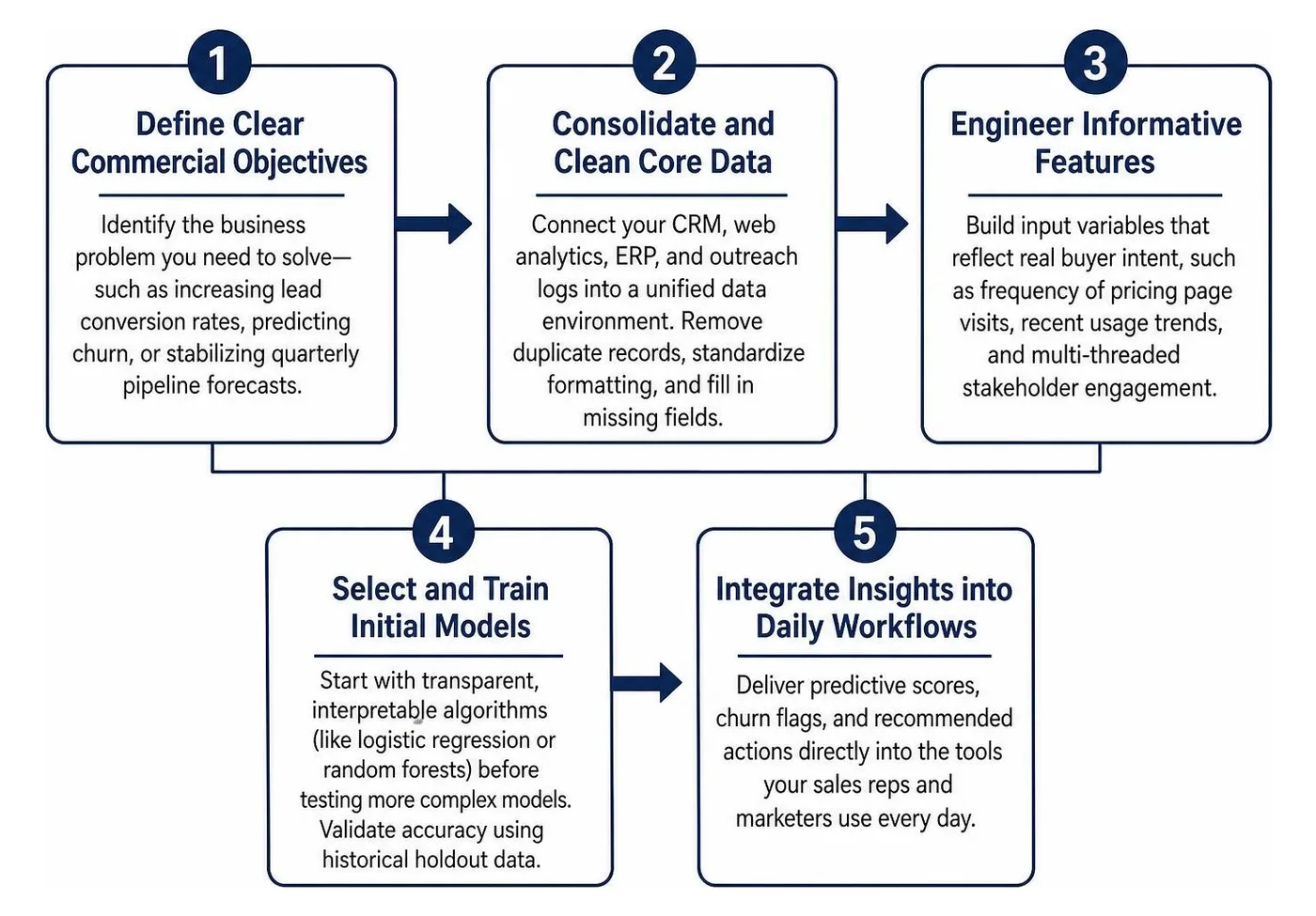
Define Clear Commercial Objectives: Identify the business problem you need to solve—such as increasing lead conversion rates, predicting churn, or stabilizing quarterly pipeline forecasts.
Consolidate and Clean Core Data: Connect your CRM, web analytics, ERP, and outreach logs into a unified data environment. Remove duplicate records, standardize formatting, and fill in missing fields.
Engineer Informative Features: Build input variables that reflect real buyer intent, such as frequency of pricing page visits, recent usage trends, and multi-threaded stakeholder engagement.
Select and Train Initial Models: Start with transparent, interpretable algorithms (like logistic regression or random forests) before testing more complex models. Validate accuracy using historical holdout data.
Integrate Insights into Daily Workflows: Deliver predictive scores, churn flags, and recommended actions directly into the tools your sales reps and marketers use every day.
Audit and Retrain Continuously: Compare predictions against real conversion and retention rates on a monthly cadence. Retrain models to prevent drift as market dynamics change.
Frequently Asked Questions About Predictive GTM Analytics
What is the difference between predictive analytics and traditional reporting?
Traditional reporting is retrospective—it summarizes historical events, such as total closed revenue or email open rates from the previous month. Predictive analytics evaluates past patterns alongside live engagement signals to forecast future behaviors, calculate conversion probabilities, and trigger proactive sales and marketing workflows.
What core data types are required to train effective sales and marketing models?
Accurate predictive models rely on a mix of first-party and third-party data sources. Essential inputs include historical CRM transaction logs, firmographic attributes, website engagement telemetry, product usage metrics, and external buyer intent signals.
Can businesses deploy predictive analytics without an in-house data science team?
Yes. Modern revenue platforms, pre-configured AI operating systems, and managed growth partners provide turnkey predictive intelligence. These unified solutions handle data consolidation, model training, and workflow automation, allowing sales and marketing teams to act on predictive insights without needing dedicated data scientists.
Conclusion
Predictive analytics changes how modern revenue teams operate. By shifting from historical reporting to forward-looking intelligence, sales and marketing organizations can focus resources on high-intent accounts, protect recurring revenue, and forecast pipeline with greater confidence.
Building a connected predictive engine requires unified data, explainable models, and practical workflow integration. At RewardLion, we help businesses install and operate unified, AI-driven growth systems—combining modern software architecture with hands-on execution to turn data into scalable revenue growth.