What monthly marketing automation services cost depends on
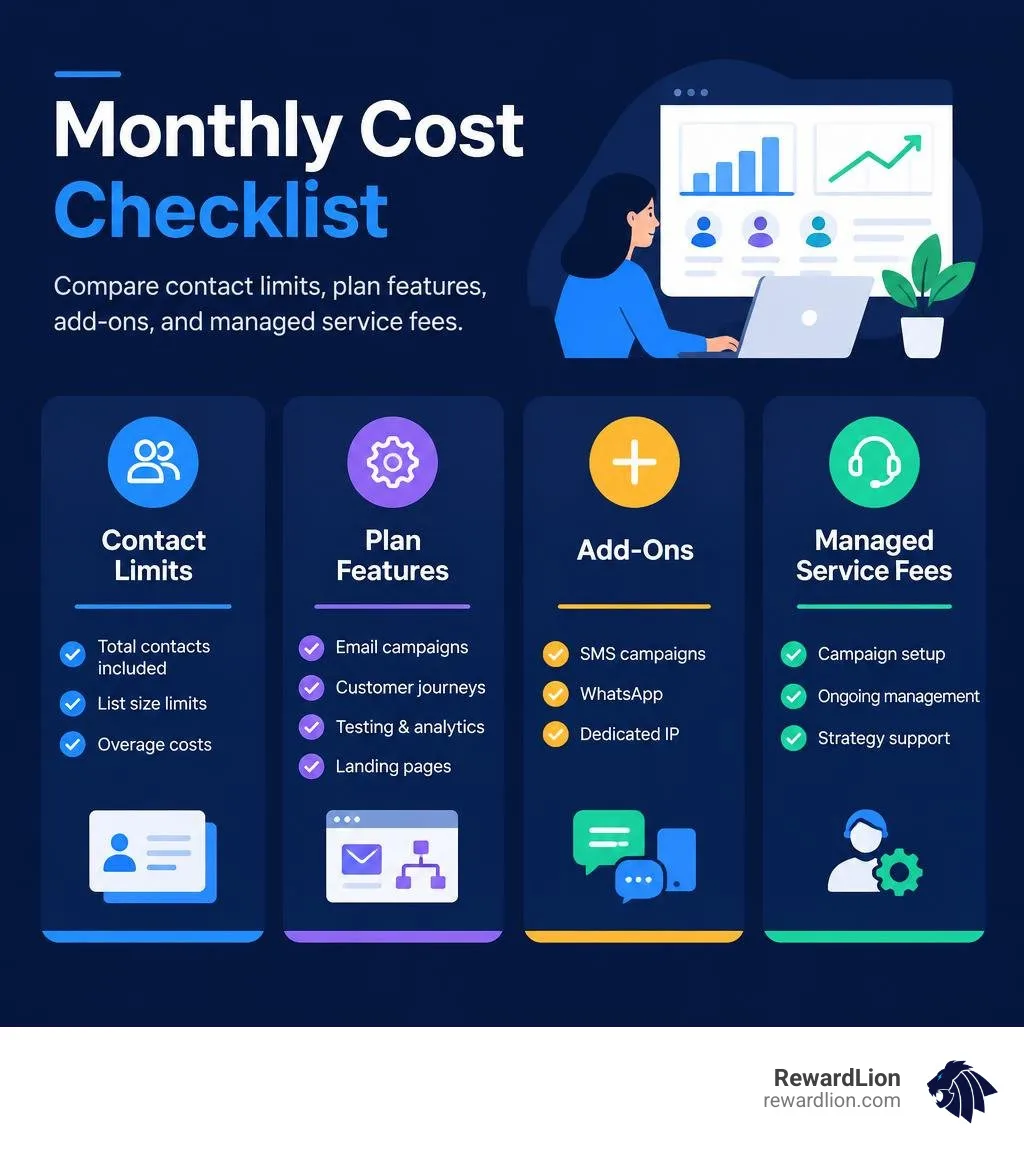
To estimate your monthly cost, start with your marketing contact count, then check the features, users, and website visitors your plan allows. A basic tier may cover email campaigns and simple customer journeys. Higher tiers can add testing, landing pages, and more room to grow. SMS, WhatsApp, or a dedicated sending IP may cost extra.
If you also need someone to set up and run your campaigns, budget for that service separately from the software. Comparing both costs helps you avoid choosing a low-priced plan that cannot handle your work.
I'm Mike Ibrahim, founder and CEO of RewardLion. I've spent more than a decade building sales and marketing strategies, including the kinds of workflows businesses weigh when choosing monthly marketing automation services.
Understanding the Pricing Tiers of Monthly Marketing Automation Services
When shopping for an automated marketing platform, navigating tier structures can feel like deciphering a secret code. Most providers structure their monthly subscription packages around functional complexity, team access, and scale. We frequently see businesses overpay for enterprise bloat they never touch, or conversely, pick an entry-level plan that chokes their lead flow within weeks.
To help clarify your options, our dedicated marketing automation services are built to bridge the gap between software capabilities and real execution. Understanding the tier dynamics is the first step toward aligning your operational budget with actual revenue goals. When evaluating providers, make sure to examine their pricing models to avoid surprise hidden fees.
Feature / Metric | Standard Tier | Professional Tier | Enterprise Tier |
|---|---|---|---|
Primary Focus | Basic email campaigns & fundamental nurture paths | Advanced testing, omnichannel journeys & landing pages | Complex multi-touch attribution & custom organizational roles |
User Concurrency | Up to 10 users | Up to 15 users | Up to 25 users |
Visitor Multiplier | Baseline tracking (e.g., 5,000 visitors per 2k contacts) | 5x traffic multiplier | 10x traffic multiplier |
Email Volume | Unlimited sends | Unlimited sends | Unlimited sends |
Non-Marketing Contacts | Up to 1,000,000 stored | Up to 1,000,000 stored | Up to 1,000,000 stored |
A/B Testing | Limited / None | Included (Email & Landing Pages) | Comprehensive Multi-Variable |
Support Model | Standard ticketing & onboarding | Priority technical support | Dedicated account management |
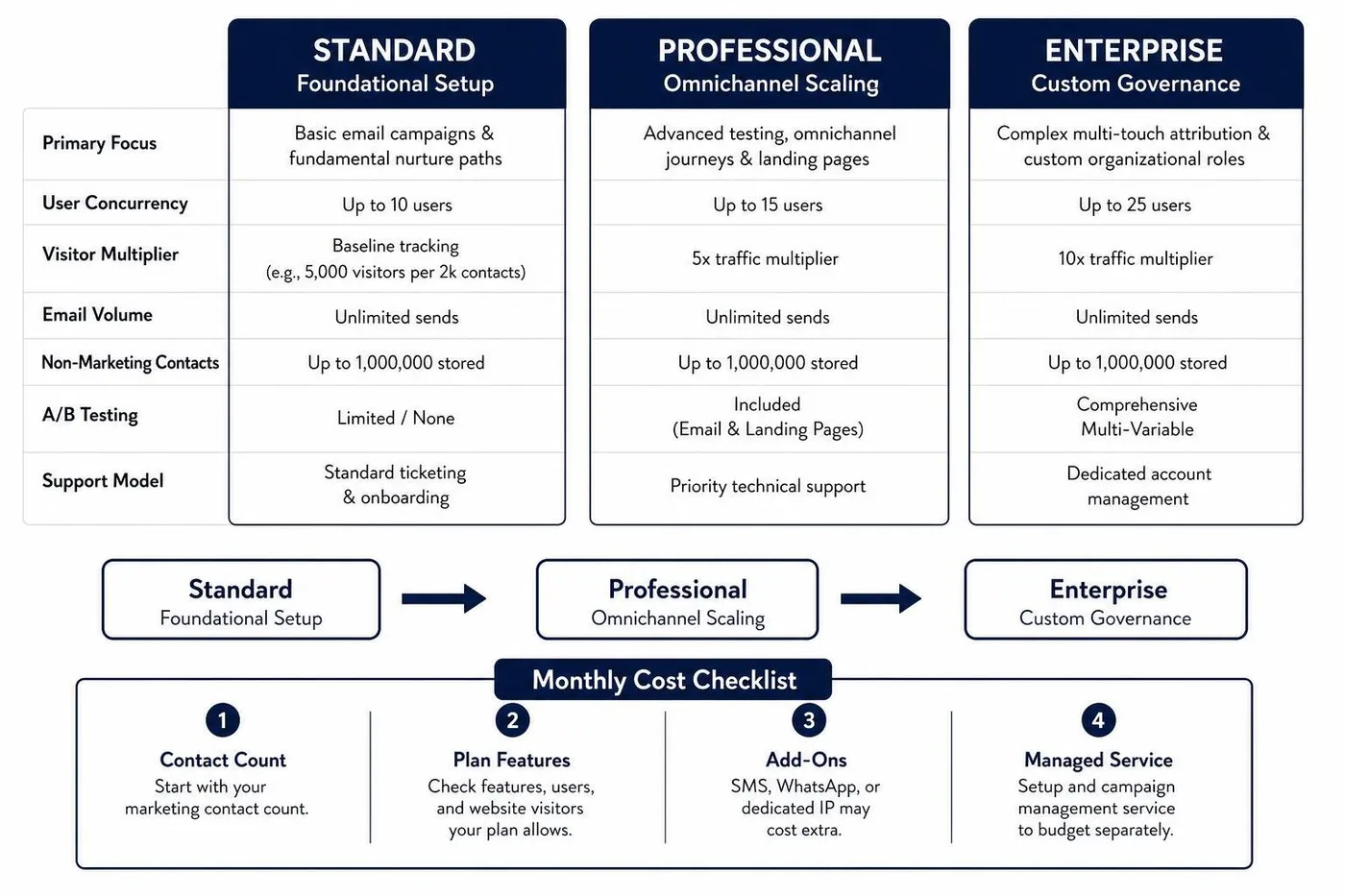
Feature Breakdown Across Standard, Professional, and Enterprise Plans
Every tier delivers distinct functionality designed for specific operational stages:
Standard Plans: Focus on foundational campaign building. You get essential segmentation tools, standard list management, unlimited emails, and a visual journey builder to guide leads through basic linear paths. This tier suits companies stepping away from manual outreach into structured, reliable email marketing automation software.
Professional Plans: Unlock dynamic optimization. You gain access to built-in landing pages, split A/B testing across messaging flows, behavioral journey branch triggers, and deeper campaign analytics. This tier is engineered for growing teams looking to convert cold traffic into sales-qualified leads with a modern automated marketing platform.
Enterprise Plans: Deliver sophisticated governance and analysis. You receive multi-touch lead attribution, custom administrative roles with granular access permissions, advanced journey tracing, and tailored integrations. It caters to established organizations managing distinct departments or regional territories.
User Seat Allocations and Web Visitor Multipliers
Software limits extend beyond contact numbers. Plan tiers govern team access and site tracking:
User Concurrency: A Standard tier generally caps access at a 10 user limit. Upgrading to Professional increases your seats to a 15 user limit, while Enterprise tiers support a 25 user limit. This ensures your sales development reps, marketing specialists, and executives can collaborate without sharing logins.
Visitor-to-Contact Multipliers: Marketing systems monitor anonymous web traffic before visitors fill out forms. Standard plans provide baseline tracking (such as 5,000 visitors alongside 2,000 marketing contacts). Professional tiers typically grant a 5x traffic multiplier, and Enterprise tiers scale to a 10x traffic multiplier. This infrastructure allows you to track extensive inbound traffic without triggering unexpected bandwidth limits, matching established marketing automation agency benchmarks.
How Contact Volumes and Data Caps Influence Monthly Platform Pricing

Contact tiering remains the primary engine driving monthly software bills. Even on identical plan tiers, an organization managing 5,000 leads pays substantially less than a brand engaging 100,000 subscribers. Setting up structured data hygiene through thorough CRM setup automation prevents inactive records from inflating your software tier.
When your contact base expands beyond standard brackets, pricing increases in predictable increments. For high-volume thresholds exceeding 500,000 marketing contacts, SaaS platforms transition out of self-serve tiers into custom enterprise pricing agreements. Deploying specialized lead automation software ensures you maximize lead value before reaching costly database brackets.
Marketing Contacts vs Non-Marketing Contacts
A vital distinction across modern marketing systems is how platforms categorize your records:
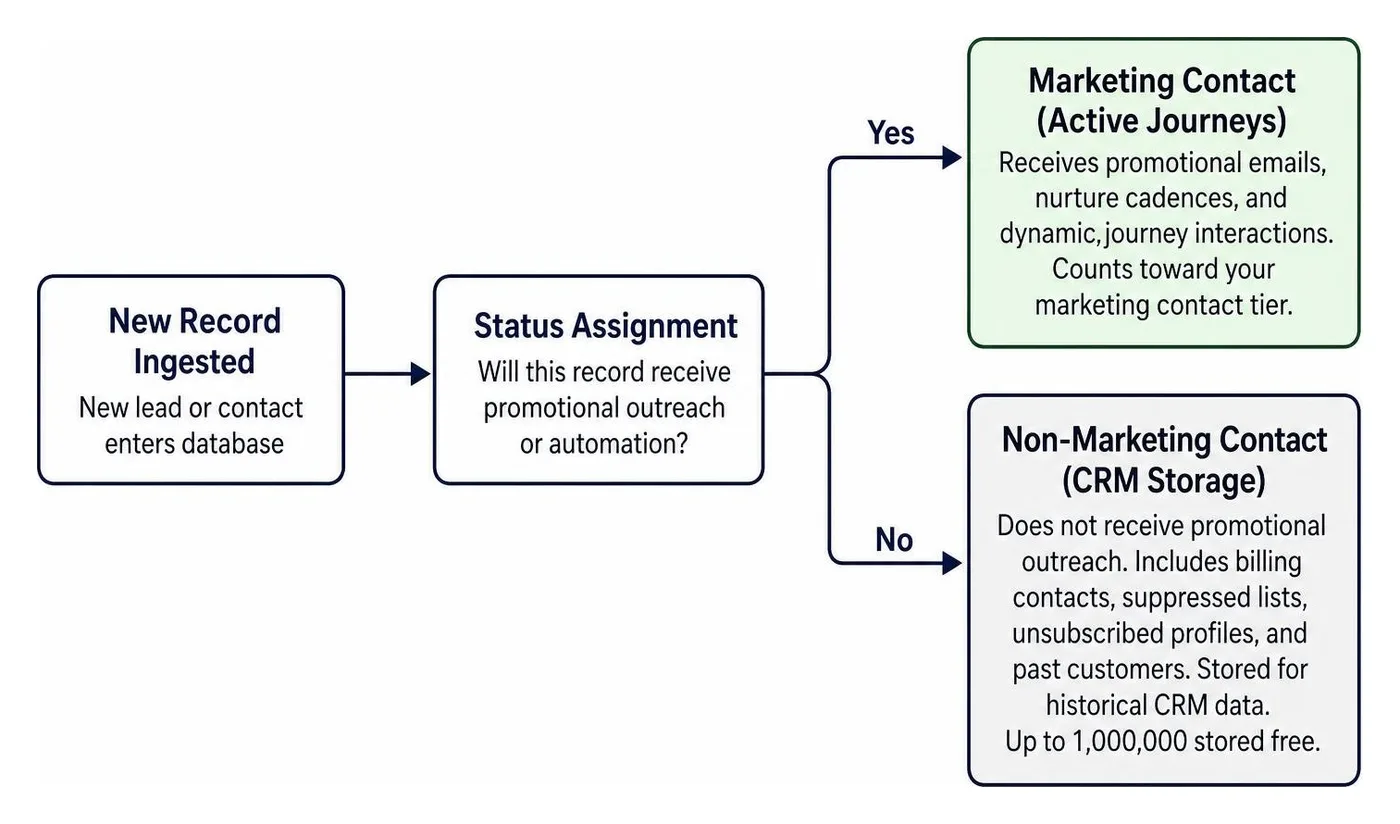
Marketing Contacts: Active subscribers who receive promotional emails, nurture cadences, and dynamic journey interactions. You pay for these contacts based on your selected tier bracket.
Non-Marketing Contacts: Stored records that do not receive active promotional outreach—including billing contacts, suppressed lists, unsubscribed profiles, and past customers maintained strictly for historical CRM data.
Leading platforms allow up to 1,000,000 non-marketing contacts stored for free alongside unlimited emails for active leads. This separation protects your marketing budget, ensuring you only pay for prospects you actively nurture through automated email marketing services.
Overages and Contact Cap Thresholds
Exceeding your active contact limit carries operational consequences. Rather than silently billing punitive overage charges, most systems enforce protective contact caps:
Journey Suspension for New Leads: When you cross your allotted subscriber tier, existing contacts continue through their active automations. However, new incoming leads cannot enter automated journeys or receive scheduled broadcast campaigns.
Lead Capture Logging: Fresh form submissions are logged into your database, but they remain frozen in queue until you adjust your tier.
Capacity Resolution: Resolving the bottleneck requires archiving stale data to non-marketing status or upgrading your subscription to the next contact bracket. Integrating advanced lead generation automation tools helps you automatically prune unengaged leads before they trigger unexpected workflow halts.
Evaluating Add-Ons, Channels, and Subscription Terms

A comprehensive marketing engine often expands beyond standard email triggers. Depending on your customer journey, omnichannel extensions introduce additional monthly variable costs that require careful planning.
Free Trial Expectations for Monthly Marketing Automation Services
Before locking into an annual or monthly contract, evaluating software in real-world conditions is essential. Reputable industry platforms provide a 14-day free trial with no credit card required.
During these trials, you typically receive access to core features, allowances for up to 2,000 marketing contacts, and 5,000 website visitor tracking credits. If you decide to transition to a paid plan, your trial data, configured workflows, and uploaded assets remain completely intact. Evaluating these sandbox features helps you identify the best marketing automation software for small business without financial risk.
Omnichannel Add-Ons: SMS, WhatsApp, and Dedicated IPs
To connect with buyers across their preferred channels, platforms offer modular add-on capabilities:
SMS & WhatsApp Credits: Direct mobile messaging delivers industry-leading open rates. WhatsApp marketing integrations and SMS credits are billed as utility add-ons, enabling two-way transactional updates and conversational promotions.
Dedicated IP Addresses: High-volume senders often purchase dedicated sending IPs. This isolates your sender reputation from shared pool deliverability risks, ensuring high inbox placement rates for critical revenue campaigns.
Multichannel Synchronization: Implementing true omnichannel marketing coordinates SMS, email, and social ad retargeting based on individual prospect actions, supported by dedicated SMS automation software.
Choosing the Right Tier of Monthly Marketing Automation Services
Selecting your operational plan involves balancing feature requirements, team capacity, and contractual terms:
Billing Flexibility: Upgrades take effect immediately, prorating your new feature access for the remainder of the billing cycle. Downgrades typically take effect at the conclusion of your current billing period.
Non-Profit Incentives: Registered non-profit organizations often qualify for custom discounts by contacting enterprise billing desks directly.
Cancellations and Data Access: Standard subscription terms allow account cancellation with clear refund parameters. Even if you pause or downgrade, your historical reporting and stored customer records remain accessible for export, fitting standard service planning frameworks.
For companies seeking predictable growth without the headaches of configuring software alone, partnering with a provider for done for you marketing pairs modern operating platforms with expert execution.
Frequently Asked Questions About Marketing Automation Pricing
What is the difference between marketing and non-marketing contacts?
Marketing contacts are active prospects eligible to receive promotional campaigns, automated journey emails, and outbound messaging. Non-marketing contacts are administrative records—such as unsubscribed users, historical customer files, and transactional contacts—stored in your database for tracking purposes. Top systems let you maintain up to 1,000,000 non-marketing contacts without paying active subscription fees for them.
What happens when you exceed your monthly contact limit?
If your database crosses your active marketing contact ceiling, running automations will continue serving existing leads without interruption. However, newly captured leads will be blocked from entering active journeys or receiving promotional broadcasts until you either clean your database by converting inactive records to non-marketing status or upgrade your contact tier.
Can you upgrade, downgrade, or cancel your monthly plan with a refund?
Yes. Upgrades apply immediately with prorated billing adjustments, granting instant access to higher user seats, visitor tracking multipliers, and advanced features. Downgrades take effect at the end of your active billing cycle. Subscriptions can be canceled under standard terms, and your historical data remains intact and available for export.
Conclusion
Selecting the right marketing software setup requires balancing technical features, database capacity, and team execution. Software alone will not grow a company; real results come from connecting strategic workflows, targeted messaging, and consistent optimization.
Instead of juggling disconnected point solutions, complex agency handoffs, and unexpected software overages, our all-in-one operating platform provides the complete engine your business needs. At RewardLion, we combine an AI-powered operating system with dedicated execution teams to handle your CRM setup, multi-channel funnels, analytics, and ongoing campaign optimization under one transparent roof.