Understanding Marketing Automation and Modern Growth Systems
Marketing automation is the use of software and AI-powered systems to automatically manage, personalize, and optimize repetitive marketing and sales processes across multiple channels. Its core operational purpose is to capture leads, nurture them with relevant content, qualify them based on behavior, and route them to the right next step—without manual intervention. This creates a scalable growth engine that improves efficiency, shortens sales cycles, and delivers consistent customer experiences.
Operational efficiency is the bedrock of any scaling organization. When we look back at the evolution of automated workflows, early systems focused merely on sending bulk communications on static schedules. Today, modern operations demand process standardization, robust data synchronization, and dynamic responsiveness across every digital touchpoint.
To establish sustainable, scalable growth, businesses must understand how different marketing technologies handle customer interactions:
System Type | Primary Focus | Trigger Mechanism | Data Synchronization | Scalability & Personalization |
|---|---|---|---|---|
Manual Campaigns | Ad-hoc one-off blasts | Manual human execution | Disconnected, siloed data | Very low; prone to human error |
Email Marketing Software | Scheduled broadcasts & static newsletters | List joins or manual dates | One-way subscriber lists | Basic personalization (name merge tags) |
Standalone CRM Systems | Sales pipeline & contact management | Manual representative updates | Internal deal records | Static customer records and history |
Marketing Automation Platforms | End-to-end journey orchestration | Dynamic real-time user behavior | Bidirectional, multi-platform sync | Hyper-personalized, adaptive multi-channel workflows |
Marketing Automation vs Email Tools and CRM Systems
A frequent misconception is equating marketing automation with basic email tools or standalone customer databases. Traditional email services send predefined messages to static lists. If a subscriber takes an action outside that specific list, the software remains unaware.
Marketing automation functions as an active decision engine. It evaluates incoming signals—such as page visits, form submissions, mobile app events, and lead scores—and dynamically directs contacts down tailored paths. Through deep CRM setup & automation, bidirectional data synchronization ensures that when a prospect engages with a marketing asset, sales pipelines update immediately, contact records enrich automatically, and lifecycle stages shift without manual input.
When to Keep Processes Manual
Automation is immensely powerful, but knowing when not to automate is just as vital. Over-automating delicate human interactions can damage customer trust.
We always recommend keeping the following processes manual:
High-touch enterprise sales negotiations: Complex deal terms require nuanced human empathy and adaptability.
Bespoke proposals and custom scoping: High-value client requirements should never rely on cookie-cutter templates.
Customer relationship repair: An upset client needs authentic listening and problem-solving, not an automated canned response.
Crisis communications: Critical organizational updates require executive oversight and real-time sensitivity.
The Five Core Components of High-Performing Workflows
Every resilient automated workflow relies on five essential components. If any single piece is missing, the entire system risks malfunction.
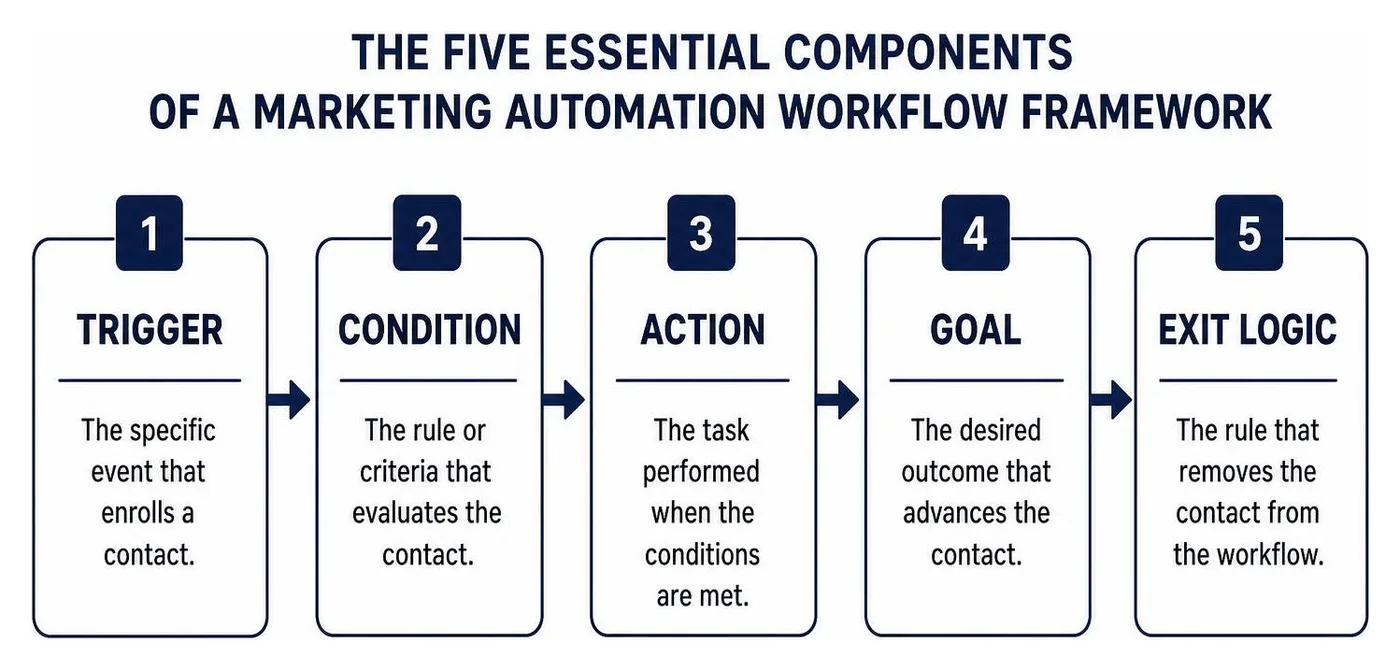
Triggers, Actions, Conditions, Goals, and Exit Logic
When building an effective automated marketing system, we structure every journey around these building blocks:
Trigger: The specific event that enrolls a contact (e.g., submitting a contact form, downloading an ebook, or opening an app).
Actions: The tasks executed by the system (e.g., sending an SMS, delivering an email, alerting an account executive, or adding a tag).
Conditions: Logical decision branches (e.g., Has the contact visited the pricing page? or Is company size > 50 employees?).
Goals: The defined conversion milestone of the workflow (e.g., booking a demonstration or completing a checkout).
Exit Logic: The critical rules that unenroll contacts automatically once a goal is met or when disqualifying criteria occur. Missing exit conditions create "zombie sequences" where contacts keep receiving introductory pitches long after purchasing.
Step-by-Step Lead Magnet Implementation
For small teams adopting marketing automation software for small business, delivering a lead magnet offers the highest initial return:
Form Submission (Trigger): A prospect submits their name and email on your landing page.
Immediate Asset Delivery (Action 1): The system fires an automated email delivering the resource within seconds. The first email matters most—it achieves the highest open rates and establishes your brand authority.
Time Delay: Allow 48 hours for the lead to consume the content.
Conditional Check (Condition): The workflow checks if the recipient clicked the download link.
If Yes: Deliver a case study detailing real-world results.
If No: Send a friendly nudge highlighting a key takeaway from the guide.
Conversion Goal & Exit Logic: If the contact schedules a discovery call at any stage, the workflow immediately triggers its exit logic, halting nurture emails and alerting your sales team.
Common Automation Pitfalls and Failures
Even seasoned teams run into operational hurdles. The most frequent points of failure include:
Overcomplicating workflow architecture: Building sprawling, fifty-step webs that no one on your team understands how to troubleshoot.
Vague naming conventions: Labeling campaigns "Test Sequence 1" or "New Workflow" makes ongoing management impossible.
Missing documentation: Failing to map logic flowcharts outside the tool leads to conflicting, overlapping triggers.
Poor database hygiene: Allowing duplicate records or unverified email addresses to degrade deliverability across your entire domain.
Strategic Implementation and Team Adoption
Transitioning to automated operations requires intentional change management. Introducing complex technical tools without preparing your team leads to software abandonment and frustration.
Prioritizing High-ROI Time-Saving Workflows
To achieve immediate wins, conduct a simple time audit of your team's weekly schedule. Identify repetitive, high-volume tasks that require no creative discretion. Implementing dedicated marketing automation for professional services often begins with routine administrative tasks:
Immediate appointment confirmation and calendar reminders.
Post-consultation onboarding sequences.
Automated review and testimonial collection requests.
Inactive client re-engagement campaigns.
Automating these administrative tasks first frees your team to focus on strategic client delivery.
Onboarding Non-Marketers to Automated Systems
When introducing automated workflows to non-technical team members, anxiety often surfaces around job security or fear of technology breaking. Alleviate these concerns by:
Framing automation as an assistant that eliminates boring, repetitive work.
Introducing additive workflows—automating a new operational process rather than immediately overhauling legacy habits.
Running collaborative workshops to demonstrate how modern AI marketing automation simplifies daily tasks.
Sharing transparent performance dashboards showing hours saved and pipeline impact.

Mobile Channels and Modern Orchestration
Customer engagement has expanded far beyond desktop email. High-growth organizations integrate mobile channels into a unified communication strategy rather than managing mobile as an isolated island.
Mobile Marketing Automation vs Static Desktop Channels
Mobile automation operates in real time, leveraging immediate behavioral and spatial data:
Push Notifications & In-App Messaging: Deliver contextual onboarding tips while a user is actively engaging with your software.
SMS/MMS Communications: Achieve near-instant open rates for urgent updates and time-sensitive promotions.
Location-Based Triggers: Engage users based on geofencing boundaries or proximity to retail locations.
Mobile Wallet Integration: Deliver dynamic digital passes, loyalty updates, and membership credentials directly to Apple Wallet or Google Pay.
Integrating these mobile touchpoints with your central customer database ensures that messaging remains coordinated across every screen.
The Shift from MAPs to Multi-Signal AI Orchestration
Traditional Marketing Automation Platforms (MAPs) were designed for an outdated, linear world: fill out a form, receive a score, enter a drip sequence, and get passed to sales. Modern buyers do not move in straight lines.
Today, enterprise businesses utilize advanced digital marketing automation software to coordinate multi-signal, cross-channel journeys. Powered by AI sales automation, these systems interpret real-time intent—such as website browsing depth, social interactions, product usage, and email engagement—dynamically routing prospects to the exact message or sales representative they need.
Frequently Asked Questions
What is the most common reason automated workflows fail?
The single most common reason workflows break is missing or poorly configured exit logic. When a workflow lacks explicit goal and exit rules, contacts continue receiving top-of-funnel nurture messages even after they have booked a call or completed a purchase, creating a disjointed customer experience.
How do you choose the right automation platform for a growing business?
Selecting the right platform depends on team technical capability, native software integrations, budget, and scalability requirements. Review our marketing automation consulting guide 2026 for an in-depth breakdown of platform selection criteria.
What metrics determine marketing automation success?
Measure success through business outcomes rather than vanity metrics:
Conversion Velocity: How quickly leads advance through each lifecycle stage.
Lead Qualification Rate: The percentage of automated leads that meet sales-ready criteria.
Operational Hours Saved: Time reclaimed by staff from manual administrative follow-up.
Customer Acquisition Cost (CAC): Reduction in acquisition spend through automated nurturing.
Conclusion
Automated systems allow modern businesses to scale revenue, eliminate operational friction, and deliver personalized experiences at every touchpoint. Achieving this level of operational excellence does not require stitching together dozens of disconnected subscriptions or overwhelming your internal team.
At RewardLion, we install and manage one fully unified growth operating system—powered by artificial intelligence, executed by dedicated specialists, and optimized continuously. Explore our all-in-one AI growth OS and done-for-you marketing automation services to build your automated growth engine today.