Why Marketing Automation for Professional Services Drives Better Growth
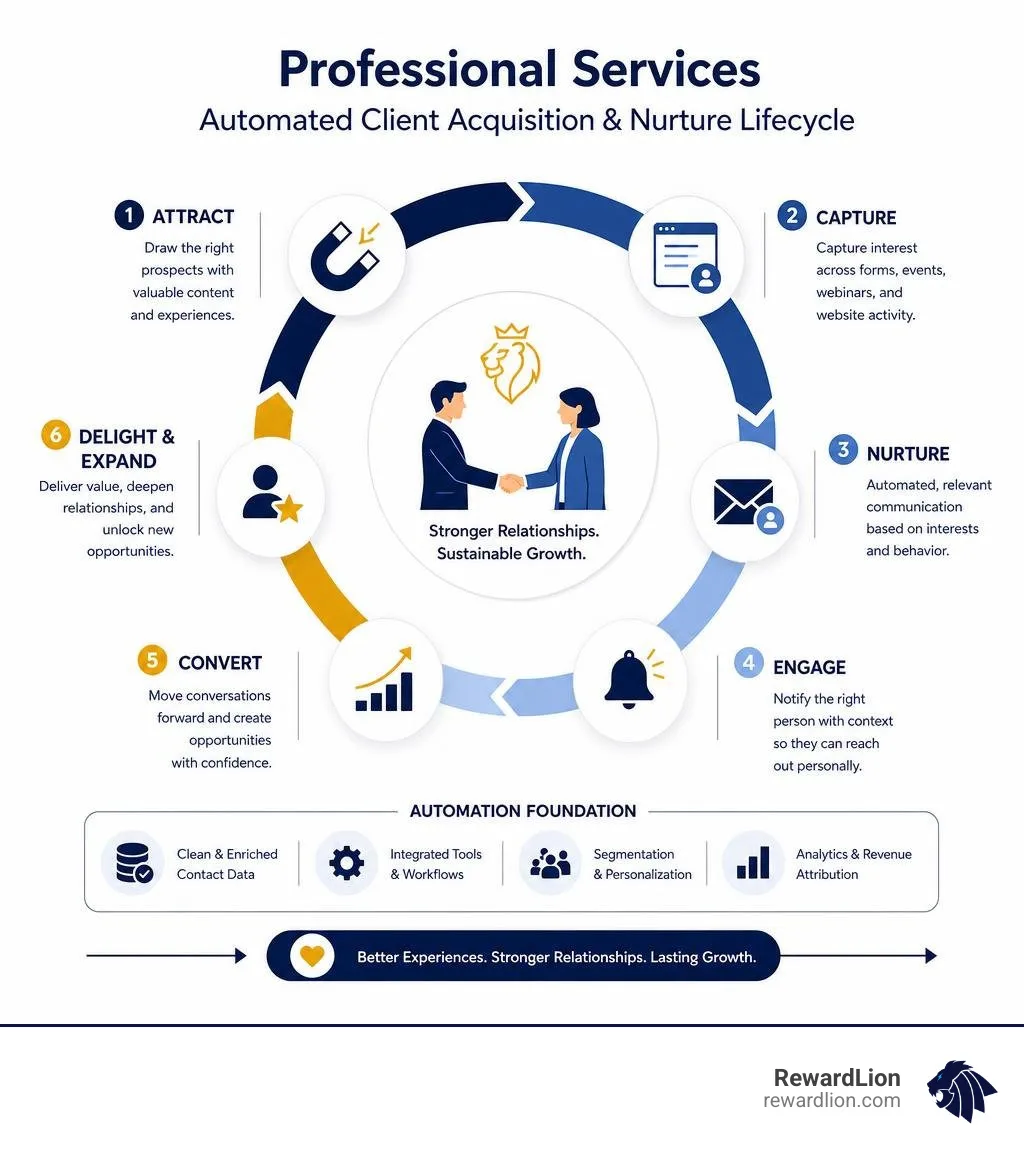
Marketing automation for professional services helps firms turn scattered contact data into timely, personal client communication without adding more admin work. Start by connecting your CRM, email, event, and website tools; clean and enrich contact records; then build automated workflows for lead follow-up, thought-leadership emails, event reminders, and partner alerts.
The practical result is simple: your team spends less time updating lists and chasing follow-ups, while prospects and clients receive messages that match their interests and actions.
For a relationship-led firm, automation should not replace human expertise. It should give partners, advisors, and business development teams better context before they reach out. When a contact registers for a webinar, downloads a guide, or repeatedly visits a service page, the right workflow can notify the account owner and send a useful next message automatically.
That matters in 2026, when clients expect relevant communication but have little patience for generic outreach. The best systems also connect activity to opportunities and revenue, helping marketing show leadership which campaigns create real business value.
I am Mike Ibrahim, a marketing leader and business-growth strategist with more than a decade of experience in sales, account development, client relationships, and technology-led marketing. In this guide to marketing automation for professional services, I will show how firms can use practical automation to create more consistent growth without losing the personal touch.
Core Benefits of Marketing Automation for Professional Services
Professional services firms operate in high-trust, high-stakes environments where relationships dictate revenue. Whether your practice provides legal counsel, financial advisory, management consulting, or accounting, your growth relies on reputation, specialized expertise, and timely client engagement.
However, many firms face operational friction. Highly compensated partners waste valuable billable hours manually compiling email lists, logging introductory calls, and trying to decipher outdated spreadsheets. Deploying comprehensive marketing automation services removes this friction by turning disconnected tools into an integrated revenue engine.
Turning Fragmented CRM Data into Actionable Client Intelligence
Data silos are a primary obstacle for growing advisory firms. Contact details sit trapped inside partner inboxes, practice management platforms, and legacy databases. This fragmentation prevents marketing teams from understanding client history or identifying cross-selling opportunities across practice groups.
By implementing smart CRM setup automation, firms establish continuous contact synchronization that enriches client profiles in real time. Rather than relying on advisors to manually update job titles, company changes, or meeting notes, automated systems capture these digital footprints seamlessly.
This relationship intelligence assigns engagement scores based on actual behaviors:
Downloading an industry white paper
Visiting a specific practice group service page multiple times
Attending an executive roundtable webinar
Interacting with partner-authored thought leadership articles
When a prospect crosses an engagement threshold, the system alerts the designated relationship manager with full context, ensuring outreach is relevant and timely.
Slashing Administrative Overhead and Reclaiming Billable Hours
Manual administrative work drains productivity in advisory practices. Industry benchmarks show that automated contact capture and data maintenance can save over 78,000 hours of administrative time across 300 active advisors in a single year.
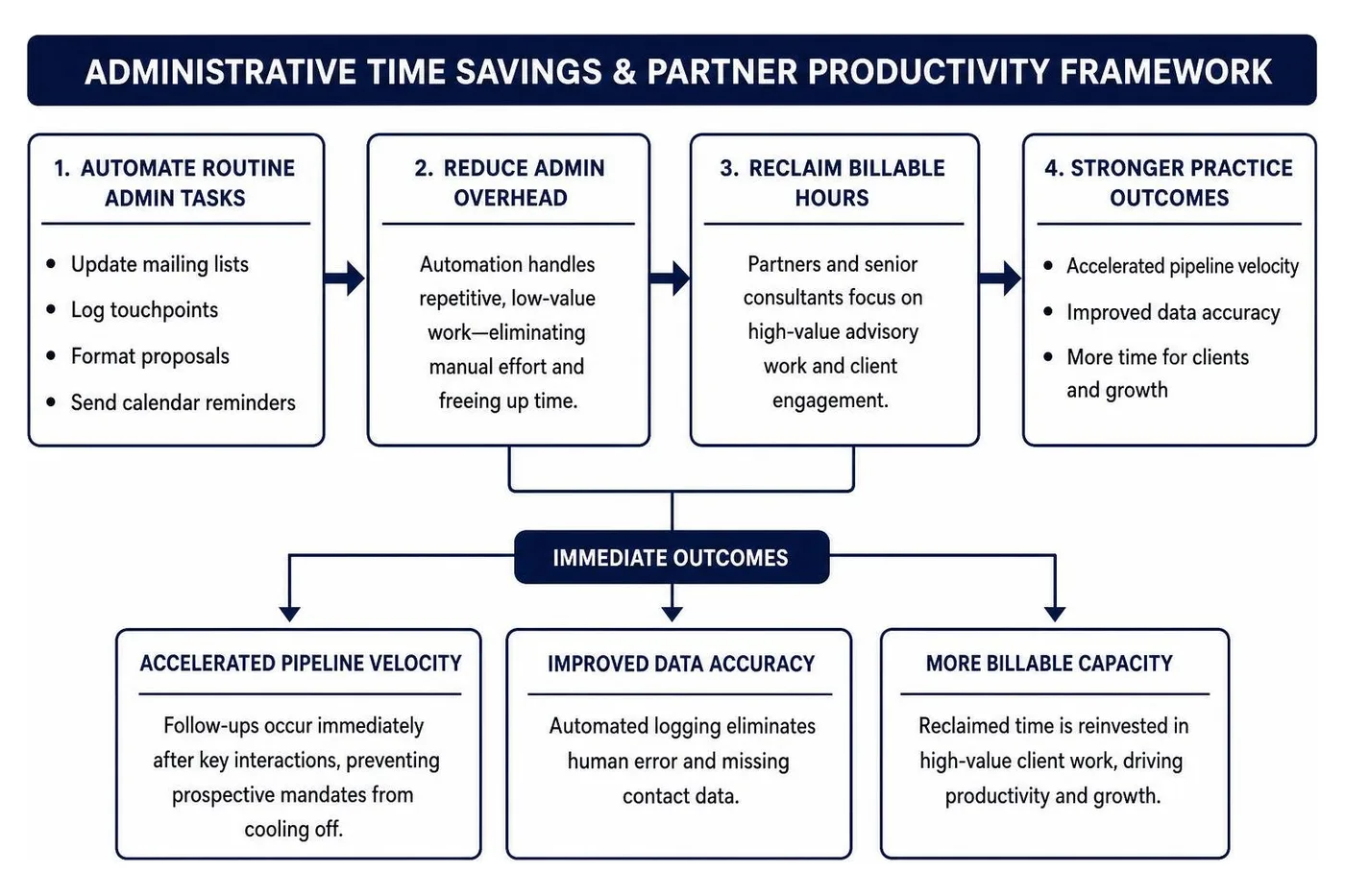
When routine admin tasks—such as updating mailing lists, logging touchpoints, formatting proposals, and sending calendar reminders—are automated, partners and senior consultants refocus their energy on high-value billable client work.
Automating administrative overhead achieves three immediate outcomes:
Accelerated Pipeline Velocity: Follow-ups occur immediately after key interactions, preventing prospective mandates from cooling off.
Improved Data Accuracy: Automated logging eliminates human error and missing contact data.
Partner Enablement: Client-facing teams receive automated briefing sheets before executive meetings, outlining recent digital touchpoints and firm-wide interactions.
Key Workflows: From Lead Generation to Event Follow-Up
Advisory client lifecycles require a balance of automated consistency and bespoke personal attention. Below is a comparison of traditional manual processes versus modern automated workflows in professional services:
Operational Stage | Traditional Manual Outreach | Modern Automated Multi-Touch Workflow |
|---|---|---|
Initial Inquiry | Manual inbox routing; 24–48 hour delay; generic brochure sent. | Instant AI-driven qualification; instant calendar booking link; CRM profile created. |
Thought Leadership | Batch-and-blast generic monthly newsletters to unsegmented lists. | Dynamic content delivery tailored to industry sector, role, and past engagement. |
Event Promotion | Static email blasts with manual RSVP tracking in spreadsheets. | Personalized multi-channel invites; automated reminder sequences; real-time CRM sync. |
Post-Event Action | Slow, generic follow-up email sent days later; no behavioral routing. | Instant post-event survey; segmented asset delivery; high-intent attendee alerts to partners. |
Dormant Nurturing | Irregular "checking in" emails from advisors when pipeline is dry. | Automated behavioral re-engagement triggers based on renewed website or content visits. |
Dynamic Nurturing and Personalized Client Engagement
Generic "batch-and-blast" newsletters yield diminishing returns in professional services. C-suite executives and corporate decision-makers expect content that directly addresses their industry challenges, regulatory changes, and strategic priorities.
Integrating dedicated lead generation systems allows firms to deploy behavioral segmentation workflows. When an enterprise prospect downloads an analysis on regulatory compliance, the system places them into a tailored nurture track delivering relevant commentary and case studies.
Through targeted email marketing, communications reference the recipient’s specific sector challenges, position your partners as trusted authorities, and automatically trigger high-intent notifications to practice leaders when engagement spikes.
Streamlining Event Marketing and Multi-Channel Touchpoints
Roundtables, executive dinners, continuing professional education (CPE) webinars, and annual symposiums form the backbone of professional services business development. Yet managing these events manually often leads to mismanaged invite lists and neglected follow-ups.
An integrated omnichannel marketing system automates the entire event lifecycle:
Dedicated Event Microsites: Custom registration landing pages that capture attendee profiles and sync directly with practice management databases.
Automated Communication Sequences: Calendar confirmations, agenda updates, and reminders delivered via email and SMS based on registration timing.
Post-Event Behavioral Triggers: Attendees receive access to session recordings and supplemental white papers within hours of concluding, while no-shows receive an automated summary sequence.
Partner Action Triggers: Advisors receive summary notifications detailing which of their direct contacts attended, what questions they submitted, and their engagement level during the session.
Critical Platform Integrations and Enterprise Security

For accounting, legal, and consulting practices, a marketing automation platform cannot function in isolation. It must integrate securely with your existing technical infrastructure and maintain strict data privacy compliance.
Seamless CRM and Enterprise Software Synchronization
A marketing automation engine must maintain a bi-directional synchronization with your central customer relationship management software and practice databases.
Through bi-directional data flow:
Marketing teams view firm-wide relationship histories, billing stages, and practice group touchpoints.
Partners view real-time marketing engagement signals directly inside the CRM interface they already use daily.
Data hygiene routines automatically remove duplicate records, standardize formatting, and enrich contact profiles.
Integrated AI sales automation tools alert relationship managers when key stakeholders switch companies or demonstrate new buying intent.
Compliance, Data Privacy, and Secure Client Communications
Professional services firms handle confidential, sensitive corporate data. Choosing and configuring an automation platform requires strict evaluation of regulatory standards and cybersecurity protocols:
Data Privacy Regulations: Full adherence to GDPR, CCPA, and regional frameworks, including automated preference centers allowing contacts to manage communication options easily.
Granular Role-Based Access Controls (RBAC): Restricting sensitive client lists and financial records so that only authorized practice members can view or export information.
Encryption & Audit Logs: End-to-end data encryption in transit and at rest, alongside comprehensive audit logs detailing who accessed, updated, or exported client data.
Deliverability & Authentication: Implementing strict enterprise-grade authentication protocols (DKIM, SPF, DMARC) to safeguard firm domain reputations and ensure executive communications never land in spam filters.
Scaling Account-Based Growth and Proving Marketing ROI
Growth in modern professional services relies on expanding existing institutional accounts and securing select high-value mandates through structured account-based marketing (ABM).
How Marketing Automation for Professional Services Enhances Account-Based Marketing
Account-based marketing requires coordinated touchpoints across multiple decision-makers within a prospective enterprise. Automation allows marketing and business development teams to scale these high-touch efforts efficiently.
By mapping accounts and tracking multi-stakeholder interactions, firms build tailored sales funnels that support the complex enterprise buying cycle:
Target Account Identification: Grouping accounts by sector, revenue tier, and service suitability.
Relationship Mapping: Identifying key stakeholders (e.g., General Counsel, CFO, Chief Risk Officer) within each target organization.
Coordinated Multi-Touch Engagement: Delivering personalized thought leadership, programmatic digital placements, and bespoke event invitations across all target decision-makers simultaneously.
Pipeline Acceleration Alerts: Notifying lead partners the moment multiple stakeholders from a single target account engage with content within the same week.
Advanced Analytics and Attribution for Leadership Reporting
Proving marketing return on investment (ROI) to practice leaders and executive committees requires connecting digital activities directly to firm revenue. Vanity metrics like opens and impressions do not demonstrate business value.
Through robust data analytics for sales and marketing, firms implement multi-touch attribution models that trace client journeys from first touchpoint to closed engagement letter:
Closed-loop attribution dashboards provide firm leadership with clear visibility into:
Pipeline contribution generated per practice group.
Exact revenue influenced by marketing campaigns and events.
Average sales cycle acceleration for nurtured versus non-nurtured prospective clients.
High-performing topics that drive retained client engagements.
Step-by-Step Implementation and Team Adoption
Implementing an automation platform should enhance advisory workflows rather than disrupt daily operations. A structured, phased roadmap ensures steady adoption without overburdening internal IT teams.
Implementing Marketing Automation for Professional Services Without IT Friction
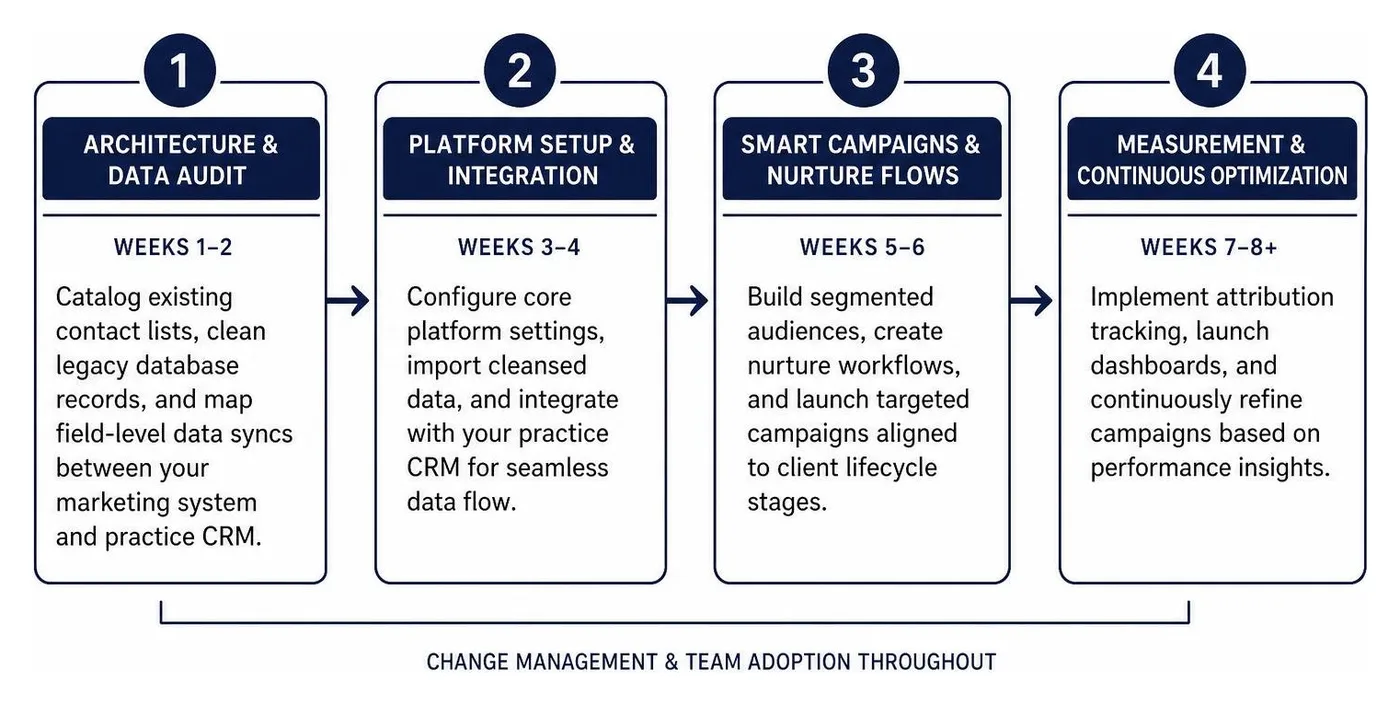
A successful rollout follows a four-phase methodology:
Phase 1: Architecture & Data Audit (Weeks 1–2): Catalog existing contact lists, clean legacy database records, and map field-level data syncs between your marketing system and practice CRM.
Phase 2: Core Integration & Template Configuration (Weeks 3–4): Connect bi-directional APIs, set up domain security protocols (DMARC/DKIM), and build branded template suites for newsletters, invitations, and landing pages.
Phase 3: Pilot Practice Group Launch (Weeks 5–6): Select a single practice group (such as M&A or Tax Advisory) to pilot initial workflows, event nurturing, and lead scoring.
Phase 4: Firm-Wide Rollout & Optimization (Weeks 7–8): Expand workflows across all practice areas, review multi-touch reporting dashboards, and refine behavioral triggers based on early engagement data.
Fast-Track Onboarding and User Adoption Strategies
Platform adoption often stalls when systems are overly complex. Modern marketing platforms are designed so that new team members can learn to create and launch compliant email campaigns in about two hours.
To accelerate internal adoption:
Use Pre-Approved Modular Templates: Give practice assistants and fee-earners standardized, brand-compliant layouts that require minimal technical effort.
Automate Internal Notifications: Deliver engagement updates directly to advisors via email or CRM tasks, removing the need for them to log into separate marketing interfaces.
Provide Role-Specific Training: Deliver short, targeted training sessions focused on specific tasks (such as pulling event lists or reviewing lead scores) rather than overwhelming staff with platform settings.
Frequently Asked Questions About Professional Services Automation
How long does it take for advisory teams to learn marketing automation software?
Most marketing team members and practice coordinators master everyday campaign creation within two hours of hands-on training. Because modern platforms feature intuitive visual builders and pre-configured templates, teams can launch email communications, build event pages, and segment contact lists without technical coding skills.
Will marketing automation replace our existing CRM?
No. Marketing automation enhances your CRM rather than replacing it. The automation engine functions as an intelligent execution layer that enriches your CRM database, logs touchpoints automatically, and passes validated, scored opportunities to client managers.
How does automation help professional firms prove marketing ROI to partners?
By deploying multi-touch revenue attribution modeling, automation connects digital touchpoints directly to closed opportunities and signed engagement letters. Leadership dashboards show the exact path from initial content engagement and event attendance to billable client revenue.
Conclusion
Professional services firms operate in an increasingly competitive environment. Sustainable practice growth requires moving away from manual data entry, disconnected marketing tools, and inconsistent follow-ups.
Deploying an integrated all-in-one growth operating system bridges the gap between marketing initiatives and client acquisition. By unifying automated contact hygiene, dynamic nurturing, multi-channel event workflows, and closed-loop revenue attribution, your firm builds a scalable business development engine while keeping partners focused on billable client advisory work.