The Foundations of Modern Lead Generation: Volume vs. Quality
To track lead generation effectively, start by standardizing UTM parameters on every campaign link, storing those values in first-party session cookies, and injecting them into hidden form fields that map directly to custom CRM properties. Then connect server-side conversion tracking and multi-touch attribution so each lead carries its full source history from first visit through closed revenue. This creates a closed-loop system that reveals which channels produce high-intent pipeline instead of just raw volume.
Every growing business eventually runs into the same frustrating bottleneck: marketing celebrates hitting record-breaking lead numbers, while the sales team complains that none of those prospects are picking up the phone. When you look closely at modern buying habits, this disconnect makes complete sense. Around 81% of the B2B buyer journey happens before a prospect ever fills out a form or enters your pipeline.
During that silent discovery window, prospective buyers read your articles, browse case studies, and compare alternatives. Yet roughly 98% of website visitors remain completely anonymous when organizations lack dedicated visitor identification and lead tracking infrastructure.
Adding to the challenge, B2B data decays at an alarming rate of 20% per month. If you capture raw names without tracking intent, origin, and velocity, your database turns into a graveyard of disconnected contacts. Relying purely on raw lead count creates a false sense of security. True marketing efficiency requires advanced lead generation analytics that reveal how prospects discover your brand, navigate your content, and ultimately convert into paying clients.
Why Tracking Lead Quality Matters More Than Raw Volume
Chasing volume alone almost always results in diminishing returns. If you generate 1,000 top-of-funnel leads at a 1% conversion rate, you end up with 10 closed deals—while your sales team wastes hundreds of hours chasing unvetted contacts. Conversely, generating 200 high-intent leads that convert at 10% yields 20 closed deals with a fraction of the sales overhead.
Industry research shows that 59.6% of marketers view generating qualified leads as their primary challenge, while 37.1% struggle specifically with overall lead quality. When marketing teams operate under disconnected systems, vanity metrics mask pipeline leaks.
By implementing structured lead generation systems, you align marketing campaigns directly with pipeline velocity and revenue outcomes. Tracking quality allows you to monitor marketing-qualified lead (MQL) to sales-qualified lead (SQL) progression, lower your customer acquisition cost (CAC), and eliminate low-intent ad spend before it drains your budget.
Core Data Points Every B2B Tracking Engine Must Capture
To gain actionable visibility into your buyer journey, your tracking architecture must record a continuous narrative for every prospect. That requires capturing four core data dimensions:
Original Acquisition Source: The exact channel, referrer, campaign name, ad creative, and keyword that initiated the prospect's very first visit.
Complete Session Path: Every landing page viewed, case study opened, pricing tier reviewed, and asset downloaded prior to conversion.
Dynamic Metadata & Timestamps: First-touch timestamp, conversion timestamp, device type, geographic location, and IP-derived firmographic details.
CRM Opportunity Progression: Complete CRM setup automation properties that log pipeline stage shifts, assigned deal values, lead scores, and finalized closed-won revenue amounts.
How to Track Lead Generation Across Web and Outreach Channels
Capturing lead intelligence requires a unified data pipeline that bridges the gap between client-side website interactions and back-end database records. When your analytics, web forms, and CRM talk to each other in real time, you eliminate the blind spots that plague disconnected marketing stacks. Connecting these layers through modern marketing automation ensures that every form fill, phone call, and chat conversation carries its full campaign history directly into your sales pipeline.
Step-by-Step Technical Setup: UTMs, Hidden Fields, and Forms
Standardizing your campaign parameters is the first step toward clean attribution. Without strict naming conventions, your analytics platform treats variations like utm_source=linkedin and utm_source=LinkedIn as completely different channels, fracturing your reporting.
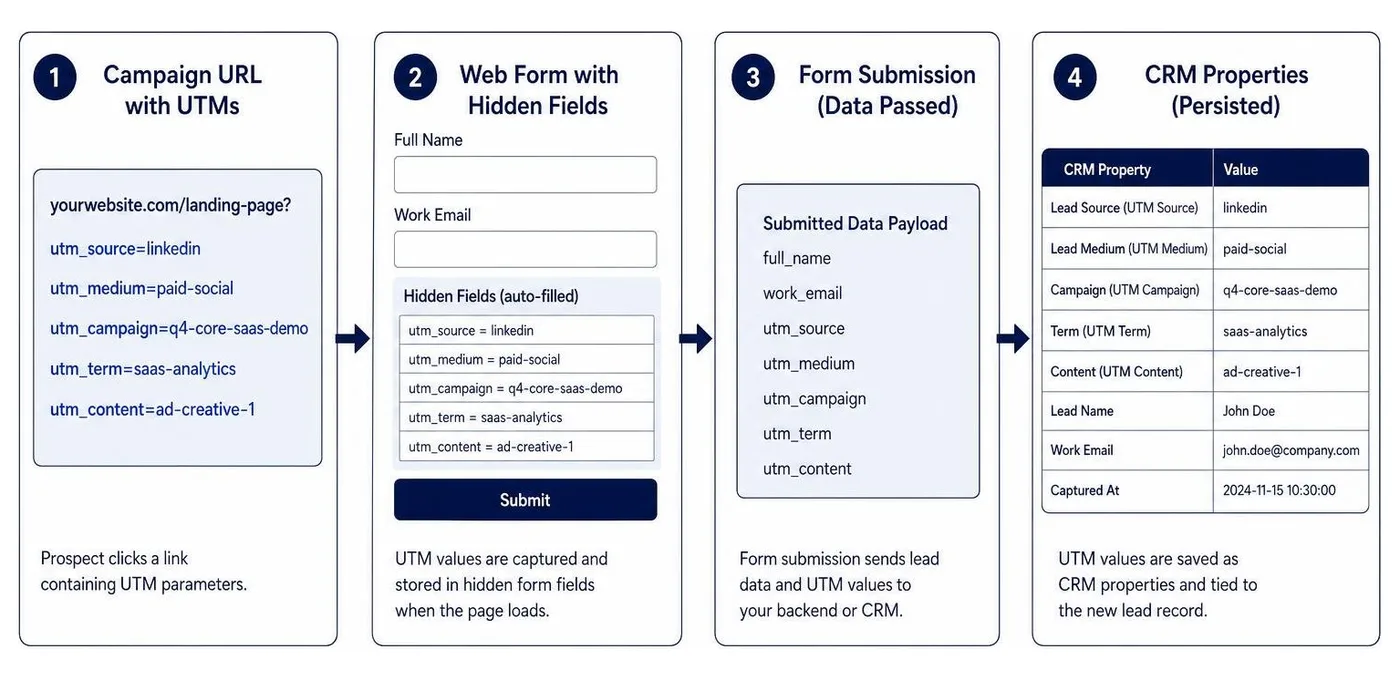
Define a Uniform UTM Taxonomy: Standardize all outbound marketing URLs using lowercase letters and hyphens instead of spaces. Use standard parameters across all paid campaigns:
utm_source: Identifies the platform (e.g.,google,facebook,linkedin).utm_medium: Identifies the channel type (e.g.,cpc,paid-social,email).utm_campaign: Specifies the strategic initiative (e.g.,q4-core-saas-demo).utm_termandutm_content: Identify target keywords or specific creative variants.
Deploy First-Party Session Storage: Use a lightweight JavaScript snippet on your website to parse incoming UTM parameters, referring domains, and landing page URLs. Save these values inside first-party browser session cookies or local storage so they persist as the user navigates across different pages.
Embed Hidden Fields in Your Web Forms: Within your lead capture software, add hidden form properties for
lead_source,lead_medium,lead_campaign,lead_content, andoriginal_landing_page.Map Fields to Custom CRM Properties: Match each hidden form field directly to corresponding custom contact properties inside your CRM. When a visitor submits a demo request, the script reads the stored cookie data and silently injects those values into the form submission, writing the complete attribution history directly onto the newly created lead record.
Connecting Phone Calls, Live Chat, and Offline Events Without Clickable Links
A major blind spot for B2B organizations is tracking touchpoints that do not originate from clickable web links. Around 62% of marketers struggle to attribute phone calls accurately, and up to 95% cannot track print or direct mail effectively.
To close these gaps, deploy dynamic number insertion (DNI). DNI dynamically swaps the phone number displayed on your website based on the visitor’s incoming UTM parameters and referral source. When the prospect dials, the call tracking platform links the telephone audio and caller ID directly to the active digital session, pushing the original campaign source into your CRM alongside the call recording.
For live chat conversations, ensure your chat software captures active session variables and pushes the full transcript along with all UTM parameters into the CRM via webhook triggers upon conversation start.
When collecting leads at trade shows or live industry events, upload attendee lists using standardized source tags (such as lead_source=event and lead_campaign=2026-b2b-summit) before initiating automated nurture sequences. If you utilize offline direct mail, generate custom QR codes that direct prospects to personalized landing pages pre-populated with campaign tracking parameters.
Future-Proofing in a Cookieless World: Server-Side and First-Party Tracking
Traditional client-side tracking pixels are increasingly blocked by privacy updates, ad blockers, and browser tracking restrictions. To maintain clean conversion data, forward-thinking organizations are transitioning toward server-side tracking and Conversion APIs (CAPI).
By processing user engagement on your own cloud server rather than inside the prospect's browser, you bypass browser-level script blocking while ensuring compliance with global privacy regulations such as GDPR and CCPA. Advanced data analytics for sales and marketing rely on server-side architectures that hash customer data (such as emails and phone numbers) before sending conversion events back to ad platforms.
Using unique event identifiers across both client and server events prevents double-counting while preserving attribution accuracy across long multi-device sales cycles.
Multi-Touch Attribution: Measuring the True Value of Each Lead Source
B2B purchasing decisions rarely happen after a single ad click. Enterprise deals often involve multiple stakeholders, lengthy evaluations, and dozens of digital interactions across a three-to-six-month window.
Relying on simplistic attribution models blinds your marketing leadership to the foundational campaigns that generate pipeline demand. In fact, 53.5% of marketers consider last-touch attribution only "somewhat effective," with just 9.3% rating it truly effective. Today, 75.5% of growth marketers favor attribution models that distribute credit across multiple touchpoints.
Attribution Model | Credit Distribution Logic | Primary Strength | Main Weakness | Best B2B Application |
|---|---|---|---|---|
First-Touch | 100% of credit goes to the initial interaction. | Highlights top-of-funnel brand discovery and awareness channels. | Completely ignores nurture campaigns, webinars, and closing efforts. | Testing new top-of-funnel content and organic awareness campaigns. |
Last-Touch | 100% of credit goes to the final conversion event. | Easy to configure; clearly identifies bottom-of-funnel conversion assets. | Undervalues early education and long-term brand building. | Short transactional sales cycles or single-offer landing pages. |
Linear | Equal credit is split evenly across all recorded touchpoints. | Provides a balanced, egalitarian view of the entire buyer journey. | Fails to distinguish high-impact conversion milestones from casual visits. | Multi-channel brand engagement with consistent touchpoint frequency. |
Time-Decay | Credit increases exponentially as touchpoints get closer to conversion. | Accurately reflects rising prospect intent as deals approach closing. | Tends to undervalue top-of-funnel content that initiated the journey. | Long, complex B2B sales cycles lasting between 60 and 180 days. |
Data-Driven (U/W-Shaped) | Weighted credit (e.g., 40% first touch, 40% lead create, 20% middle touches). | Accurately credits key pipeline creation and conversion inflection points. | Requires higher conversion data volume and advanced attribution software. | Sophisticated omnichannel B2B pipelines and multi-stakeholder deals. |
Decoding First-Touch, Last-Touch, and Multi-Touch Attribution Models
Choosing the right attribution model depends on your sales cycle length and deal complexity. First-touch attribution is helpful when evaluating top-of-funnel content marketing initiatives, as it shows which blog posts, organic search terms, or social assets initially bring buyers into your ecosystem.
However, relying entirely on first-touch can cause you to over-index on broad informational keywords that fail to generate pipeline revenue.
Last-touch attribution represents the opposite extreme: it gives 100% of the credit to the final link clicked right before the lead submitted a form. In enterprise B2B environments, this often leads teams to credit retargeting ads or branded search terms, completely missing the white papers and outbound campaigns that did the heavy lifting months earlier.
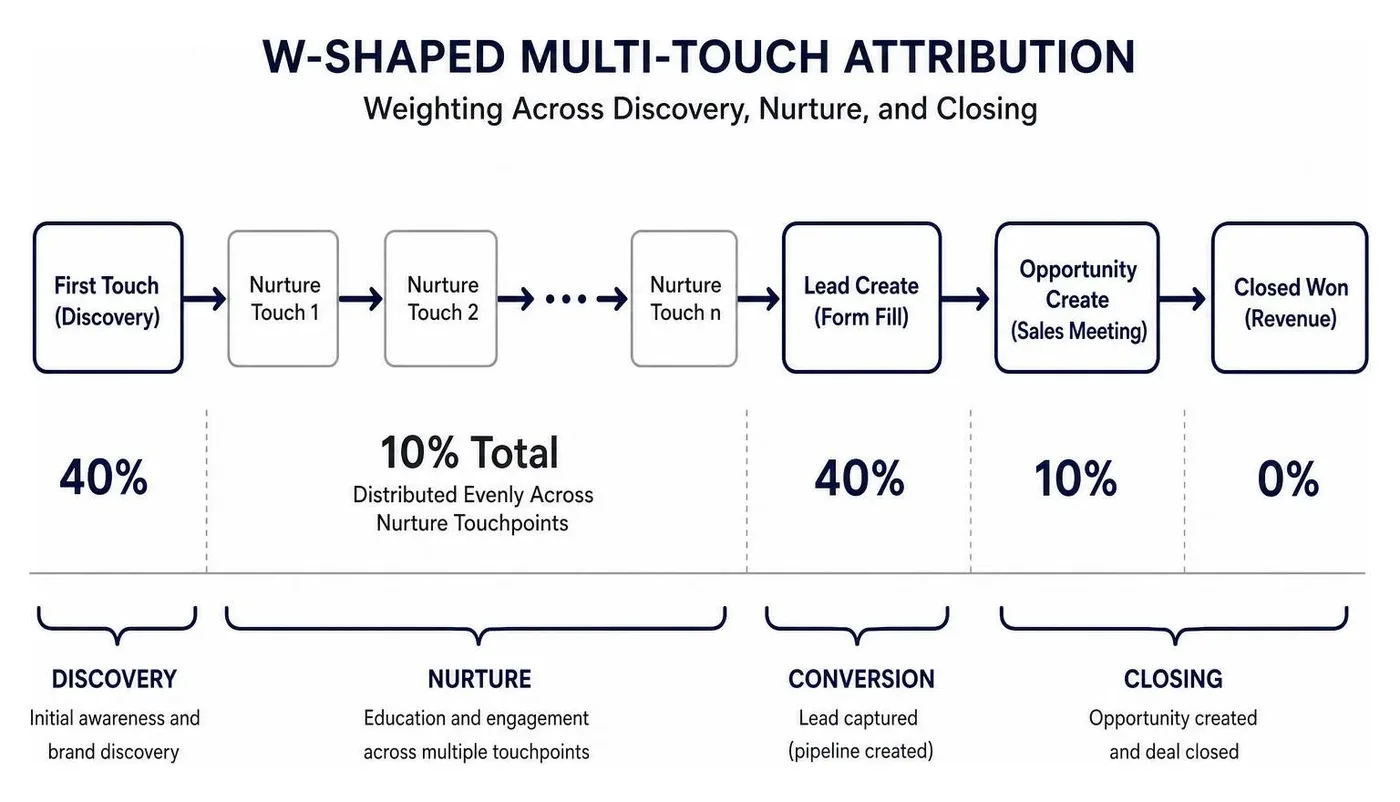
Multi-touch models—specifically W-shaped attribution—offer a far more accurate representation of B2B buying behavior. A W-shaped model typically allocates 40% of the credit to the first touchpoint (discovery), 40% to the lead creation touchpoint (the conversion form fill), 10% to the opportunity creation touchpoint (the sales discovery meeting), and distributes the remaining 10% evenly across intermediate nurturing touches. Leveraging unified business intelligence and using analytics to align sales and marketing teams ensures that marketing budgets are allocated based on complete pipeline contributions rather than isolated clicks.
How to Track Lead Generation to Close the Lead-to-Revenue Loop
Closed-loop marketing means connecting every dollar of closed-won revenue in your CRM back to the specific marketing touchpoints that generated the original lead.
Pass Unique Lead IDs: When a prospect converts on your landing page, assign a unique tracking identifier that syncs with both your web analytics engine and your CRM contact record.
Track Opportunity Progression: As sales reps qualify leads, conduct discovery calls, and move deals from MQL to SQL and Opportunity stages, log deal sizes and stage changes in your CRM.
Sync Revenue Data Back to Ad Platforms: Once an opportunity is marked Closed-Won, transmit that revenue value back to your advertising networks using server-side conversion feeds (such as Google Enhanced Conversions and Meta Offline Conversions).
Enable Value-Based Bidding: By feeding actual closed revenue data back into your ad networks, the platform algorithms optimize for high-value prospects rather than just cheap, low-intent clicks.
Building Actionable Dashboards and Sales Feedback Loops
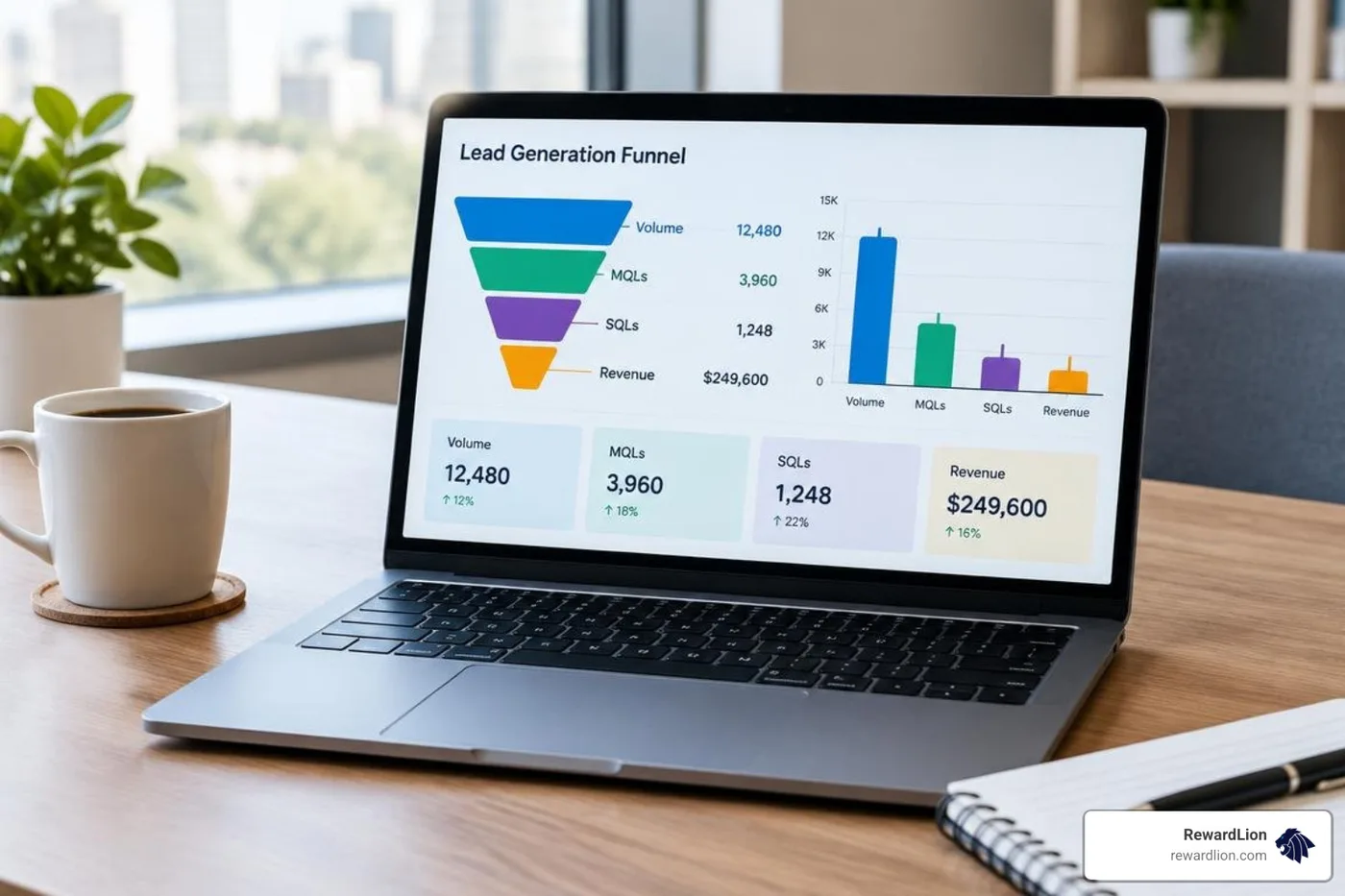
A tracking system is only as valuable as the business decisions it enables. Simply collecting data into complex CRM tables leads to analysis paralysis if your revenue leadership cannot quickly extract actionable takeaways. Setting up centralized all in one analytics dashboards provides full visibility across every stage of your sales funnel.
Essential Metrics to Include in Your Lead Tracking Dashboard
To monitor funnel health and diagnose pipeline bottlenecks, your lead tracking dashboard should track these core performance indicators:
Cost Per Lead (CPL) by Source: The true acquisition cost per raw lead across organic search, paid social, search advertising, and outbound sequences.
MQL-to-SQL Velocity Ratio: The percentage of marketing-qualified leads that meet sales qualification standards, segmented by original acquisition source.
Cost Per Pipeline Dollar: Total marketing spend divided by the total open pipeline opportunity value generated by each specific channel.
Lead-to-Close Win Rate: The final percentage of captured leads that convert into paying customers.
Return on Ad Spend (ROAS) and Customer Lifetime Value (LTV): The net revenue and long-term customer value generated compared against the initial marketing investment.
To monitor pipeline velocity in real time, many high-performing marketing teams use a daily waterfall report. A waterfall report tracks actual lead capture, qualification numbers, and pipeline value against linear monthly targets. If a paused campaign or broken form causes lead flow to dip, the waterfall dashboard flags the deficit within 24 hours, allowing your team to adjust budgets and resolve tracking issues immediately.
Implementing Automated Lead Scoring and Closed-Loop Feedback
Lead scoring acts as the operational bridge between marketing acquisition and sales execution. When you integrate AI sales automation into your qualification workflow, you can score prospects dynamically based on both demographic fit and digital behavioral signals.
Establish a monthly sales-marketing feedback loop to review lead scoring accuracy. Review recently closed-won deals alongside disqualified leads to uncover patterns in acquisition channels, company size, and engagement history. If sales reps frequently disqualify leads from a particular source, update your qualification thresholds, tighten form fields, and refine ad targeting to maintain high pipeline quality.
Common Lead Tracking Pitfalls and How to Avoid Them
Even sophisticated marketing teams can run into tracking errors that distort performance reporting. Here are the most common pitfalls and how to prevent them:
Non-Standardized UTM Parameters: Inconsistent capitalization or spelling (e.g.,
google-ads,GoogleAds,cpc) fragments channel reporting. Maintain a centralized, locked UTM spreadsheet generator to ensure team-wide consistency.Over-Complicating Initial Setups: Building complex 30-field tracking forms often causes high bounce rates and maintenance headaches. Start by tracking the four primary source categories—organic search, paid advertising, referrals/direct, and social—before adding more granular sub-metrics.
Relying on Client-Side Pixels Alone: Ad blockers and browser tracking updates frequently drop client-side pixels, resulting in underreported conversions. Implement dual-tagging environments combining client-side pixels with server-side Conversion APIs.
Missing Event Deduplication IDs: Firing both a browser pixel and a server-side event without a shared
event_idcan cause ad platforms to double-count conversions, distorting CAC calculations.Allowing CRM Data Decay: Failing to audit custom fields leads to orphaned contact records. Schedule monthly pipeline hygiene reviews to archive stale leads, correct missing source values, and verify active CRM integrations.
Frequently Asked Questions About How to Track Lead Generation
What is the most effective attribution model for B2B lead tracking?
For B2B businesses with sales cycles lasting between 30 and 90 days, multi-touch attribution models like W-shaped or time-decay attribution are generally the most effective. These models distribute credit across the entire buyer journey—rewarding the top-of-funnel content that created initial brand awareness, the conversion point that captured the lead, and the final interactions that closed the deal.
How do you track inbound phone calls and offline lead sources?
Inbound phone calls are tracked using dynamic number insertion (DNI). DNI displays a unique telephone number on your website based on the visitor’s incoming UTM parameters and referral channel. When a call occurs, the platform records the session data and passes the source, campaign, and caller details directly into your CRM. Offline leads from conferences or direct mail are tracked using unique event tags, customized short URLs, or dedicated QR codes mapped directly to campaign parameters.
Why are leads showing up as direct or unknown in the CRM?
Leads typically appear as direct or unknown due to missing UTM parameters on campaign links, strict browser privacy settings that strip referrer headers, cross-domain tracking errors, or misconfigured hidden form fields. Implementing server-side tracking, first-party cookie scripts, and automated UTM link builders ensures attribution data is preserved consistently.
Eliminate Attribution Blind Spots and Scale Your Pipeline
Accurately tracking lead generation across multiple outreach channels and CRM stages is no longer optional for growth-focused B2B organizations.
Moving away from vanity lead volume and adopting closed-loop attribution gives you complete visibility into which marketing channels produce high-intent prospects and closed revenue.
Consolidating your tracking, automation, and CRM infrastructure into a unified tech stack can reduce administrative overhead by up to 64% while eliminating data silos between sales and marketing.
At RewardLion, we build and manage fully connected revenue engines. Our dedicated team deploys, optimizes, and manages your lead capture pipelines, server-side attribution systems, marketing automation workflows, and CRM architectures within an all-in-one operating system.
Whether you need to overhaul your lead scoring models, deploy multi-touch attribution dashboards, or scale your multi-channel acquisition campaigns, we provide the platform and hands-on execution to grow your business predictably.
Ready to gain complete visibility into your marketing pipeline and scale your sales revenue? Scale Your Revenue With RewardLion today.