The Best Lead Generation Tools for Real Estate Agents in 2026
The best lead generation tools for real estate agents available right now include:
Tool / Strategy Best For Key Strength Google Local Services Ads High-intent local seller/buyer leads Pay-per-lead; Google Screened badge Facebook Lead Ads High-volume demographic targeting Low cost-per-lead; native forms Portal Advertising High-traffic portal leads Massive active buyer audience Google Business Profile Free local organic leads High trust; local map pack visibility YouTube Video Marketing Building local authority High engagement; long-term organic traffic RewardLion OS All-in-one automated lead generation AI-powered qualification + expert management
Here is the hard truth most agents don't want to hear: your sphere of influence alone will not sustain your business.
Only 3-6% of your contacts are thinking about selling at any given time. That means 94 out of every 100 people in your network are simply not ready to move. And in a market where inventory is still tight and buyers are doing more research before ever picking up the phone, waiting for referrals to trickle in is a losing strategy.
The agents who consistently win listings are not the ones working harder. They are the ones who have built repeatable, automated systems that fill their pipeline whether they are on the phone or not.
This guide breaks down exactly which tools are worth your money, which ones are overhyped, and how to stack them together into a lead generation engine that actually closes deals.
I'm Mike Ibrahim, Founder and CEO of RewardLion and a marketing strategist with over a decade of experience helping businesses scale through AI-powered tools and data-driven systems - including lead generation tools for real estate agents built for modern, high-volume pipelines. My work across dozens of industries gives me a practical, results-first lens for evaluating what actually moves the needle versus what just looks good on a pricing page.
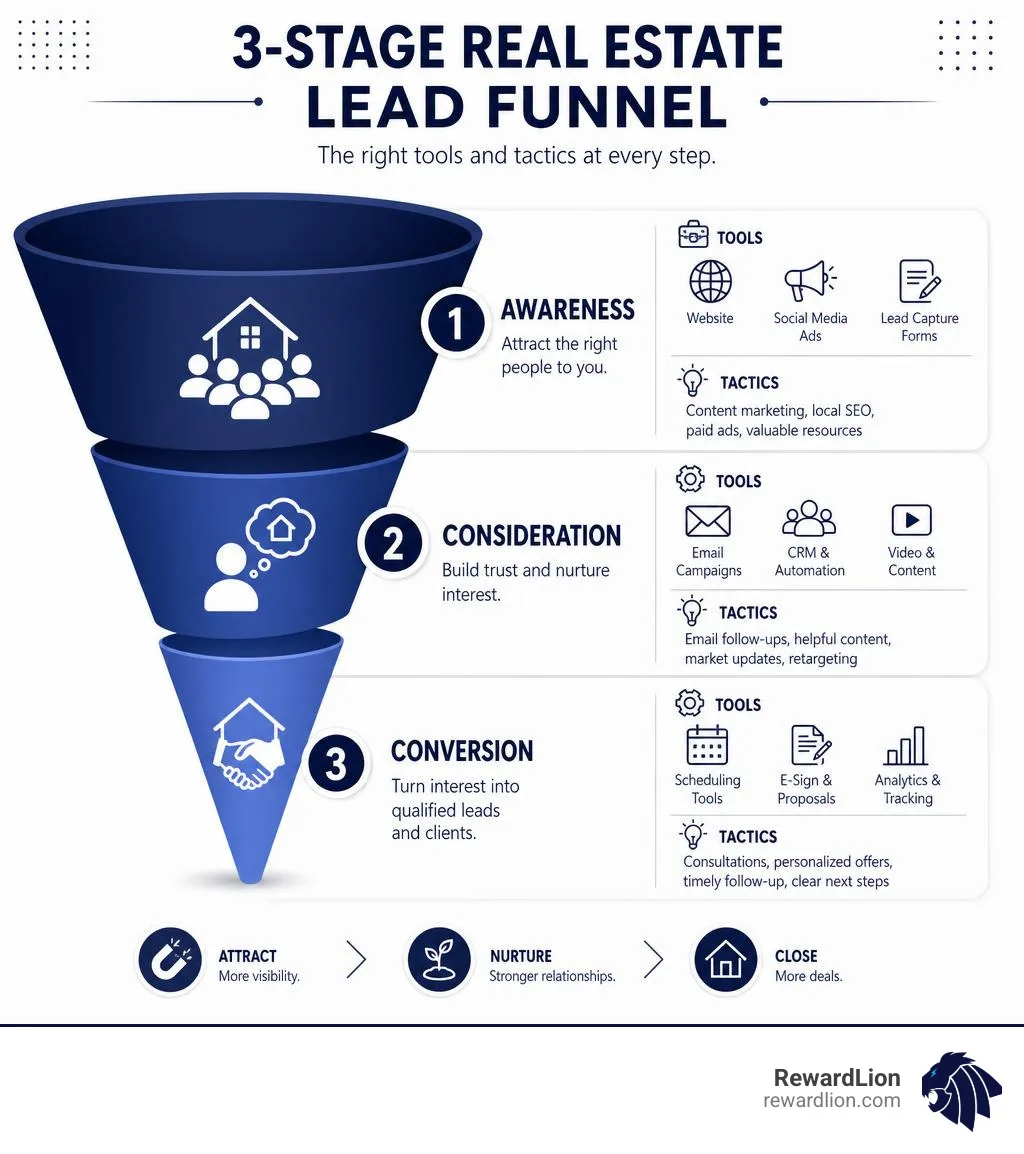
Why Traditional Prospecting Fails in May 2026

Let's face it: the old playbook is broken. If your daily routine consists of buying cold lists, manually dialing numbers for hours, or waiting around for your sphere to magically buy another house, you are fighting an uphill battle.
Industry data shows that 42.83% of traditional leads are dead leads right out of the gate. They are disconnected numbers, fake emails, or people who registered just to browse pictures of a $5 million mansion they can't afford. This inefficiency explains why the average real estate agent spends 4+ hours per day chasing cold leads instead of doing what they do best: closing deals and shaking hands.
Additionally, not all leads are created equal. Seller leads are 4.5x more valuable than buyer leads because they represent immediate inventory and often lead to dual-sided transactions. Yet, many agents spend their entire marketing budget chasing low-intent buyers on major search portals. For broader context on homebuyer and seller behavior, the National Association of Realtors publishes its annual Profile of Home Buyers and Sellers, which is useful for understanding how consumers choose agents and move through the transaction process.
To build a predictable business, you must target high-probability niches using dedicated lead gen software. Consider these undeniable statistics:
Expired Listings: 43% of Expireds will eventually relist and sell their home with an agent for a commission.
For Sale By Owner (FSBO): 88% of FSBOs eventually give up trying to sell on their own and hire an agent.
Pre-Foreclosures: 15% of Pre-Foreclosure leads list their property, representing a highly motivated seller niche.
Relying on manual prospecting to find these opportunities is exhausting. That is why top-producing agents rely on automated systems to identify, filter, and deliver these opportunities directly to their dashboards.
Core Categories of Lead Generation Tools for Real Estate Agents

When selecting lead generation tools for real estate agents, you should evaluate options based on four critical pillars:
Lead Exclusivity: Are you buying leads that are sold to five other agents simultaneously, or do you own them outright?
CRM Integration: Does the tool seamlessly feed your database, or are you stuck manually exporting CSV files?
Agent Adoption: Is the platform simple enough that you (or your team) will actually use it daily?
Automation Capabilities: Can the platform nurture leads in the background, or does it require manual follow-up for every interaction?
To understand how to balance your marketing mix, let's compare paid lead generation platforms against organic, sphere-based strategies:
Feature Paid Lead Generation Organic / Sphere-Based Speed to Results Immediate (leads flow within 24 hours) Slow (takes months to build momentum) Scalability High (increase budget to get more leads) Low (limited by the size of your network) Cost Per Lead Variable ($3 to $150+ depending on source) Low (primarily sweat equity and time) Conversion Rate Lower (typically 1–15% depending on tool) High (often 10–30% due to built-in trust) Predictability High (predictable cost-per-acquisition) Low (highly dependent on seasonal timing)
Let's explore the core categories of tools driving results in May 2026.
AI-Powered Lead Generation Tools for Real Estate Agents
Artificial intelligence has shifted from a novelty copywriting tool to the backbone of modern lead qualification. Platforms leveraging predictive scoring and automated conversational assistants are helping agents scale their businesses without adding administrative overhead.
Modern AI-powered systems use advanced predictive analytics to analyze over 50 data points—including property equity, years of ownership, local market conditions, and life events—to predict the likelihood of a transaction within 90 days.
This predictive scoring yields a 96% lead quality score compared to the 42% industry average. Because these advanced systems operate on an exclusive basis, agents enjoy an 8-15% conversion rate (compared to the standard 1-3% for cold leads) at an average cost of just $3.94 per lead.
Another powerhouse in the AI space is the use of dynamic questionnaires that replace traditional 3-field contact forms. By asking 25+ deep-profiling questions, these systems filter out looky-loos and categorize leads into three distinct high-intent buckets:
Prequal Leads (14% of leads): Handraisers who specifically request mortgage prequalification. Within 14 days of registering, 22.5% of these leads become fully qualified.
Handraiser Leads (20% of leads): Prospects who actively request a phone call or property showing. Within 14 days, 24.3% of these leads are qualified.
Home Searcher Leads (66% of leads): Active buyers wanting to view properties. 19.5% of these leads qualify within 14 days.
Crucially, AI texting assistants engage these leads instantly, with 51% of all consumers replying to the AI within the first 14 days. This hybrid approach generates 4X higher quality leads than traditional pay-per-click and social ads. With a typical $1,200 monthly budget, agents receive 40 to 60 highly vetted leads at a stable cost of $20–$30 per lead.
For agents looking to automate their existing database, virtual assistants handle lead nurturing at scale. These assistants sync directly with your CRM to set up property search boards, send real-time alerts, answer buyer questions, and schedule showings automatically.
Additionally, investors and agents targeting off-market deals use automated multi-channel cold outreach via email, SMS, and direct mail, using AI to manage back-and-forth negotiations before flagging qualified deals for the agent.
To keep these systems running smoothly, utilizing modern lead capture software ensures that no prospect slips through the cracks.
Outbound Prospecting and Dialer Systems
If you prefer to actively hunt for listings rather than waiting for incoming inquiries, outbound prospecting systems are your best option.
Modern outbound prospecting platforms aggregate hard-to-find data on Expired Listings, FSBOs, For Rent By Owner (FRBO) properties, Pre-Foreclosures, and neighborhood contacts.
By combining this high-intent seller data with a multi-line power dialer, agents can make up to 200 calls per hour while automatically filtering out numbers on the National Do Not Call (DNC) Registry. This ensures you spend your time speaking with motivated sellers rather than manually dialing disconnected numbers.
Using these automated outbound systems allows solo agents and teams to build a highly predictable listing pipeline through structured, daily outbound prospecting.
Local SEO and Organic Authority Platforms
While paid lead generation provides immediate results, organic authority platforms build long-term equity. High-intent buyers and sellers routinely search for hyper-local terms on Google, such as "best real estate agent in Miami" or "how to sell my home fast in Fort Lauderdale."
Building organic authority requires optimizing your digital footprint, starting with your Google Business Profile. Consistently collecting verified client reviews and publishing hyper-local content sends strong signals to search engines.
To turn this organic traffic into registered leads, your website must feature IDX integration, allowing visitors to search active MLS listings directly on your site. For agents operating in competitive regions, investing in seo for real estate florida is essential for ranking on the first page of search results and capturing high-intent organic traffic.
Maximizing ROI: Best Practices for Real Estate Lead Conversion
Buying the best lead generation tools for real estate agents is only half the battle. If your follow-up process is slow or disorganized, you are throwing marketing dollars out the window. To maximize your return on investment, implement these conversion best practices.
How to Choose the Best Lead Generation Tools for Real Estate Agents
When building your technology stack, don't buy tools in isolation. Consider these guidelines:
Budget Realism: If you are a new agent on a limited budget, start with outbound prospecting tools (like neighborhood search tools) or hyper-local SEO before scaling to high-ticket paid lead platforms.
CRM Integration: Ensure any lead generation tool you buy connects natively to your CRM via API or Zapier. If you have to manually copy and paste lead details, your follow-up speed will suffer.
Lead Quality vs. Volume: Don't chase cheap leads. A $3 lead that has a 42% chance of being a dead number is far more expensive in wasted time than a $25 verified handraiser.
Automated Nurturing and Multi-Channel Follow-Up
The modern consumer expects an immediate response. If a lead registers on your website and you take 30 minutes to call them, they have already moved on to another agent.
To prevent this, leverage multi-channel workflows that combine:
Immediate SMS Automation: Send an automated, personalized text message within 60 seconds of registration.
Dynamic Email Drip Campaigns: Deliver value-driven content, such as local market reports or homebuyer guides, tailored to their specific search behavior.
Voicemail Drops & Calls: Use power dialers to schedule manual call touchpoints while your automated systems handle the digital outreach.
To monitor which channels are producing the highest conversion rates and lowest cost-per-acquisition, make sure you track your campaigns using lead generation analytics.
Frequently Asked Questions About Real Estate Lead Generation
What is the fastest way for real estate agents to generate high-intent leads?
The fastest way to generate high-intent leads is to combine targeted paid advertising (such as Google Local Services Ads) with AI-qualified lead capture systems. These platforms capture users actively searching for real estate services and pre-qualify them before they reach your inbox.
Are paid real estate leads worth the investment?
Yes, but only if you have an automated follow-up system in place. Paid leads show varying levels of intent. Without instant text auto-responders, CRM segmentation, and consistent nurturing, your conversion rates will remain low. When paired with automation, paid leads offer a highly scalable way to grow your business.
Do new real estate agents need a dedicated CRM?
Absolutely. A dedicated real estate CRM is not just an address book; it is the central operating system of your business. It tracks your pipeline, automates drip campaigns, logs call notes, and alerts you when a past client visits your website. Investing in a CRM early ensures you build a clean, organized database from day one.
Conclusion
Building a successful real estate business in May 2026 requires moving away from manual, disconnected systems. Instead of managing five different software platforms and wasting hours chasing dead leads, top-producing agents are switching to unified operating systems.
At RewardLion, we provide an AI-powered, all-in-one OS platform that unifies your marketing, sales, automation, and analytics. We don't just hand you a software login and wish you luck.
Through our unique CAPSS (Fractional Team) model, our in-house marketing experts implement, optimize, and manage your entire growth engine for you. From dominating local SEO and running high-converting Meta and Google ad campaigns, to setting up automated CRM workflows and deploying 24/7 AI conversational assistants—we handle the technology so you can focus on closing deals.
Ready to stop chasing cold leads and start attracting highly qualified clients on autopilot? Explore the RewardLion Platform today and let us build your predictable lead engine.