Why Most B2B Lead Generation Efforts Fail (And How to Fix Yours)
Lead generation for B2B companies is one of the hardest things to get right in modern sales and marketing — and the numbers back that up: 85% of B2B marketers say it's their single biggest challenge.
Here's a quick answer to what actually works in 2026:
Top B2B Lead Generation Strategies That Drive Results:
Omnichannel outreach — combine LinkedIn, cold email, and calling in a coordinated sequence
Account-based marketing (ABM) — target 25–50 high-value accounts with personalized campaigns
Content marketing + SEO — publish problem-focused guides that attract in-market buyers
BANT-qualified appointments — verify Budget, Authority, Need, and Timeline before handing leads to sales
Referral programs — activate happy customers to bring in warm, high-converting leads
Lead nurturing automation — use email sequences and retargeting to stay top-of-mind across long sales cycles
Social proof — case studies, reviews, and testimonials that build trust before the first conversation
The core problem most small and mid-size businesses run into isn't a lack of tactics. It's that they treat lead generation as a series of disconnected campaigns instead of a system. They chase volume over quality. They let inbound and outbound run in separate silos. And they hand unqualified leads to sales teams who don't want them.
B2B buying decisions are also just harder than B2C. You're not convincing one person — you're convincing a buying committee of 6 to 10 stakeholders, across a sales cycle that can stretch 3 to 12 months. Generic outreach doesn't cut it.
This guide breaks down exactly how to build a lead generation system that fills your pipeline with qualified opportunities — not just names on a list.
I'm Mike Ibrahim, Founder and CEO of RewardLion and Marketing Director for several companies, with over a decade of experience building sales and marketing strategies — including scalable lead generation for B2B companies across diverse industries. I've authored five marketing and business management books and have a track record of generating new business and hitting revenue targets, so everything in this guide is grounded in what actually works. Let's get into it.
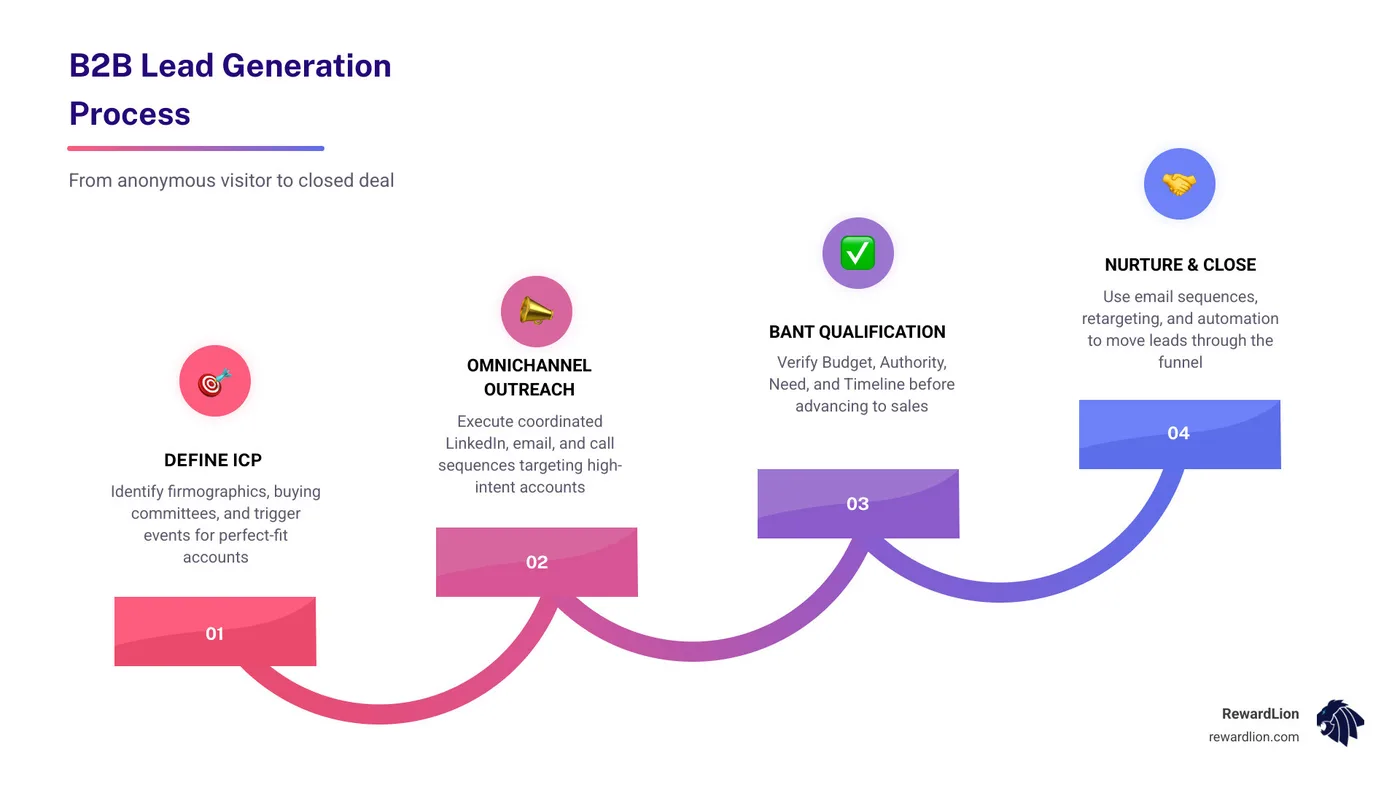
The Evolution of Lead Generation for B2B Companies in 2026
By May 2026, the landscape of lead generation for B2B companies has shifted dramatically. The days of spraying and praying with mass emails are over. Today, success is built on "Cyborg SDR" models-where AI handles the heavy lifting of data analysis and initial outreach, but humans provide the strategic touch that closes deals.
We’ve seen a massive transition from focusing on Marketing Qualified Leads (MQLs) to Sales Qualified Leads (SQLs) and, more importantly, BANT-qualified appointments. Traditional MQLs are often just "behavioral proxies"-someone who downloaded a whitepaper might just be a student or a competitor. In fact, research shows that 87% of MQLs are rejected by sales teams because they lack actual buying intent.
In 2026, we focus on 1st-party intent data. While 3rd-party data (buying lists) only offers about 40-50% accuracy, using 1st-party data from your own assets or media brand partnerships can reach 95%+ accuracy. To stay ahead, you need robust Lead Generation Analytics to track these signals in real-time. If you want a neutral overview of how first-party data works in digital marketing, this first-party data resource is a useful starting point.
Qualifying Lead Generation for B2B Companies with BANT
To prevent your sales team from wasting time on "tire kickers," we implement the BANT framework. This is the gold standard for qualifying lead generation for B2B companies:
Budget: Does the prospect have the financial resources to invest in your solution?
Authority: Are you speaking to a decision-maker or an influencer within the buying committee?
Need: Does your product solve a specific, high-priority pain point they are currently facing?
Timeline: Are they looking to implement a solution within a reasonable timeframe (e.g., the next 3-6 months)?
Using Lead Capture Software, we can build multi-step forms that ask these qualifying questions early, ensuring that only high-intent prospects make it to a discovery call.
The Shift from Volume to High-Intent Appointments
The "MQL Black Hole" is where marketing budgets go to die. In 2026, leading B2B firms have shifted to a pay-for-performance model focused on appointments rather than raw leads.
Consider the math: A traditional MQL model might yield a 13% conversion to SQL with a cost per SQL of over $1,100. Conversely, a BANT-qualified appointment model often sees 95%+ conversion to SQL with costs ranging between $420 and $632. By prioritizing quality, companies can achieve 3X higher conversion rates and significantly lower their customer acquisition costs (CAC).
High-Impact Strategies to Scale Your Pipeline
Scaling lead generation for B2B companies requires moving beyond a single channel. You need a "connected system" where your inbound (content/SEO) and outbound (LinkedIn/Email) efforts feed into each other.
Scaling Lead Generation for B2B Companies via Omnichannel Outreach
The most effective approach in 2026 is omnichannel engagement. This isn't just "being everywhere"; it's a sequential touchpoint strategy. A typical high-performing sequence might look like this:
Day 1: LinkedIn profile view and connection request with a personalized note.
Day 3: Highly personalized cold email referencing a specific "trigger event" (like a recent funding round or new hire).
Day 5: A "warm" phone call referencing the previous email.
Day 7: A LinkedIn message sharing a relevant case study.
By using Demand Generation Software, we can automate these sequences while maintaining a human touch. This signal-based targeting ensures your outreach is timely and relevant. It takes an average of 7-13 touchpoints before a B2B prospect is ready to engage.
Leveraging Authority and Social Proof
In a world of AI-generated noise, authority is your best defense. 95% of consumers read reviews before buying, and B2B is no different. We’ve found that case studies rank as the third most-used content type in B2B sales for a reason—they prove you can deliver results.
Video Content: YouTube is the second-largest search engine. Using video to explain complex solutions builds trust faster than text alone.
Referrals: This is the "holy grail" of lead generation for B2B companies. Referred customers have a 16% higher lifetime value, yet only 11% of sales professionals ask for them.
Interactive Content: 81% of marketers agree that interactive content (calculators, quizzes, assessments) is more effective at grabbing attention than static whitepapers.
For more on building this foundation, check out these B2B Lead Generation Strategies.

Mastering the Lead Generation Process
Building a system for lead generation for B2B companies starts with a deep understanding of your target. If you try to sell to everyone, you end up selling to no one.
Identifying Your Ideal Customer Profile (ICP)
Your ICP is more than just a "target audience." It’s a detailed map of the companies most likely to buy from you. In 2026, we look at:
Firmographics: Revenue, headcount, industry, and growth stage.
Buying Committees: Identifying the 5-15 stakeholders (CFO, IT Director, End User) and their specific pain points.
Trigger Events: Reaching out within two weeks of a job change or funding announcement can result in 10-50x better response rates.
Once you have your ICP, you can use Lead Gen Software to scrape data and build ultra-refined prospect lists.
Nurturing Leads Through the Funnel
Most B2B leads are not ready to buy today. They require systematic nurturing. We use automated email sequences that provide value—sharing industry benchmarks, audits, or checklists—before ever asking for a demo.
Integrating these efforts with your CRM is non-negotiable. It allows you to track engagement signals, like when a prospect visits your pricing page three times in one week, triggering an immediate follow-up from a sales rep. For a deep dive into the tech stack required, see our Lead Generation Software Complete Guide.
Essential Tools and Analytics for B2B Growth
To dominate lead generation for B2B companies in 2026, you need the right tools. Here is how the top platforms stack up:
Feature Website Visitor ID Tools Contact Databases Sales Engagement Platforms Primary Goal Reveal anonymous traffic Find new prospects Automate outreach Data Source IP-to-Company mapping Scraped/Verified lists CRM & Email integrations Best For Capturing existing intent Scaling outbound volume Managing sequences 2026 Trend Cookieless tracking AI-verified direct dials "Cyborg" personalization
Measuring Success and ROI
If you can't measure it, you can't improve it. At RewardLion, we focus on the metrics that actually move the needle:
Cost Per Lead (CPL): While important, it’s a vanity metric if those leads don’t close.
Customer Acquisition Cost (CAC): How much does it cost to get a paying customer? Healthy SaaS businesses keep this at 25-30% of LTV.
Lifetime Value (LTV): Referred customers typically show a 16% higher LTV.
Qualified Lead Rate: The percentage of raw leads that meet your BANT criteria.
For those looking to manage this on the go, our Lead Generation App Complete Guide covers the best mobile-first solutions.
Frequently Asked Questions about B2B Lead Generation
What is the difference between an MQL and an SQL?
A Marketing Qualified Lead (MQL) is someone who has engaged with your marketing content (like downloading an e-book) and is deemed likely to become a customer. A Sales Qualified Lead (SQL) is a lead that has been vetted by the sales team and has shown a direct intent to purchase, often meeting BANT criteria.
How long does it take to see results from a B2B lead generation program?
Paid advertising and outbound outreach can produce initial appointments within 30 days. However, organic strategies like SEO and content marketing typically require 3 to 6 months to build momentum and show a significant ROI.
Why is 98% of B2B website traffic anonymous and how do I fix it?
Most visitors browse without filling out a form. In 2026, we use website visitor identification tools that use IP-to-company mapping to tell us which businesses are visiting our site. This allows us to reach out to the right people at those companies even if they didn't "convert" on a page.
Conclusion
Lead generation for B2B companies doesn't have to suck. By moving away from disjointed tactics and building a connected, AI-powered system, you can create a predictable flow of high-value appointments.
At RewardLion, we don't just give you a tool and wish you luck. We provide a hybrid solution: an AI-powered all-in-one OS platform combined with a dedicated "CAPSS" team that acts as your in-house marketing department. From SEO and local domination in Florida to omnichannel media buying across the United States, we handle the execution so you can focus on closing deals.
Stop managing disconnected tools and start growing. More info about RewardLion platform is available for those ready to scale their B2B pipeline the right way in 2026.