Understanding Digital Marketing Automation Software and Its ROI Impact
At its core, digital marketing automation software is the engine that drives modern business growth. It isn't just about sending bulk emails; it is about orchestrating complex, multi-channel journeys that respond to customer behavior in real time. By automating repetitive tasks like lead scoring, follow-up sequences, and social media scheduling, we free up our creative energy for high-level strategy and data-driven decision making.
The financial impact of these systems is staggering. The industry currently generates over $8 billion annually, with projections hitting nearly $14 billion by 2030 according to market research data. At a practical level, these platforms usually connect with a customer relationship management system, making it easier to track lead activity, automate follow-up, and tie campaign performance back to revenue.
Consider these industry benchmarks:
Conversion Rate Lifts: Companies like Vodafone have utilized on-site reminders and automated triggers to increase conversion rates by as much as 159%.
Rapid ROI: Some beauty brands, such as Clarins, have reported a 45% increase in lead capture and a 30x ROI within just 12 weeks of implementing advanced orchestration tools.
Lead Quality: Automation does not just give you more leads; it gives you better ones. By using behavioral data to "score" prospects, sales teams only spend time on high-intent buyers.
For businesses in Miami, Fort Lauderdale, and across the United States, transitioning from manual processes to an automated system is the difference between "working harder" and "working smarter." If you are looking to bridge that gap, you can find more info about marketing automation services that we provide to help businesses scale without the headache of managing dozen of disconnected tools.
Essential Features to Look for in Modern Automation Platforms
Not all digital marketing automation software is created equal. To ensure you’re getting a tool that actually moves the needle on your bottom line, there are several "must-have" features we always look for during our evaluations:
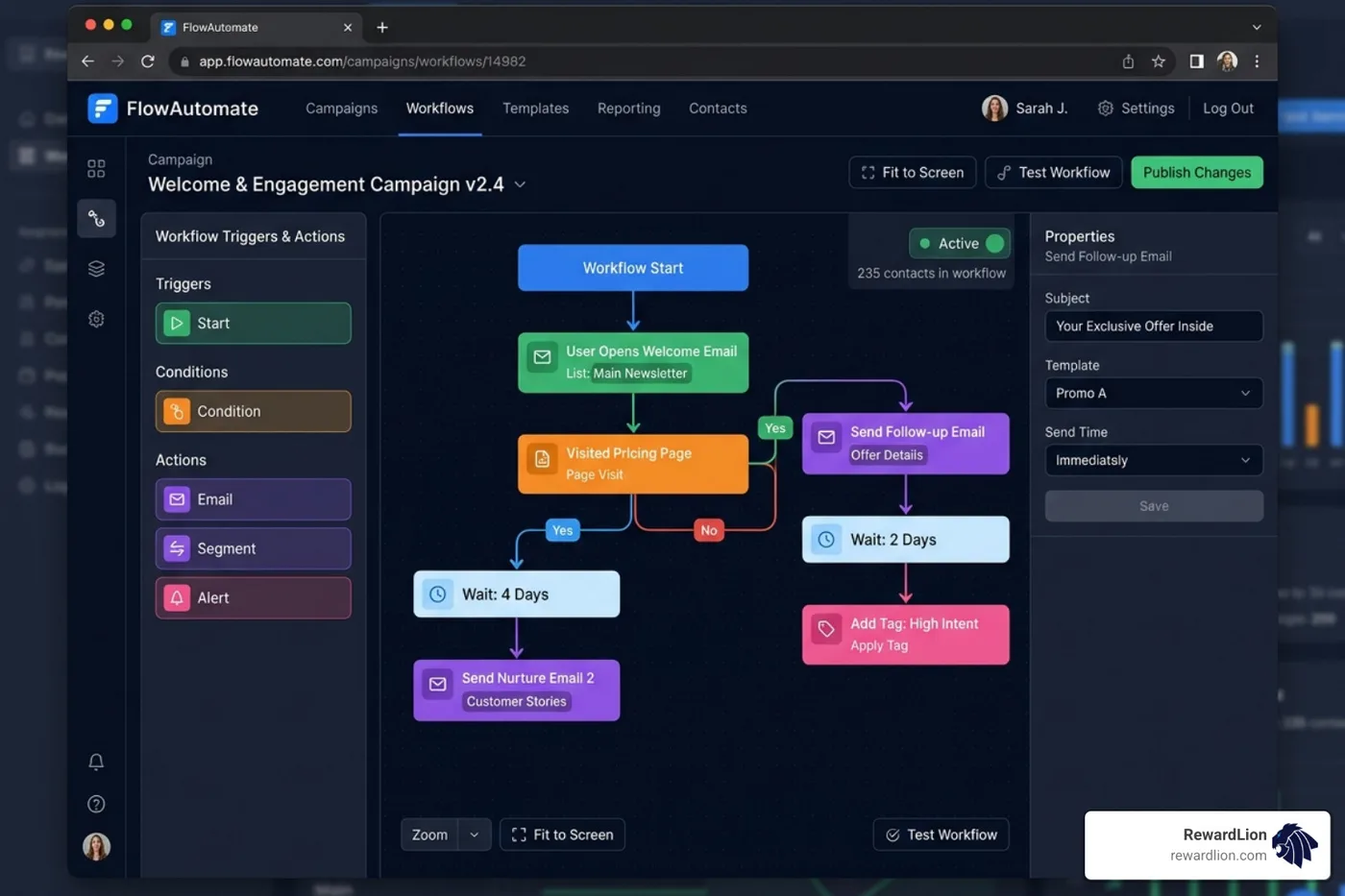
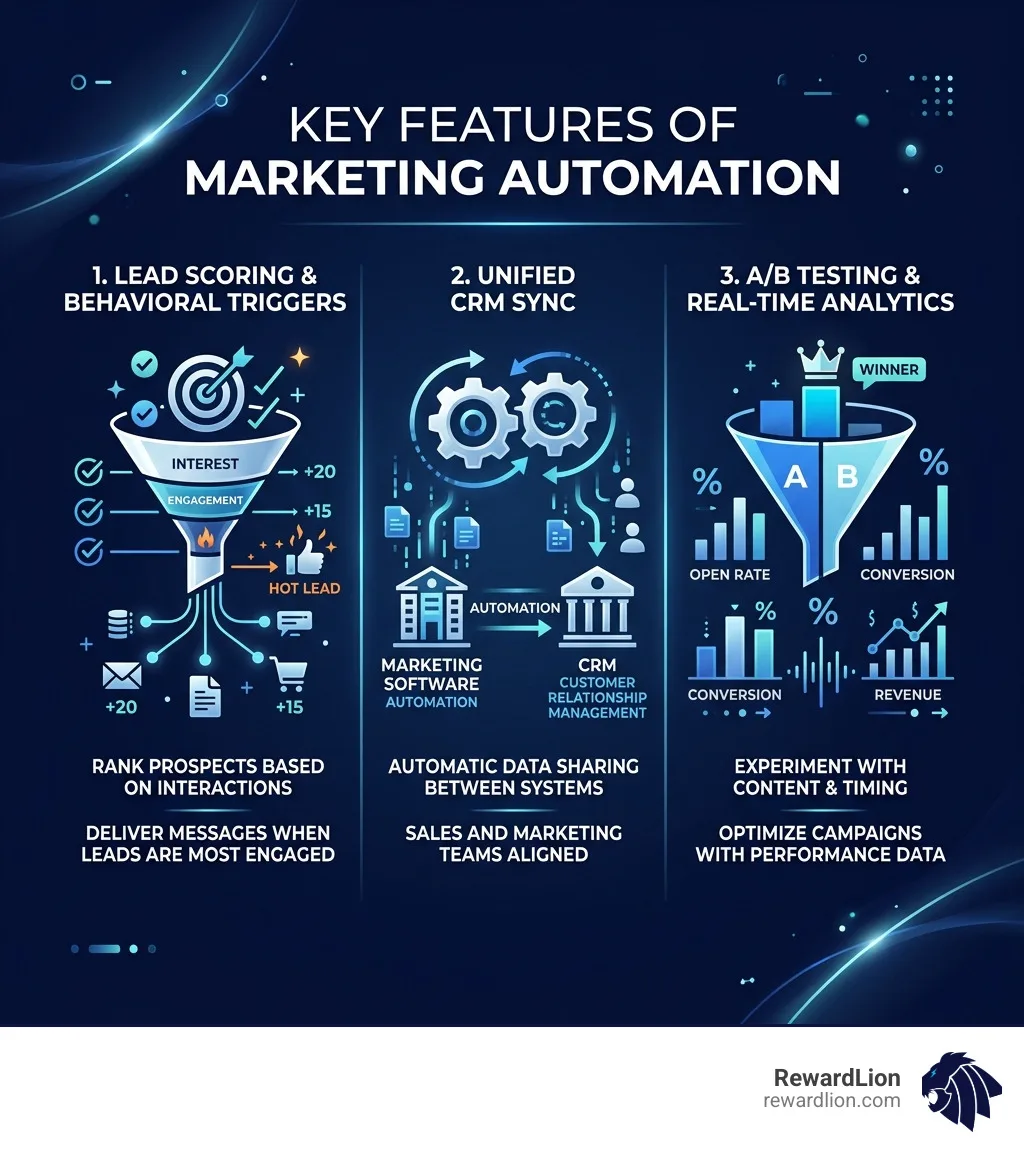
Lead Scoring & Behavioral Triggers: The software should automatically rank leads based on their interactions (e.g., opening an email, visiting a pricing page). This allows for "predictive sending"—delivering a message exactly when a prospect is most likely to engage.
CRM Integration: Your automation tool and your CRM must speak the same language. A unified system ensures that when a lead is "hot," your sales team knows instantly. You can explore our custom software solutions to see how we bridge these gaps.
A/B Testing & Real-Time Analytics: You shouldn't have to guess what works. Modern platforms allow you to test up to eight variations of a campaign simultaneously, automatically picking the winner based on performance data.
Dynamic Content: This allows you to show different images or text to different people within the same email or landing page based on their past purchases or preferences.
Unified Customer Profiles: The best tools pull data from every touchpoint—SMS, email, web, and social—to create a 360-degree view of the customer.
Comparing Solutions: SMB vs. Enterprise-Grade Needs
Choosing the right tool depends heavily on your team size and technical resources. An enterprise-grade powerhouse is a massive asset, but it often requires a dedicated "admin" and months of setup. Conversely, a startup might only need a simple, streamlined tool to get off the ground.
Feature SMB Requirements Enterprise Requirements Primary Goal Lead gen & time savings Cross-channel orchestration Implementation 1–4 weeks (Rapid setup) 3–6 months (Deep integration) Pricing Model Contact-based or flat fee Custom, volume-based contracts Support Self-service / Chat support Dedicated Account Manager Compliance Standard GDPR/CCPA Global data residency & SOC2
To see how these costs break down for your specific business size, you can view our pricing models.
Choosing the Right Digital Marketing Automation Software for SMBs
For small to mid-sized businesses, the focus should be on agility. You need a user-friendly interface that doesn't require a degree in computer science to operate.
All-in-one CRM platforms are frequently praised for their comprehensive approach, allowing SMBs to manage SEO, ads, and email in one place.
Intelligence-driven automation suites offer "Active Intelligence" that helps smaller teams go to market up to 3x faster by suggesting workflows based on proven data.
Usage-based marketing platforms offer a unique advantage for growing businesses: they charge based on the contacts you actually market to, rather than every single name in your database, which can lead to significant cost savings as your list grows.
Specialized Use Cases: Ecommerce, Email, and Cross-Channel Orchestration
Different industries require different "tricks" from their digital marketing automation software.
Ecommerce Specialists: These tools are built specifically to turn data into repeat sales. They excel at "abandoned cart" flows—sending a polite nudge via email, followed by an SMS or WhatsApp message if the customer doesn't return. This multi-touch approach ensures that no potential revenue is left on the table due to simple distractions.
Email-Centric Tools: While these started as simple broadcast systems, they’ve evolved. Modern versions are excellent for businesses needing specific data residency and affordable multi-channel tools like SMS and WhatsApp.
Cross-Channel Orchestration Platforms: For brands that need to be everywhere, these platforms coordinate journeys across 12+ channels natively. Imagine a customer browsing a product on your site, receiving a web push notification an hour later, and then a personalized WhatsApp discount the next morning.
To understand how these pieces fit together in a real-world environment, learn how our platform works. We specialize in taking these complex "omnichannel" strategies and making them feel seamless for the end user.
The Evolution of AI and the Future of Marketing Automation through 2030
The future of digital marketing automation software isn't just about "if/then" logic; it's about autonomous marketing. By 2030, we expect the industry to reach $14 billion as AI moves from a "helper" to a "strategist."
We are already seeing the rise of AI Agents. Unlike traditional automation that only runs what you build, autonomous systems can actually build what you need. They analyze your goals, look at market trends, and suggest entire campaign roadmaps.
Key AI advancements to watch include:
Predictive Churn Modeling: Identifying which customers are likely to leave before they actually do, and triggering a retention campaign automatically.
Sentiment Monitoring: Autonomous AI agents can monitor brand mentions across social media and community forums, categorizing the "mood" of the conversation and alerting your team to issues in real time. This allows for proactive reputation management before a small complaint turns into a PR crisis.
Intent Scoring: Moving beyond simple clicks, AI can now analyze "digital body language" to determine if someone is just browsing or ready to buy.
For more information on how to stay ahead of these trends, check out more info about our custom solutions.
The Role of AI in Digital Marketing Automation Software
AI is the "brain" inside the machine. It powers Natural Language Processing (NLP) for 24/7 chatbots and machine learning for hyper-personalization. Instead of sending one email to 10,000 people, AI allows you to send 10,000 different versions of an email—each tailored to the individual’s specific interests and buying stage.
Frequently Asked Questions about Marketing Automation
What is the difference between an ESP and marketing automation?
An Email Service Provider (ESP) is primarily designed for sending one-to-many broadcasts (newsletters). Digital marketing automation software is much broader; it handles multi-step journeys, integrates with your CRM, manages social media, and triggers actions based on specific user behaviors across multiple channels.
How does contact-based pricing work for automation tools?
Most platforms charge based on the total number of contacts in your database. However, smarter usage-based platforms only charge for "active" contacts—those you’ve actually messaged in the last 30 days. This is crucial for businesses with large, older lists who don't want to pay for "dead" data.
How long does it take to implement an enterprise-grade platform?
For a top-tier enterprise-grade system, expect a timeline of 6 to 12 weeks. This includes data migration, CRM syncing, and setting up complex IP warming for email deliverability. SMB tools can often be "plug-and-play" within a few days.
Can AI replace my marketing team?
AI is designed to augment your team, not replace it. While it can handle data analysis and repetitive tasks, human oversight is essential for brand voice, creative direction, and high-level strategy. Our fractional teams provide this human expertise alongside our AI-powered OS.
Conclusion
At RewardLion, we believe that you shouldn't have to spend your days managing a dozen disconnected tools. Our AI-powered OS is designed to unify your marketing, sales, and analytics into one cohesive system.
When you work with us, you aren't just getting software; you're getting a dedicated CAPSS fractional team—your own in-house marketing agency that implements, optimizes, and manages the system for you. Whether you are in Boca Raton, Las Olas, or anywhere across the United States, we provide the "done-for-you" expertise needed to turn digital marketing automation software into a true revenue generator.
Start your journey with the RewardLion Platform today and let us build the automated growth system your business deserves.