What Is Digital Display Advertising?
Digital display advertising uses visual ads on screens to reach people online and in public places. It includes banners on websites and apps, digital billboards, and screens in stores or transit stations. Unlike a printed billboard or newspaper ad, many digital displays can change creative quickly, run at set times, and provide data to help measure results.
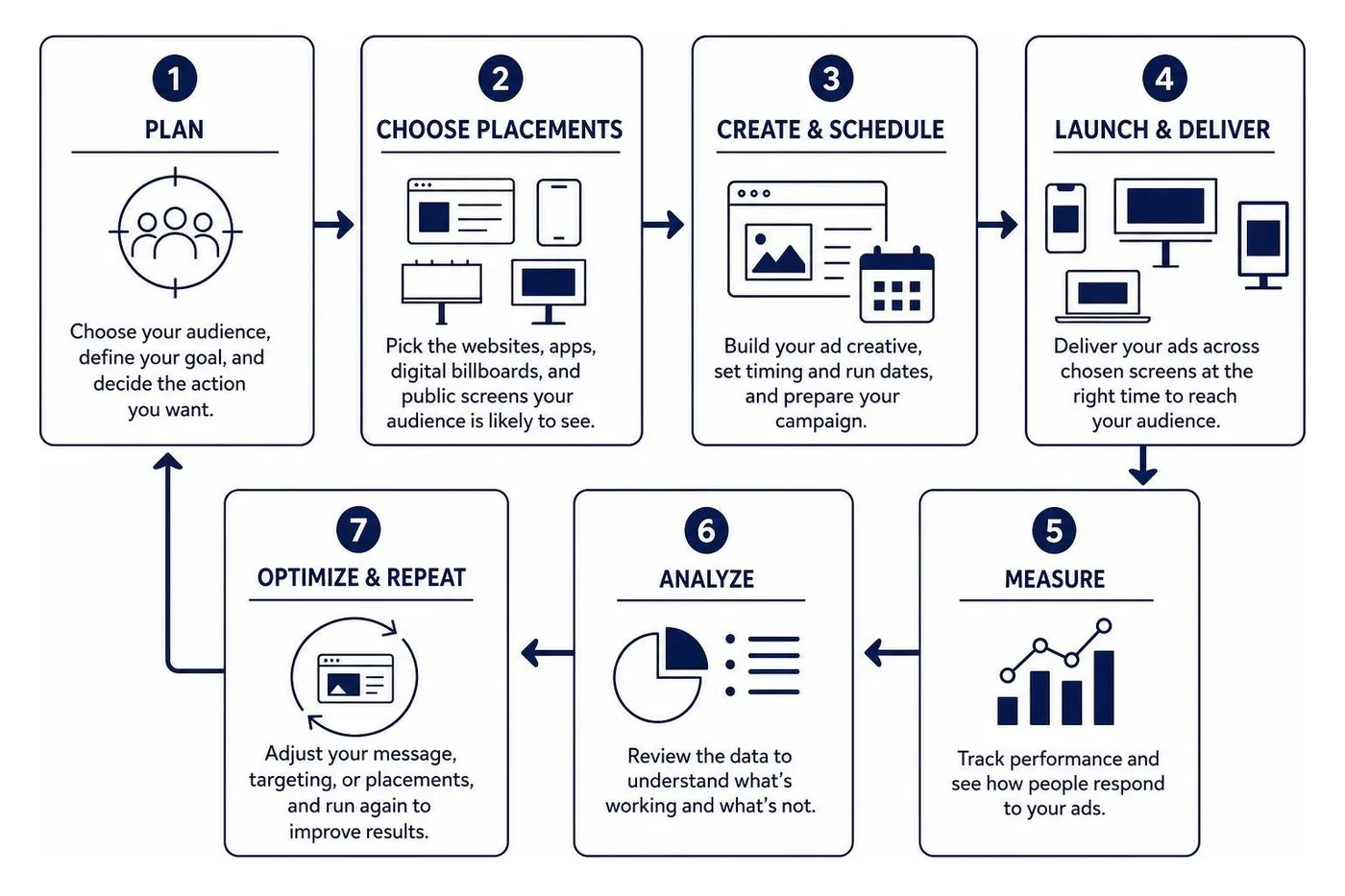
For a small business, the starting point is simple: choose the people you want to reach, pick screens they are likely to see, and decide what action you want them to take. Then track results and adjust the message or placement.
I'm Mike Ibrahim, founder and CEO of RewardLion, with more than a decade of experience in marketing and business growth. I'll use that experience to make digital display advertising easier to plan, buy, and measure.
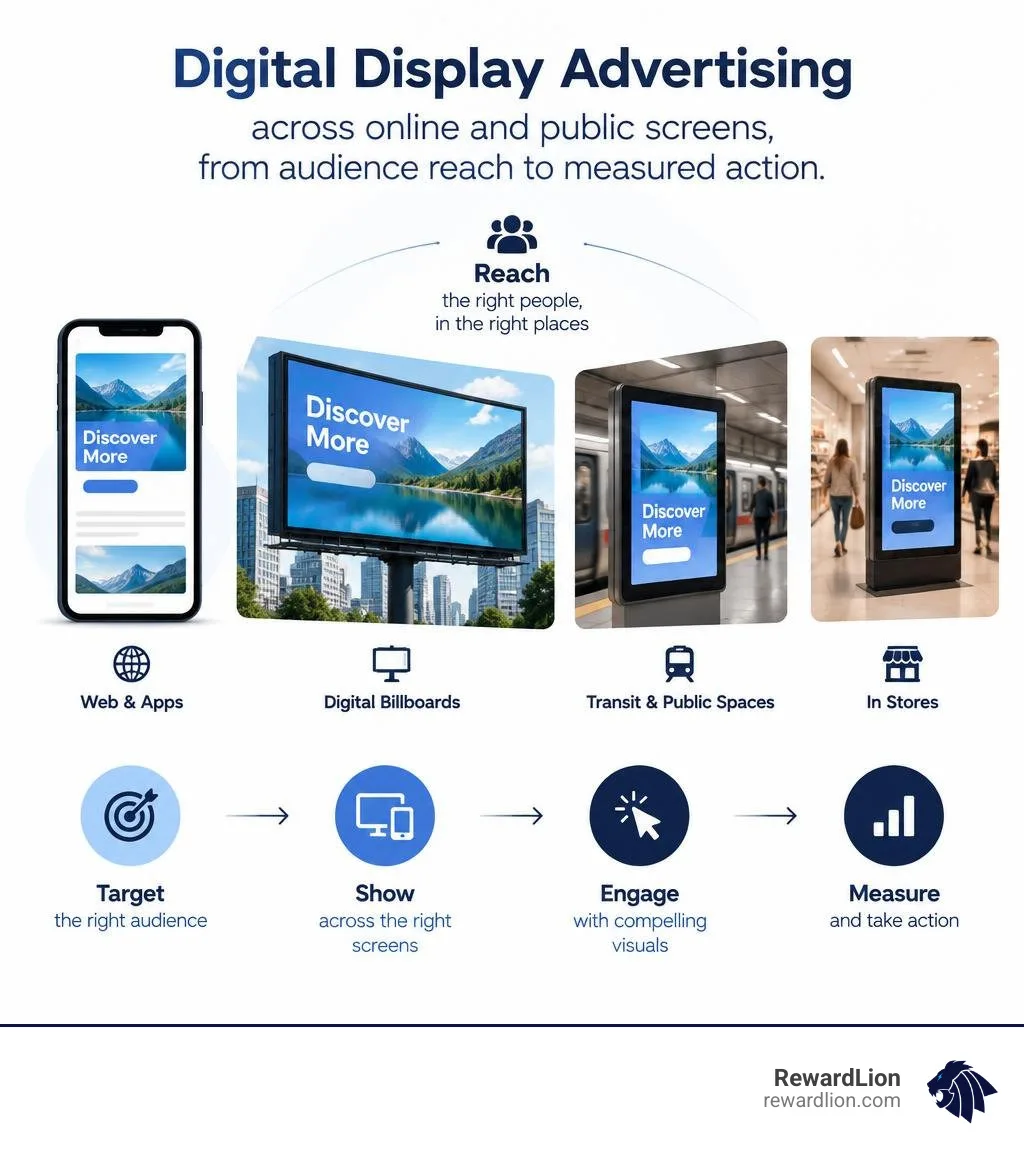
Understanding Digital Display Advertising and How It Works
At its core, visual marketing bridges the gap between passive consumers and active buyers. Modern display strategies allow brands to present high-impact visual banners, interactive graphics, and prominent digital signage to targeted audiences across every screen they encounter throughout the day.
Historically, visual advertising standards relied on static print, television broadcasts, or physical paper billboards. These traditional mediums were fixed, costly to update, and notoriously difficult to measure. In contrast, modern display campaigns rely on dynamic, data-driven delivery mechanisms. Whether we are launching hyper-targeted banner placements or enterprise-level paid advertising strategies, display advertising serves as the visual engine of brand awareness and direct response.
Web Display and Responsive Formats
Online display reaches prospects while they read news articles, check weather forecasts, watch videos, or use mobile applications. The Google Display Network campaign configuration alone provides access to over 35 million websites and apps, as well as native Google properties like YouTube and Gmail.
Rather than manually designing hundreds of fixed banner sizes, modern ad platforms utilize responsive display ads. Advertisers provide core assets—multiple headlines, descriptive copy, high-resolution imagery, logos, and short video clips. Machine learning models then automatically assemble, format, and render these assets into ideal visual combinations that natively match any publisher's available ad slot. This AI-driven assembly maximizes inventory access while optimizing for performance in real time.
Digital Out-of-Home (DOOH) and Programmatic Billboards
Display marketing does not end when users step away from their computers and phones. Digital Out-of-Home (DOOH) brings visual ads into the physical world through roadside LED screens, transit shelters, shopping mall panels, and airport displays.
Roadside inventory, such as highway bulletins, typically operates on rotating loops—commonly displaying six to eight non-competing ad slots in a 64-second rotation, giving each advertiser an impactful eight-second window. The impact of these physical screens is immense:
79% of consumers notice digital billboard ads during their daily travels.
73% of U.S. consumers view digital out-of-home advertising favorably.
Digital billboards deliver an extraordinary 86% ad recall rate, the highest of any major paid advertising channel.
By deploying modern digital billboards, brands achieve unmatched real-world prominence combined with the agility of digital ad scheduling.
Core Types and Placement Channels
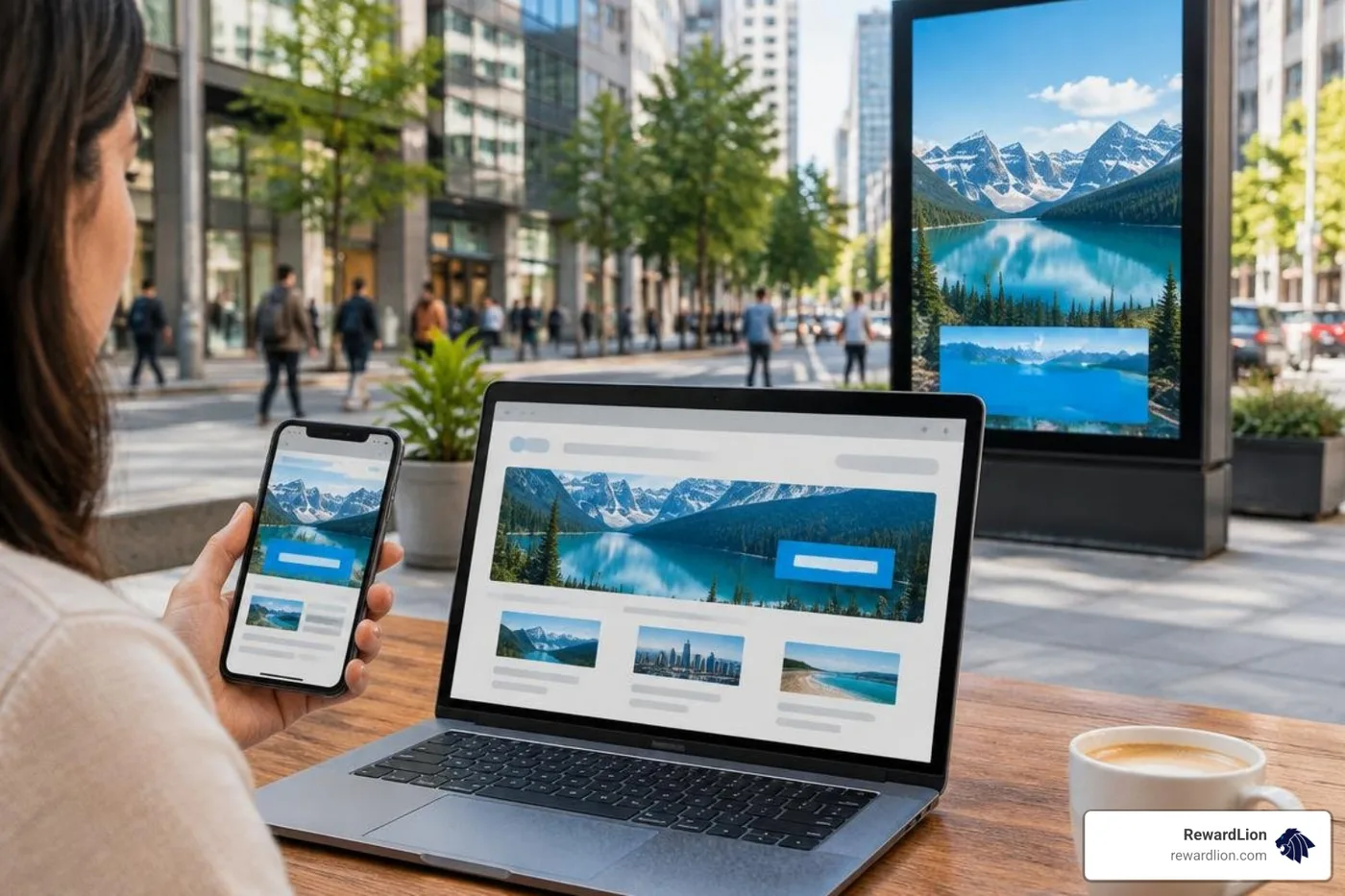
Modern display campaigns encompass a spectrum of physical and virtual environments, meeting audiences across their entire daily routine.
Online Digital Display Advertising Formats and Specifications
To maintain cross-platform visual consistency, online web display adheres to standardized Interactive Advertising Bureau (IAB) dimensions alongside responsive canvas specifications:
Leaderboards (728x90 px & 970x250 px): Prominently placed at the top of editorial content.
Medium Rectangles (300x250 px): The most versatile format, embedded directly within article bodies and mobile feeds.
Half-Page / Large Skyscraper (300x600 px): High-impact vertical inventory offering rich visual real estate.
Mobile Banners (320x50 px & 300x50 px): Sticky bottom or top banners designed for mobile browser environments.
Beyond static imagery, rich media assets—such as HTML5 animated banners and lightweight video assets produced via professional commercial video production—deliver significantly higher interaction rates. As documented across online display advertising platforms market growth research, rich media integrations continue to capture higher engagement than static text or image placements alone.
Large-Format Bulletins, Urban Posters, and Place-Based Screens
Physical digital display inventory falls into distinct structural formats, each fulfilling specific campaign objectives:
Digital Highway Bulletins (14x48 ft): Major expressway installations designed to deliver mass brand awareness, generating between 50,000 and 500,000+ daily impressions per unit.
Urban Digital Posters (10x22 ft): High-density city installations along surface streets and commuter corridors, ideal for driving localized foot traffic.
Place-Based Displays: Screen networks placed inside fitness clubs, medical offices, grocery aisles, and shopping malls, engaging captive audiences in high-intent environments.
Mobile Digital Billboards: Dedicated high-resolution LED trucks that navigate designated metropolitan routes, event perimeters, or retail corridors.
Directional DOOH is especially effective for local retail and dining locations. Research shows that 30% of consumers recently noticed a directional digital OOH ad directing them to a nearby business. Of those viewers, 51% visited the business within 30 minutes, and an astounding 93% of those visitors made an immediate purchase.
Campaign Strategy, Buying Models, and Cost Benchmarks
Selecting the right transaction model and understanding pricing parameters ensures media budgets generate maximum business impact.
Evaluation Metric | Direct Buying (Guaranteed) | Programmatic Display / pDOOH |
|---|---|---|
Pricing Model | Fixed flat fee or locked contract CPM | Real-time bidding (RTB) based on audience auction |
Inventory Access | Specific, guaranteed ad placements | Broad networks across thousands of sites and screens |
Flight Flexibility | Rigid dates, set timeframes | Real-time pacing, instant pausing, and live adjustments |
Targeting Precision | Contextual/geographic placement | Data-driven, audience segments, dynamic triggers |
Minimum Spend | Higher entry thresholds | Scalable with customizable budget minimums |
Programmatic Bidding vs Direct Buying
Advertisers acquire display inventory through two primary avenues: direct operator contracts or automated programmatic marketplaces.
Through automated programmatic advertising, ad platforms bid in fractions of a second using Demand-Side Platforms (DSPs). This enables real-time bidding across thousands of web publishers and programmatic digital out-of-home (pDOOH) networks simultaneously. Instead of paying for a static screen or a single website placement, you pay exclusively for audience impressions matching specific criteria.
For premium placements, high-visibility event sponsorships, or major metropolitan takeovers, strategic media buying services secure guaranteed inventory directly with media owners to lock in exclusive share-of-voice (SOV).
Cost Structures, Pricing Factors, and CPM Ranges
Digital display is primarily priced via Cost-Per-Thousand impressions (CPM):
Web Display CPMs: Typically range from $1.50 to $10.00+ CPM, depending on placement depth, audience data layers, and rich media format requirements.
DOOH and Billboard CPMs: Generally average between $3.00 and $20.00 CPM across standard digital outdoor formats.
When securing physical billboard inventory through monthly flat-rate agreements, standard market pricing benchmarks include:
Highway Digital Bulletins: $3,000 to $15,000+ per month
Urban Digital Posters: $1,500 to $6,000 per month
Place-Based Screen Networks: $500 to $5,000 per month
Mobile Digital Billboard Trucks: $1,500 to $5,000 per week
High-Impact Spectaculars (Iconic Placements): $25,000 to $100,000+ per month
Pricing variables depend heavily on metropolitan market density, target share of voice (such as buying one ad slot in an eight-slot rotation versus a full roadblock takeover), and daypart scheduling restrictions.
Optimization Best Practices and Omnichannel Execution
A display campaign achieves optimal efficiency when fueled by structured audience data, automated triggers, and synchronized cross-channel execution.
Optimizing Digital Display Advertising for Maximum ROI
To drive measurable pipeline growth rather than hollow view counts, top-performing advertisers deploy specific optimization levers:
Audience First-Party Data Integration: Implement first-party data audience management to run dynamic remarketing ads that present previously viewed products or tailor messaging based on customer lifecycle stages.
Dayparting and Ambient Triggers: Schedule ad rotations to mirror peak buying hours. For outdoor screens, adjust creative dynamically based on real-time weather changes (e.g., highlighting hot coffee on cold mornings and iced beverages during hot afternoons).
Proximity Geofencing & Conquesting: Trigger localized display ads and DOOH placements within tight radiuses of your business or directly around competitor locations.
Sequential Storytelling: Expose audiences to brand awareness creative first, followed by educational value propositions, and finally direct-response offers as they progress through your funnel.
Conversion-Focused Bidding: Utilize Smart Bidding models (such as Target CPA or Maximize Conversions) paired with dedicated high-converting sales funnels to ensure your spend prioritizes actual conversions over low-intent clicks.
Marketing Automation Integration: Connect incoming display traffic directly into your marketing automation platform to capture, score, and nurture inbound leads instantly.
Cross-Channel Attribution and Multi-Touch Funnels
Display ads do not operate in a silo. They provide the visual awareness that drives downstream search, direct site traffic, and in-store visits. In fact, Google Ads data shows that advertisers running both Search and Display campaigns generate 11% more Search ad conversions than those running Search ads alone.
Furthermore, 76% of consumers who notice digital out-of-home screens take a direct action afterward—whether searching for the brand online, visiting a retail location, or engaging on social platforms. Tracking these multi-touch touchpoints through integrated omnichannel marketing systems provides clear visibility into foot-traffic lift, branded search acceleration, and overall return on ad spend (ROAS).
Frequently Asked Questions About Digital Display Campaigns
How much does digital display advertising typically cost?
Digital display is one of the most accessible advertising channels available. Web-based banner campaigns can launch with modest daily budgets of $10 to $50, scaling upward based on performance. Digital out-of-home campaigns typically range from $3 to $20 CPM, with localized urban poster and place-based screen placements starting around $500 to $1,500 per month. Major highway digital bulletins generally run between $3,000 and $15,000+ monthly depending on market size and traffic volume.
What is the difference between programmatic DOOH and online display ads?
Online display delivers individual visual impressions directly to personal devices (smartphones, tablets, and desktop computers), allowing for 1-to-1 tracking and direct click-through attribution. Programmatic Digital Out-of-Home (pDOOH) delivers 1-to-many impressions on shared physical screens in public environments. While pDOOH ads cannot be directly clicked, they deliver immense visual impact, achieve an industry-leading 86% brand recall rate, and remain immune to online ad blockers and cookie deprecation.
How quickly can a digital display campaign be launched and measured?
Online display campaigns set up through automated ad networks can launch within 24 to 48 hours. Digital billboard and DOOH campaigns typically require 5 to 10 business days for inventory verification, creative scheduling, and operator approval. Once active, digital ad networks optimize campaign performance within a standard 5- to 7-day algorithmic learning phase, stabilizing performance metrics over weeks one and two.
Conclusion
Digital display advertising is an essential component of modern growth marketing. By uniting high-impact web placements with real-world digital billboard networks, brands can surround target audiences with cohesive, memorable visual touchpoints across their entire journey.
At RewardLion, we eliminate the complexity of managing fragmented platforms, disconnected media buys, and siloed agencies. Our hybrid growth model pairs an AI-powered operating system with our dedicated in-house fractional team to plan, build, and optimize your omnichannel campaigns from start to finish.
Ready to dominate your market across every screen? Discover how our unified growth engine scales your business with predictable, full-funnel execution.