Why Every Growth Team Needs a Demand Generation Platform in 2026
A demand generation platform is a software system that helps businesses attract, engage, and convert high-quality buyers — not just collect contact forms.
Quick answer: What is a demand generation platform?
Feature What It Does Audience targeting Reaches buyers before they raise their hand Multi-channel campaigns Runs ads, webinars, email, and content in one place AI personalization Tailors content to each buyer's behavior and intent CRM integration Syncs lead data directly to your sales team Pipeline analytics Shows which programs drive real revenue
If you're running disconnected tools — one for email, another for ads, another for webinars — you already know the problem. Leads fall through the cracks. Follow-up is slow. And it's nearly impossible to know what's actually working.
That's exactly what a demand generation platform is built to fix.
The numbers back this up. Teams using these platforms report a 3x increase in speed-to-lead, 2x conversion rates throughout the funnel, and a 25% year-over-year increase in audience engagement. These aren't small gains — they're the difference between a pipeline that stalls and one that compounds.
And the stakes are getting higher. In 2026, buyers are doing more research on their own — through YouTube, Google feeds, AI tools, and content hubs — before they ever talk to a salesperson. If your brand isn't showing up in those moments, you're losing deals you don't even know exist.
This guide walks growth teams through everything: what these platforms do, how to choose one, and how to get real ROI from them.
I'm Mike Ibrahim, Founder and CEO of RewardLion and Marketing Director for several companies, with over a decade of hands-on experience building and optimizing demand generation platform strategies across diverse industries. I've seen how the right platform transforms fragmented marketing efforts into predictable, scalable pipeline — and this guide distills those lessons for you.
Understanding the Demand Generation Platform
To build a predictable revenue engine in 2026, we have to look past the outdated playbook of collecting random email addresses and hoping for the best. Modern marketing requires a holistic strategy that builds long-term brand equity while capturing active buyer intent. This is where a demand generation platform comes into play.
What is a Demand Generation Platform?
At its core, a demand generation platform is an integrated software ecosystem designed to build brand awareness, identify buyer intent, and nurture prospects throughout their entire customer journey.
Unlike single-point tools that only send cold emails or build landing pages, a true demand generation system unifies these touchpoints. It acts as the central brain of your marketing operations, tracking how an anonymous visitor interacts with your brand, analyzing their behavior, and delivering personalized content experiences that guide them toward a purchase decision.
Whether you are looking to scale your local presence in Fort Lauderdale or expand internationally, using the right demand generation software ensures that every marketing dollar spent contributes directly to a measurable pipeline.
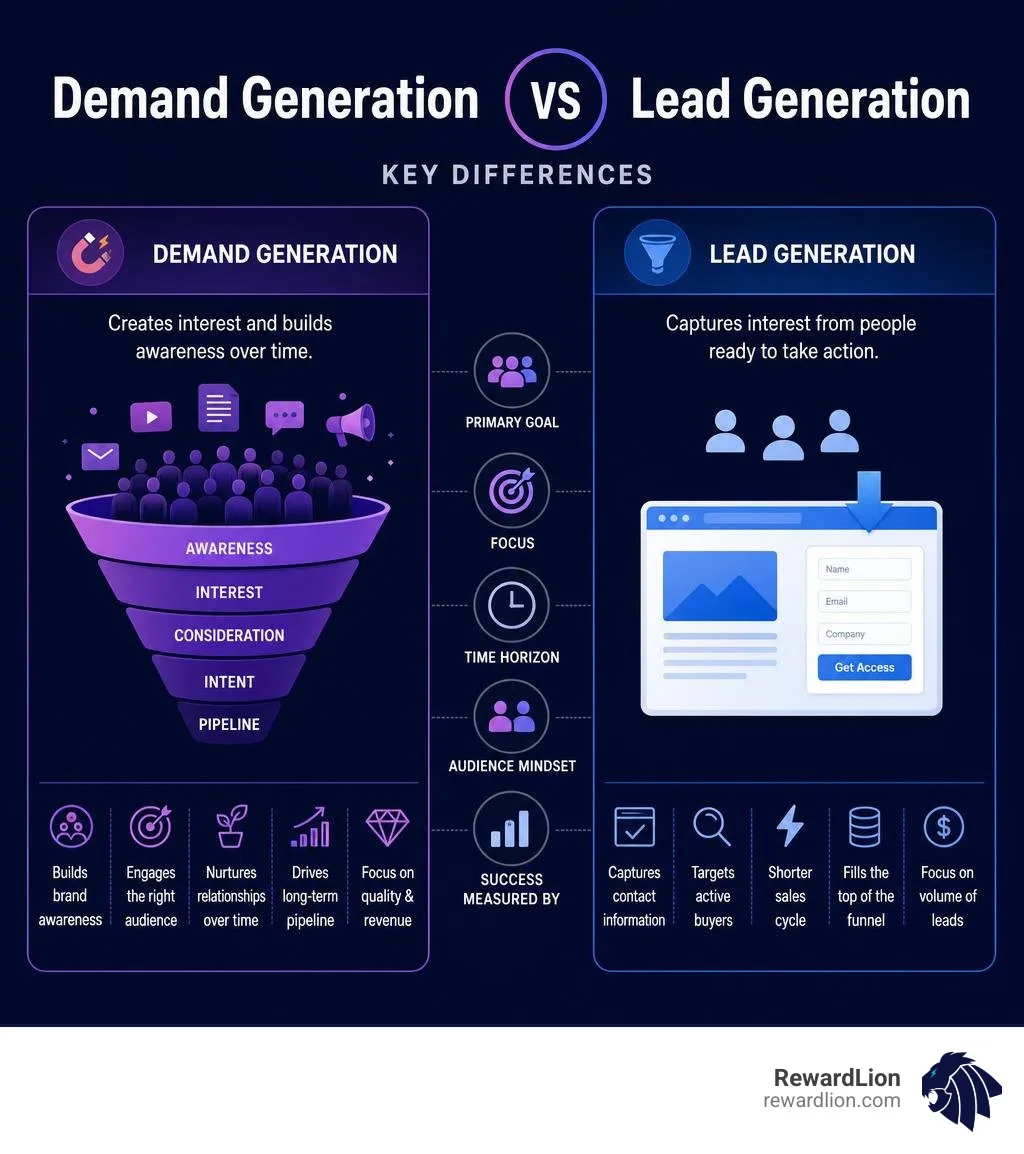
Demand Gen vs. Traditional Lead Gen
The difference between traditional lead generation and modern demand generation comes down to one core philosophy: capture vs. creation.
Traditional lead generation focuses heavily on gatekeeping. You write an ebook, hide it behind a form, and force users to exchange their contact details to read it. The result? A database full of fake phone numbers, low-intent leads, and frustrated sales reps who waste hours calling people who aren't ready to buy.
Demand generation flips this model. Instead of gating every piece of content, we focus on distributing high-value information freely to build trust and educate the market. We use a lead gen software framework that prioritizes buying signals over form fills.
Metric / Approach Traditional Lead Generation Modern Demand Generation Primary Goal Maximize lead volume (MQLs) Maximize pipeline velocity and closed-won revenue Content Strategy Heavily gated PDF guides and forms Open-access content hubs, webinars, and interactive demos Sales Alignment Leads are thrown over the fence to sales Marketing and sales coordinate on high-intent accounts Data Reliance Static databases and basic contact info Real-time behavioral intent and first-party data
By focusing on demand generation, we ensure that when a prospect finally reaches out, they already understand our value proposition, trust our expertise, and are highly motivated to convert. For a deeper dive into choosing the right tools for this process, explore our lead generation software complete guide.
Core Capabilities of a Modern Demand Generation Platform
A modern demand generation platform must be able to manage complex, multi-channel campaigns while maintaining absolute data integrity and privacy compliance. Let’s break down the essential capabilities that make these platforms so powerful in 2026.
Multi-Channel Campaign Orchestration
In 2026, the buyer's journey is highly visual and multi-format. Buyers don't just search on Google; they research products across YouTube, interact with personalized content hubs, and attend live digital experiences.
A high-performing platform allows you to orchestrate these touchpoints seamlessly:
Immersive Webinars and Virtual Events: High-quality virtual events are a cornerstone of modern demand generation. Modern platforms help increase registration-to-attendee conversion rates by 20% and boost audience engagement year-over-year by 25%. Tools like Demand Generation Software | Webinar Event Solutions - ON24 demonstrate how live and on-demand experiences can be turned into continuous content engines.
Google Feeds and YouTube Ads: Visual channels have become dominant for product discovery. In fact, YouTube is 2X more likely than any other video service or social media platform to be used for researching products and brands. Furthermore, viewers rate YouTube ads as 16% more trustworthy, credible, and honest than ads on other social channels.
Massive Reach: Through Google feeds like Gmail, Discover, and YouTube, growth teams can reach up to 3 billion monthly active users. This is incredibly powerful considering that 63% of consumers discover new products on Google feeds, and 91% of those take action immediately. Adding Google Display Ads to these campaigns can yield a statistical significance lift of +16% in conversions.
To manage these touchpoints without losing your mind, we rely on robust digital marketing automation software to coordinate ads, content hubs, and email sequences from a single place.
Data Governance and Privacy Compliance
With strict international regulations like GDPR and CCPA, how your platform handles first-party data is non-negotiable. A modern platform must act as a pipeline integrity layer, validating and standardizing data before it ever reaches your CRM.
By implementing a governed intake layer, such as the workflows detailed by Lead Management Platform for Demand Generation | Integrate , businesses can automatically screen third-party leads against their ideal customer profile (ICP) and compliance rules. Any non-marketable or non-compliant records are rejected or corrected upstream. This ensures that your database remains clean, your email deliverability stays high, and your sales team only focuses on compliant, high-quality prospects.
Integrating Systems and Leveraging AI for Personalization
A demand generation platform cannot exist in a vacuum. It must connect seamlessly with your existing tech stack and leverage artificial intelligence to personalize experiences at scale.
Seamless CRM and Marketing Automation Integration
The magic happens when your demand generation platform sits in perfect harmony with your CRM and marketing automation engines. Instead of manually exporting CSV files and uploading them to different systems, data must flow bi-directionally in real-time.
This tight integration eliminates data silos and supercharges your speed-to-lead. When a prospect engages with a high-intent asset (like an interactive demo or a webinar), the platform immediately alerts your sales team. By utilizing an ai-driven sales platform alongside your core CRM, you can automate lead routing and follow-up sequences instantly. This seamless data synchronization is what drives a 3x increase in speed-to-lead and keeps your sales pipeline moving fast.
The Role of AI in Personalization and Analytics
AI has transitioned from a buzzword into the operational backbone of demand generation. Here is how we use sales automation ai tools to scale our campaigns in 2026:
Behavioral Intent Tracking: AI monitors digital body language across your website, content hubs, and social channels to identify accounts actively researching solutions in your category.
Lookalike Segments: By analyzing your best-performing customers, AI-powered algorithms build highly targeted lookalike audiences to scale your paid media campaigns with extreme precision.
Content Personalization: AI-driven engines dynamically suggest the next best piece of content (such as an ebook, video, or case study) to a visitor based on their industry, role, and historical behavior.
Automated Copywriting: Growth teams can test and optimize email subject lines, landing page copy, and ad creatives in real-time using embedded AI assistants.
Maximizing Pipeline Conversion and ROI
A demand generation platform is an investment that must justify itself through increased revenue and improved pipeline conversion rates.
Key Metrics and KPIs for Success
To measure whether your demand generation engine is working, you must move beyond vanity metrics like "clicks" and "impressions." Instead, focus on metrics that directly impact your bottom line using robust lead generation analytics:
Marketing Qualified Leads (MQL) to Sales Accepted Leads (SAL) Conversion: Are the leads you generate actually accepted by your sales team?
Pipeline Velocity: How quickly do prospects move from their first touchpoint to a closed-won deal?
Customer Acquisition Cost (CAC): Is your multi-channel approach driving down your overall cost to acquire a customer?
Multi-Touch Revenue Attribution: Which specific combinations of webinars, ads, and content hubs are actually closing deals?
By tracking these metrics on a dedicated analytics platform for marketing, you can confidently allocate your budget to the channels driving the highest ROI.
Selecting the Right Demand Generation Platform for Your Stack
Selecting the right platform requires careful evaluation of your budget, technical resources, and growth goals. The market offers a wide variety of specialized tools, each with distinct pricing structures:
Data Enrichment & Prospecting: Tools like Clay (starting at $149/month) and Trigify ($69 to $549/month) help enrich lead data and find in-market buyers.
Outreach & Engagement: Platforms like Instantly (ranging from $37 to $358/month) and HeyReach ($79 to $1,999/month) automate multi-channel messaging.
Optimization & Management: Solutions like Unbounce (starting at $74/month) and VWO (starting at $339/month) optimize landing pages, while CRMs like Pipedrive ($14.90/user/month) and HubSpot ($15/month) manage the pipeline.
Workflow Integration: Zapier (starting at $19.99/month) connects these disparate systems together seamlessly.
For businesses looking for a localized or national agency partner to manage these complex systems, checking directories like the Best Lead Generation Companies in Florida 2026 | Semrush or reviewing the Top Lead Generation Companies in Fort Lauderdale - Clutch can provide great regional insights.
However, managing ten different SaaS subscriptions and coordinating multiple external agencies is incredibly time-consuming. That is why we built RewardLion. We provide an all-in-one AI-powered operating system that unifies your marketing, sales, automation, and analytics—backed by your dedicated Fractional CAPSS team to execute everything for you hands-off.
To learn more about optimizing your SaaS stack, read our guide on sales automation software saas.
Frequently Asked Questions about Demand Generation Platforms
How do demand generation platforms improve speed-to-lead?
When a high-intent buyer engages with your brand, every second counts. Demand generation platforms use lead automation software to instantly validate, score, and route leads to the correct sales rep. By eliminating manual lead-processing tasks, businesses can achieve a 3x increase in speed-to-lead, ensuring hot prospects are contacted while their interest is at its peak.
What are the main categories of demand generation software?
Demand generation software generally falls into four main buckets:
Account-Based Marketing (ABM) Platforms: Designed to target and engage specific high-value accounts.
Conversational & Webinar Solutions: Platforms that host engaging digital experiences and track real-time audience participation.
Outbound Engagement Tools: Automated systems for LinkedIn, email, and cold outreach.
Lead Governance & Data Enrichment: Software that cleanses, enriches, and validates contact records before they enter your CRM.
How long does it take to implement a demand generation platform?
A basic implementation involving CRM synchronization and simple email automation can take 2 to 4 weeks. However, a fully optimized enterprise setup—including multi-touch attribution, advanced AI-driven personalization, and comprehensive data governance—typically takes 60 to 90 days of onboarding, data mapping, and pilot campaign testing to run at peak efficiency.
Conclusion
Building a scalable, predictable pipeline in 2026 requires growth teams to move away from fragmented tools and embrace an integrated demand generation platform. By combining multi-channel orchestration, robust data governance, and AI-powered personalization, you can build a system that attracts high-value buyers and accelerates them through your sales funnel.
But you don't have to manage this complex transition alone. At RewardLion, we install one fully connected growth system into your business. You get our unified, AI-powered operating system alongside a dedicated Fractional CAPSS team to implement, optimize, and manage your local growth, lead generation, and sales automation systems for you.
Ready to scale your pipeline hands-off? Get Your Quote today, and let's build your predictable growth engine together.