Why Big Data and Marketing Automation Matter for Growth
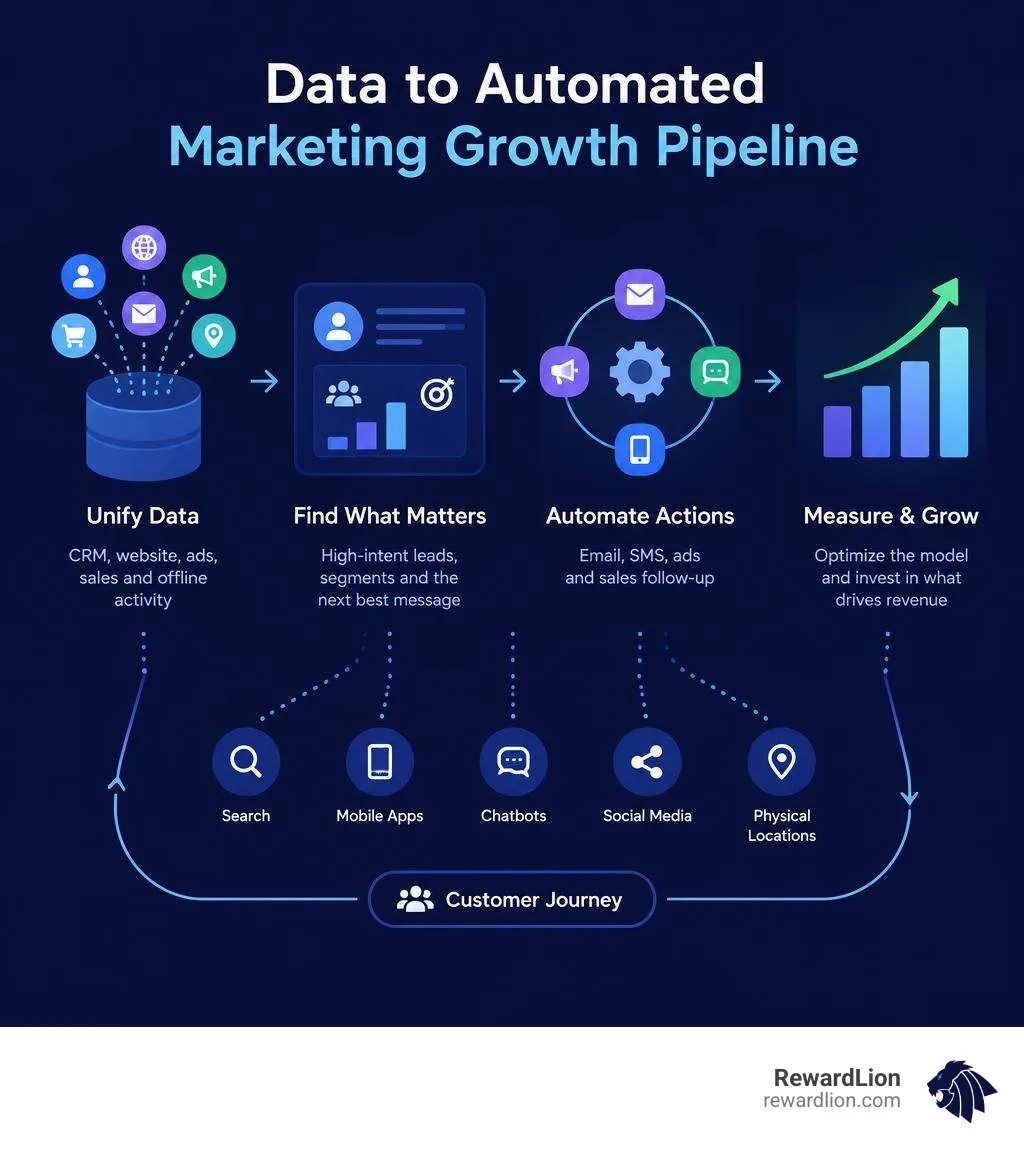
Big data and marketing automation help you replace guesswork with repeatable growth. The practical approach is simple:
Bring customer data from your CRM, website, ads, sales, and offline activity into one trusted view.
Use that data to identify high-intent leads, customer segments, and the next best message.
Automate timely actions across email, SMS, ads, and sales follow-up.
Measure results, improve the model, and move budget toward what creates revenue.
For a growing business, this means fewer disconnected tools and fewer campaigns based on hunches. Instead of sending the same message to every lead, you can respond to what people actually do: pages viewed, purchases made, forms completed, support requests, and engagement across channels.
The goal is not to collect more data for its own sake. It is to turn accurate, consented data into useful decisions and automated customer experiences. Clean integration matters: widely cited IBM research estimates poor-quality data costs the global economy trillions of dollars each year.
I am Mike Ibrahim, Founder and CEO of RewardLion and a marketing leader with more than a decade of experience building sales, e-commerce, and customer-growth strategies. In this guide, I will show how big data and marketing automation can help businesses unify operations, improve lead handling, and scale with more confidence.
The Convergence of Big Data and Marketing Automation: Turning Raw Signals into Actionable Growth
Modern marketing moves too fast for batch uploads and monthly spreadsheet audits. Every millisecond, prospects generate signals across search engines, mobile apps, conversational chatbots, social platforms, and physical locations.
To make sense of this landscape, we look at the core characteristics of modern data:
Volume: Massive quantities of clickstream logs, transaction records, and behavioral triggers generated daily.
Velocity: Real-time data streams requiring sub-second ingestion and processing.
Variety: Structured CRM tables blended with unstructured text, video engagement, and conversational queries.
When raw data feeds directly into modern execution pipes, marketing stops being a passive broadcasting exercise. Instead, it becomes an active conversational system where triggers fire precisely when purchase intent peaks.
How Big Data and Marketing Automation Enable Hyper-Personalization at Scale
Traditional personalization meant adding a {{First_Name}} snippet to an email subject line. Today, that basic tactic is obsolete. True personalization means dynamically altering website content, pricing incentives, ad creative, and messaging cadences based on real-time behavior.
Using an automated marketing system, businesses can group audiences into micro-segments based on live engagement. If an enterprise prospect visits a pricing page three times, watches an onboarding demo, and downloads a technical paper, the system instantly upgrades their account tier. Rather than receiving a generic nurture email, they are served contextually relevant case studies and an automated invitation for a personalized walkthrough.
Breaking Silos: Integrating Online and Offline Customer Touchpoints
Customer journeys are rarely linear. A buyer might research a product on their smartphone, consult a sales rep over the phone, visit a physical location, and finalize the purchase through a dedicated portal.
When offline interactions remain siloed from digital marketing, customers experience disjointed communication—such as receiving promotional ads for items they purchased in-store an hour earlier. By orchestrating omnichannel marketing architectures, we merge point-of-sale (POS) records, customer service logs, and online events into a single profile. This complete view ensures that every automated outreach reinforces the overall customer experience.
Predictive Analytics and AI in Campaign Execution
Descriptive analytics tell you what happened in the past; predictive analytics tell you what will happen next. By integrating machine learning models with continuous feedback loops, marketing teams can shift from reacting to events to anticipating customer needs.
Applying advanced data analytics for sales and marketing enables automated platforms to score prospects dynamically, predict purchase timing, and deliver targeted offers before a prospect begins evaluating alternatives.
Maximizing Customer Lifetime Value and Attribution Precision
Accurately predicting Customer Lifetime Value (CLV) is critical for sustainable acquisition. Recent peer-reviewed research on LLMs for Integrated Business Intelligence: A Big Data-Driven Framework Integrating Marketing Optimization, Financial Performance, and Audit Quality demonstrates that hybrid ensemble models and fine-tuned LLMs improve CLV prediction accuracy from 76.4% to 91.3%.
Understanding precise value unlocks smarter attribution. Relying on basic first-touch or last-touch rules misrepresents campaign impact. Modern systems deploy attention-weighted attribution and Markov chain modeling to assign fractional credit across every customer touchpoint.
Using integrated sales and marketing analytics, teams can uncover hidden revenue drivers—such as top-of-funnel content or automated nurture sequences—that traditional models fail to credit.
Intelligent Budget Allocation and Financial Forecasting
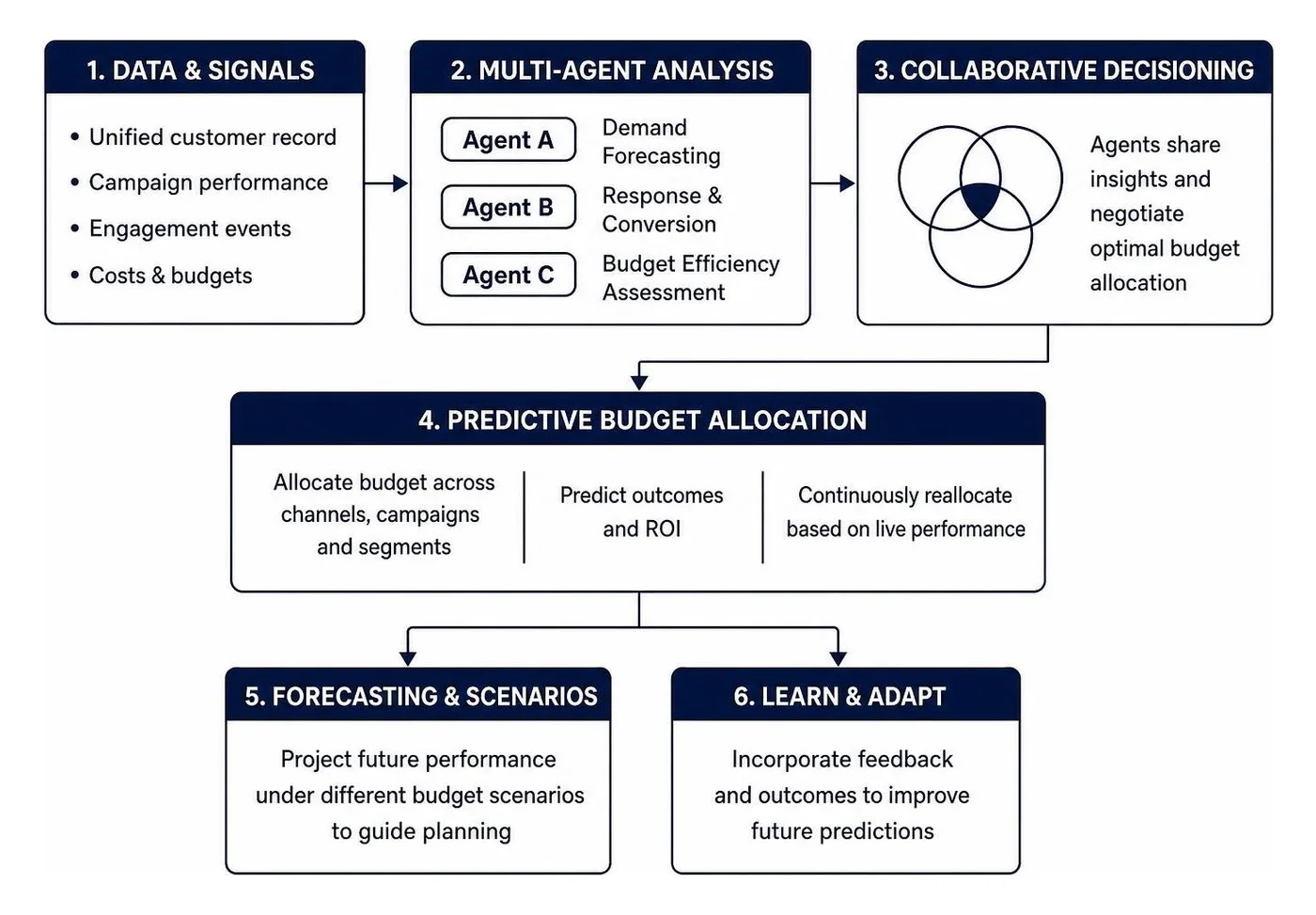
Data-driven frameworks eliminate the guesswork from media buying and channel investment. By feeding multi-touch attribution and real-time conversion data into Media Mix Modeling (MMM), automated systems continuously optimize spend across acquisition channels.
The performance gains of these integrated systems are substantial:
Marketing ROI Improvements: Research reveals marketing ROI can rise from 4.2 to 6.78—a 61.4% relative gain—when orchestrating cross-channel optimization through integrated intelligence models.
Forecasting Precision: Financial forecasting error (Mean Absolute Percentage Error, or MAPE) drops from 12.8% to 4.7% (a 63.3% reduction) by pairing LLM-driven market signals with financial systems.
Faster Strategic Execution: Decision-processing duration decreases by up to 93.8%, allowing automated budget reallocation in hours rather than weeks.
Overcoming Core Challenges in Data-Driven Marketing Adoption
Transitioning to high-performance automation requires overcoming common organizational hurdles: technical debt, fragmented applications, and internal resistance to data-driven workflows.
Mitigating Bad Data and Eradicating Costly Silos
Dirty data degrades marketing automation. Duplicate entries, outdated contact details, and missing attributes derail workflows and waste ad spend. With bad data costing enterprises trillions annually, maintaining data hygiene is essential for operational success.
Establishing automated crm setup automation ensures incoming records are validated, normalized, and enriched in real time.
Capability | Manual Marketing Workflows | Automated Data Pipelines |
|---|---|---|
Data Synchronization | Weekly or monthly CSV exports | Sub-second real-time API / Reverse ETL |
Audience Segmentation | Static lists prone to decay | Dynamic queries based on live behavior |
Data Consistency | High conflict rates (~12% profile errors) | Governed master record (99.7%+ accuracy) |
Lead Routing Speed | Hours to days (manual assignment) | Instantaneous automated distribution |
Campaign Latency | Weeks to build and launch | Hours from ideation to active deployment |
Navigating Privacy Regulations and Eliminating Cognitive Biases
Data-driven strategies must prioritize user privacy. Global regulations such as GDPR and CCPA require strict compliance frameworks, explicit consent management, and transparent data usage policies. Marketers must move away from brittle third-party tracking toward resilient first-party data strategies.
Equally important is cultivating a data-informed culture. Marketers frequently fall victim to confirmation bias—cherry-picking analytics that support pet projects while ignoring warning signs. Modern automation systems establish unbiased, continuous testing protocols that evaluate campaigns based on verified business metrics rather than assumptions.
Modernizing Infrastructure for Scalable Execution
Legacy marketing stacks often struggle under the weight of disjointed integrations. Modern strategies favor composable architectures, decoupling the central data layer from activation platforms.
Modernizing Your Architecture with Big Data and Marketing Automation Pipelines
Modern marketing infrastructure relies on the cloud data warehouse or lakehouse as the single source of truth. Instead of siloing customer intelligence across isolated tools, organizations centralize their data assets and use reverse ETL to feed real-time customer segments into execution tools.
This approach gives operational tools direct access to governed metrics, unified purchase histories, and predictive churn indicators without requiring brittle custom integrations.
Accelerating the Lead Capture and Conversion Lifecycle
Capturing attention is only the first step; conversion requires speed. Deploying advanced lead capture solutions allows businesses to capture intent at the exact moment of engagement.
Pairing automated routing with full-funnel lead generation systems enables organizations to enrich inbound leads instantly, append firmographic metrics, score readiness, and deliver qualified prospects to sales reps within seconds.
Frequently Asked Questions About Big Data in Automated Marketing
How does big data improve marketing automation ROI?
Big data maximizes marketing ROI by eliminating ad waste and targeting high-intent prospects with tailored messaging. By combining predictive scoring, dynamic personalization, and multi-touch attribution, platforms allocate budget toward top-performing channels while automating nurture cycles that drive conversions.
How do privacy laws like GDPR and CCPA impact automated data collection?
Privacy frameworks mandate explicit user consent, strict data governance, and on-demand user data deletion. Marketers must transition to transparent first-party and zero-party data strategies, using centralized consent management platforms to maintain regulatory compliance across all automated touchpoints.
What is the difference between traditional marketing automation and modern warehouse-native intelligence?
Traditional marketing automation stores customer records inside isolated platform silos, causing data latency and sync conflicts. Modern warehouse-native architectures centralize behavioral and operational data within a governed cloud data warehouse, using reverse ETL pipelines to power execution tools with real-time, unified intelligence.
Conclusion
The era of intuition-based marketing has come to an end. Businesses that rely on fragmented systems and gut instincts risk being outpaced by agile competitors who leverage modern data pipelines and predictive intelligence.
By pairing big data with real-time execution, organizations eliminate operational silos, improve forecast accuracy, and build seamless customer journeys that drive predictable revenue.
At RewardLion, we help businesses transition from fragmented tools to an integrated growth engine. Our hybrid model combines our AI-powered Operating System with dedicated execution experts—providing a complete, hands-off growth platform from our Florida roots to enterprises nationwide. Discover how you can eliminate guesswork and begin scaling growth with an all-in-one OS today.