What You're Actually Paying for Instagram Ads in 2026
Advertising costs on Instagram vary widely depending on your goals, industry, and creative quality. Here's a quick snapshot of what most businesses pay in 2026:
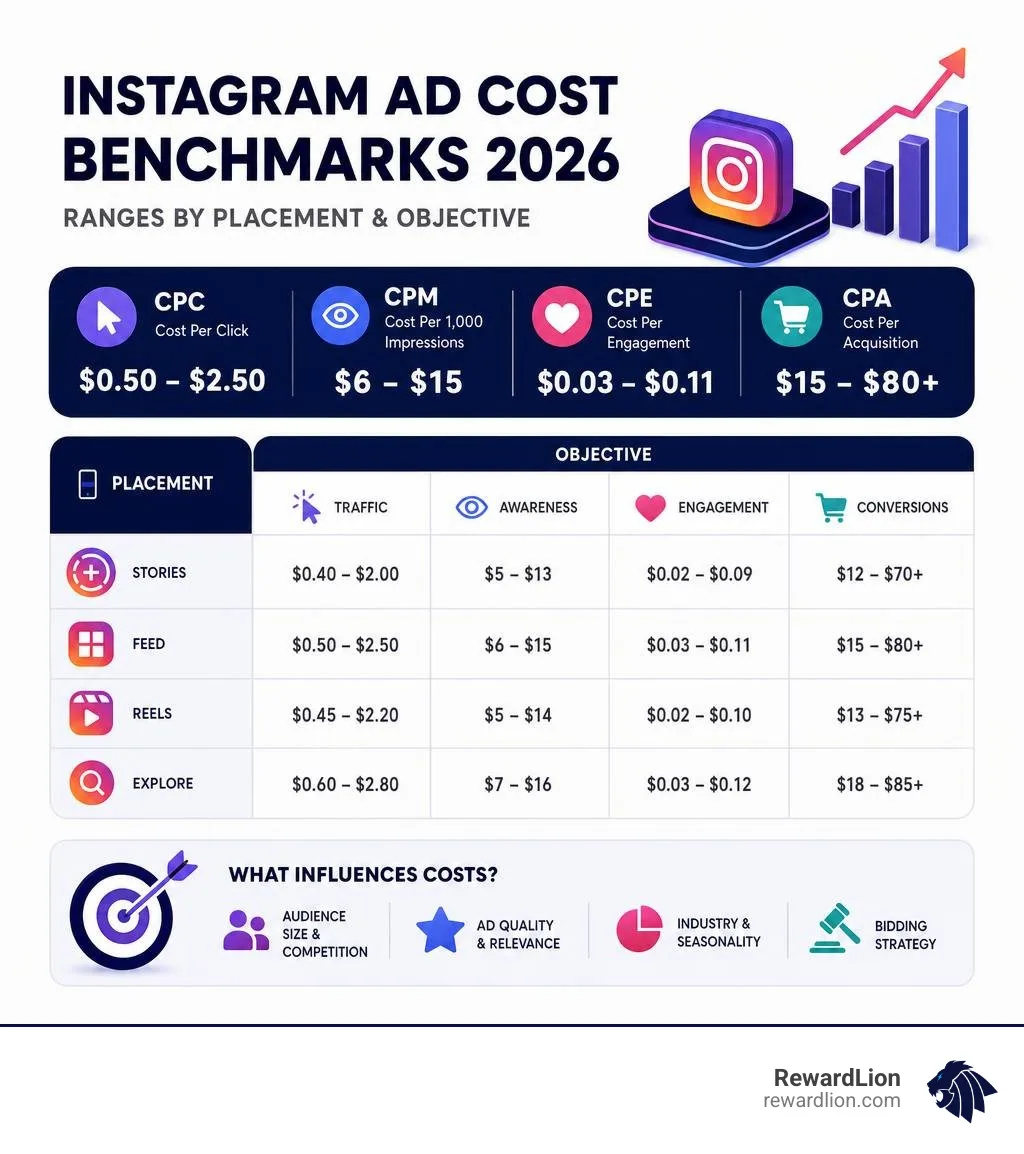
Metric Typical Range Cost Per Click (CPC) $0.50 – $2.50 Cost Per 1,000 Impressions (CPM) $6 – $15 Cost Per Engagement (CPE) $0.03 – $0.11 Cost Per Acquisition (CPA) $15 – $80+ Minimum Daily Budget $5/day (Meta recommendation) Typical Monthly Spend $500 – $5,000
These are starting points, not fixed prices. Instagram uses an auction system — your actual cost depends on your bid, your ad quality, and how many other advertisers are competing for the same audience at the same time.
The short version: you can start small, but what you pay per result is largely in your control.
A $5 click that converts into a $300 sale is a bargain. A $0.50 click that never converts is a waste. That's the core tension every business faces when running Instagram ads — and understanding the cost structure is the first step to making smart decisions.
Instagram now has over 3 billion monthly active users, and up to 44% of them shop on the platform weekly. That reach is why so many businesses are willing to pay for visibility here. But without knowing how pricing actually works, it's easy to burn through budget fast.
I'm Mike Ibrahim, Founder and CEO of RewardLion and Marketing Director for several companies, with over a decade of experience helping businesses navigate advertising costs on Instagram and across the full digital landscape. In this guide, I'll break down exactly what you should expect to pay, what drives those costs up or down, and how to get the most from every dollar you spend.
Current Benchmarks for Advertising Costs Instagram in 2026
When planning your budget, it is helpful to look at standard industry benchmarks. However, a major reason why different reports on advertising costs instagram seem to contradict each other is that they measure different things. For example, "all-clicks" CPC (which includes likes, comments, and profile visits) is much cheaper than "destination-click" CPC (which only counts clicks to your website).
According to data compiled by How Much Do Instagram Ads Cost in 2026? | WordStream, the core benchmarks for 2026 look like this:
Cost Per Click (CPC): The average CPC ranges from $0.40 to $2.00. If you are tracking destination URL clicks specifically, expect to pay between $0.50 and $1.20 per click.
Cost Per Thousand Impressions (CPM): The average CPM ranges from $5.00 to $15.00. Better-performing, highly engaging campaigns often see CPMs drop to the $2.00 to $6.00 range.
Cost Per Engagement (CPE): Engagement actions (likes, comments, saves) are highly affordable, averaging between $0.03 and $0.11.
Cost Per Acquisition (CPA) / Cost Per Lead (CPL): For conversions and leads, average costs run between $15.00 and $60.00, though competitive niches can easily exceed $100.00 to $200.00.
Understanding these benchmarks is critical because they dictate how far your money will go. To see how these paid metrics fit into a broader, cohesive growth strategy, check out our guide on The Power of Ads.
How Placements Affect Your Advertising Costs Instagram Campaigns
Instagram is not just one single feed anymore. It is a collection of distinct experiences—Feed, Stories, Reels, and Explore—and each operates as its own mini-auction with its own supply, demand, and cost dynamics.
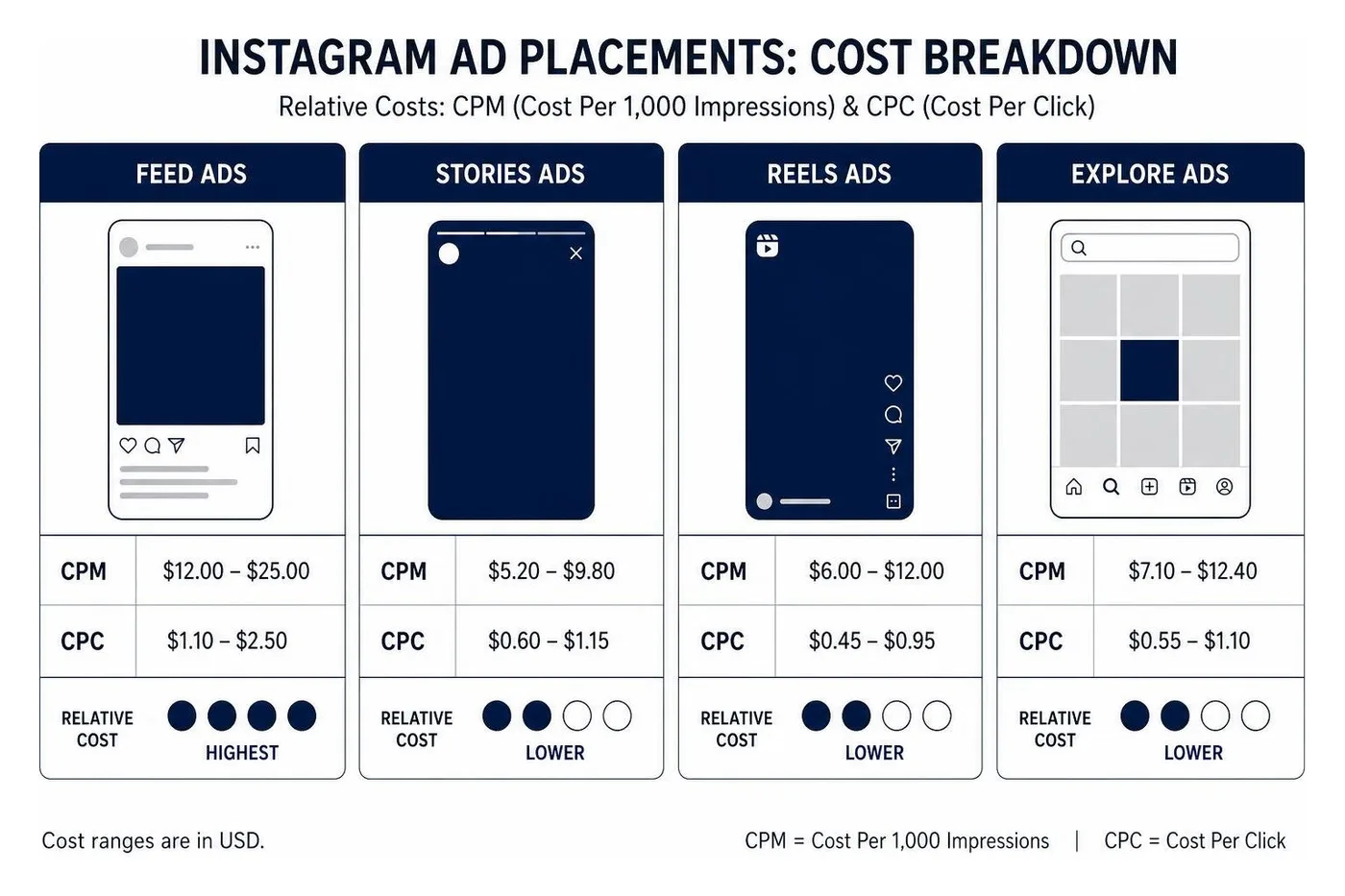
Instagram Feed Ads: This is the traditional, high-intent placement. Because it is highly visible and highly competitive, Feed CPMs generally range from $12.00 to $25.00, with CPCs hovering between $1.10 and $2.50.
Instagram Stories Ads: Stories offer full-screen vertical engagement. They generally carry lower CPMs—ranging from $5.20 to $9.80—and highly competitive CPCs around $0.60 to $1.15.
Instagram Reels Ads: Reels are the fastest-growing surface on the platform. Because Meta is actively expanding inventory here, Reels ads typically see CPMs ranging from $6.00 to $12.00, with CPCs between $0.45 and $0.95. Reels are highly efficient for top-of-funnel reach, often delivering 20% to 40% lower CPMs than Feed placements when paired with native vertical video.
Instagram Explore Ads: Perfect for catching users in discovery mode, Explore ads are relatively affordable, with CPMs running between $7.10 and $12.40.
If you want to run calculations based on your own campaign data, you can use the Instagram CPM Calculator 2026 – Feed, Stories & Reels CPM | CalculateCPM. To understand how these placements interact with broader Meta campaigns, see our breakdown of The Power of Facebook Ads.
Industry-Specific Benchmarks for Advertising Costs Instagram
Your industry is one of the biggest external factors dictating your ad costs. If you are selling $20 t-shirts, your conversion costs will be vastly different than a law firm looking for personal injury clients.
Based on data from Instagram Advertising Costs in 2026: CPM, CPC & CPA Benchmarks, here is how costs break down across key verticals:
Industry Average CPC Average CPM Average CPA / CPL eCommerce & Apparel $0.45 – $0.85 $5.00 – $8.00 $15.00 – $35.00 Beauty & Cosmetics $0.50 – $0.90 $6.00 – $9.00 $20.00 – $40.00 B2B & SaaS $1.80 – $3.00 $12.00 – $18.00 $60.00 – $120.00 Finance $2.50 – $4.00 $14.00 – $22.00 $80.00 – $150.00 Legal Services $3.00 – $4.50 $12.00 – $16.00 $100.00 – $188.00
For eCommerce and direct-to-consumer brands looking to scale these numbers, reviewing Top Rated Direct to Consumer Marketing Agency Options can help you find the right team to optimize your funnel.
Key Factors That Influence Instagram Ad Pricing
Why does one brand pay $3.00 CPM while another in the same niche pays $15.00? The answer lies in how Meta's auction algorithm calculates the Total Value of an ad. The auction formula looks like this:
$$\text{Total Value} = \text{Bid} \times \text{Estimated Action Rate} + \text{User Value}$$
Your Bid: The maximum amount you are willing to pay for your desired action.
Estimated Action Rate (EAR): How likely the algorithm thinks a user is to complete your campaign objective (e.g., click, watch, or buy) based on historical data.
User Value: A score determined by ad quality, expected click-through rate (CTR), and post-click experience (landing page speed and relevance). If users hide or report your ad, your user value drops, and your costs skyrocket.
Beyond the formula, several other variables play a major role:
Campaign Objectives: Choosing "Awareness" or "Traffic" is highly affordable because Meta targets users who click or look at things easily. Choosing "Leads" or "Sales" targets users with a history of purchasing, which is a smaller, more competitive audience, driving your costs higher.
Audience Size: Narrow targeting (such as layering 5 different interests) makes your target pool tiny. This forces Meta to bid aggressively, driving up CPMs. Broader targeting allows the algorithm's machine learning to find the cheapest conversions naturally.
Seasonality: Costs rise significantly during major retail periods. Expect Q4 CPMs to spike by 40% to 80% as global brands flood the auction for the holidays.
Creative Fatigue: If you run the same ad for too long, your target audience will get tired of seeing it. When CTR drops, Meta lowers your User Value score, raising your costs.
To build a strategy that navigates these variables successfully, read our guide on Effective Advertising Strategies.
How to Budget and Compare Instagram Ads with Other Platforms
When setting up your budget, you have two primary options:
Daily Budgets: The maximum amount Meta will spend in a single day. This is best for evergreen, ongoing campaigns.
Lifetime Budgets: The total amount spent over the scheduled lifetime of the ad set. This is ideal for promotions with a hard end date.
To get reliable data and allow Meta's machine learning to exit the learning phase, you need to generate roughly 50 conversion events per week per ad set. If your target CPA is $30.00, a budget of $5.00/day won't cut it. You should aim for at least $50.00 to $100.00 per day per active ad set during your testing phases to feed the algorithm enough data.
How does Instagram compare to other marketing channels in 2026?
Instagram vs. Facebook: While they share the same ad manager, Instagram generally carries slightly higher CPMs but offers significantly higher organic engagement rates (0.48% on Instagram vs. 0.15% on Facebook).
Instagram vs. TikTok: TikTok can offer cheaper top-of-funnel reach, but Instagram's mature conversion tracking and shopping integrations often yield a higher return on ad spend (ROAS) for bottom-of-funnel sales.
Instagram vs. Google Search: Google Search is high-intent but incredibly expensive, with competitive keywords easily exceeding $4.00 to $6.00+ per click. Instagram allows you to build demand visually at a fraction of the cost per click.
To understand how to craft creatives that stand out regardless of platform, see What Makes an Ad Effective.
Actionable Strategies to Lower Your Ad Costs and Improve ROI
If you want to lower your advertising costs on Instagram quickly, stop trying to trick the algorithm with complex bidding hacks. Instead, focus on these fundamental business and creative levers:
Increase Creative Velocity: Creative is the new targeting. We recommend testing 3 to 5 new creative concepts per week. By constantly introducing fresh hooks, you prevent creative fatigue and maintain high relevance scores.
Embrace Broad Targeting: Instead of micro-targeting niche interests, use broad targeting (age, gender, and location only). Let your ad creative do the targeting. The algorithm will automatically find the right buyers, keeping your CPMs low.
Deploy Meta Advantage+: Advantage+ Shopping Campaigns (ASC) use Meta's AI to optimize placements and creatives automatically. Accounts utilizing ASC often see up to a 32% reduction in CPA.
Install Conversions API (CAPI): With the ongoing degradation of cookie-based tracking, implementing CAPI alongside your Meta Pixel is essential. It ensures accurate attribution, giving Meta the clean data it needs to optimize your campaigns.
Optimize Your Landing Page: If your ad gets clicks but no sales, your landing page is likely the culprit. Slow load times, confusing layouts, or a disconnect between the ad's offer and the landing page copy will destroy your conversion rates and drive up your CPA.
For a deeper dive into crafting high-converting ad systems, read our Power of Advertisement Complete Guide and check out our insights on Commercial Video Advertising.
Organic Alternatives to Promote Your Brand Without Paid Ads
If you don't have the budget for paid ads yet, you can still build a powerful presence on Instagram using organic strategies:
Reels-First Strategy: Reels are the single best tool for organic reach on Instagram right now. Posting 3 to 4 high-quality Reels per week can expose your brand to thousands of non-followers without spending a dime.
Niche Hashtags: Skip the massive hashtags like #fashion or #marketing. Instead, use highly specific, niche hashtags where your content can actually rank in the top search results.
Deep Community Engagement: Social media is meant to be social. Reply to every single comment and direct message like a real human. Engaging with your community builds brand loyalty that paid ads can't buy.
User-Generated Content (UGC): Encourage your existing customers to post photos or videos of your products. Re-sharing authentic customer content builds incredible social proof.
To see visual inspiration of how to structure high-impact videos and imagery for organic growth, review our Product Advertisement Video Example and our guide on What Makes a Good Advertisement Poster.
Frequently Asked Questions About Instagram Ad Costs
What is a realistic starting budget for Instagram ads in 2026?
While Meta allows you to start with as little as $1.00 to $5.00 per day, a realistic starting budget for a small business is $500 to $1,500 per month. This budget allows you to run proper A/B tests, gather enough conversion data to exit the learning phase, and determine what actually works.
Why are my Instagram ad costs suddenly spiking?
Ad costs typically spike for three reasons:
Creative Fatigue: Your audience has seen your ad too many times, causing CTR to drop.
Seasonality: You are competing during a high-traffic holiday or sales event (like Black Friday/Cyber Monday).
Audience Overlap: You are running multiple ad sets targeting the same audience, causing your ads to compete against each other in the auction.
Do I need a Facebook Page to run ads on Instagram?
Yes, to access the full power of Meta Ads Manager, you must connect your Instagram professional account to a Facebook Page and a Meta Business Suite account. While you can "boost" posts directly inside the Instagram app without a Facebook Page, doing so severely limits your targeting, optimization, and reporting capabilities.
Conclusion
Managing your advertising costs on Instagram isn't about finding the lowest possible CPC. It is about understanding your business economics. If you spend $10.00 to acquire a customer who is worth $100.00 over their lifetime, your ad costs are incredibly cheap—no matter what the individual CPC or CPM says.
To scale efficiently in 2026, you must look beyond vanity metrics and focus on your Marketing Efficiency Ratio (MER)—your total revenue divided by your total ad spend.
If managing complex ad accounts, producing high-velocity creative, and setting up automated sales funnels feels overwhelming, we can help. At RewardLion, we install a fully connected growth system powered by AI and executed by dedicated experts. From our roots in Fort Lauderdale, Florida, we deploy complete lead generation, paid advertising, and creative production systems for businesses across all 50 states and internationally.
Ready to stop guessing and start scaling? Get Your Quote today, or learn more about how we partner with local businesses by reading about Advertising Agencies Fort Lauderdale FL.